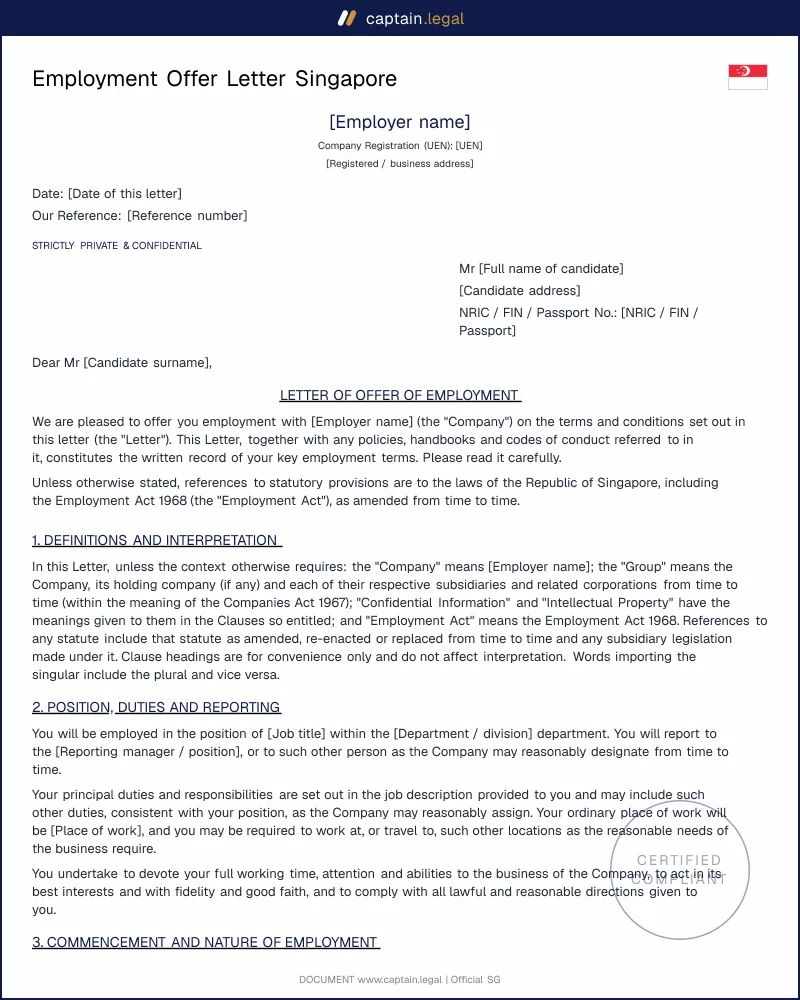
The offer letter sits within the framework of the Employment Act 1968, Singapore's baseline labour statute administered by the Ministry of Manpower (MOM). The Act now covers most employees, including managers and executives, though certain protections such as hours of work and rest days apply only to workmen and to non-workmen earning below the salary threshold. Contract formation itself is governed by ordinary Singapore contract law: an offer accepted by the candidate produces a binding agreement, and no particular form or notarisation is required for it to take effect.
The most consequential overlay is the Key Employment Terms regime. Under the Employment (Employment Records, Key Employment Terms and Pay Slips) Regulations 2016, an employer must give every covered employee engaged for fourteen days or more a written record of the KETs within 14 days of the first day of work. A properly drafted appointment letter is the natural vehicle for this record, which is why so many employers merge the two. The KETs are a fixed checklist, not a menu: they must cover the parties' names, job title and main duties, start date, working hours and rest days, salary period and components, overtime terms, leave, medical benefits, probation and notice for termination. An employer who issues an incomplete set faces an administrative penalty of up to 400 SGD per affected employee. MOM's own guidance on the required contents is set out in its Ministry of Manpower guide to Key Employment Terms, and the compliant standalone version is our Singapore KETs statement drafted to the 2016 Regulations.
Contributions follow the appointment. The Central Provident Fund Act 1953 requires CPF contributions for Singapore citizens and permanent residents, and the Work Injury Compensation Act 2019 provides no-fault cover for workplace injury. Overlaying all of this, the Tripartite Guidelines on Fair Employment Practices steer hiring away from discriminatory selection, a point that matters at the offer stage as much as at dismissal.