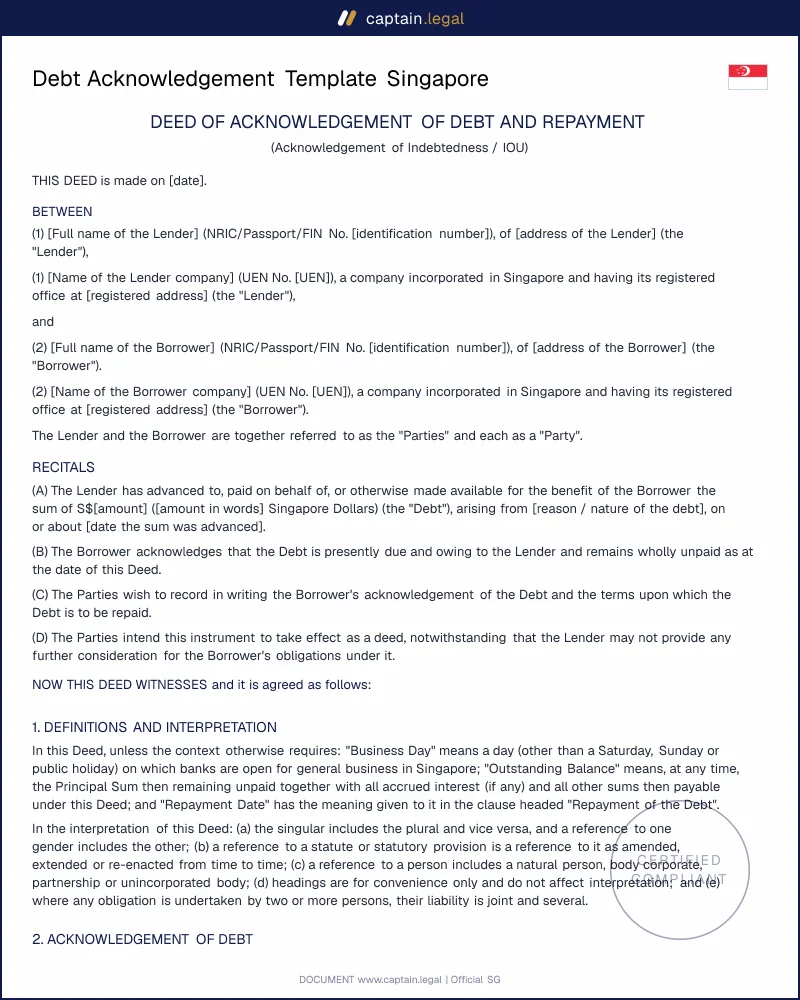
A debt acknowledgement in Singapore draws its force from ordinary contract law rather than from a single dedicated statute. The core requirements are offer, acceptance, consideration and an intention to create legal relations. Where the document records a pre-existing debt, the original advance of money supplies the consideration; where it restructures terms, the lender's forbearance from suing can serve as fresh consideration. This is why an IOU between family members can fail in court: if there was never any intention to create legal relations, a judge may treat the arrangement as a domestic understanding rather than a binding contract. The cure is to state expressly in the document that the parties intend the acknowledgement to be legally binding.
The most consequential statute for any creditor is the Limitation Act 1959. Under section 6(1)(a), an action founded on a contract, which includes recovering a debt, must generally be brought within six years from the date the cause of action accrues, typically the day repayment falls due and is not made. Miss that window and the debtor can plead limitation as a complete defence, leaving the debt real but irrecoverable through the courts. Here the acknowledgement earns its keep a second time. Under sections 26 and 27 of the same Act, a signed written acknowledgement of the debt, or a part payment, makes time start running afresh from the date of that acknowledgement. The Court of Appeal confirmed this mechanism in Chuan & Company Pte Ltd v Ong Soon Huat [2003] SGCA 15, while warning that the acknowledgement must clearly admit the debt to count. A vague reference to an "alleged" sum will not do.
Two further points complete the picture. If the lender is in the business of lending money, the Moneylenders Act 2008 and its interest caps may apply, and an unlicensed moneylender's loan can be unenforceable, so private one-off loans should make clear the lender is not carrying on a moneylending business. And the Evidence Act 1893 governs how the signed document is admitted, which is precisely why a dated signature beats an oral promise every time. For the statutory text, the Limitation Act is published on the official Singapore Statutes Online portal maintained by the Attorney-General's Chambers.