Create my document
Login

Choose country

SingaporeSingaporeChoose country
Family & Divorce

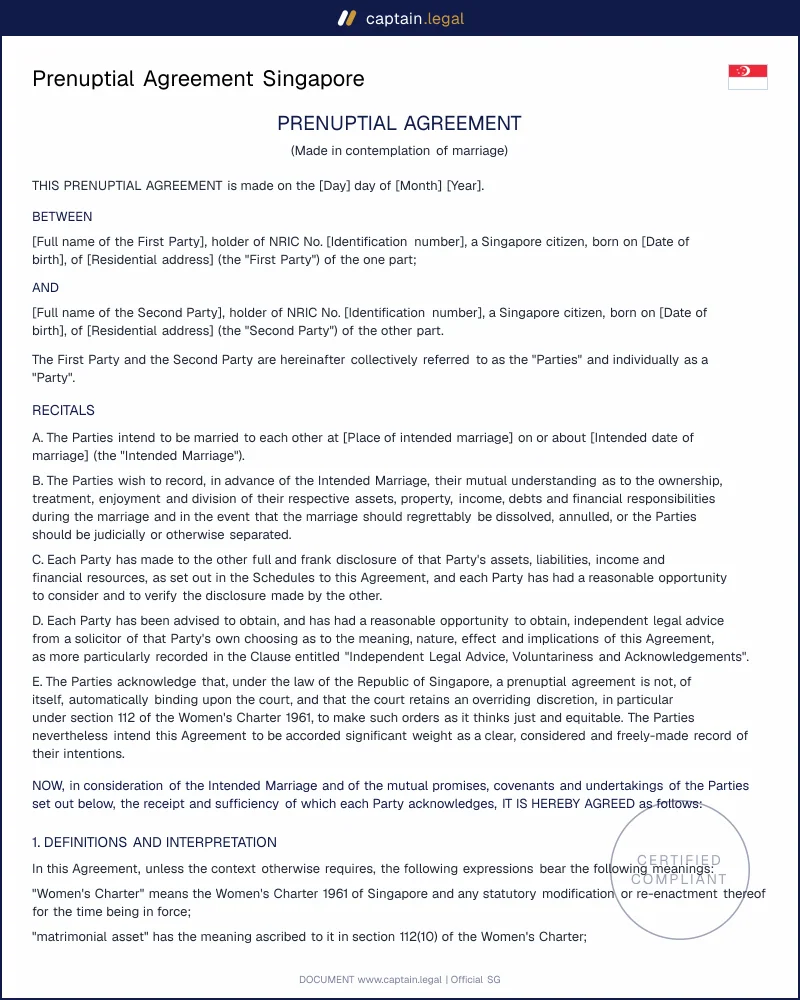
Prenuptial Agreement Singapore Under s.112 Women's Charter

Prenuptial agreement built on TQ v TR and s.112 Women's Charter. Full disclosure schedule, separate property and maintenance clauses in Word & PDF.
4.7/515 reviews50 000+ downloadsInstant download
Share

A prenuptial agreement is a contract signed by two people before they marry, setting out how their property, finances, and maintenance will be handled if the marriage later ends. In Singapore, couples increasingly sign one to protect a family business, ring-fence pre-marriage savings, or bring certainty to a cross-border marriage. The document is not automatically binding here the way it is in some jurisdictions, but a well-drafted prenup carries real weight in court when it is fair, fully disclosed, and independently advised. This page explains how prenuptial agreements work under the Women's Charter, how they differ from postnuptial agreements, and what a Singapore court actually looks at before giving one effect.

Compliant

2026 Legislation

50,000+ clients

trust us

Affordable

From $4.90 / doc

Secure payment

Instant download

Prenuptial Agreement Singapore Under s.112 Women's Charter

Secure payment

Fill in the template

What is a prenuptial agreement in Singapore?

A prenuptial agreement is a written contract between two people who intend to marry, governing what happens to their assets and financial obligations should they divorce, separate, or one of them die. Practitioners in Singapore treat it as a marital agreement, the same broad category that also captures postnuptial agreements and deeds of separation. The label matters less than the timing and the intention behind it. What distinguishes a prenup is simply that both parties sign it before the marriage is solemnised.

The confusion most couples arrive with is the difference between a prenuptial and a postnuptial agreement. A prenup is signed before marriage; a postnup is signed after the wedding, whether during a stable marriage or when separation is already on the horizon. The contents can look almost identical, but Singapore courts tend to give greater weight to postnuptial agreements, because they are usually made when parties have a clearer, more realistic picture of their married life and finances. A prenup, signed in the optimism before a wedding, is scrutinised more carefully. Do not assume a prenup and a postnup are interchangeable: if your circumstances change significantly after marriage, refreshing the terms in a postnuptial deed often strengthens their standing. Couples who are separating rather than marrying should instead look at a Deed of Separation aligned with the Women's Charter, which serves a different legal function.

2

When do you need this document?

The most common reason couples in Singapore sign a prenup is to protect assets brought into the marriage, particularly a family business or an inheritance that one side wants kept outside the matrimonial pool. If a spouse holds shares in a company built by their parents, a prenup can record the intention that those shares stay separate, which is far cleaner than arguing about it years later during ancillary proceedings. The same logic applies to a property owned before the wedding, or to a professional practice one party will keep building throughout the marriage.

Cross-border and expatriate marriages are the next big driver, and they are where prenups carry the most weight in Singapore. In TQ v TR itself the agreement was signed by foreign nationals under Dutch law, and the Court of Appeal was prepared to give a foreign prenup significant, even full, effect where it was valid under the governing foreign law and did not offend Singapore public policy. Couples where one or both are foreign citizens, or who hold assets in several countries, benefit most from setting a clear choice of governing law and jurisdiction early. Second marriages form another category, especially where children from a previous relationship need their inheritance protected. Here the prenup often works alongside a Singapore-ready will and estate document, since a properly executed will takes precedence over agreement terms dealing with what happens on death. One edge case worth flagging: an agreement drafted purely to shield future income or to strip a spouse of any right to maintenance rarely survives scrutiny, because it collides directly with the protective policy of the Women's Charter.

3

Key clauses included in our template

  • The identification of the parties and recitals open the agreement by naming both prospective spouses, stating the intended date of marriage, and recording that each enters freely, after independent advice, and with full knowledge of the other's finances. These recitals are not decoration; courts read them as evidence that both parties went in with their eyes open, which is the touchstone from Surindar Singh.
  • The full financial disclosure schedule lists each party's assets, liabilities, income, and expected inheritances as at the date of signing. Because a deed made without full and frank disclosure risks being held non-binding, this schedule is drafted as a signed annexure that both parties confirm they have read and accepted.
  • The separate property clause ring-fences the assets each party wishes to keep outside the matrimonial pool, such as a pre-marriage flat, business shares, or family heirlooms. It is written to align with how section 112 defines and treats matrimonial assets, rather than pretending to override the court's power.
  • The division of matrimonial assets clause sets out the agreed split of property acquired during the marriage, phrased as the parties' considered intention for the court to weigh, not as a self-executing order.
  • The maintenance provisions address spousal maintenance and, where relevant, contributions to children, while expressly preserving the court's supervisory role over any term affecting a child's welfare.
  • The governing law and independent advice clauses fix which jurisdiction's law applies and confirm each party had the opportunity to consult their own lawyer, the two procedural anchors Singapore courts look for before giving an agreement real weight.
4

How to fill out this prenuptial agreement

You start by confirming that both parties intend to marry and that the agreement is being prepared with enough time before the wedding, since a prenup signed days before the ceremony invites an argument about pressure. From there, the form guides each of you through your own financial disclosure, prompting for assets, liabilities, income, and any inheritances you expect, so the disclosure schedule is complete rather than skeletal. You then identify which assets each party wants treated as separate property and how assets built during the marriage should be divided, with the wording kept consistent with the Women's Charter framework. The template flags where maintenance and any child-related terms need careful phrasing, because those attract the closest judicial scrutiny. It also sets the governing law and records that each party had the chance to take independent legal advice. Once both of you have reviewed the draft, you download it in Word and PDF, sign it, and keep the executed copy somewhere secure. Many couples pair it with a broader family and divorce document set for Singapore so the paperwork stays coherent if circumstances later change.

5

Common mistakes to avoid

The mistake practitioners see most often is thin or missing financial disclosure. A prenup that hides or glosses over one party's real financial position is fragile, because Singapore courts have declined to treat deeds as binding where full and frank disclosure was absent. Closely related is skipping independent legal advice: when one lawyer drafts for both sides, or one party signs without advice at all, the agreement looks less like a considered bargain and more like something imposed, which is exactly the impression that erodes its weight. Signing too close to the wedding compounds the problem, since last-minute pressure is a classic vitiating factor that lets a court set terms aside for duress or undue influence.

The other recurring error is overreaching on children and maintenance. Couples sometimes try to write off a spouse's right to maintenance entirely, or to fix custody in advance, and are surprised when a court ignores those clauses. Terms affecting a child begin from a presumption against enforcement, and anything that contradicts the Women's Charter's protective policy will not survive. A prenup should also not be treated as permanent and untouchable: circumstances shift, and an agreement never revisited across a long marriage carries less persuasive force than one refreshed by a postnuptial deed. Couples running a company together should keep the prenup consistent with any shareholders' agreement governing their business, so the two documents do not pull in opposite directions.

Key takeaways

WOMEN'S CHARTER

A prenup guides, but cannot bind

In Singapore, a prenuptial agreement does not override the court’s power under section 112 of the Women’s Charter to divide matrimonial assets in a just and equitable way. Under TQ v TR [2009] 2 SLR(R) 961, it is not enforceable on its own; it is a factor the court may weigh. Expect closer scrutiny because it was signed before marriage.

FAIRNESS

Full disclosure and advice make it count

A prenup carries more weight when it is fair, backed by full and frank financial disclosure, and both parties had independent legal advice. Because it is still a contract, it must be free from misrepresentation, fraud, duress, undue influence, or unconscionability. If one side hid assets or pressured the other near the wedding, the court may give the agreement little or no weight.

CHILDREN

Child-related terms may be disregarded

Any clause dealing with custody, care and control, or child maintenance starts from a presumption of unenforceability unless it aligns with the child’s best interests. The welfare of the child is the first and paramount consideration, so the court can depart from what the prenup says even if both parents agreed to it. Treat child provisions as planning notes, not final outcomes.

Frequently Asked Questions

A prenuptial agreement is not automatically binding in Singapore, but it is far from worthless. Under section 112 of the Women's Charter, the court retains the final say over how matrimonial assets are divided, and in TQ v TR the Court of Appeal confirmed a prenup cannot be enforced on its own. What it does is stand as a significant factor the court weighs. Where the agreement is fair, both parties disclosed their finances fully, each took independent advice, and nothing offends the Charter's policy, courts will often give it substantial, sometimes decisive, weight. The stronger the process behind it, the more effect it carries.

Timing is the core distinction. A prenuptial agreement is signed before the marriage is solemnised, while a postnuptial agreement is signed afterwards, whether during a settled marriage or as separation approaches. Their contents can be almost identical, covering asset division, separate property, and maintenance. Singapore courts, however, tend to give postnuptial agreements more weight, because they are usually made when parties understand their finances and married life realistically. A prenup signed amid wedding optimism is scrutinised more closely. Many couples sign a prenup first, then reaffirm or update it through a postnup once circumstances settle. You can explore related personal and family legal documents for Singapore to keep everything consistent.

Independent legal advice is not a strict statutory requirement, but it is one of the strongest things you can do to make a prenup stand up. In Surindar Singh s/o Jaswant Singh v Sita Jaswant Kaur, the court gave conclusive effect to an agreement reached after both parties took separate advice and negotiated at length. When one lawyer acts for both sides, or one party signs with no advice, the agreement looks imposed rather than freely bargained, and that impression drains its weight in later proceedings. Each party having their own adviser also reduces the risk of a duress or undue influence challenge down the line.

It can address these matters, but the court is not bound by what you write. The welfare of the child is the paramount consideration in every Singapore family matter, so any term dealing with custody, care and control, or child maintenance starts from a presumption of unenforceability. The party relying on such a term must show it genuinely serves the child's best interests. In practice this means a prenup can record the parents' intentions and financial arrangements for children, but it cannot lock a court out of deciding what is actually best for them when the time comes. Terms that shortchange a child rarely survive.

Three things do most of the work. First, full and frank financial disclosure by both parties at the time of signing, since deeds made without it have been held non-binding. Second, independent legal advice for each spouse, which signals a considered bargain rather than an imposed one. Third, timing and fairness: signing well before the wedding, with terms that do not contradict the Women's Charter or strip a spouse of reasonable protection. Courts also examine the conduct around the drafting, not just the words. An agreement negotiated carefully over weeks, with both parties clearly aware of what they were agreeing to, carries far more weight than one rushed through.

They can carry real weight. In TQ v TR, the agreement was signed by foreign nationals under Dutch law, and the Court of Appeal was prepared to give it significant, even full, effect because it was valid under the governing foreign law and did not offend Singapore public policy. There is no blanket rule of automatic enforcement, though, and such an agreement remains one factor in the section 112 division exercise. If you or your partner are foreign citizens, or hold assets across borders, it is worth fixing a clear governing law and jurisdiction in the agreement and having a lawyer from the relevant country review the terms.

The prenuptial agreement downloads in both Word and PDF, so you can adjust wording where your circumstances need it and then produce a clean final copy for signing. Because the strength of a prenup depends heavily on process, both parties should sign after completing their financial disclosure and having had the chance to take independent advice, ideally comfortably ahead of the wedding rather than at the last minute. Keep the signed original somewhere secure and give each party a copy. If your situation later changes in a major way, consider reaffirming the terms through a postnuptial deed rather than assuming the original will carry the same weight indefinitely.

4.7/5

15 verified reviews · 50 000+ downloads

Prenuptial Agreement Singapore Under s.112 Women's Charter
  • Immediate access to the document
  • PDF + Word download
  • Compliant with 2026 legislation
  • Reviewed by lawyers
Fill in the template
Secure payment
Updated on July 7, 2026

You might also like

Deed of Separation Singapore
Postnuptial Agreement Singapore