Create my document
Login

Choose country

SingaporeSingaporeChoose country
Family & Divorce

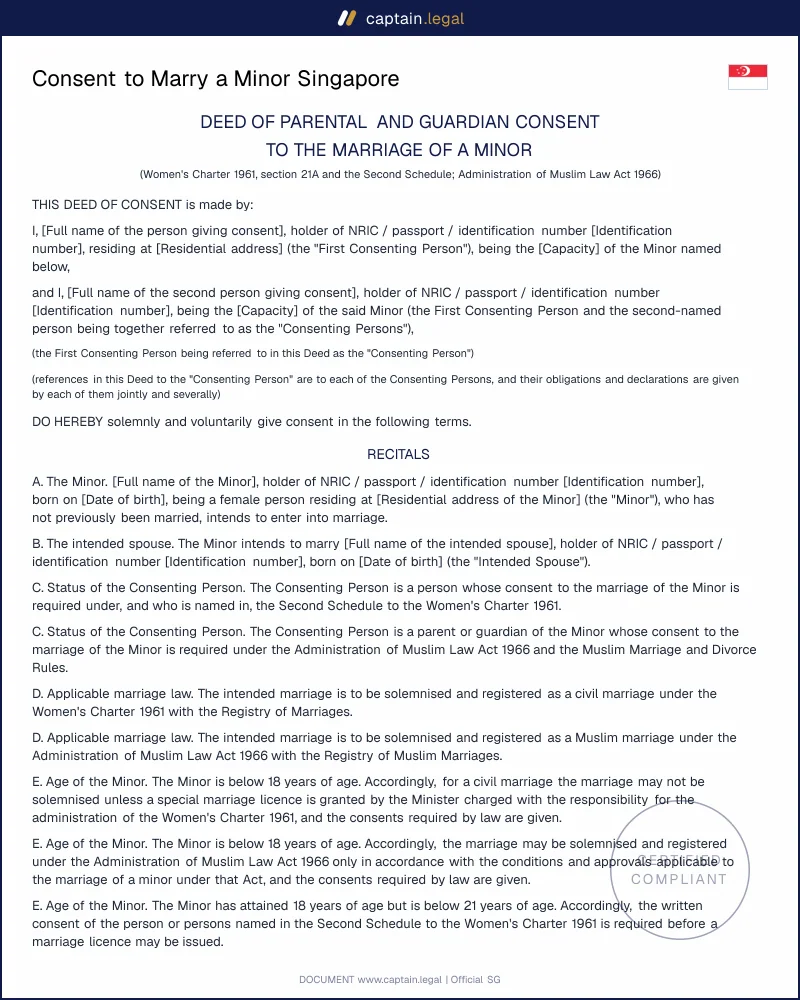
Consent to Marry a Minor (Women's Charter s.9) Singapore

Consent to marry a minor drafted to s.9 Women's Charter and the Second Schedule. Covers ROM civil marriage, below-18 licence and AMLA wali rules.
4.9/512 reviews50 000+ downloadsInstant download
Share

Marriage in Singapore is treated as a serious civil act, and the law does not let a young person walk into the Registry of Marriages and sign the register on their own. Where one party to an intended civil marriage is a minor who has not been previously married, the Women's Charter 1961 requires the written consent of a specified adult before the Registrar will issue a marriage licence. This page explains the consent to marry a minor used under the Women's Charter framework, and separately under the Administration of Muslim Law Act 1966 for Muslim marriages, and gives you a template drafted to the standard a Singapore firm would expect on a solemnisation file.

The document sits at the intersection of two brackets that people constantly confuse: the 18 to below 21 bracket, where written parental consent is the operative requirement, and the below 18 bracket, where consent alone is never enough and a Special Marriage Licence from the Minister must also be obtained. Getting the wrong document into ROM is the fastest way to stall an application by months.

Compliant

2026 Legislation

50,000+ clients

trust us

Affordable

From $4.90 / doc

Secure payment

Instant download

Consent to Marry a Minor (Women's Charter s.9) Singapore

Secure payment

Fill in the template
2

When do you need this document?

The most common trigger is straightforward: one party is 18, 19, or 20 years old on the intended solemnisation date and has never been married. ROM will expect written consent from the appropriate person before it issues the licence, and couples in this bracket routinely underestimate how early they need it. A useful planning point is that age is measured at solemnisation, not at filing, so a party who turns 21 between lodging the Notice of Marriage and the ceremony no longer needs consent, while one who is still 20 on the day does. You need the document for the ROM notice of marriage and solemnisation process, not merely for the engagement.

The second scenario is the below-18 marriage, where consent is one component of a larger Special Marriage Licence application. Here the document supports the Social Assessment Interview and the Minister's decision rather than standing alone. A third situation arises where the natural first choice on the Second Schedule list cannot act: the father has died, a parent is overseas, or a guardian holds authority under a court order. The consent must then be signed by the next appropriate person, and the drafting has to state the basis of that authority so ROM can verify it. Do not assume a mother can sign simply because the father is uncontactable; the statute sets an order, and skipping a step invites rejection. A final edge case is the Muslim couple who assume a Women's Charter consent will serve at the Registry of Muslim Marriages, when the Administration of Muslim Law Act requires a wali and its own consent pathway instead.

3

Key clauses included in our template

  • The identification of the parties names the minor, the intended spouse, and the consenting adult in full, with NRIC or passport particulars and dates of birth, so the Registrar can confirm the minor's exact age at the intended solemnisation date. Vague drafting that omits the date of birth is a frequent cause of rejection, because ROM cannot verify which bracket applies.
  • The statement of capacity to consent sets out precisely why the signatory is the appropriate person under the Second Schedule to the Women's Charter, whether as father, mother, or lawful guardian, and cites the source of guardianship where relevant. This is the clause that fails most often when a relative signs without establishing standing.
  • The express and specific consent ties the authorisation to the identified marriage and the identified spouse, not to marriage in the abstract. A consent that reads as general can be attacked as uninformed, so the template fixes it to the particular union before ROM.
  • The acknowledgement of the Special Marriage Licence position flags, where the minor is below 18, that consent alone does not authorise the marriage and that the Minister's licence remains outstanding. This keeps the document honest about its own limits.
  • The execution block provides for the signature of the consenting person, the date, and witnessing, and leaves room for attestation before a Commissioner for Oaths where ROM or the couple prefer a statutory declaration of marital status to accompany the file.
4

Regional considerations

Singapore is a single jurisdiction, so there is no state-by-state variation of the kind found in federal systems. The meaningful split here is between the two registries and the two statutes, and it changes which consent document is valid. For a civil marriage, the Women's Charter 1961 and its Second Schedule govern, ROM administers the process, and the consent described on this page is the correct instrument. Written parental consent handles the 18-to-20 bracket, while the below-18 bracket adds the Special Marriage Licence, the Social Assessment Interview, and a mandatory marriage preparation programme that both parties and, often, the minor's parents must attend.

For a Muslim marriage, the position is different in substance and not just in form. The Administration of Muslim Law Act 1966 now sets the minimum age of marriage at 18, and the Registry of Muslim Marriages requires a wali, the bride's male guardian, whose role is not interchangeable with a Women's Charter parental consent. A kadi solemnises the marriage, and the consent architecture follows Muslim law rather than the Second Schedule. A couple who prepare a Women's Charter consent for a marriage that belongs at the Registry of Muslim Marriages will find it does not fit the process at all. If either party is Muslim and the marriage is to be registered under Muslim law, treat this template as inapplicable and follow the ROMM pathway. For non-Muslim couples and for civil marriages generally, the document here is drafted to the register that will actually be used, and you can pair it with related Singapore family and divorce templates where the wider arrangement needs documenting.

6

Common mistakes to avoid

The error that derails the most applications is the wrong signatory. Families assume any parent will do, but the Second Schedule sets an order, and a mother cannot simply step in because the father is difficult to reach unless the statutory conditions for her to act are actually met. Establish standing before anyone signs. The second recurring mistake is confusing the two brackets: couples treat parental consent as sufficient for a below-18 marriage, when consent there is only one input into a Special Marriage Licence application that also requires the Social Assessment Interview and the Minister's approval. Submitting consent as if it were the whole answer wastes the months that process takes.

A third mistake is drafting consent in the abstract, as a general blessing rather than authorisation for a named marriage, which weakens it if the union is later questioned. Dates of birth get omitted, so ROM cannot confirm the minor's age at solemnisation and returns the file. And Muslim couples occasionally prepare a Women's Charter consent when their marriage belongs at the Registry of Muslim Marriages under the Administration of Muslim Law Act, where a wali and a different consent pathway apply. Each of these is avoidable with a template that forces the right questions early, and none of them should surface for the first time at the ROM counter. Where the wider family arrangement also needs recording, a Singapore child travel consent letter or related instruments can be prepared alongside.

Key takeaways

Age brackets

18 to below 21 needs written consent

For a civil marriage at ROM, the rules split by age. If a party is 18 or above but below 21 and has not been previously married, the Women’s Charter 1961 (s.9) requires written consent from the “appropriate person” in the Second Schedule before the Registrar will issue a marriage licence. Without that signed consent on file, the application does not proceed.

Under 18

Consent alone is never enough below 18

If either party is below 18 at the date of solemnisation, the Women’s Charter 1961 (s.17) treats the marriage as void unless the Minister authorises it through a Special Marriage Licence. Parental consent may still be part of the file, but it does not replace the licence. Mixing up these requirements is a common reason ROM applications get stalled for months.

Who signs

The Second Schedule hierarchy decides validity

Not every relative can sign. The Second Schedule to the Women’s Charter sets a strict order for the “appropriate person” (typically father, then mother, then a lawful guardian, with further categories if a parent is deceased, of unsound mind, or absent from Singapore). A consent signed by the wrong person is not valid, and can expose the solemnisation to challenge. If the right person refuses or cannot be found, s.9 allows the High Court (via the Family Justice Courts) to grant consent instead.

Frequently Asked Questions

Not necessarily. The Women's Charter 1961 and its Second Schedule set out an order of appropriate persons rather than requiring joint signatures. In the ordinary case the father consents, and where the father has died, is of unsound mind, or is absent from Singapore, the mother or a lawful guardian steps into that role under the statutory order. What matters is that the person signing is the correct appropriate person for the minor's circumstances, and that the document states the capacity in which they act. A consent signed by a relative who does not hold that standing is not valid, so establish who is entitled to consent before anyone puts pen to paper.

The template produces a properly drafted written consent that meets the form the Registry of Marriages expects, and once signed by the appropriate person it functions as the statutory consent required under section 9 of the Women's Charter. It is legally effective as consent, but it is not the whole of the law: for a party below 18, the consent supports rather than replaces the Special Marriage Licence granted by the Minister. Treat the document as the correct instrument for the consent element, and follow the full ROM process for the rest. If a parent refuses and the couple seek the High Court's consent instead, that is a separate court application rather than something this document can supply.

Age is measured at the date of solemnisation. Where a party is 18, 19, or 20 and has not been married before, written parental or guardian consent under the Second Schedule is the operative requirement, and ROM issues the licence once it is on file. Where a party is below 18, consent alone never suffices: the marriage is void under section 17 unless the Minister authorises it through a Special Marriage Licence, which involves a Social Assessment Interview and a compulsory marriage preparation programme. The below-18 route takes considerably longer, often several months, so couples in that bracket should start early and not treat consent as the finish line.

For a marriage where a party is below 18, the Registry of Marriages indicates the process runs to at least four months from the point of submitting the marriage application, because it includes the Social Assessment Interview and the Minister's consideration of the Special Marriage Licence. That timeline is a floor, not a promise, and delays in gathering consent or completing the marriage preparation programme extend it. The 18-to-20 bracket is faster, since written consent slots into the standard notice period, but even there you should assemble the consent well ahead of the intended solemnisation date rather than scrambling in the final weeks.

No. Muslim marriages are governed by the Administration of Muslim Law Act 1966 and registered at the Registry of Muslim Marriages, not under the Women's Charter. That statute now sets a minimum age of 18 and requires a wali, the bride's male guardian, whose role is not the same as a Women's Charter parental consent. A consent drafted to the Second Schedule will not fit the ROMM process. If either party is Muslim and the marriage is to be solemnised under Muslim law, follow the ROMM pathway and its own consent requirements instead of using this template.

Section 9 of the Women's Charter provides a route: where the appropriate person refuses consent, cannot be found, or is unable to consent, the High Court may give consent in place of that person. This is a formal application heard in the Family Justice Courts, and the court will consider the minor's circumstances and welfare rather than rubber-stamping the request. It is a genuine legal proceeding, not a form, so a couple in this position should seek advice on the application rather than assuming the court's consent is automatic. The template records consent where it is given; it does not substitute for the court process where consent is withheld.

The consent is available in both Word and PDF. The Word version lets you complete the particulars of the minor, the spouse, and the consenting adult, adjust the recitals to the correct capacity under the Second Schedule, and tailor the specific marriage details before signing. The PDF gives you a clean final copy for lodgement with ROM or for attestation before a Commissioner for Oaths where you want the consent to sit alongside a statutory declaration of marital status. Keep the signed version secure, since it contains the personal particulars of a minor and should not be circulated more widely than the marriage application requires.

Where a party is a minor, a marriage preparation programme is compulsory before the application, and both the bride and groom must attend. For a below-18 marriage the minor's parents or legal guardians may also be required to attend relevant parts of the programme, which is why the consenting adult's involvement often goes beyond simply signing the document. This is part of the Social Assessment framework that sits behind the Special Marriage Licence, and it reflects the seriousness with which ROM treats a young marriage. Plan for the programme as a scheduled step, not an afterthought, because the application cannot complete without it.

4.9/5

12 verified reviews · 50 000+ downloads

Consent to Marry a Minor (Women's Charter s.9) Singapore
  • Immediate access to the document
  • PDF + Word download
  • Compliant with 2026 legislation
  • Reviewed by lawyers
Fill in the template
Secure payment
Updated on July 9, 2026

You might also like

Deed of Gift Singapore Template
Prenuptial Agreement Singapore