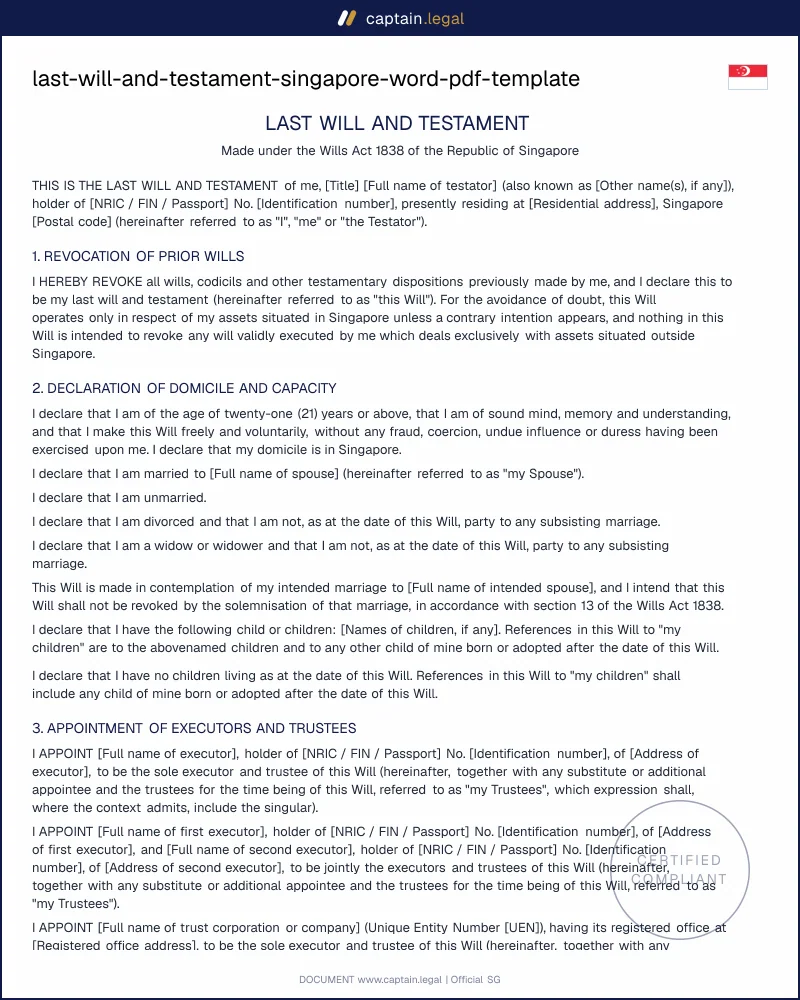
Wills in Singapore are governed by the Wills Act 1838 (2020 Revised Edition), which descends directly from the English statute of the same year and remains the controlling law on validity and execution. Section 6 sets the formal requirements, and they are unforgiving. The will must be in writing, signed by the testator at the foot or end of the document, and that signature must be made or acknowledged in the presence of two or more witnesses present at the same time, who then subscribe the will in the testator's presence. The testator must be at least 21 years old and of sound mind for the will to be valid. Get the witnessing wrong and the entire will can fail, as it did in AEL v Cheo Yeoh & Associates LLC [2014] SGHC 129, where a will witnessed by only one person was struck down and the estate fell into intestacy.
The most dangerous trap sits in section 10. A gift to an attesting witness, or to that witness's spouse, is void, even though the witness's signature still validates the will. A beneficiary who witnesses your will keeps their status as a witness but loses their inheritance entirely. For an authoritative statement of the statutory text, the Singapore Statutes Online publication of the Wills Act 1838 sets out the execution rules in full.
Where someone dies without a valid will, the Intestate Succession Act 1967 dictates a fixed order of distribution among spouse, children and parents, and the estate is administered under the Probate and Administration Act 1934. Muslims fall outside this regime: succession is governed by the Administration of Muslim Law Act under faraid principles. Singapore abolished estate duty in 2008, so the question is purely one of valid documents, not death tax.