Create my document
Login

Choose country

FranceBelgiqueEspañaUnited StatesUnited KingdomMarocDeutschlandItaliaSchweizSingapore
Business

Singapore Share Transfer: Companies Act 1967 Ready

Instrument of transfer under s126, board resolution under s157A, 0.2% IRAS stamp duty under the Stamp Duties Act 1929. Compliant Word & PDF pack.
4.8/518 reviews50 000+ downloadsInstant download
Share

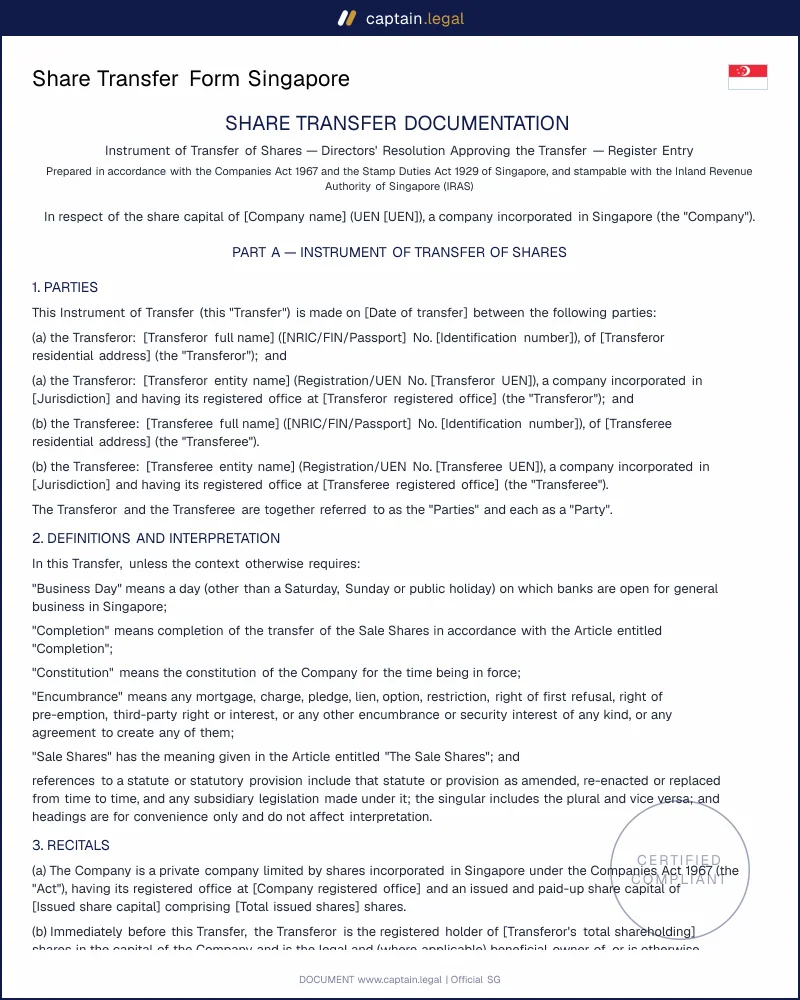
Transferring shares in a Singapore private limited company is one of those transactions that looks deceptively simple and trips up business owners more often than any other corporate filing. The share transfer form and instrument of transfer are the core documents that move ownership of existing shares from a transferor to a transferee, and getting them right matters because legal title does not pass on a handshake or even on signature. It passes only when ACRA updates the electronic register of members. This template covers the instrument of transfer, the board resolution approving the transfer, and the register entry that completes it, drafted for a Singapore Pte Ltd and built to sit cleanly alongside your IRAS stamping obligation under the Stamp Duties Act 1929.

Compliant

2026 Legislation

50,000+ clients

trust us

Affordable

From $4.90 / doc

Secure payment

Instant download

Singapore Share Transfer: Companies Act 1967 Ready

Secure payment · No subscription

Fill in the template

What is a share transfer form and instrument of transfer?

The instrument of transfer is the operative document. It records that the transferor agrees to transfer a stated number of shares and that the transferee agrees to take them, and it is signed by both parties, often before a witness where individuals are involved. People use "share transfer form" loosely to mean the same thing, but in Singapore practice the phrase also catches the Share Transfer Form submitted to IRAS for stamping, which is a related but distinct step in the same workflow. A clean transaction pack therefore holds three moving parts: the instrument that the parties sign, the board resolution that approves registration, and the updated register of members that gives the transferee legal title.

A share transfer is not a share allotment, and the difference is worth fixing in your mind before you start. An allotment creates new shares and increases the company's issued capital, filed with ACRA as a return of allotment. A transfer moves shares that already exist from one holder to another and changes nothing about the total issued capital. The wrong instrument here means the wrong filing, the wrong stamp duty treatment, and a register that no longer reconciles. If you are forming the company rather than reshuffling an existing one, the Singapore company constitution and incorporation documents are the starting point instead.

2

When do you need this document?

The textbook trigger is a founder or early shareholder exiting and selling out to a co-founder, a continuing shareholder, or a third party. This is the cleanest case, but it still needs the full pack because the buyer gets nothing recognisable until the register is updated. A close second is an incoming investor taking shares from existing holders rather than subscribing for new ones, which keeps the cap table flat on total issued capital while changing who owns what. Internal reorganisations are the third common scenario, where shares move between a holding entity and a subsidiary or between related parties to tidy up a group structure ahead of a financing or sale.

Estate and family situations make up much of the rest. When a shareholder dies, shares pass to the estate and are then transferred to beneficiaries, a transmission that sits next to but is not identical to an ordinary transfer and often pairs with the Singapore wills, statutory declarations and personal documents used to settle the estate. Two edge cases legitimately complicate the standard form. Where the transferor or transferee is a foreign corporate entity, the instrument needs adjustment and the signing authority must be evidenced, usually by a directors' resolution authorising a corporate representative. And where individual shareholders cannot personally sign, a form of proxy lets an appointed person execute on their behalf. Both of these change the documentation, not just the names.

3

Key clauses included in our template

  • The identification of the parties and the company fixes the transferor, the transferee and the target Pte Ltd with their full registered details, including ACRA registration numbers for corporate parties. Vague naming is a frequent cause of rejected lodgments, so each shareholder is named precisely as they appear on the existing register.
  • The description of the shares transferred states the class, the number and the distinguishing numbers where the company numbers its shares, together with the consideration. This figure drives the stamp duty computation, so it must align with the IRAS Working Sheet and the company's accounts rather than being a round number plucked for convenience.
  • The consideration and stamp duty allocation records who pays the duty. The instrument usually stipulates this, and where it is silent the transferee bears it by default, so the clause removes a common point of later dispute between buyer and seller.
  • The transferor's and transferee's covenants confirm the seller's good title and the buyer's agreement to take the shares subject to the constitution, with a witness attestation block where individuals sign.
  • The board resolution approving the transfer is drafted as a separate instrument under section 157A, recording the directors' approval, the satisfaction of any pre-emption rights, the cancellation of the old certificate and the authority to update the register and lodge with ACRA. Companies running formal director paperwork will want this consistent with their other Singapore board resolutions and corporate governance templates.
  • The register of members entry and new share certificate complete the pack, since the register is what confers title and the certificate is the shareholder's evidence of it.
4

Regional considerations

Singapore is a single jurisdiction with one Registrar and one stamping authority, so there is no canton or state variation to manage, but the practical contours still shift with the parties and the company. For a company limited by guarantee or a non-profit vehicle there are no shares to transfer at all, and the governing documents are entirely different, which is where the Singapore society and non-profit constitution templates apply instead. The point matters because business owners sometimes assume every entity has transferable shares; a CLG does not.

Where the company holds residential property, an additional duty layer can arise through Additional Conveyance Duties on transfers of equity interests in property-holding entities, a regime aimed at indirect property transfers that ordinary trading companies never touch. Foreign-party transfers are the other live variable. A transferor or transferee incorporated overseas needs its signing authority documented, and an instrument executed outside Singapore shifts the stamping clock, giving 30 days from first receipt of the document in Singapore rather than the standard 14. Companies with cross-border shareholders should build that timing difference into completion planning rather than discovering it after the duty falls due.

5

How to fill out this share transfer form

You start by confirming what your constitution permits, because pre-emption rights and director discretion can reshape the whole timeline before a single signature is collected. From there the template walks you through naming the transferor, the transferee and the company, then capturing the class and number of shares and the agreed consideration. The form prompts you to allocate the stamp duty between the parties so that the instrument of transfer states it plainly rather than leaving it to the statutory default. Once the parties' details and the share particulars are in, the document set generates the matching board resolution approving the transfer and authorising the secretary to act.

The sequence after drafting is where discipline pays off. You execute the instrument, the board passes its resolution, and the paying party submits the Share Transfer Form to IRAS for stamping with the Working Sheet. With the stamped instrument in hand and the old certificate surrendered, the company lodges the transfer through BizFile+ and the register of members is updated. Only then is the transferee a shareholder. If the buyer is also coming in under a wider deal, the Singapore shareholders agreement and commercial contract templates handle the relationship that the bare transfer cannot.

6

Common mistakes to avoid

The single most damaging error is treating signature as completion. A signed instrument that is never stamped and never registered moves no title at all, and the transferee who behaves as an owner on that basis is exposed if a dispute arises. Closely related is late stamping. The duty is due within 14 days of execution in Singapore, and IRAS can levy a penalty of up to four times the duty for late payment, so a forgotten Stamp Duties Act 1929 deadline turns a small ad valorem charge into a real cost. Owners also routinely understate the consideration, forgetting that duty is computed on the higher of the price paid and the net asset value of the shares, which means a nominal price on a profitable company still attracts duty on the NAV figure.

Two structural mistakes round out the pattern. The first is skipping the constitution check and tripping a pre-emption clause, which can render the whole transfer voidable against the company and force the parties to unwind. The second is missing the ACRA lodgment, since the transfer is legally inert until the electronic register is updated and the company carries a filing obligation it cannot quietly ignore. A transfer that is signed, stamped and then left unfiled is the most common half-finished transaction Singapore secretaries see.

Key takeaways

Legal title

Ownership shifts only when ACRA registers

In a Singapore Pte Ltd, signing the instrument of transfer does not, by itself, move legal title. Under s126(3) of the Companies Act 1967, the share transfer takes effect only when the electronic register of members is updated by the Registrar (ACRA). Until that update happens, the buyer may have paid and signed, but is still not the registered member.

Documents

Three parts complete a clean transfer

A workable transfer pack has three moving parts: the instrument of transfer signed by transferor and transferee (often with a witness for individuals), a board resolution approving registration, and the updated register of members entry. People often call all of this a “share transfer form”, but IRAS stamping is a separate step. Miss one piece and the register will not reconcile.

Control & tax

Board discretion and IRAS stamp duty apply

Directors are the gatekeepers. Based on s157A of the Companies Act 1967 and your constitution, the board usually must approve registration, and the constitution may impose pre-emption rights or allow refusal. If the company refuses, s128 governs notice duties. Separately, the instrument is typically subject to ad valorem stamp duty under s45 of the Stamp Duties Act 1929, including the commonly cited 0.2% IRAS rate.

Frequently Asked Questions

The template produces a properly drafted instrument of transfer and supporting board resolution that satisfy the form requirements of section 126 of the Companies Act 1967, and electronic execution is valid under the Electronic Transactions Act 2010. That said, the documents create the transfer mechanism, not the transfer itself. Legal title passes only when ACRA updates the electronic register of members under section 126(3), so the instrument is binding between the parties on signature but the transferee becomes a recognised shareholder only after stamping and lodgment are complete. Used in the correct sequence, the pack is exactly what a Singapore company secretary would prepare.

Stamp duty is 0.2 percent of the consideration or the net asset value of the shares, whichever is higher, charged on the instrument of transfer under the Stamp Duties Act 1929. The value is worked out on an IRAS Working Sheet drawn from the company's latest audited or management accounts, dividing net assets by the total shares in issue and multiplying by the number transferred. Because the higher-of test applies, a sale at a token price in a company with real net assets still attracts duty on the asset value. Where multiple share classes exist, the computation is less straightforward and you should confirm the figure with IRAS.

A clean transfer with no pre-emption complications generally completes within one to two weeks. The timeline runs from executing the instrument, to board approval, to IRAS stamping, to the BizFile+ lodgment that updates the register. The binding deadline to watch is stamp duty: 14 days from execution in Singapore, or 30 days where the instrument is executed abroad and first received here. The company then lodges the transfer notice with ACRA, and the register update is what makes the transfer effective. Delays usually come from missing accounts for the Working Sheet or an unresolved constitutional restriction.

The share transfer pack is available in both Word and PDF. The Word version lets your company secretary or counsel adjust party details, consideration and any constitution-specific transfer conditions before execution, while the PDF gives you a clean copy for signing and for your statutory records. Most users keep the editable Word file for drafting and retain the signed PDF alongside the stamped instrument and the updated register entry as the permanent record of the transaction.

In almost all cases, yes. Section 157A of the Companies Act 1967 vests management of the company in its directors, and the constitution typically requires the board to approve registration of a transfer, sometimes with a discretion to refuse. The board resolution records that approval, confirms any pre-emption rights have been satisfied, authorises cancellation of the old certificate and instructs the secretary to update the register and lodge with ACRA. Skipping it leaves the transfer unauthorised at company level even if the parties have signed and stamped the instrument, which is why the resolution sits inside this pack.

It takes effect only when ACRA updates the electronic register of members, not when the instrument is signed and not when stamp duty is paid. This is the rule in section 126(3) of the Companies Act 1967, in force since 3 January 2016. Until the register update is processed through BizFile+, the transferee is not formally a shareholder, cannot validly vote the shares and is not entitled to dividends as of right. Treating the signed instrument as the finish line is the most frequent and most consequential mistake in the whole process.

Late stamping carries a penalty. IRAS may impose a charge of up to four times the duty that was due, on top of the original duty, so a missed 14-day window can multiply a modest ad valorem amount into a meaningful liability. Beyond cost, an unstamped instrument is not properly admissible and the company should not register the transfer on it, which stalls the whole transaction. The fix is to stamp promptly and, where late, to settle the duty and any penalty with IRAS before lodging with ACRA so that the register update proceeds on a clean instrument.

Yes, and Singapore places no general restriction on foreign shareholding in a Pte Ltd. The documentation simply needs adjustment. A foreign corporate party should evidence its signing authority, usually through a directors' resolution authorising a corporate representative to execute the instrument, and individuals abroad can appoint a proxy. Timing also shifts, because an instrument executed outside Singapore must be stamped within 30 days of its first receipt in Singapore rather than the usual 14. The substance of the transfer is unchanged; the form and the stamping clock are what you adapt.

4.8/5

18 verified reviews · 50 000+ downloads

Singapore Share Transfer: Companies Act 1967 Ready
  • Immediate access to the document
  • PDF + Word download
  • Compliant with 2026 legislation
  • Reviewed by lawyers
Fill in the template
Secure payment · No subscription
Updated on June 17, 2026

You might also like

Directors' & Shareholders' Resolution
NDA Singapore Template