Create my document
Login

Choose country

SingaporeSingaporeChoose country
Real Estate

Lease Assignment & Novation Deed Singapore (CLPA 1886)

Assign or novate a Singapore lease under the Conveyancing and Law of Property Act 1886. Three-party deed with landlord consent and deposit clause. Word and PDF.
4.7/518 reviews50 000+ downloadsInstant download
Share

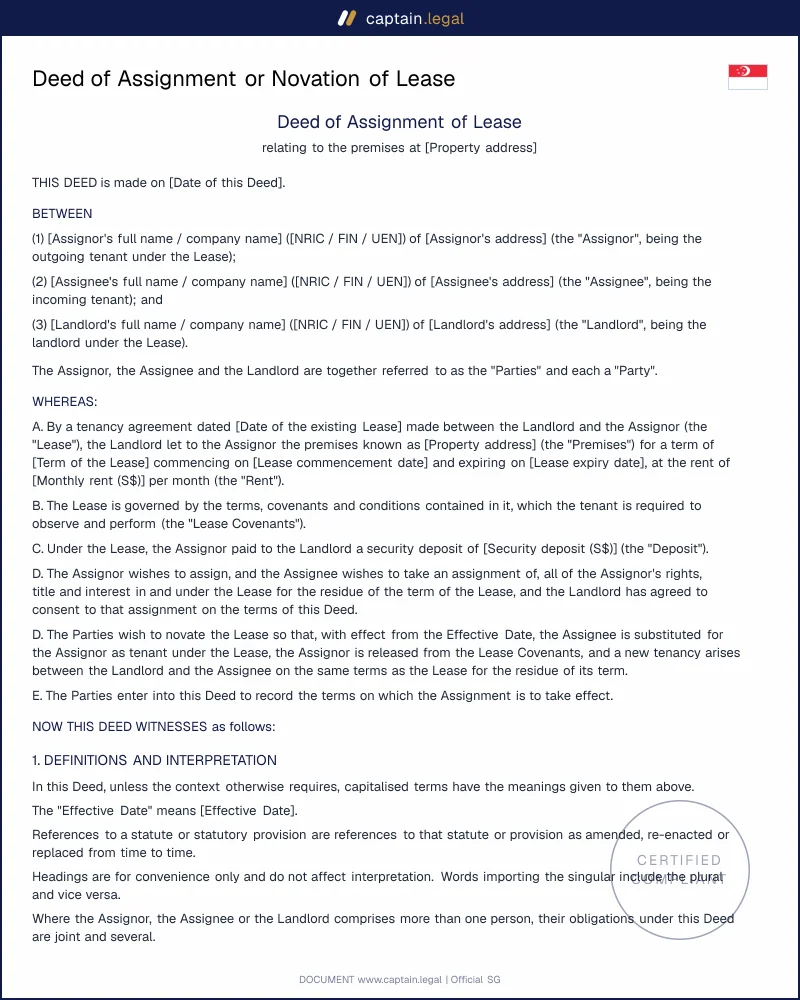
A Deed of Assignment or Novation of Lease is the instrument that moves an existing tenancy from one tenant to another without tearing up the lease and starting again. In Singapore practice these are two distinct routes with very different consequences, and choosing the wrong one is where problems begin. This template covers the tenant-side transfer: an outgoing tenant hands the remainder of the term to an incoming tenant, with the landlord's written consent, under the Conveyancing and Law of Property Act 1886. It is drafted for residential and commercial leases alike, structured so the landlord, the departing tenant and the replacement tenant all sign, and built to sit cleanly alongside your original tenancy agreement rather than override it.

Compliant

2026 Legislation

50,000+ clients

trust us

Affordable

From $4.90 / doc

Secure payment

Instant download

Lease Assignment & Novation Deed Singapore (CLPA 1886)

Secure payment

Fill in the template

What is a deed of assignment or novation of lease?

The two words describe two different legal mechanics, and Singapore lawyers do not use them interchangeably. An assignment transfers the tenant's rights under the lease to a new party, but the outgoing tenant stays contractually on the hook unless the landlord expressly releases them. A novation goes further: it extinguishes the original tenancy and replaces it with a fresh contract on identical terms, so the outgoing tenant walks away with a clean break and the incoming tenant steps fully into their place. In everyday property practice the tenant-substitution most people actually want is a novation, because the whole point is usually to be released from future rent, not merely to pass the benefit along.

The distinction matters for consent. A pure assignment of contractual rights can, at common law, happen without the other party's agreement, but a novation is never presumed and requires all three parties to sign. Because almost every Singapore tenancy contains a covenant against assigning or subletting without the landlord's written consent, the practical reality is that both routes need the landlord at the table. This template treats the landlord as a signing party throughout, which is what makes the transfer enforceable and keeps the security deposit and the tenancy covenants intact. If you are letting a whole unit and need the underlying contract itself, start from a compliant Singapore tenancy agreement for HDB and condo lettings.

2

When do you need this document?

The classic trigger is the tenant who must leave mid-term. An expatriate posted overseas by their employer, a couple whose circumstances change, or a business relocating its office all face the same problem: a fixed-term lease with rent still running and no lawful way to simply hand back the keys. A novation lets the outgoing tenant introduce a replacement, secure the landlord's blessing, and be released from everything that falls due after the handover date. Without it, the departing tenant remains liable for the full unexpired term even after moving out, and a diplomatic clause rarely covers a voluntary early exit.

Flat-sharing arrangements are the next most common scenario. When one co-tenant on a joint tenancy leaves and another moves in, the names on the lease no longer match the people in possession, and an undocumented swap risks being treated as unauthorised subletting. A shared-home reshuffle is far cleaner handled as a formal substitution than left to an informal understanding; if the arrangement is a single bedroom rather than the whole unit, a purpose-built room rental agreement for HDB and condo occupants is often the better fit. Business sales generate their own need: when a company sells its operations, the buyer usually wants the premises to come with it, and the commercial lease is novated to the purchaser so that the original tenant drops out entirely. One edge case worth flagging is the assignment where the outgoing tenant is not released. If the landlord consents to the incoming tenant but stops short of a full novation, the departing tenant can still be pursued for the new tenant's later defaults, which is precisely the trap the wrong choice of instrument creates.

3

Key clauses included in our template

  • The identification of the three parties names the landlord, the outgoing tenant (assignor) and the incoming tenant (assignee) in full, with NRIC or company registration details, because a substitution that omits any signatory is not a novation at all. Where the original tenancy was a joint tenancy, every remaining co-tenant is named so that possession and the names on the lease line up.
  • The recital of the original tenancy pins the deed to a specific agreement by its date, term, premises and rent, and confirms the Stamp Certificate reference. This is what lets the incoming tenant see exactly which covenants they are inheriting and prevents any later argument about which version of the terms applies.
  • The landlord's written consent and release records the landlord's approval of the incoming tenant and, in a true novation, expressly releases the outgoing tenant from obligations arising after the effective date. The release is drafted tightly so it does not accidentally waive pre-transfer liabilities such as unpaid rent or damage.
  • The transfer of the security deposit deals with the deposit already held. It either novates the deposit to the incoming tenant, who reimburses the outgoing tenant directly, or has the landlord acknowledge the substitution, so nobody is left chasing a deposit that has quietly changed hands.
  • The assumption of covenants confirms the incoming tenant takes on the full tenancy on identical terms, including maintenance, permitted use, the covenant against further assignment, and reinstatement at the end of the term.
  • The apportionment and effective date clause fixes the exact date from which rent, utilities and outgoings pass to the incoming tenant, closing off the gap where two people could each claim the other owed a month.
4

Regional and property-type considerations

Singapore is a single jurisdiction, so the statute is uniform island-wide, but the property type changes what you must do before signing. For HDB flats, the transfer cannot proceed on the CLPA alone. Subletting of an HDB flat or bedroom is subject to HDB's own eligibility conditions, minimum occupation period rules and registration requirements, and a substitution of tenant that ignores them can expose both the flat owner and the incoming occupant to enforcement action regardless of how well the deed is drafted. Always confirm the flat owner has current HDB approval to sublet before novating the tenancy of an HDB unit.

For private condominiums and landed residential property, the management corporation's by-laws under the Building Maintenance and Strata Management Act 2004 may require the incoming tenant to be registered with the MCST, and where the incoming tenant is a foreign person, the Residential Property Act 1976 restrictions on landed residential property need checking even at the tenancy level in edge cases. For commercial and industrial premises, the landlord's consent regime is usually stricter, and JTC-controlled industrial leases frequently require JTC to be notified of any change in the tenant's profile and to consent to the substitution, so the deed alone does not complete the picture. Across all types, an option to purchase or sale and purchase document governs the ownership layer separately from the tenancy, and the two should never be conflated in a single instrument.

5

How to fill out this deed of assignment or novation of lease

You begin by choosing between assignment and novation, and the form guides that choice by asking whether the outgoing tenant needs a full release or merely wishes to pass the benefit along. From there you enter the three parties, their identification details and the particulars of the original tenancy, including its commencement date, term, monthly rent and the premises address. The template then generates the landlord's consent and, if you selected novation, the release language that discharges the outgoing tenant from future obligations. You set the effective date, which drives the apportionment of rent and outgoings, and record how the existing security deposit is being handled between the parties. Once the fields are complete, you download the deed in Word and PDF, arrange signature by all three parties, and attend to stamping where consideration is involved. If the transfer is part of a landlord-side change instead, you would reach for a notice to quit drafted to section 18 of the CLPA or a landlord assignment rather than this tenant-substitution deed.

6

Common mistakes to avoid

The most damaging error is confusing assignment with novation and assuming the outgoing tenant is free. An assignment without an express landlord release leaves the departing tenant liable for the incoming tenant's later defaults, and tenants regularly discover this only when a demand for arrears lands months after they have moved on. The fix is simple but must be deliberate: if you want a clean exit, insist on novation language that actually releases you, and get the landlord to sign it. A second frequent slip is treating the landlord's consent as a formality that can be sorted out afterwards. Because nearly every Singapore tenancy bars assignment without prior written consent, a substitution executed before the landlord agrees is a breach that can trigger forfeiture, and a landlord who spots it early can enforce even against an innocent incoming tenant.

The deposit is the third recurring problem. Parties novate the lease but forget the security deposit, leaving the outgoing tenant out of pocket and the incoming tenant unsure what protects them; the deed must say expressly who holds the deposit going forward and who reimburses whom. Fourth, people overlook stamping. Where consideration passes on the transfer, ad valorem duty may apply, and an unstamped instrument is inadmissible in evidence in a Singapore court until the duty and any penalty are paid, which defeats the whole purpose of documenting the substitution. Finally, HDB tenants novate their tenancies without checking whether the flat owner holds valid subletting approval, converting a paperwork exercise into a regulatory breach.

Key takeaways

MECHANICS

Assignment and novation do different jobs

An assignment transfers the tenant’s rights to the incoming tenant, but the outgoing tenant may still remain liable on the tenancy unless the landlord expressly releases them. A novation replaces the original tenancy with a fresh contract on the same terms, giving the outgoing tenant a clean break. Pick the wrong route and you can end up still “on the hook” for future rent and breaches.

CONSENT

Landlord must sign to make it stick

Most Singapore leases prohibit assignment or subletting without the landlord’s written consent, so in practice the landlord needs to be at the table. A novation is never presumed and requires all three parties to sign. This three-party deed structure helps keep the original tenancy terms, covenants and the security deposit arrangements intact, instead of accidentally overriding the underlying tenancy agreement.

CLPA 1886

Consent fees are restricted by statute

Section 17 of the Conveyancing and Law of Property Act 1886 implies a key protection where the lease needs consent to assign: the landlord cannot charge a fine or premium simply for granting consent, although they may recover a reasonable sum for legal costs in preparing the licence. If the landlord demands a lump sum “approval fee”, that can be outside the statute.

Frequently Asked Questions

Yes, provided it is properly executed by all the necessary parties and, in the case of a novation, signed by the landlord, the outgoing tenant and the incoming tenant. A novation is never presumed and depends on the genuine consent of everyone to the original tenancy, so the three-party signature block is what gives the document its force. The deed operates under the Conveyancing and Law of Property Act 1886, relying on sections 10 and 11 to carry the lease covenants across to the incoming tenant through privity of estate. As long as the original tenancy permitted transfer with consent and that consent is recorded in the deed, the substitution is enforceable and the incoming tenant inherits the full tenancy on its existing terms.

An assignment transfers the tenant's rights to a new party but leaves the outgoing tenant contractually liable unless the landlord expressly releases them, so the departing tenant can still be pursued for later defaults. A novation cancels the original tenancy and replaces it with a fresh contract on identical terms between the landlord and the incoming tenant, releasing the outgoing tenant completely. If your goal is a clean break from all future rent and obligations, novation is the route you want. If you only need to pass a benefit along while retaining your own position, assignment may suffice. Most tenant-substitutions in practice are novations, because the departing tenant is trying to be fully released.

In almost every case, yes. Standard Singapore tenancies contain a covenant against assigning, subletting or parting with possession without the landlord's prior written consent, and a novation requires the landlord's agreement by definition. Under section 17 of the Conveyancing and Law of Property Act 1886, the landlord cannot charge a fine or premium simply for granting that consent, though they may recover a reasonable sum for the legal cost of preparing the licence. Where the covenant says consent must not be unreasonably withheld, the landlord must have a proper reason to refuse. Transferring without consent is a breach that can expose you to forfeiture of the lease.

It depends on whether consideration changes hands. IRAS treats a novation of lease between an incoming and outgoing tenant, or an assignment of the existing lease, as chargeable on the consideration at Buyer's Stamp Duty rates where a sum is paid; where no consideration passes, stamp duty is generally not applicable. This differs from your original tenancy, on which lease duty of 0.4% of the rent over the term was payable to IRAS. You should still check the position for your specific transfer, because an unstamped instrument that ought to have been stamped is not admissible in evidence until the duty and any penalty are settled. When in doubt, the document can be submitted to IRAS for adjudication.

Yes. The deed is available in both Microsoft Word and PDF as soon as you complete the guided fields. The Word version lets you make final adjustments, such as adding a special condition specific to your arrangement or aligning the wording with a clause in your original tenancy, while the PDF gives you a clean, print-ready copy for signing. Because this is a three-party deed, you will typically circulate the document for signature by the landlord, the outgoing tenant and the incoming tenant, and having an editable format makes it straightforward to insert their details and execute the agreement without redrafting from scratch.

Only if the deed says so. A bare assignment does not release you; the outgoing tenant stays liable for the incoming tenant's obligations unless the landlord expressly agrees to discharge you, which is what a novation achieves. This is the single most misunderstood point in tenant transfers. If you move out believing you are free but the document was drafted as an assignment without a release, a later default by the new tenant can still land at your door. Insist on release language, confirm the landlord has signed it, and keep the executed copy. A rent receipt and deposit acknowledgement can help evidence that your obligations ended cleanly on the effective date.

The deed should state expressly what happens to the deposit the landlord already holds. In practice the deposit is usually novated to the incoming tenant, who reimburses the outgoing tenant for it directly, with the landlord acknowledging that the deposit now stands to the credit of the new tenant. The alternative is for the landlord to return the deposit to the outgoing tenant and collect a fresh one from the incoming tenant. Either approach works, but the deed must record which one applies, because an unaddressed deposit is a common source of dispute after the handover. Fix it in writing so nobody is chasing money that has quietly changed hands.

Once a full novation takes effect, the incoming tenant is the tenant, and the landlord enforces the covenants against them directly, including the covenants on rent, permitted use and the bar on further assignment. As Century Housing Services Pte Ltd v Koh Chiep Chong [2026] SGMC 11 illustrates, a party who steps into a lease can enforce those covenants and even decide whether to continue or end a predecessor's waiver of a breach. If the transfer was only an assignment without release, however, the outgoing tenant may remain exposed alongside the incoming tenant. This is why the choice between assignment and novation is not a drafting nicety but the difference between a clean exit and a lingering liability.

4.7/5

18 verified reviews · 50 000+ downloads

Lease Assignment & Novation Deed Singapore (CLPA 1886)
  • Immediate access to the document
  • PDF + Word download
  • Compliant with 2026 legislation
  • Reviewed by lawyers
Fill in the template
Secure payment
Updated on July 9, 2026

You might also like

Licence to Occupy Singapore
Tenancy Renewal Agreement Singapore