Create my document
Login

Choose country

FranceBelgiqueEspañaUnited StatesUnited KingdomMarocDeutschlandItaliaSchweizSingapore
Real Estate & Rental

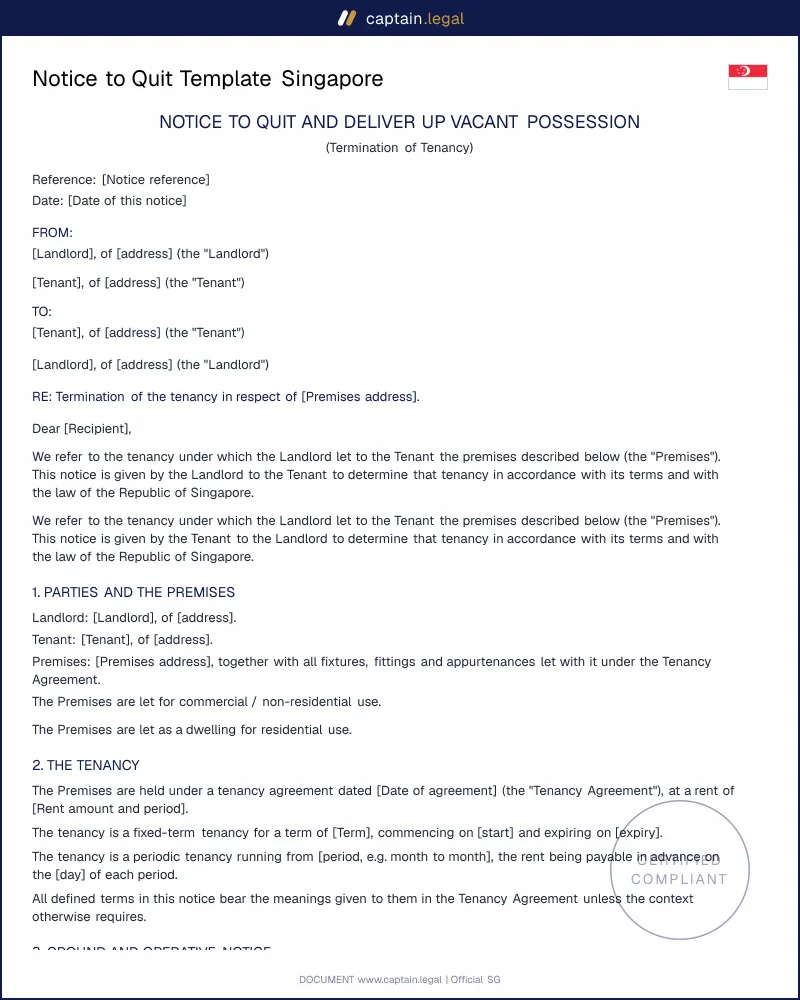
Notice to Quit Singapore: Section 18 CLPA Compliant

Notice to Quit drafted to section 18 Conveyancing and Law of Property Act 1886. Breach, non-payment and re-entry handled correctly. Word and PDF.
4.7/527 reviews50 000+ downloadsInstant download
Share

A Notice to Quit is the written notice a landlord or tenant serves to bring a tenancy to an end in Singapore, whether the term has run its course, a party wants out early, or the other side has breached the tenancy agreement. It fixes the date possession must be given up and, where a breach is involved, sets out exactly what went wrong and what the law requires before re-entry. Because Singapore has no general statutory rent control and most residential tenancies sit under common law and the contract itself, the wording and the notice period carry real legal weight. This template is drafted for Singapore tenancy practice, covers breach, non-payment and early termination, and is ready as Word and PDF so you can serve it the same day.

A clean termination protects the deposit, the security of possession and your standing if the matter ever reaches the courts. A sloppy one invites a wrongful eviction claim or a forfeiture that the tenant gets relieved from.

Compliant

2026 Legislation

50,000+ clients

trust us

Affordable

From $4.90 / doc

Secure payment

Instant download

Notice to Quit Singapore: Section 18 CLPA Compliant

Secure payment · No subscription

Fill in the template

What is a notice to quit in Singapore?

A notice to quit is a formal demand that an occupier give up possession of premises by a stated date. In Singapore practice the term is used loosely for several distinct instruments, and getting the label right matters. A pure notice to quit ends a periodic tenancy by giving the contractual or common-law notice, with no allegation of fault. A notice of termination invokes a break clause or an early-exit right written into the agreement. A forfeiture notice is the heavyweight: it asserts a breach and threatens re-entry, and it is governed by statute rather than left to the contract.

The distinction drives everything that follows. A notice that picks the wrong route is often worthless. If you serve a bare notice to quit when the real ground is a breach, you skip the statutory warning the tenant is entitled to, and any later re-entry can be challenged. If you serve a forfeiture notice on a tenancy that has simply expired, you burden a routine handover with allegations you do not need to prove. Most disputes our drafters see start here, with a landlord who served the document that felt strongest rather than the one the situation called for. The tenant's right to quiet enjoyment lasts until the tenancy is lawfully ended, and Singapore courts read that right strictly. Choosing the correct notice, and serving it the correct way, is what separates a tenancy that ends cleanly from one that ends in court.

2

When do you need this document?

The most frequent trigger is the natural end of a fixed term, where the landlord or tenant confirms in writing that the tenancy will not renew and that vacant possession is due on the expiry date. Skipping this step is risky because silence on both sides can create an implied periodic tenancy that then needs its own notice to end. The second common scenario is non-payment of rent, where many agreements allow re-entry once rent is unpaid for a set window, often seven days after it falls due, whether or not it has been formally demanded.

Early termination is the third bucket and the one that generates the most friction. A tenant invoking a diplomatic clause or a contractual break right serves notice and leaves at the end of the period without owing compensation, but a tenant with no such right who walks out early is in breach and can be sued. Landlords face the mirror image: most leases give the landlord no early-exit right at all, so an owner who wants the unit back mid-term must negotiate a surrender rather than serve notice. Breach of a non-rent covenant fills out the rest, covering unauthorised subletting, illegal use, or serious damage, each requiring a section 18 notice before re-entry. One edge case worth flagging for landlords: where a tenant's immigration or employment status changes so they can no longer lawfully reside in Singapore, the agreement may allow termination, but the clause has to exist in the contract first. A reason that feels fair is not a legal ground unless the agreement or a statute supplies it.

3

Key clauses included in our template

  • The identification of the parties and the premises names every party to the tenancy and describes the property precisely, including the unit number and any included furniture or car-park lot. A notice served on the wrong legal person, or one that misdescribes the premises, is open to challenge, so our template pulls these details through from the agreement rather than leaving them to free text.
  • The statement of ground sets out clearly whether the notice ends an expired term, exercises a break right, or alleges a breach. Where a breach is relied on, the clause is drafted to the language of section 18 of the CLPA, specifying the exact covenant breached rather than a vague reference to a "lease violation" that a court can pick apart.
  • The notice period and quit date state the precise date possession must be given, calculated against the contractual notice or the common-law minimum, commonly thirty days for a periodic tenancy unless the agreement says otherwise. The clause makes the period unambiguous because an under-length notice is treated as no notice at all.
  • The remedy and compensation demand appears in breach notices, giving the tenant a defined chance to fix the problem and stating any compensation sought, exactly as the statute requires before re-entry becomes enforceable.
  • The reservation of rights and re-entry clause preserves the landlord's right to claim arrears, draw on the deposit, and pursue distress or forfeiture, so that ending the tenancy does not waive money still owed. If you are also putting the wider arrangement in writing, our Singapore tenancy and lease agreement templates carry the matching re-entry wording this notice depends on.
4

Regional considerations

Singapore is a single jurisdiction, so the rules do not change by region the way they would across a federation, but the type of property changes the procedure significantly. For private condominiums and landed homes, termination runs on the tenancy agreement plus the CLPA and common law, and the clauses described above govern. The Small Claims Tribunals can hear tenancy disputes where the lease does not exceed two years, which gives tenants a fast, low-cost route to challenge a deposit forfeiture or an early termination, so landlords should expect their notice to be scrutinised even in modest matters.

HDB flats follow a separate track. Subletting a flat or bedrooms is only lawful with HDB approval and within the minimum occupation period and tenant-mix rules, and ending such an arrangement can engage HDB's own conditions alongside the agreement. A landlord who never had approval to sublet is in a weak position to enforce a notice cleanly, so confirm the arrangement was authorised before serving anything. Commercial and industrial premises raise their own points: corporate leases rarely give tenants any pre-termination right, so a business that vacates early is usually in breach and exposed to a claim for the rent over the remaining term. Whatever the property, the right of re-entry must already sit in the contract, which is why getting the underlying commercial and incorporation document templates right at signing matters as much as the notice itself. Where the dispute touches an employee's tied housing, the interaction with the employment relationship is worth checking through our Singapore employment and HR templates.

5

How to fill out this notice to quit

You start by telling the form what kind of ending you are dealing with, since that single choice reshapes the rest of the document. Selecting an expiry, a break-clause exit, or a breach changes the wording, the warnings and the statutory references that appear. From there you enter the parties exactly as named in the tenancy agreement and describe the premises down to the unit and any car-park lot, so the served notice cannot be attacked for naming the wrong person or place. The form then asks for the key dates, the rent position and, where a breach is in play, the specific covenant relied on, building the section 18 remedy demand for you rather than leaving you to draft it. You confirm the notice period against your contract, the template flags where a common-law minimum may apply, and you set the quit date. Before generating, a short review screen surfaces the points that most often sink a notice, including an under-length period and a missing right of re-entry. You download the finished notice as Word and PDF, ready to sign, date and serve. If you need the supporting paperwork too, the full Singapore real estate and rental document library sits alongside this one.

6

Common mistakes to avoid

The error that defeats the most notices is serving the wrong type for the situation, typically a bare notice to quit when the real ground is a breach that demanded a section 18 warning, or a forfeiture notice flung at a tenancy that had simply expired. Close behind is the under-length period: an owner who gives thirty days where the contract requires more, or who ignores a contractual notice clause entirely, has effectively served nothing, and the quit date is unenforceable. A third recurring failure is asserting a right of re-entry that was never written into the agreement, since that right does not exist by default and cannot be conjured after the fact.

Self-help eviction is the most dangerous mistake of all. Changing the locks, removing the tenant's belongings, or cutting utilities to force a departure is unlawful and turns the landlord from claimant into defendant in a wrongful-eviction action. Landlords also stumble by waiving the breach, continuing to accept rent after the ground for forfeiture arose, which a court can read as acceptance that the tenancy continues. Tenants make the opposite error, walking out early on a lease with no break clause and assuming the deposit settles it, when the landlord can pursue the rent for the unexpired term. Documenting the premises properly avoids a related fight, which is why pairing the notice with the right property and personal legal documents for Singapore keeps the evidence clean from entry to exit.

Key takeaways

NOTICE TYPE

Use the right route to end tenancy

In Singapore practice, “notice to quit” can mean different things. A plain notice to quit ends a periodic tenancy without alleging fault, a notice of termination relies on a break clause, and a forfeiture notice is used for breach with re-entry threatened. Pick the wrong instrument and the notice may be worthless, leaving the tenant’s quiet enjoyment intact and pushing a handover into a dispute.

CLPA s18

For breach, the statutory warning comes first

If you are ending the tenancy for breach and relying on re-entry or forfeiture, section 18 of the Conveyancing and Law of Property Act 1886 applies. The landlord’s right of forfeiture is not enforceable unless the notice specifies the particular breach, asks for it to be remedied where possible, and demands any compensation. The tenant must then be given a reasonable time to fix it.

RISK

Lock changes can backfire badly

Termination does not automatically give you possession. Re-entry must be peaceful and lawful, and forcing entry or changing locks can trigger a wrongful eviction claim. Even for non-payment, section 18A of the CLPA allows the tenant to stop a possession action by paying arrears and costs into court, and the court will usually grant at least four weeks before ordering possession.

Frequently Asked Questions

The template produces a notice that is valid and enforceable when it is filled out correctly, served properly, and matched to a tenancy agreement that contains the rights it relies on. A notice has no force on its own; it works by triggering the contractual and statutory machinery already in place. For a breach-based notice, that means satisfying section 18 of the Conveyancing and Law of Property Act 1886, which requires you to specify the breach and allow time to remedy it. For an ordinary end-of-term notice, validity turns on giving the correct period and a clear quit date. Provided those conditions are met, the served notice stands as a proper legal step toward recovering possession.

It depends first on your tenancy agreement, which almost always states the required notice, and that figure governs. Where the contract is silent and the tenancy runs periodically, the common minimum applied in Singapore practice is thirty days, though you should always check the agreement before relying on it. For fixed-term tenancies, the notice usually confirms that the term will end on its stated expiry date rather than cutting it short. An under-length notice is treated as no notice, so when in doubt, give the longer of the contractual and common-law periods. Early-exit rights such as a diplomatic clause carry their own notice windows, which the clause itself sets out.

Not by force. A landlord may serve the notice and, if the tenant leaves, recover possession peacefully. But where the tenant stays, the landlord cannot lawfully change the locks, seize belongings or cut services to drive them out; doing so is wrongful eviction and exposes the landlord to a claim. Possession against a tenant who refuses to go is recovered through the courts, usually by a writ for possession after a valid section 18 notice. The tenant can apply for relief against forfeiture, and for non-payment the court typically allows at least four weeks to pay arrears before ordering possession.

You receive the notice in both Microsoft Word and PDF. The PDF is ready to sign and serve as is, which suits most straightforward terminations. The Word version lets you adjust wording where your tenancy agreement uses unusual definitions or where a solicitor wants to tailor the breach particulars before service. Having both means you can serve immediately or refine first, without being locked into a fixed layout.

You have parallel routes. You can serve a notice relying on the non-payment ground and proceed toward forfeiture and possession, observing the section 18A relief the tenant is entitled to. Separately, under the Distress Act you can apply for a writ of distress, which allows a court sheriff to seize movable property on the premises and recover up to twelve months of arrears if the tenant does not pay within the prescribed days. The deposit can also be applied against what is owed. These remedies require the right of re-entry and the relevant clauses to exist in the agreement, so check the contract before acting.

Only if the agreement gives that right. A diplomatic clause or a negotiated break clause lets a tenant serve notice and leave at the end of the stated period without paying compensation. Without such a clause, a tenant who leaves before the term ends is in breach and can be sued for the rent over the unexpired period, with the landlord usually entitled to retain the deposit against the loss. The practical solution is to negotiate a surrender, agreeing terms in writing so both sides know where they stand, rather than simply walking away and hoping the deposit closes the matter.

The notice to quit itself is not a stamped instrument; stamping applies to the tenancy or lease agreement, which must be stamped through IRAS under the Stamp Duties Act. What matters for the notice is correct service and an accurate record of when and how it was delivered, because the date of service starts the clock on the notice period. Keep proof of service, since a dispute over whether and when the notice reached the tenant is one of the easier ones to avoid and one of the harder ones to win after the fact.

4.7/5

27 verified reviews · 50 000+ downloads

Notice to Quit Singapore: Section 18 CLPA Compliant
  • Immediate access to the document
  • PDF + Word download
  • Compliant with 2026 legislation
  • Reviewed by lawyers
Fill in the template
Secure payment · No subscription
Updated on June 16, 2026

You might also like

Tenancy Agreement Singapore
Room Rental Agreement Singapore