Create my document
Login

Choose country

FranceBelgiqueEspañaUnited StatesUnited KingdomMarocDeutschlandItaliaSchweizSingapore
Family & Divorce

Cohabitation Agreement Singapore | Deed of Cohabitation

Unmarried couples get no automatic rights in Singapore. Set out who owns the home and what happens if you split. Customise and download fast.
4.7/522 reviews50 000+ downloadsInstant download
Share

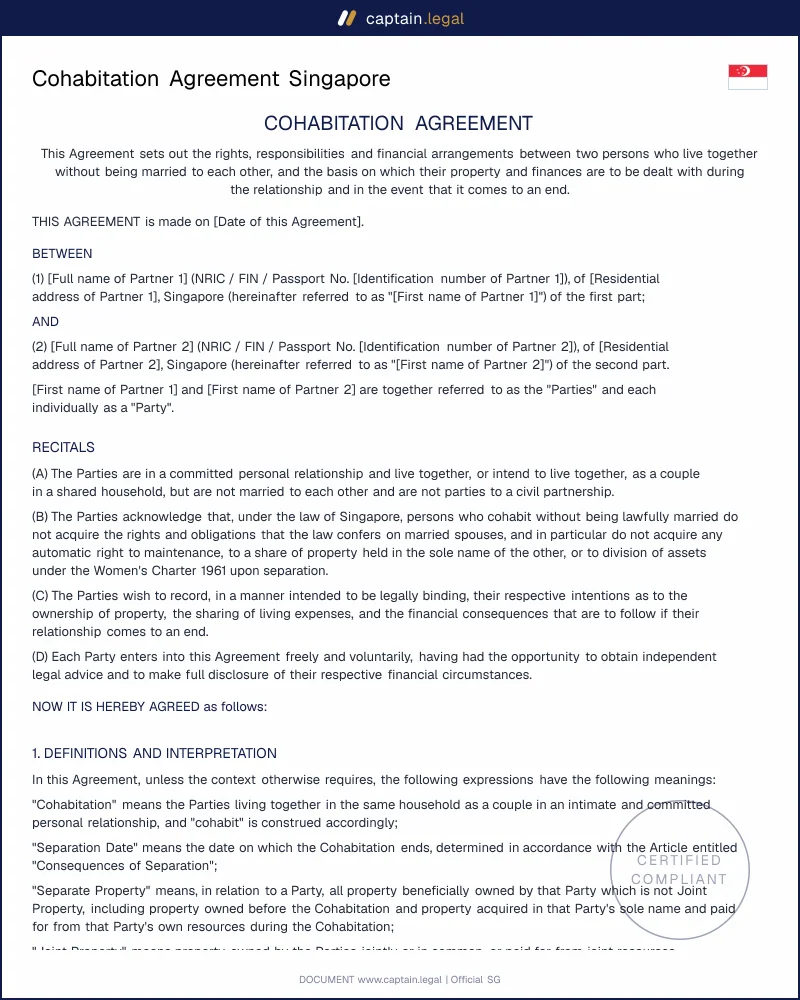
A cohabitation agreement is a private contract between two unmarried partners who live together, setting out who owns what, how shared expenses are split, and what happens to property and money if the relationship ends. In Singapore it is sometimes called a Deed of Cohabitation, and it matters far more here than in many other countries, because Singapore law gives cohabiting couples almost no automatic rights. If you are buying a flat together, pooling savings, or moving into a partner's property without marrying, this is the document that records your intentions in writing before a dispute makes those intentions impossible to prove.

Unlike a married couple, partners who simply live together do not fall under the matrimonial regime of the Women's Charter 1961. There is no "common-law marriage" in Singapore, and the length of cohabitation buys you no extra protection. A cohabitation agreement fills that gap by turning a couple's understanding into enforceable contractual terms supported by clear evidence of ownership.

Compliant

2026 Legislation

50,000+ clients

trust us

Affordable

From $4.90 / doc

Secure payment

Instant download

Cohabitation Agreement Singapore | Deed of Cohabitation

Secure payment · No subscription

Fill in the template

What is a cohabitation agreement in Singapore?

A cohabitation agreement is a written contract that governs the financial and property relationship between two people living together outside marriage. Lawyers also call it a Deed of Cohabitation, and the substance is close to a prenuptial agreement, except that the parties have no intention of relying on family law if they separate. The document typically records each partner's existing assets and debts, sets out how the home and its costs are shared, and states how jointly acquired property will be divided if the couple splits or one partner dies.

The practical reason it exists is that Singapore does not recognise de facto relationships or cohabitation under matrimonial law. When an unmarried couple separates, the courts apply ordinary principles of contract, trust and property law, not the asset-division rules that protect spouses. This was made plain in Chia Kum Fatt Rolfston v Lim Lay Choo [1993], where the court confirmed that cohabitants in dispute fall back on general civil and property law with no special matrimonial recourse.

People often confuse this document with a Deed of Separation, which is used by married couples preparing for divorce. They are not interchangeable. A Deed of Separation sits inside the Women's Charter framework and deals with spousal maintenance and matrimonial assets, while a cohabitation agreement operates purely as a commercial contract between two individuals who were never married. Choosing the wrong instrument can leave you with a document the court reads in an entirely different way than you intended.

2

When do you need this document?

The most common trigger is buying or moving into a home together while unmarried. Singapore's housing rules push unmarried couples toward private property or sole ownership of an HDB flat, and the partner who is not on the title is dangerously exposed. If you paid part of the deposit, covered renovations, or serviced the mortgage for years, only a written record reliably proves your stake when feelings have soured. The agreement should sit alongside your conveyancing arrangements and any Singapore HDB or condo tenancy documentation where one partner rents space from the other.

A second scenario is financial pooling: shared bank accounts, joint loans, or one partner funding the other's business while the relationship is strong. Couples also reach for the document when one partner gives up a career or relocates for the relationship, expecting some recognition of that sacrifice if things end. Because Singapore law grants no compensation for these contributions automatically, the only protection is a clause negotiated while both still trust each other.

Two edge cases deserve attention. Same-sex couples, whose relationships cannot be registered as marriage in Singapore, rely on cohabitation agreements as one of the few contractual tools available to structure shared finances and property. And couples with children should remember that a cohabitation agreement cannot fix custody or maintenance for a child, since the welfare of the child remains the court's paramount concern. Those issues belong in a separate parenting arrangement, and the broader family and divorce document range for Singapore covers the situations where a relationship breakdown involves children.

3

Key clauses included in our template

  • The disclosure of assets and debts schedule requires each partner to list property, savings, investments and liabilities at the start. Full disclosure is not a formality here; it is what allows a court later to see that the agreement was fair and informed, which directly affects how much weight the document carries.
  • The property ownership clause records exactly who owns the home and in what proportion, and whether co-owners hold as joint tenants with a right of survivorship or as tenants in common in defined shares. This is the single most litigated issue between former cohabitants, so the clause names contributions to deposit, mortgage and renovation with figures.
  • The shared expenses clause sets out how rent or mortgage, utilities, groceries and household costs are divided, and whether one partner's payments build any beneficial interest in the other's property. Couples who skip this often discover that years of paying bills created no ownership stake at all.
  • The separation clause states what happens to jointly acquired property, shared accounts and any loans between the partners if the relationship ends. It can provide for a buy-out, a sale, or a fixed division, and it specifies how disputes are resolved, often through mediation before litigation.
  • The estate and death clause clarifies what each partner intends should one of them die, and expressly directs the couple to back the agreement with a will, since the Intestate Succession Act leaves a surviving cohabitant with nothing on its own.
  • The independent legal advice and severability clause records that each partner had the chance to take advice and that surviving clauses stay valid even if one is struck out, both of which help the agreement withstand a later challenge.
4

Regional and practical considerations

Singapore is a single jurisdiction, so there is no canton or state variation, but several local realities shape how a cohabitation agreement should be drafted. The first is housing policy. HDB eligibility schemes are built around marriage and family nuclei, and an unmarried couple usually cannot jointly own an HDB flat under the ordinary schemes, which often forces sole ownership. That makes the non-owning partner's contributions invisible on paper, and the agreement becomes the only durable record that those payments happened and were meant to create an interest.

The second is the manner of holding for couples who do buy private property together. Holding as joint tenants means the survivor automatically takes the whole property on death, bypassing the will, while holding as tenants in common lets each partner leave their defined share to whomever they choose. The two approaches lead to completely different outcomes, and the agreement should state which one the couple has chosen and why, consistent with the conveyancing documents. Partners who later want to switch can do so, but it requires formal steps through a conveyancing lawyer.

The third is religion and applicable law. For Muslim couples, succession is governed by the Administration of Muslim Law Act 1966 rather than the Intestate Succession Act, which changes the estate-planning analysis that sits behind the agreement. The fourth is stamp duty and property transfers: any clause that contemplates transferring a share in property between partners can trigger duty and should be coordinated with proper instruments rather than handled loosely in the agreement. Where the relationship involves business assets, the relevant terms may need to dovetail with Singapore shareholders' and founders' agreement documents so that ownership of a jointly built company is not left ambiguous.

5

How to fill out this cohabitation agreement

You start by entering the full legal names, identification details and current addresses of both partners, then state the date the cohabitation began or is intended to begin. The form moves next to disclosure, where each partner lists existing assets, the property they are bringing into the relationship, and any debts, because honest disclosure is what gives the document its strength later. From there you describe the home: who owns it, the manner of holding, and the financial contributions each partner has made or will make toward deposit, mortgage and improvements.

The agreement then asks how you want to handle shared expenses month to month and whether those payments are meant to create any ownership interest, which is the question most couples never think to answer until it is too late. You set out what happens on separation, choosing between a sale, a buy-out or a fixed division, and you add a dispute-resolution step such as mediation. Finally you address death and estate intentions, and the form prompts you to pair the agreement with a will. Once the terms are complete, you download the document in Word and PDF, review it with your partner, and sign it as a deed in front of a witness. Couples who also need to record everyday consents can pair this with the personal documents and statutory declaration templates for Singapore.

6

Common mistakes to avoid

The most damaging mistake is assuming that living together creates rights. Many partners genuinely believe that years of cohabitation, shared bills and a joint mortgage give them a "common-law" claim, and they are shocked to learn that Singapore recognises no such status and that time together adds nothing to their legal position. The second frequent error is hiding or under-stating assets during disclosure. An agreement built on incomplete disclosure invites a later argument that it was unfair or signed without full knowledge, which is exactly the kind of challenge that weakens its weight in court. A third mistake is silence on the manner of holding for jointly owned property, leaving partners to discover only on a death or a sale that survivorship rules overrode what they thought they had agreed.

People also routinely try to use a cohabitation agreement to settle child custody or child maintenance, which a court will not allow, since a child's welfare cannot be bargained away by the parents' contract. Others treat the document as a one-time fix and never update it after a major change such as buying a second property, having a child, or one partner leaving employment, with the result that the agreement no longer matches reality. Sign it as a properly witnessed deed and keep the original secure, because an unsigned draft or a copy circulated casually in a group chat is worth very little when a dispute finally arrives. Finally, do not skip the companion will: without it, the Intestate Succession Act can hand everything to relatives and leave a devoted partner with nothing.

Key takeaways

LEGAL POSITION

No automatic rights for cohabiting partners

In Singapore, living together does not create spousal rights. The Women’s Charter 1961 applies only to registered marriages, and there is no common-law marriage or de facto status. That means no automatic maintenance and no automatic share of your partner’s assets, regardless of how long you have cohabited. If things turn sour, you are treated as two individuals under ordinary civil law.

THE DOCUMENT

A Deed of Cohabitation records ownership

A cohabitation agreement (also called a Deed of Cohabitation) is a private contract setting out who owns what, how household costs are split, and what happens to property and money if you separate or one partner dies. It is most useful when you buy a flat together, pool savings, or move into a partner’s property, because it fixes your intentions in writing before a dispute.

DISPUTE RISK

Without it, courts fall back on trusts

If you separate without a clear agreement, disputes are decided using contract, trust and property law, not matrimonial asset rules. Even if only one name is on the title, a contributing partner may argue a beneficial interest through resulting or constructive trusts, as discussed in cases like Lau Siew Kim v Yeo Guan Chye Terence [2008] and Chan Yuen Lan v See Fong Mun [2014]. That uncertainty is exactly what the agreement reduces.

Frequently Asked Questions

A cohabitation agreement is a contract, so it is binding between the partners in the same way any properly formed contract is, provided there is offer, acceptance, consideration and an intention to create legal relations. Signing it as a deed with a witness removes doubts about consideration and strengthens enforceability. That said, a court retains some discretion, particularly where terms touch on children or where one party can show the agreement was signed without disclosure or under pressure. The practical value is high: even where a clause might be revisited, the agreement is strong evidence of the couple's common intention about property, which is precisely what trust law looks for under Chan Yuen Lan v See Fong Mun [2014].

No. Singapore does not recognise cohabitation or de facto relationships under matrimonial law, and there is no common-law marriage. The Women's Charter 1961 applies only to registered marriages, so an unmarried partner has no automatic right to maintenance and no automatic share of the other partner's assets, regardless of how long the couple lived together. If a relationship breaks down, the partners fall back on ordinary contract, trust and property law. This is exactly why a written agreement matters so much: it is the only reliable way to give an unmarried partner the protection that the law otherwise reserves for spouses.

That depends on whose name is on the title and what your agreement and contributions show. If only one partner owns the property, the other must prove a beneficial interest through financial contributions and common intention under trust law, which is difficult without documentation. If you own jointly, the manner of holding governs the split: tenants in common divide by their defined shares, while joint tenants are treated as equal unless the presumption is rebutted. A cohabitation agreement that records each partner's contributions and intended shares gives a court direct evidence and avoids the costly reconstruction that Lau Siew Kim [2008] describes.

No. A cohabitation agreement cannot fix custody, care and control, access or child maintenance, because the welfare of the child is the court's first and paramount consideration and cannot be contracted away by the parents. Any terms attempting to do so are unlikely to be upheld. Children's arrangements belong in a separate parenting plan, and maintenance for a child is dealt with under family law rather than private contract. You can still use the cohabitation agreement for the financial and property side of your relationship, but treat the children's issues as a distinct matter handled through the appropriate family documents.

Under the Intestate Succession Act 1967, a surviving cohabitant inherits nothing, because the statute distributes an intestate estate only among spouses, children, parents and other blood relatives. An unmarried partner is simply not on the list. Jointly held assets with a right of survivorship can pass outside the estate to the surviving co-owner, which is one reason the manner of holding matters, but anything in the deceased partner's sole name follows the intestacy rules. The reliable fix is to pair your cohabitation agreement with a valid will and, ideally, a lasting power of attorney, so your intentions are honoured rather than overridden by default succession law.

You can download the completed cohabitation agreement in both Word and PDF. The Word file lets you make further adjustments to suit your circumstances, for example adding a specific property schedule or refining the separation terms, while the PDF gives you a clean, final version ready for signing and safekeeping. Because the document should be executed as a witnessed deed, most couples finalise the wording in Word, generate the PDF, then print and sign the signed copy. Keep the original signed deed somewhere secure and give each partner a copy, since a casual scan circulated informally carries far less evidential weight than the properly executed original.

You can enter into a cohabitation agreement at any time before separation: before you move in together, when you buy a home, or at any later point while the relationship is intact. The strongest agreements are signed early, while both partners are cooperative and disclosure is genuinely full, rather than hastily in the middle of a dispute. It is also wise to revisit the agreement after any significant change, such as buying property, starting a business together, having a child, or a shift in either partner's income. An agreement that still reflects your real arrangements carries far more weight than one that has quietly gone out of date.

4.7/5

22 verified reviews · 50 000+ downloads

Cohabitation Agreement Singapore | Deed of Cohabitation
  • Immediate access to the document
  • PDF + Word download
  • Compliant with 2026 legislation
  • Reviewed by lawyers
Fill in the template
Secure payment · No subscription
Updated on June 17, 2026

You might also like

Divorce Settlement Agreement Singapore
Parenting Plan Singapore