Create my document
Login

Choose country

SingaporeSingaporeChoose country
Family & Divorce

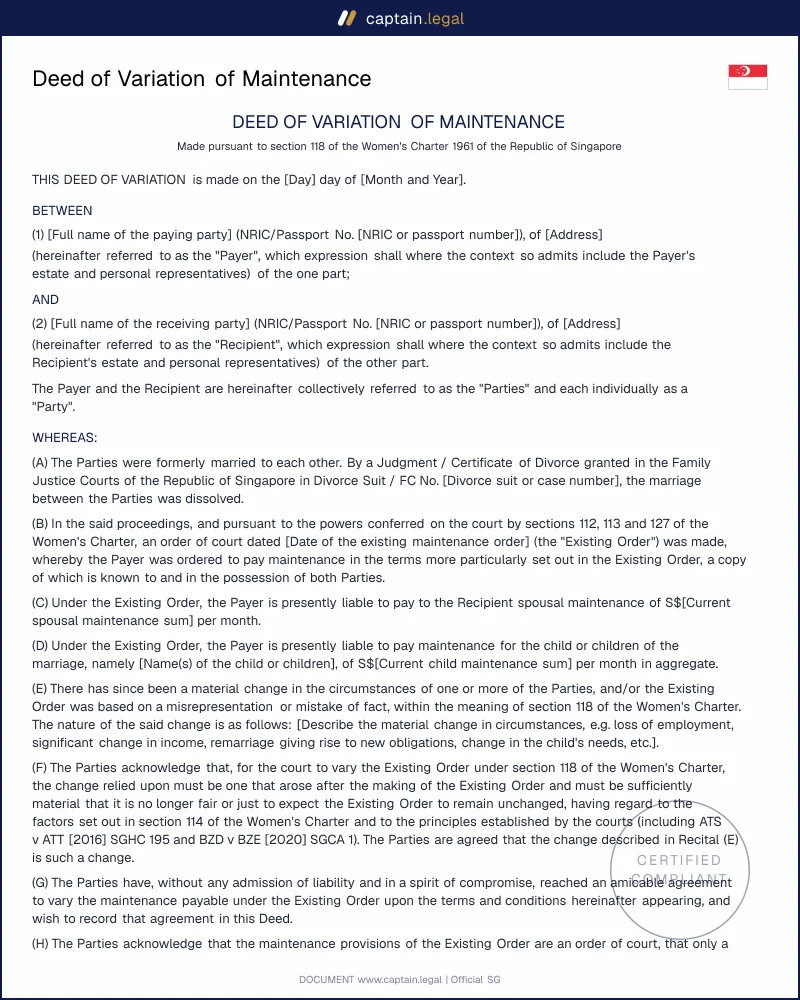
Deed of Variation of Maintenance (s.118 WC)

Amend a subsisting maintenance order under section 118 Women's Charter. Practitioner-grade Singapore deed of variation, Word and PDF.
4.6/523 reviews50 000+ downloadsInstant download
Share

This page covers the Deed of Variation of Maintenance used in Singapore when former spouses want to change an existing maintenance arrangement after divorce. It is written for a payer or recipient facing a genuine change in circumstances, such as a salary drop, remarriage, a child entering tertiary study, or new medical costs. A deed of variation records the revised terms both parties accept, whether the underlying obligation sits in a private separation deed or a maintenance order made under the Women's Charter 1961. Used correctly it can save a contested hearing. Used carelessly it can leave a court order untouched while both sides wrongly believe the figure has changed.

Compliant

2026 Legislation

50,000+ clients

trust us

Affordable

From $4.90 / doc

Secure payment

Instant download

Deed of Variation of Maintenance (s.118 WC)

Secure payment

Fill in the template

What is a deed of variation of maintenance?

A deed of variation of maintenance is a written agreement, signed as a deed, in which two former spouses record their consent to change the amount, duration, or mechanics of an existing maintenance obligation. It does not create the duty to maintain. That duty comes from an earlier deed of separation, a divorce settlement, or a maintenance order the Family Justice Courts made under section 113 of the Women's Charter. The variation deed amends what already exists.

The distinction that trips people up is the one between a private deed and a court order. If your original maintenance was purely contractual, sitting inside a deed of separation the parties signed without any court order, a fresh deed of variation between the same parties can lawfully amend those contractual terms. But if a judge made a maintenance order during divorce proceedings, that order stays live until the court itself varies it. A private deed cannot override a subsisting court order. What the deed does in that situation is record the parties' agreed position so they can jointly ask the court to vary the order by consent under section 118 of the Women's Charter, which is faster and cheaper than a contested application. Treat the deed as evidence of agreement, not as the variation itself, whenever a court order is in play.

2

When do you need this document?

The most frequent trigger is a substantial income change. A payer who loses a job, takes a forced pay cut, or retires often cannot sustain the original figure, and a recipient whose earnings have risen sharply may face a downward application from the other side. Silence just builds arrears while the old order keeps running, which is why documenting the new position early protects both parties. A related scenario is the recipient's remarriage, which ends spousal maintenance by operation of law, though any separate child maintenance survives and usually needs its own recalculated figure.

Children drive the second cluster of cases. A child moving into secondary or tertiary education changes the cost base completely, and enrichment, tuition, or a diagnosed medical condition can push the monthly need well beyond what the original order contemplated. Parents who agreed a round number years ago often find it no longer maps to reality, and a variation lets them reset it against actual expenses. If you are still setting the underlying figure, our child and spousal maintenance agreement for Singapore families is the natural starting point before any variation arises.

An edge case worth flagging: a nominal maintenance order of S$1 per month exists precisely so a recipient can later apply to vary it upward if genuine need appears, which is common where a former spouse becomes ill or disabled after the divorce. Another is a payer facing bankruptcy, where a downward variation may be realistic but the timing and evidence have to be handled with care, since the court scrutinises whether the hardship is genuine and ongoing rather than convenient.

3

Key clauses included in our template

  • The recital of the existing obligation identifies the precise source being varied, whether a dated deed of separation, a divorce settlement, or a Family Justice Courts order with its suit and order numbers. This anchors the variation to a real instrument and prevents later disputes about what was actually changed.
  • The statement of the material change sets out, in plain terms, the event that justifies the variation, such as retrenchment, a child's entry into university, or a documented medical condition. Where the parties intend to seek a consent variation of a court order, this clause doubles as the factual basis for the supporting affidavit the court expects under section 118.
  • The revised maintenance terms specify the new monthly sum, the payment date, the payment method, and the end date or triggering event, replacing the corresponding terms of the original document. Clarity here is what stops a recipient and payer arguing about whether school fees sit inside or outside the headline figure.
  • The allocation of specific expenses separates cash maintenance from school fees, insurance, medical bills, and enrichment, and states who pays what and what proof is needed for reimbursement. Disputes cluster around big-ticket items like orthodontics and overseas school trips, so naming them expressly saves grief.
  • The review and further-variation mechanism records how the parties will handle the next change, whether by a defined annual review or a fresh agreement, so the deed does not have to be renegotiated from scratch each time. This is the clause most DIY documents forget.
4

Regional and jurisdictional considerations

Singapore is a single jurisdiction, so there is no state-by-state divergence, but the deed still has to fit local practice rather than a foreign template. All variation applications for divorce-derived orders proceed in the Family Justice Courts, and the procedural mechanics follow the Family Justice Rules, which require the applicant to file a summons supported by an affidavit setting out the change and the evidence for it. A deed drafted in isolation from that procedure often reads well but fails to give the court what it needs.

Muslim marriages add a real layer of complexity. Maintenance and variation for parties married under Muslim law generally fall within the jurisdiction of the Syariah Court rather than the Family Justice Courts, and the substantive rules differ from the Women's Charter framework, so a Women's Charter deed is not automatically the right instrument. Anyone in that position should confirm the correct forum before signing, and our Singapore family and divorce document library flags which templates map to which regime.

Enforcement also shapes how you draft. If the original order was a court order, the recipient keeps access to enforcement tools such as an attachment of earnings order, and a private deed that quietly reduces the sum without a matching court variation can leave both parties in an unenforceable muddle. Never treat a signed deed as a substitute for varying a live court order. Where property, CPF, or the matrimonial flat were part of the original settlement, a change to maintenance can interact with those terms, and the Singapore divorce settlement agreement covering HDB, CPF and maintenance shows how those moving parts were originally tied together.

5

How to fill out this deed of variation of maintenance

You start by identifying the exact document you are varying, entering the date of the original deed or the suit and order numbers of the maintenance order, so the variation attaches to the right instrument. From there the template asks you to describe the change in circumstances in concrete terms, because a bare assertion that things are "different now" carries no weight if the matter reaches a judge. You then enter the revised figure, the payment date, the method, and any end date, and you allocate the specific expenses that sit outside the headline sum.

The template adapts as you go. If you indicate the original obligation was a court order, it prompts you to treat the deed as the agreed basis for a joint section 118 application rather than a standalone fix, and it reminds you a supporting affidavit will follow. If the obligation was purely contractual, it lets the deed stand on its own as a binding amendment between the parties. Once complete, you download in Word and PDF, review the revised terms against the original, and arrange signature and witnessing. For related family paperwork you may need alongside this, the Singapore personal and statutory documents section covers declarations and consents that often travel with a variation.

6

Common mistakes to avoid

The single most damaging error is signing a private deed and assuming it has changed a court order. It has not. The order runs untouched until the court varies it, so a payer who quietly pays the lower figure is building arrears and exposing himself to enforcement, including an attachment of earnings order, no matter what the deed says. The fix is simple: where a court order exists, use the deed to record agreement and then file a joint application under section 118. A second frequent mistake is describing the change too vaguely. Courts want to see that the change arose after the original order, that it is material rather than minor, and that it is not self-inflicted, and a deed that says nothing useful about any of this gives the applicant no foundation for the affidavit.

The other errors are more mundane but just as costly. People forget to separate child maintenance from spousal maintenance, then discover a recipient's remarriage wiped out the spousal element while leaving the child figure unresolved. They omit an end date, so the obligation runs longer than anyone intended. They fail to name who covers school fees, medical costs, and enrichment, which guarantees a fight over the first orthodontist bill. And they leave out any review mechanism, forcing a full renegotiation the next time life shifts. Each of these is avoidable with a template that forces the awkward questions up front.

Key takeaways

Court order

A deed cannot change a live order

If maintenance sits in a Family Justice Courts order made during divorce, that order stays in force until the court varies or rescinds it. A private deed of variation cannot override a subsisting maintenance order. In that scenario, the deed mainly records both parties’ agreed position and supports a consent application under section 118 of the Women’s Charter, avoiding a contested hearing.

Legal basis

Use the right section or fail

Variation depends on the source of the maintenance. For divorce-related maintenance orders, section 118 of the Women’s Charter is the route, and the court can act where there was misrepresentation or mistake of fact, or a material change in circumstances. Section 72 is for maintenance during a subsisting marriage, and section 73 preserves the court’s overriding power on child maintenance. Picking the wrong section wastes time and costs.

Threshold

Material change must be real and clean

The court does not vary maintenance for minor fluctuations or tactical moves. The change must arise after the original order and be significant enough to make the existing terms unfair, as discussed in cases like ATS v ATT and BZD v BZE. Remarriage or retirement alone rarely suffices; what matters is the genuine financial impact. A self-inflicted income drop to avoid payment is unlikely to succeed.

Frequently Asked Questions

A properly executed deed is binding as a contract between the two parties who sign it, provided it is signed as a deed and records genuine agreement. The important qualification is that a private deed binds only the parties, not the court. If your original maintenance was a court order made under the Women's Charter, the deed does not by itself change that order. It records what you both accept, and you then ask the Family Justice Courts to vary the order by consent under section 118. Where the original obligation was purely contractual, sitting in a Singapore deed of separation, the variation deed can amend those terms directly and stands on its own.

Yes. You complete the document through the guided form, then download it in both Word and PDF formats. The Word version lets you make final adjustments to names, dates, figures, and expense allocations before signing, which matters because every variation is fact-specific and no two maintenance histories are identical. The PDF gives you a clean, fixed copy suitable for signing, witnessing, and safekeeping. Keep the signed original secure and share it only with people who genuinely need it, since variation documents contain financial details and, where children are involved, sensitive personal data that should not be circulated casually.

If both parties agree, a consent variation is comparatively quick, because the court is confirming an agreement rather than resolving a dispute. Where the variation is contested, expect it to take considerably longer, since the applicant must first establish a material change in circumstances, and it may then be several months before the application is heard. The precise timing depends on the Family Justice Courts' schedule and the complexity of the evidence. This is exactly why a clear deed recording agreement is worth preparing early, as it can move a matter from the contested track toward the consent track.

A material change is a significant, ongoing shift that arose after the original order and makes the existing figure unfair. Retrenchment, a serious pay cut, a diagnosed illness, a child entering tertiary education, or a sharp rise in the recipient's income can all qualify. The change cannot be trivial, and it cannot be self-inflicted, meaning a payer who deliberately reduces his own income to dodge maintenance will not succeed. In CKO v CKP [2021] SGHC 92 the court confirmed that remarriage or retirement alone rarely suffice, though the new obligations or income drop they produce may. The applicant carries the burden of proving the change with documents such as payslips and expense records.

Remarriage of a recipient former wife ends her right to spousal maintenance by operation of law, so payments toward her own support stop. It does not automatically resolve child maintenance, which is a separate obligation owed to the child and survives the parent's remarriage. In practice this is where a variation deed earns its keep, because the parties need to strip out the spousal element cleanly while recalculating or confirming the child figure against current needs. If the child maintenance figure itself needs resetting, our child and spousal maintenance template for Singapore provides the structure to do it properly.

It depends entirely on the source of the original obligation. If maintenance was set purely by private agreement, with no court order ever made, the two of you can vary it by signing a fresh deed, and no court involvement is required. If a court made the maintenance order during divorce proceedings, you cannot lawfully change that order by private agreement alone. The order remains enforceable until the court varies it under section 118, so even a fully agreed change should be put before the Family Justice Courts as a consent variation. The deed still matters in that case, because it is the evidence of agreement that makes the consent application straightforward.

If a live court order is in force and the payer stops paying or pays less than ordered, arrears accumulate and the recipient can enforce. Enforcement tools include an attachment of earnings order directed at the payer's employer, and in serious cases the court has power to impose penalties for non-payment. A private deed reducing the sum offers the payer no protection here if the underlying court order was never varied, which is the single most important trap to avoid. The safe course is always to convert an agreed reduction into a formal variation of the order rather than relying on an informal side agreement the court has never seen.

4.6/5

23 verified reviews · 50 000+ downloads

Deed of Variation of Maintenance (s.118 WC)
  • Immediate access to the document
  • PDF + Word download
  • Compliant with 2026 legislation
  • Reviewed by lawyers
Fill in the template
Secure payment
Updated on July 8, 2026

You might also like

Postnuptial Agreement Singapore
Consent to Marry a Minor Singapore