Create my document
Login

Choose country

SingaporeSingaporeChoose country
Non-Profit & Associations

Grant Agreement Singapore | Charities Act & COC

Grant agreement drafted to the Charities Act 1994 and Code of Governance. Restricted funds, reporting and enforceable clawback for Singapore non-profits.
4.7/513 reviews50 000+ downloadsInstant download
Share

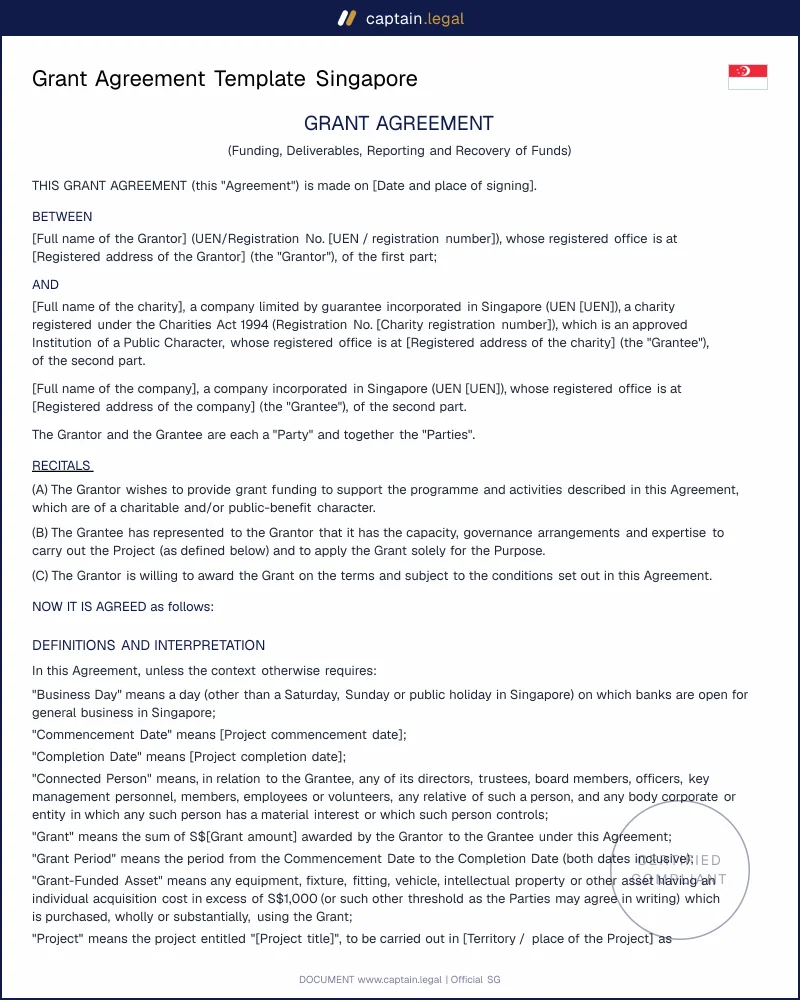
A grant agreement is the contract that governs money given by a funder to a non-profit for a defined purpose, and in Singapore it is the document that decides whether that funding is a clean gift or a set of enforceable obligations. A well-drafted funding agreement records the grant amount, the approved use of funds, the milestones and deliverables the grantee must meet, the reporting the funder expects, and the circumstances in which unspent or misused money must be returned. It is used by community foundations, corporate donors, government-linked funders and family philanthropies whenever they hand public or private money to a charity, a society or a company limited by guarantee.

For a Singapore non-profit, the stakes go beyond the two parties. Grant income feeds directly into the accountability regime that the Charities Act 1994 and the Commissioner of Charities impose on registered charities and Institutions of a Public Character. A loose agreement invites disputes over scope, exposes committee members to questions about fund handling, and complicates the annual submissions that sit on the public Charity Portal. This template is drafted to hold up in that environment.

Compliant

2026 Legislation

50,000+ clients

trust us

Affordable

From $4.90 / doc

Secure payment

Instant download

Grant Agreement Singapore | Charities Act & COC

Secure payment

Fill in the template

What is a grant agreement in Singapore?

A grant agreement is a binding contract under which a grantor commits funds to a grantee for charitable, community or programme purposes, subject to conditions on use, reporting and repayment. It is not a donation receipt and it is not a sponsorship deal. A plain donation transfers money with no strings; a sponsorship exchanges money for marketing benefits and is commercial in nature. A grant sits between them: the funder expects no commercial return, but it does attach conditions, and those conditions are legally enforceable because the document is a contract supported by consideration under Singapore common law.

The distinction matters for how the money is treated in the grantee's accounts. Where a funder imposes conditions on how the money may be spent, the grant becomes a restricted fund, which must be used only for its stated purpose and reported separately in the financial statements. A grant given with no conditions falls into unrestricted funds. Getting this classification right at the drafting stage saves the grantee's treasurer from awkward year-end reconciliations and keeps the audit trail clean. You will also see the term "funding agreement" used interchangeably, particularly for multi-year or programme-level support, and the same drafting principles apply. Whether the grantee is a society registered under the Societies Act 1966, a charity, or a company limited by guarantee incorporated under the Companies Act 1967, the agreement should name the correct legal entity and the person authorised to bind it.

2

When do you need this document?

The clearest trigger is a restricted or programme-specific grant, where a funder gives money for a named project and needs a written record that the grantee will spend it only on that project. Corporate foundations and community funds almost always insist on this before disbursing, because their own boards must account for where the money went. A second common scenario is multi-year or tranched funding, where the funder releases money in instalments tied to milestones. Here the agreement carries real weight: it lets the funder pause or stop later tranches if the grantee falls behind, without walking into a breach of its own.

Government-linked grants form a third category. Funders channelling money through schemes run by the National Council of Social Service or similar bodies pass reporting obligations down to the grantee, and the grant agreement is where those obligations are captured in writing. A fourth trigger is any grant to an IPC, because the tax-deductible status of the recipient raises the bar on documentation and audit trail. Do not treat a grant to an IPC as an informal handshake.

Two edge cases deserve flagging. First, cross-border or foreign-sourced funding attracts additional scrutiny, since Singapore regulates foreign donations above certain thresholds to guard against foreign influence, and the agreement should record the source clearly. Second, a grant that funds staff salaries or capital assets rather than programme delivery needs a repayment clause tailored to what happens if the role ends early or the asset is disposed of, a point a generic template usually misses.

3

Key clauses included in our template

  • The grant purpose and approved use of funds clause defines exactly what the money may be spent on, in language specific enough to create a restricted fund. Vague purposes like "general support" defeat the point; the template ties the funds to named activities, budget lines or a project scope schedule, which is what the Code of Governance expects for restricted-fund reporting.
  • The disbursement and tranche schedule sets out how and when money is released, whether as a lump sum or against milestones. Where funding is tranched, each release is conditioned on the grantee meeting the prior milestone and submitting the required report, giving the funder a clean contractual basis to hold back later payments.
  • The deliverables and milestones clause records what the grantee must achieve and by when, expressed as measurable outputs rather than good intentions. This is the backbone that the reporting and clawback clauses hang off, so the template pushes you to state concrete targets.
  • The reporting obligations clause specifies the frequency, format and content of progress and financial reports, including whether a utilisation statement or independent project audit is required. For IPC grantees, this clause anticipates the separate reporting that government and institutional funders demand.
  • The clawback and repayment clause sets out when unspent, unaccounted-for or misapplied funds must be returned. It is drafted as a recovery of the funder's actual loss rather than a punitive sum, keeping it on the right side of the rule against penalties confirmed in Denka Advantech.
  • The variation, suspension and termination clause lets the parties adjust scope, pause disbursement or end the arrangement on defined grounds, with a mechanism for dealing with the balance of funds on termination.
4

Regional and structural considerations

Societies. A grantee registered under the Societies Act 1966 is not a separate legal person in the way a company is, so the agreement should be signed by authorised office-bearers and the committee should minute its acceptance of the grant and its conditions. Because a society's committee can carry personal exposure, the reporting and fund-handling terms matter more here, not less. The template pairs naturally with the society's own governance records, and committees often adopt a committee resolution recording the decision to accept funding alongside signing the grant.

Charities and IPCs. A registered charity must slot the grant into its restricted-fund accounting and reflect it in the annual submissions the Commissioner of Charities publishes on the Charity Portal. An IPC faces the highest documentation standard: funders routinely require utilisation reports and may commission separate project audits, and a red flag on the portal can jeopardise both future grants and IPC renewal. The reporting clause should therefore be drafted to the funder's audit expectations, not the bare statutory minimum. A charity governance pack aligned with the Code of Governance gives the board the conflict, reserves and delegation policies that a diligent funder will want to see before releasing money.

Companies limited by guarantee. A CLG incorporated under the Companies Act 1967 is a separate legal entity, which simplifies signing but adds a layer: the board must resolve to accept the grant, and larger CLGs pursuing government grants must show clean statutory filings and financial statements prepared under the applicable reporting standards. The grant agreement should name the company precisely and be executed by directors authorised under its constitution.

5

How to fill out this grant agreement

You start by identifying the two parties: the grantor by its correct legal name and the grantee by its registered entity type, whether society, charity or CLG, together with the person authorised to sign. From there the form asks you to state the grant amount and the disbursement method, so you choose between a single payment and a tranche schedule tied to milestones. You then define the approved use of funds, and this is where the template prompts you to be specific enough to create a restricted fund rather than a vague pot of money.

Next you set the deliverables and the reporting rhythm, selecting how often the grantee reports and whether a financial utilisation statement or audit is required. The clawback section then lets you describe what happens to unspent or misapplied funds, drafted as a return of the funder's actual exposure. You finish with the term, variation and termination provisions, and the execution block for signatures. The completed agreement downloads in Word and PDF, so you can circulate it for negotiation or sign it as final. For grantees also formalising helper roles under the funded project, a matching volunteer agreement with a conflict-of-interest declaration keeps the whole project file consistent.

6

Common mistakes to avoid

The most damaging error is a purpose clause too broad to bite. When "approved use of funds" reads like a mission statement, the grantee cannot treat the money as a restricted fund, the funder cannot enforce misuse, and the auditor has nothing concrete to test against. A second frequent mistake is treating reporting as a formality: agreements that say the grantee will "report periodically" without fixing frequency, format or content leave both sides guessing, and for an IPC that vagueness can surface as a governance gap in the annual submission. Grantors also forget to link tranche release to milestone completion, which strips them of the one lever that makes staged funding safe.

On the repayment side, the classic trap is drafting a clawback as a punishment rather than a recovery. A clause demanding return of the full grant plus a penalty sum on any minor breach risks being unenforceable under the Denka Advantech line of authority, leaving the funder worse off than a modest, well-calibrated recovery clause would. Finally, parties overlook who has authority to sign. A society office-bearer or CLG director signing without a recorded committee or board decision creates a gap that a diligent funder, or a later dispute, will expose. A short resolution accepting the grant closes it. Non-profits handling donor and beneficiary data under the funded project should also confirm their data-handling practices meet PDPA requirements, since grant reporting often involves personal information.

Key takeaways

Purpose

A grant is a contract with strings

In Singapore, a grant agreement decides whether funding is a clean gift or a set of enforceable obligations. Unlike a donation receipt (no conditions) or a sponsorship (commercial marketing exchange), a grant sits in between: no commercial return, but conditions on use, milestones, reporting and repayment. Because it is a contract under common law, those conditions can be enforced if drafted clearly.

Accounting

Conditions turn money into restricted funds

If the funder imposes conditions on how the money may be spent, the grant should be treated as a restricted fund and tracked separately in the financial statements. If there are no conditions, it sits as unrestricted funds. Getting this right at drafting stage avoids painful year-end reconciliations for the treasurer, supports a clean audit trail, and reduces disputes about whether spending was within scope.

Governance

Draft for CoC scrutiny and clawback

For registered charities and IPCs, the Charities Act 1994 and the Commissioner of Charities create a compliance backdrop that goes beyond the funder-grantee relationship. A loose agreement can trigger questions about fund handling and complicate annual submissions on the Charity Portal. The Code of Governance for Charities and IPCs expects transparent accounting, clear delegation and limits of approval, so repayment or clawback clauses must be specific, not aspirational.

Frequently Asked Questions

Yes. Once both parties sign and the grantor commits funds in exchange for the grantee's obligations, the agreement is a binding contract under Singapore common law, supported by consideration and an intention to create legal relations. The conditions on use of funds, the reporting duties and the repayment mechanism are all enforceable, provided they are drafted specifically. The template gives you that specificity. Enforceability does not depend on notarisation; a properly executed agreement signed by authorised representatives of each entity is sufficient. For a society or CLG, make sure the signatory has the authority to bind the organisation, ideally recorded in a committee or board resolution.

A funder can require repayment of unspent, unaccounted-for or misapplied funds, and a well-drafted clawback clause is enforceable. The key is that the repayment must reflect the funder's actual loss rather than operate as a penalty. In Denka Advantech Pte Ltd v Seraya Energy Pte Ltd [2021] 1 SLR 631, the Court of Appeal confirmed that a sum payable on breach must be a genuine pre-estimate of loss, not an extravagant deterrent, or it risks being struck down. The template drafts clawback as a recovery of misused or leftover money, which keeps it on the safe side of that rule.

Reporting should be pinned down in the agreement itself: how often the grantee reports, in what format, and whether a financial utilisation statement or independent project audit is required. Registered charities must account for restricted funds separately and reflect grant income in the annual submissions the Commissioner of Charities publishes on the Charity Portal. IPCs face heightened scrutiny, since institutional and government funders often demand detailed utilisation reports or separate project audits to show exactly how the money was spent. Drafting the reporting clause to the funder's audit expectations, not just the statutory floor, prevents governance gaps later.

No. A grant agreement is a private contract between the funder and the grantee, and there is no filing or registration requirement with the Registrar of Societies, ACRA or the Commissioner of Charities. What is required is that the grant income and its restricted-fund status are reflected in the grantee's accounts and, for registered charities, in the annual submissions on the Charity Portal. Keep the signed agreement, all reports and the fund reconciliation together as part of the audit trail. That file, rather than any registration, is what demonstrates accountability to a regulator, an auditor or the funder.

The template is available in both Word and PDF. The Word version lets you negotiate and adjust the scope, milestones and reporting terms before signing, which matters because grant terms are almost always the product of back-and-forth between funder and grantee. The PDF version is suited to circulating a final, locked agreement for signature. Most parties negotiate in Word and then execute a PDF, keeping a clean signed copy for the project file and the accounts.

There is no fixed statutory term; the length follows the project. A single-project grant often runs the length of the programme plus a short reporting tail so the grantee can submit a final utilisation report and, if required, an audit. Multi-year funding typically ties each year's tranche to the prior year's milestones and reports. The template lets you set the term, the disbursement schedule and the reporting intervals independently, so you can match a lump-sum grant with a single end-of-project report or a tranched grant with quarterly or milestone-based reporting.

That depends on what the agreement says, which is exactly why the clause should be explicit. The standard and safest approach is for unspent funds to be returned to the funder or, with the funder's written agreement, carried forward to a defined next phase. Because these are restricted funds, the grantee cannot simply absorb the balance into general reserves. The template includes a provision dealing with the balance on completion or termination, drafted so the return of leftover money reflects the funder's position rather than functioning as a penalty, keeping it enforceable under Singapore law.

4.7/5

13 verified reviews · 50 000+ downloads

Grant Agreement Singapore | Charities Act & COC
  • Immediate access to the document
  • PDF + Word download
  • Compliant with 2026 legislation
  • Reviewed by lawyers
Fill in the template
Secure payment
Updated on July 10, 2026

You might also like

Deed of Gift to Charity Singapore
Office-Bearer Appointment & Resignation