Create my document
Login

Choose country

FranceBelgiqueEspañaUnited StatesUnited KingdomMarocDeutschlandItaliaSchweizSingapore
Employment & HR

Part-Time Employment Contract Singapore | Employment Act

Part-time employment contract drafted to the Employment Act 1968 and Part-Time Employees Regulations. Pro-rated leave, CPF and notice done right.
4.7/526 reviews50 000+ downloadsInstant download
Share

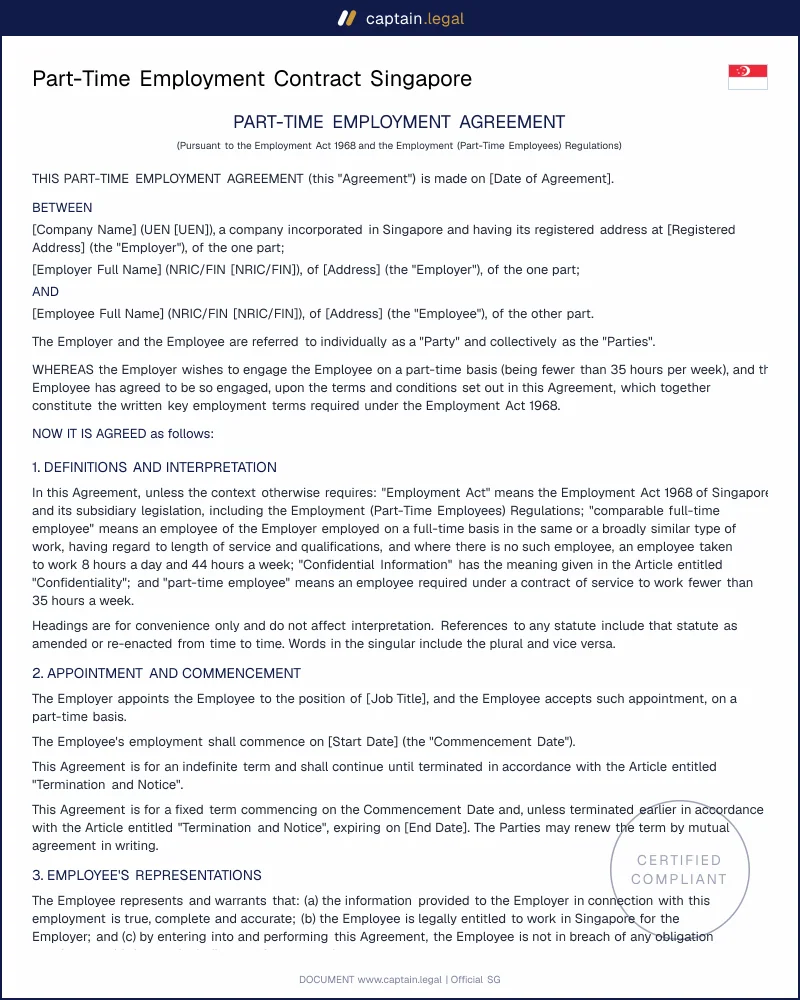
A part-time employment contract sets out the terms for any employee who works fewer than 35 hours a week, and in Singapore that single number changes everything about how you draft it. Below the 35-hour line, the Employment (Part-Time Employees) Regulations 1996 let you do things a full-time contract cannot: pay leave in hours, encash unused annual leave, and fold the rest-day premium into the hourly rate. Get the drafting right and a part-timer costs exactly what the hours justify. Get it wrong and you inherit full-time liabilities for someone working two mornings a week. This template is built for Singapore employers hiring retail staff, F&B crew, tutors, clinic assistants and back-office help on a part-time basis, with pro-rated leave, hourly pay, CPF and rest days handled to the letter of the Employment Act 1968.

Compliant

2026 Legislation

50,000+ clients

trust us

Affordable

From $4.90 / doc

Secure payment

Instant download

Part-Time Employment Contract Singapore | Employment Act

Secure payment · No subscription

Fill in the template

What is a part-time employment contract in Singapore?

A part-time employment contract is a contract of service, the same legal animal as a full-time contract, between an employer and an employee whose contractual hours fall below 35 hours per week. That 35-hour figure is not a soft convention. It is the statutory dividing line in the Employment (Part-Time Employees) Regulations 1996, and crossing it moves the worker out of part-time treatment entirely. An employee on a 34-hour week is part-time; one on 36 hours is not, regardless of what either party calls the arrangement.

The distinction matters because part-timers covered by the Regulations get a tailored version of the Key Employment Terms (KETs) every employer must issue. Hours, hourly or monthly rate, leave and notice are all expressed proportionally rather than as the flat full-time figures. A part-timer is a different creature from a casual or on-call worker with no fixed hours, and different again from an independent contractor on a contract for service, who sits outside the Employment Act altogether and earns no CPF, no leave and no statutory notice. Misclassifying a genuine employee as a contractor to dodge those obligations is one of the fastest ways to attract a Ministry of Manpower inquiry. The contract is the document that fixes which category applies, so its wording on control, hours and exclusivity carries real weight if the relationship is ever questioned.

2

When do you need this document?

The clearest trigger is a deliberate part-time hire: a café taking on weekend baristas, a tuition centre engaging tutors for evening slots, a clinic adding a receptionist for three mornings a week. In each case the employer wants a worker on a fixed, sub-35-hour schedule, and the contract is the instrument that records the hourly rate, the days worked and the pro-rated benefits before the first shift. Issuing it on day one is not optional housekeeping; the KETs requirement obliges you to put those terms in writing within fourteen days of the start date.

A second common scenario is converting a full-timer to part-time, often after parental leave or as a phased step toward retirement. This is a variation of the contract of service, not a fresh hire, and it needs the employee's written agreement, because unilaterally cutting someone's hours and pay can amount to a breach. A new part-time contract or a signed variation letter is the safe route. A third situation is the multiple-job worker who holds two or more part-time roles at once, where each employer needs a clean contract defining its own hours so that CPF and leave are computed correctly against that employer's wages alone.

The edge cases are where drafting earns its keep. A part-timer whose hours fluctuate week to week, common in F&B and events, needs an averaging method written into the contract so leave and notice can be calculated against a stable figure rather than a moving target. And a part-timer earning above the Part IV salary cap sits outside the statutory overtime regime, which means the contract, not the Employment Act, has to spell out what happens when they work extra hours. Businesses formalising several such hires at once often pair this with the broader set of Singapore business and incorporation templates when setting up payroll and contracting policies.

3

Key clauses included in our template

  • The hours and work pattern clause fixes the contractual weekly hours below the 35-hour line and sets out the specific days and shift times. This is the clause that establishes part-time status in law, so it states the figure precisely rather than describing the role as merely "part-time," and it includes the averaging mechanism for workers whose hours vary.
  • The remuneration clause states the hourly basic rate and the payment frequency, and records whether the rest-day premium permitted under the Regulations is consolidated into that hourly figure or paid on top. Salary must be paid within seven days of the end of the salary period, and the clause says so to track the Employment Act.
  • The pro-rated leave clause applies the statutory formula, annual and sick leave calculated as part-time hours over full-time hours, multiplied by the full-timer's entitlement and the daily hours, then granted in hours. It also flags the option, unique to part-timers, to encash unused annual leave by mutual agreement.
  • The CPF and statutory contributions clause confirms that contributions are payable on actual monthly wages for citizens and permanent residents above the SGD 50 monthly floor, with no reduction for part-time status.
  • The rest day and public holiday clause sets the weekly rest day where Part IV applies and records pro-rated public holiday pay, calculated on the same hours-based proportion as leave.
  • The notice, confidentiality and termination clause sets a notice period proportionate to the engagement and scopes any confidentiality or restraint obligation to a legitimate business interest, the only basis on which a Singapore court will enforce one.
4

How to fill out this part-time employment contract

You begin by entering the employer and employee details and the exact contractual hours, because that figure drives the rest of the form: keep it under 35 and the template applies part-time treatment automatically. From there you set the hourly basic rate and choose whether the rest-day premium is built into that rate or paid separately, a decision that depends on whether the employee falls under Part IV. The form then asks for the full-timer's leave entitlement in a comparable role, and it runs the statutory proportion for you so annual and sick leave come out correctly in hours rather than days.

Next you confirm CPF status, since contributions turn on citizenship or PR status and the SGD 50 monthly threshold, and you set the notice period and probation length. The confidentiality and termination clauses adjust to the seniority of the role. Once every field is complete you generate the document and download it instantly in Word and PDF, ready to sign, with the editable Word version giving you room to add any company-specific policy. If you also need an appointment or offer letter to precede it, you can prepare one from the same Singapore employment and HR templates hub.

5

Common mistakes to avoid

The most expensive error is misjudging the 35-hour line. Employers routinely write a "part-time" contract for someone scheduled at 38 or 40 hours, assuming the label controls. It does not; the worker is full-time in law and entitled to the full slate of benefits, and the Part-Time Regulations simply never bite. Just as common is forgetting that CPF runs on actual wages with no part-time abatement, so a contract that quietly omits CPF for a citizen earning above SGD 50 a month is non-compliant from the first payslip. A third recurring slip is leaving the rest-day and overtime treatment to assumption when the employee earns above the Part IV cap, where the statute is silent and only the contract speaks.

Two further traps catch careful employers. Calculating pro-rated leave in days rather than hours produces the wrong number for part-timers and breaches the Regulations; the entitlement must be expressed and granted in hours. And drafting a sweeping non-compete that bans the worker from any competing employment is almost always unenforceable, because a Singapore court upholds a restraint only where it protects a genuine interest such as confidential information or client connections and goes no wider than necessary. A clause that overreaches is not narrowed by a judge, it is struck down whole, leaving you with no protection at all.

Key takeaways

35-HOUR RULE

Below 35 hours changes the contract

In Singapore, 35 hours per week is the statutory line under the Employment (Part-Time Employees) Regulations 1996. A worker on 34 hours is treated as part-time; at 36 hours, they fall out of the part-time regime no matter what you call them. Your contract must state the contractual hours clearly, because crossing the threshold affects how pay, leave and notice should be drafted and applied.

KETs & LEAVE

Write terms in hours, not days

Part-time staff still have Key Employment Terms, but the figures are expressed proportionally. The Regulations allow annual leave to be granted in hours rather than days, and unused annual leave can be encashed if both sides agree. The contract can also allow the rest-day premium to be folded into the hourly rate, instead of paying a separate uplift later. If you do not draft these conversions properly, costs can be mis-stated and disputes follow.

CPF & MISCLASSIFICATION

You cannot sidestep CPF or coverage

A part-time employment contract is still a contract of service under the Employment Act 1968, so statutory protections apply. CPF contributions are mandatory under the Central Provident Fund Act 1953 for Singapore citizens or PRs earning more than SGD 50 in a calendar month, based on actual wages with no part-time discount. Labelling a genuine employee as an independent contractor to avoid CPF, leave or notice can trigger a Ministry of Manpower enquiry, and the contract wording on control and exclusivity will be scrutinised.

Frequently Asked Questions

Yes. Once both parties sign it, the contract is a binding contract of service enforceable under the Employment Act 1968 and the Employment (Part-Time Employees) Regulations 1996. The template is drafted to current Ministry of Manpower practice and uses the statutory definitions and formulas, so the terms hold up provided the details you enter are accurate. No witness or notarisation is required for an ordinary employment contract in Singapore. The document also satisfies the Key Employment Terms obligation, meaning a signed copy doubles as the written record of terms you must issue within fourteen days of the start date.

Leave is worked out as a proportion and granted in hours rather than days. The formula is the part-timer's working hours over a full-timer's working hours, multiplied by the full-time leave entitlement for equal service, multiplied by the daily working hours of a comparable full-timer. So a worker doing 20 hours against a 40-hour full week earns half the full-time entitlement, converted into hours. The same proportion applies to sick leave, hospitalisation leave and public holiday pay. The template runs this calculation for you once you enter the comparable full-time figures, and it flags the part-timer's option to encash unused annual leave by agreement.

Yes, if the employee is a Singapore citizen or permanent resident earning more than SGD 50 in a calendar month. CPF contributions are mandatory under the Central Provident Fund Act 1953 and are calculated on the actual wages paid, with no reduction because the work is part-time. The contribution rates are the same as for full-time staff at the equivalent wage. Foreign employees on work passes do not attract CPF. The contract confirms the position so payroll is set up correctly from the first month, and you can find related hiring paperwork among the Singapore business and incorporation document templates.

It depends on salary. Rest days and statutory overtime under Part IV of the Employment Act apply only to workmen earning up to SGD 4,500 a month and non-workmen earning up to SGD 2,600 a month. For part-timers within those limits, the rest-day premium can be consolidated into the hourly rate under the Part-Time Regulations, and overtime beyond a comparable full-timer's normal hours is paid at 1.5 times the hourly basic rate. For part-timers earning above the Part IV thresholds, neither entitlement applies automatically, so whatever the contract sets is the whole arrangement. The template adjusts these clauses to the salary you enter.

The notice period is whatever the contract states, and this template lets you set it to suit the engagement. If the contract is silent, the Employment Act supplies a statutory minimum that rises with length of service, from one day for under twenty-six weeks up to four weeks for five years or more. Either party can also pay salary in lieu of notice, calculated on the part-timer's actual rate. Because notice for part-timers should reflect their proportionate engagement, the template prompts you to set a figure rather than defaulting to a full-time period that may not fit a two-day-a-week role.

Yes, but it must be done by agreement. Reducing an existing employee's hours and pay is a variation of their contract of service, not something the employer can impose unilaterally, so the change needs the employee's written consent. You can use this template to issue a fresh part-time contract that the employee signs, which cleanly supersedes the old terms. Make sure the effective date and any carried-over service are recorded, because length of service affects leave and notice. A signed document protects both sides if the change is later disputed.

You can download the completed contract instantly in both Word and PDF. The PDF is ready to print and sign as is, while the editable Word file lets you add company-specific policies, a staff handbook reference or bespoke confidentiality wording before issuing it. Both versions contain the same Singapore-compliant clauses. Keeping the signed copy on file also helps you meet the employer's record-keeping duty under the Employment Act. Other HR and onboarding documents are available through the full Singapore legal document catalogue and the Singapore non-profit and association templates for organisations hiring part-time staff.

4.7/5

26 verified reviews · 50 000+ downloads

Part-Time Employment Contract Singapore | Employment Act
  • Immediate access to the document
  • PDF + Word download
  • Compliant with 2026 legislation
  • Reviewed by lawyers
Fill in the template
Secure payment · No subscription
Updated on June 16, 2026

You might also like

Resignation Acceptance Letter Singapore
Employment Contract Singapore