Create my document
Login

Choose country

SingaporeSingaporeChoose country
Personal

Vehicle Sale Agreement Singapore | Sale of Goods Act

Sell your car privately with a solid contract: as-is clause, deposit terms and OneMotoring transfer covered. Ready in Word and PDF.
4.8/532 reviews50 000+ downloadsInstant download
Share

Selling a used car privately in Singapore turns on paperwork as much as price. The physical handover of keys means nothing until the Land Transport Authority (LTA) records the buyer as registered owner, and everything in between (the deposit, the balance, the "as-is" condition, the transfer of the remaining COE) should sit in one signed vehicle sale agreement. This template is drafted for a private sale of a second-hand vehicle between two individuals in Singapore, covering the sale price, the LTA transfer of ownership, the Certificate of Entitlement handover and a clear sold-as-seen clause. It gives a direct seller and a direct buyer a written record that holds up if a dispute reaches the courts.

Compliant

2026 Legislation

50,000+ clients

trust us

Affordable

From $4.90 / doc

Secure payment

Instant download

Vehicle Sale Agreement Singapore | Sale of Goods Act

Secure payment

Fill in the template

What is a vehicle sale agreement in Singapore?

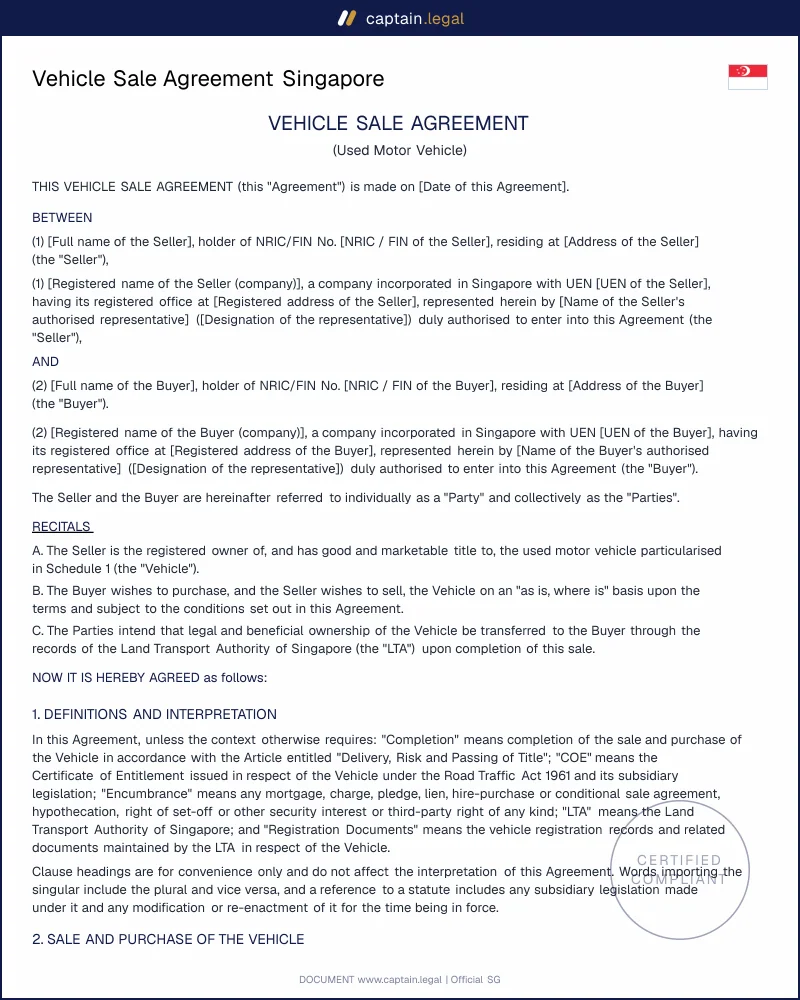
A vehicle sale agreement is a written contract recording the sale of a car, motorcycle or other registered vehicle from one party to another, with the price, the parties, the vehicle particulars and the terms of transfer set out in full. In a Singapore private sale it does the work that a dealer's invoice would do in a showroom transaction, but between two individuals who owe each other no statutory consumer duties. The document names the seller and buyer by NRIC or FIN, identifies the vehicle by registration number, engine number and chassis number, states the agreed price, and fixes the date on which ownership passes through LTA.

People often confuse this agreement with the LTA transfer itself. They are not the same thing. The OneMotoring transfer is the administrative act that changes the registered owner in LTA's records; the sale agreement is the private contract that governs the commercial deal behind it, including deposit, balance payment, the condition of the vehicle and what happens if either side pulls out. A buyer who relies only on the LTA transfer has no written terms to fall back on if the seller misrepresented the mileage or failed to disclose an accident history. A seller who skips the agreement has nothing to show that the car left in working order and was accepted as-is. The written contract is what protects both sides once the vehicle has changed hands.

2

When do you need this agreement?

The classic case is a direct owner-to-owner sale where neither party wants a dealer's commission eating into the price. Here the agreement is the only written record of the deal, so it carries real weight. It fixes the price, the deposit that holds the car while insurance and loan clearance are arranged, and the balance payable on the day the LTA transfer is submitted. Without it, a seller who has taken a deposit and a buyer who has paid it are relying on messages and memory, which is exactly what fails in the State Courts when a transaction sours.

A second common scenario is a sale where the vehicle still sits under a hire-purchase or financing charge. The finance company must release its interest before LTA will approve the transfer, and the agreement should record whether the seller clears the loan from the proceeds or the buyer settles it directly, because the timing of that release decides when ownership can pass. A third situation is the sale between family members or friends, where the parties assume goodwill removes the need for paperwork. It does not: an undocumented transfer between relatives is where disputes over agreed condition and price turn ugliest, precisely because no one wrote anything down. Get it in writing even when you trust the other side.

Two edge cases deserve a flag. Vehicles registered with a Category A or B COE cannot be transferred within the first three months of registration, so a near-new car sale must wait out that window. And where the buyer is a foreigner without Singpass, the transfer cannot be done online at all and both parties must attend the LTA counter in person, which changes the practical timeline the agreement should set.

3

Key clauses included in our template

  • The identification of the parties and the vehicle records both seller and buyer by full name and NRIC or FIN, and pins the vehicle down by registration number, make, model, engine number and chassis number. Getting the engine and chassis numbers right matters because they must match LTA records, and any tampering can render the vehicle ineligible for PARF or COE rebates on later deregistration.
  • The purchase price and payment terms set out the total price, any deposit paid to reserve the vehicle, and the balance due on the transfer date, with the accepted payment method stated to avoid the bounced cashier's order problem that plagues private sales. The clause makes clear that the deposit is forfeited or refunded on defined terms if a party withdraws.
  • The as-is, sold-as-seen condition clause states that the buyer has inspected the vehicle and accepts it in its present condition, with no warranty as to roadworthiness or future performance beyond what the law implies. This is the clause that gives effect to caveat emptor and is the seller's main protection, subject always to the seller's duty not to misrepresent.
  • The LTA transfer of ownership clause commits both parties to complete the OneMotoring transfer within the required window, allocates the transfer fee to the buyer, and records the agreed transfer date that fixes the cutoff for road tax, insurance and liability for offences.
  • The COE and rebate handover clause confirms that the remaining Certificate of Entitlement tenure passes with the vehicle and that any PARF or COE rebate follows the car, so the buyer knows exactly what tenure is being bought and the seller cannot later claim a refund.
  • The encumbrances and disclosure clause requires the seller to confirm the vehicle is free of outstanding loans, fines and road tax arrears at the transfer date, and to disclose known accident history, mirroring the honesty the Misrepresentation Act enforces.
4

Regional and practical considerations

Singapore is a single jurisdiction, so there are no state-by-state variations of the kind seen elsewhere, but the vehicle category and COE status create the practical distinctions a seller must handle. A car registered under Category A (smaller, less powerful vehicles) and one under Category B (larger or more powerful cars) both trigger the three-month no-transfer rule from registration, and a vehicle sold between four and six months of registration can attract an additional levy on the buyer where the current COE quota premium exceeds the premium first paid. The agreement should identify the category and registration date so both parties price this correctly.

The type of vehicle also shifts the process. Standard private cars transfer entirely online through OneMotoring, but private buses, private-hire buses, school buses and heavy vehicles carry extra requirements before the buyer can confirm the transfer, and a Vehicle Parking Certificate in the buyer's name may be needed. Sellers of these vehicles should build the extra lead time into the agreed transfer date. Older vehicles bring an inspection wrinkle: a car over three years old generally needs a valid inspection certificate from an LTA-authorised inspection centre before road tax can be renewed, and the agreement should say whether the seller delivers a current inspection or the buyer takes that on. For anyone selling under a company name or transferring a fleet vehicle, the transaction may sit closer to a commercial dealing, and a tailored service agreement drafted for Singapore contract law or a proper business-to-business record may be the better instrument.

5

How to fill out this vehicle sale agreement

You start by entering the seller's and buyer's details, with each party's NRIC or FIN, because these identifiers drive both the contract and the eventual LTA transfer. From there the form asks for the vehicle particulars, and you copy the registration number, make, model, engine number and chassis number directly from the vehicle log card so they match LTA's records exactly. The next stage captures the commercial terms: the agreed price, any deposit already paid, the balance and the method of payment, along with the date on which ownership will transfer through OneMotoring.

The form then guides you through the condition and handover terms, letting you confirm the as-is basis of the sale, record the remaining COE tenure passing to the buyer, and set out the seller's confirmation that the vehicle is free of loans, fines and road tax arrears. You add any specific disclosures, such as known accident history or outstanding financing to be cleared from the proceeds. Once every field is complete, you generate the document and download it in Word and PDF, ready for both parties to sign and date before initiating the transfer. If you need a matching authorisation for a third party to sign or collect on your behalf, a letter of authorisation under Singapore agency law can be prepared alongside it.

6

Common mistakes to avoid

The most frequent error is treating the OneMotoring transfer as the whole deal and skipping the written agreement altogether. When a dispute arises over the deposit, the agreed condition or an undisclosed defect, the LTA record shows only who owns the car, not what was promised, so the parties are left with nothing enforceable. A related mistake is taking payment by an instrument that can be reversed, then handing over the car before the funds have genuinely cleared. Cashier's orders can bounce and digital transfers can be retracted, so the agreement should tie handover to confirmed, irreversible payment. Sellers who ignore this discover the problem only after the buyer has driven away.

On the condition side, buyers routinely skip a proper inspection and then assume the law will rescue them. It will not: caveat emptor means a private buyer who fails to inspect carries the risk of defects that inspection would have revealed, and no Lemon Law applies to a direct-owner purchase. Sellers make the opposite error by overstating the vehicle to close the sale, forgetting that the Misrepresentation Act 1967 reaches false statements even under an as-is clause. Finally, both sides forget the timing traps: submitting the transfer late, or attempting it inside the three-month COE lock, or overlooking that a car over three years old needs a valid inspection before road tax renewal. Each of these can delay or block the transfer after money has changed hands. When the sale involves acknowledging money still owed between the parties, a separate debt acknowledgement drafted to the Limitation Act 1959 keeps that obligation clean and enforceable.

Key takeaways

LTA TRANSFER

Ownership changes only when LTA records it

Handing over keys does not, by itself, make the buyer the legal owner. The deal only completes when the Land Transport Authority updates the registered owner via OneMotoring. Your agreement should tie payment steps and handover to that transfer date, and record what happens if either party cannot or will not complete the LTA transfer. Treat the administrative transfer and the private contract as separate, but linked.

AS-IS SALE

Private sales are caveat emptor

A private sale between individuals is not a dealer transaction. Under the Sale of Goods Act 1979, the baseline is “let the buyer beware”: the buyer is expected to inspect, and obvious defects become the buyer’s risk once the sale completes. That is why a sold-as-seen / as-is clause matters, and why the agreement should spell out vehicle condition, what was inspected, and what is not warranted.

DISPUTES

As-is does not protect misstatements

Even with an as-is clause, a seller can still be exposed under the Misrepresentation Act 1967 if they make a false statement of fact that induces the sale, such as understating mileage or denying accident damage. On the buyer side, relying only on the OneMotoring transfer leaves you with no written terms if something was misdescribed. Put the key facts in writing and keep the signed copy.

Frequently Asked Questions

Yes. Once both the seller and the buyer sign and date the agreement, it is a valid contract under Singapore law, enforceable in the same way as any other written agreement between competent adults for lawful consideration. The signatures create binding obligations on price, condition and transfer, and either party can rely on the document in the State Courts if the other defaults. What the agreement cannot do is override statute: it will not, for example, exclude liability for a genuine misrepresentation, because the Misrepresentation Act 1967 limits such exclusions. Used correctly, with accurate vehicle particulars and honest disclosures, it gives both sides a contract that holds up. It does not itself transfer ownership; that still happens through the LTA OneMotoring process.

Not entirely. An as-is clause reflects caveat emptor and shifts the risk of ordinary defects to the buyer, which is why inspection before purchase is so important in a private sale. A buyer who later finds worn brakes or a tired gearbox that inspection would have revealed generally cannot come back on the seller. The clause has a firm limit, though. It cannot protect a seller who actively lied, because a false statement of fact that induced the sale remains actionable under the Misrepresentation Act 1967 whatever the contract says. So the buyer accepts the vehicle's condition but keeps the right to challenge deliberate deceit about mileage, accident history or outstanding finance.

The transfer runs through the OneMotoring portal, where the seller initiates and the buyer confirms. Once the seller submits, the buyer must log in and accept within the stated window, commonly five calendar days from initiation, or the application lapses and must be restarted. LTA expects the whole transfer to be finalised promptly around the sale date, and the buyer must already hold valid motor insurance in their own name before it can be approved. Do not hand over the car until the transfer is confirmed and payment has cleared, because the registered owner remains liable for fines and road tax until LTA updates its records. Building the transfer date into the agreement keeps both parties aligned on this cutoff.

Yes. The agreement is generated in both Word and PDF formats, so you can print it for a wet-ink signature or edit the Word file if a specific term needs adjusting before signing. The PDF is the clean version for record-keeping, and both parties should keep a signed copy along with the vehicle log card, payment receipts and the OneMotoring confirmation. Holding the full set together matters if any question later arises about the price agreed or the condition accepted, since the paper trail is what settles a dispute. Having the document ready before you meet also lets you complete signing and transfer in a single sitting.

By standard practice the buyer pays the transfer fee at the point of confirming the transfer on OneMotoring, and the template allocates it that way unless you agree otherwise. Where the vehicle is between four and six months old and registered under a Category A or B COE, an additional levy can apply to the buyer if the prevailing COE quota premium is higher than the premium first paid, and the agreement should flag this so it is priced into the deal rather than sprung on the buyer at transfer. Fixing responsibility for these amounts in writing avoids the last-minute argument that otherwise stalls the confirmation step.

The remaining Certificate of Entitlement tenure passes to the buyer with the vehicle. It is not cancelled and it is not refunded to the seller, and the expiry date stays exactly as it was. This is a central part of what the buyer is paying for, since a car with long COE remaining is worth considerably more than one nearing expiry. The agreement records the remaining tenure so both parties are clear on what is being bought, and any PARF or COE rebate similarly follows the vehicle rather than staying with the seller. A buyer valuing the car should treat the COE balance as a core component of the price, not an afterthought.

Yes, arguably more than ever. Sales between relatives and friends are where people most often skip documentation on the strength of trust, and they are also where disagreements over agreed price, condition and outstanding costs become most bitter, because nothing was written down to point back to. A signed agreement protects the relationship as much as the parties, giving a neutral record of what each side actually agreed. It also keeps the LTA transfer clean, since the same vehicle particulars and disclosure confirmations are needed whoever the buyer is. Family goodwill is not a substitute for a contract that fixes the terms in plain writing.

4.8/5

32 verified reviews · 50 000+ downloads

Vehicle Sale Agreement Singapore | Sale of Goods Act
  • Immediate access to the document
  • PDF + Word download
  • Compliant with 2026 legislation
  • Reviewed by lawyers
Fill in the template
Secure payment
Updated on July 12, 2026

You might also like

Advance Medical Directive Singapore
Last Will and Testament Singapore