Create my document
Login

Choose country

FranceBelgiqueEspañaUnited StatesUnited KingdomMarocDeutschlandItaliaSchweizSingapore
Family & Divorce

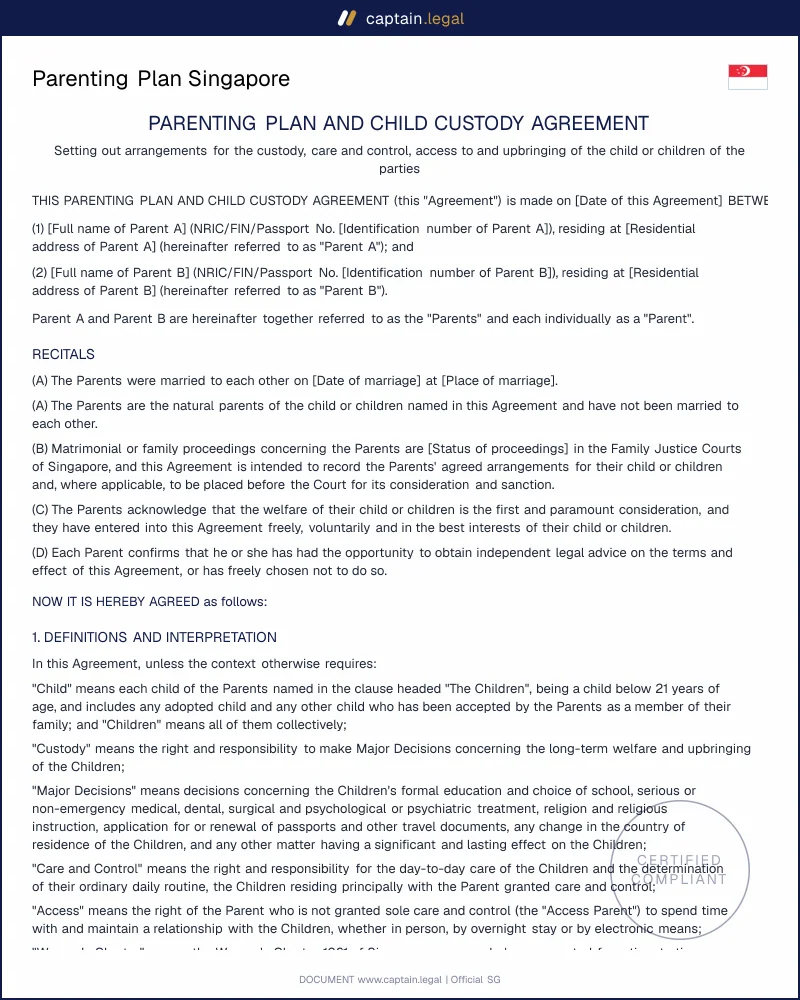
Singapore Parenting Plan: Women's Charter Ready

Custody, care and control and access drafted to ss 122-126 Women's Charter and Family Justice Courts practice. Simplified-track ready. Word and PDF.
4.8/514 reviews50 000+ downloadsInstant download
Share

A Parenting Plan is the written agreement that records how separating or divorcing parents in Singapore will share custody, care and control, and access for a child under 21. It sets out who makes major decisions, where the child lives, and how the other parent spends time with the child, so that day-to-day life keeps running while the marriage winds down. Couples filing on the simplified track use it to put their agreed arrangements in front of the Family Justice Courts in a form the court can convert into a consent order. This child custody agreement is written for Singapore practice, aligned with the Women's Charter and the way local proceedings actually unfold. You can edit it in Word and export a clean PDF for signing and filing.

Compliant

2026 Legislation

50,000+ clients

trust us

Affordable

From $4.90 / doc

Secure payment

Instant download

Singapore Parenting Plan: Women's Charter Ready

Secure payment · No subscription

Fill in the template

What is a parenting plan in Singapore?

A parenting plan is a structured statement of the arrangements two parents have agreed for their child after separation. In Singapore it is the practical companion to a divorce filing, the document where you spell out custody, care and control, and access instead of leaving them to argument later. Parents often confuse it with a maintenance agreement or a deed of separation, but the parenting plan deals only with the child: living arrangements, decision-making, the access timetable, schooling, healthcare, and travel. Maintenance and the split of matrimonial assets belong in separate instruments.

The terminology trips up almost everyone, so it is worth fixing early. Custody is the authority to make major decisions about the child, things like education, religion, healthcare, and overseas relocation. Care and control is the right to have the child live with you and manage daily life, and it is usually granted to one parent. Access is the time the non-resident parent spends with the child. Most Singapore families end up with joint custody paired with sole care and control to one parent, because that mirrors how decisions and routines really work. A well-drafted plan names each of these clearly so a Deed of Separation prepared for Singapore couples and any later court order rest on the same vocabulary.

2

When do you need this document?

The clearest trigger is an uncontested divorce on the simplified track, where both spouses have settled the ancillary matters and need a parenting plan to attach to the filing. Here the document does real work: it shows the court a coherent, agreed set of arrangements that can be turned into a consent order with minimal friction. The next most common scenario is separation before any filing, when one parent has moved out and the household needs a workable routine for handovers, school runs, and weekend access while the legal process is still months away.

Parents also reach for a parenting plan when they broadly agree but keep snagging on detail. Pick-up times, school holiday rotation, who attends parent-teacher meetings, how enrichment fees are split: these are the points that quietly poison co-parenting if left unwritten. Putting them on paper forces the awkward conversation now, while both parties are still talking. A further use is documenting a variation, when an existing arrangement no longer fits because a child has changed schools, a parent has relocated within Singapore, or work hours have shifted.

Two edge cases deserve flagging. First, relocation, whether overseas or a significant move within Singapore, often sits in the custody bucket as a major decision, so a plan should say expressly whether one parent can relocate the child without the other's consent. Second, families with children of different ages sometimes agree split care and control, each parent caring for different children, which the court treats cautiously and which needs its own affidavit. The arrangements here connect naturally to the broader family and divorce templates available for Singapore.

3

Key clauses included in our template

  • The identification of custody, care and control, and access sets out, in the court's own vocabulary, who holds decision-making authority, with whom the child lives, and the access timetable for the other parent. Vague phrasing is replaced with the Women's Charter terms so the plan reads cleanly into a consent order.
  • The major-decisions clause lists the areas requiring joint or sole agreement, typically education, healthcare, religion, and overseas travel or relocation. It states how disagreements are resolved, whether through mediation or a return to the Family Justice Courts, so deadlock has a route out.
  • The access schedule breaks down weekday and weekend contact, public holidays, and the school holiday rotation, including the long mid-year and year-end breaks. It fixes handover times and locations because most co-parenting disputes erupt at the handover point, not in court.
  • The travel and passport clause records who holds the passport, the notice required before overseas trips, and the written consent needed for travel, a frequent flashpoint where one parent fears the child will not be returned.
  • The maintenance and expenses interface notes how the plan sits alongside any child maintenance agreement, clarifying what cash maintenance covers and how school fees, medical costs, and enrichment are shared, without duplicating the financial document.
  • The communication and review clause sets ground rules for contact between the child and the non-resident parent and a trigger for revisiting the plan when circumstances change, since the Women's Charter treats children's arrangements as variable, not frozen.
4

Regional and practical considerations

Singapore is a single jurisdiction, so there is no state-by-state variation, but several local realities shape how a parenting plan should read. Housing is the most pressing. Many couples hold an HDB flat, and the care-and-control arrangement is tied up with who keeps occupation, the minimum occupation period, and whether the flat is sold or transferred. A plan that ignores the housing question tends to unravel because the child's residence depends on it. Draft the living arrangements with the HDB position in mind, and cross-refer to the matrimonial-property settlement rather than leaving a gap.

Religion matters in a multi-religious society, and the major-decisions clause should say plainly which parent decides on religious upbringing, an issue that surfaces sharply where the parents come from different faiths. For Muslim families, the Administration of Muslim Law Act and the Syariah Court govern much of the divorce, and the parenting programme requirement runs through the Syariah Court's own counselling track rather than the civil Co-Parenting Programme, so the procedural path differs even where the parenting terms look similar.

Schooling and geography carry weight on a small island where a cross-island commute changes a child's whole day. Tie access timing to school location and realistic travel, not to an idealised calendar. Finally, mind the Personal Data Protection Act 2012: a parenting plan holds a child's address, school, and medical details, so keep distribution tight and store the signed copy securely. These considerations sit alongside the wider personal and family legal documents for Singapore residents.

5

How to fill out this parenting plan

You begin by entering the parents' details and the particulars of each child, including dates of birth, since the Women's Charter threshold runs to age 21 and the plan must cover every child of the marriage. From there the form walks you through the custody structure, prompting you to choose between joint and sole custody and to assign care and control, with plain-English explanations of what each term means in Singapore practice so you are not guessing at the difference.

The access section then builds the timetable. You set weekday and weekend contact, fill in the public-holiday and school-holiday rotation, and fix handover times and locations. The form nudges you toward the detail that prevents later argument, prompting for travel consent, passport custody, and the notice period for overseas trips. You add the major-decision areas and choose how disputes are resolved, then note how the plan interacts with maintenance without restating the figures. Once complete, you export a clean Word file for negotiation and a signed PDF for filing or annexing to the divorce application, alongside the other business and contract templates drafted for Singapore if a family business is in the picture.

6

Common mistakes to avoid

The most damaging error is treating the parenting plan as binding on the court. It is not. Under section 125(2) the judge applies the welfare principle and can override anything the parents agreed, so a plan drafted only to suit the adults, rather than the child, invites variation or rejection. A close second is muddling custody with care and control; parents who casually agree to "joint custody" sometimes think it means equal living time, then discover it governs decisions, not residence, and the disappointment breeds fresh conflict. Write each term in its correct sense and the rest of the document holds together.

Many plans also leave the access schedule too loose. "Reasonable access" sounds amicable but collapses the first time the parents disagree about a specific weekend, so fix concrete times, holiday rotations, and handover points. Forgetting the Mandatory Co-Parenting Programme is a procedural trap that can delay the whole filing, since the certificate must be ready before the originating application goes in. Finally, parents often ignore the review mechanism, freezing arrangements that were built around a toddler and no longer fit a teenager. Build in a trigger to revisit the plan, and keep the signed version off group chats to respect the child's privacy.

Key takeaways

Scope

This plan covers only child arrangements

A Parenting Plan records custody, care and control, and access for a child under 21, and sets out living arrangements, decision-making, schooling, healthcare and travel. It is not a maintenance agreement and it does not deal with the division of matrimonial assets. Keep those topics in separate documents, so your divorce papers stay consistent and the court can read each instrument for its proper purpose.

Terminology

Name custody, care and control, access

In Singapore practice, custody is about major decisions (education, religion, healthcare, overseas relocation), care and control is where the child lives and who runs daily routines, and access is the non-resident parent’s time with the child. Many families land on joint custody with sole care and control to one parent. Using the right labels avoids misunderstandings when the Family Justice Courts convert agreed terms into a consent order.

Court process

Court decides by child’s welfare

Under the Women’s Charter, especially section 125(2), the child’s welfare is the first and paramount consideration. That means your private Parenting Plan does not automatically bind the court: the judge may adopt it, vary it, or reject it if it does not serve the child. Also, since 1 July 2024, parents with a child under 21 must complete the Mandatory Co-Parenting Programme before filing, or the application can be held up.

Frequently Asked Questions

A signed parenting plan is a contract between the parents and good evidence of what they intended, but it does not bind the Family Justice Courts on its own. Under section 125(2) of the Women's Charter, the welfare of the child is the paramount consideration, so the judge can adopt, vary, or reject the terms. In practice, a clear and child-focused plan in an uncontested divorce is usually converted into a consent order with little change. Its real power is showing the court a sensible agreed arrangement, which is exactly what speeds a simplified filing through.

Custody is the authority to make major decisions about the child, such as education, religion, healthcare, and overseas travel. Care and control is the right to have the child live with you and run daily life, and it is normally granted to one parent. Access is the time the other parent spends with the child. The most common Singapore outcome is joint custody with sole care and control to one parent, which keeps both involved in big decisions while giving the child a settled home. Getting these terms right in your plan is what makes it usable in court.

Yes, in almost all cases. Since 1 July 2024, every parent with a child under 21 must complete the Mandatory Co-Parenting Programme before filing for divorce, under section 94A of the Women's Charter, whether the divorce is simplified or contested. The programme runs as an e-learning module plus consultation and takes a few hours. The certificate of completion is annexed to the originating application. The court may waive it in exceptional cases such as family violence, but you should not assume an exemption. Muslim families follow the Syariah Court's counselling track instead.

Yes. The template is delivered as an editable Word file and a print-ready PDF. You draft and negotiate in Word, where you can adjust the access schedule, decision-making clauses, and travel terms to fit your family, then export a clean PDF for signing and for annexing to the divorce filing. Keeping both formats matters in practice, because you will often revise the Word version several times during negotiation before the parties settle on the final wording that goes to the Family Justice Courts.

More detailed than feels comfortable. "Reasonable access" left undefined is the single most common source of co-parenting disputes, because it collapses the first time the parents read it differently. Fix exact weekday and weekend times, set a public-holiday rotation, divide the long school holidays, and name handover times and locations. The Women's Charter does not prescribe a quantum of access, so the detail is yours to settle. A precise schedule protects the child from being caught in adult arguments and gives the court a workable arrangement to endorse as a consent order.

Yes. Children's arrangements are never truly fixed. The court retains power to vary custody, care and control, and access when circumstances change, and parents can agree variations between themselves. A plan built around a young child rarely suits the same child as a teenager, so a good template includes a review trigger and a dispute-resolution route. If parents cannot agree on a change, either can apply to the Family Justice Courts, which will again apply the welfare principle to whatever the child's situation has become at that point.

It should, and our template prompts for it. Relocation, whether abroad or a significant move within Singapore, is usually treated as a major decision sitting under custody, so the plan should state expressly whether one parent may relocate the child without the other's consent and what notice is required. Relocation disputes are among the hardest the Family Justice Courts hear, decided again on the child's welfare. Recording the agreed position upfront, including passport custody and travel consent, heads off a great deal of later conflict and gives the court a clear starting point.

Then the matter becomes contested, and the parenting plan shifts from an agreed document to each parent's proposed position. The court will decide custody, care and control, and access itself, applying the welfare principle and weighing factors like who has been the main caregiver, each parent's stability, and the child's needs. The court can order a social welfare report, interview the child, or direct counselling. Even in a contested case, drafting a clear, reasonable plan is worthwhile, because it shows the court you have thought through a workable arrangement focused on the child.

4.8/5

14 verified reviews · 50 000+ downloads

Singapore Parenting Plan: Women's Charter Ready
  • Immediate access to the document
  • PDF + Word download
  • Compliant with 2026 legislation
  • Reviewed by lawyers
Fill in the template
Secure payment · No subscription
Updated on June 17, 2026

You might also like

Child & Spousal Maintenance Agreement
Deed of Separation Singapore
Parenting Plan Singapore: Custody Agreement Template