Create my document
Login

Choose country

FranceBelgiqueEspañaUnited StatesUnited KingdomMarocDeutschlandItaliaSchweizSingapore
Family & Divorce

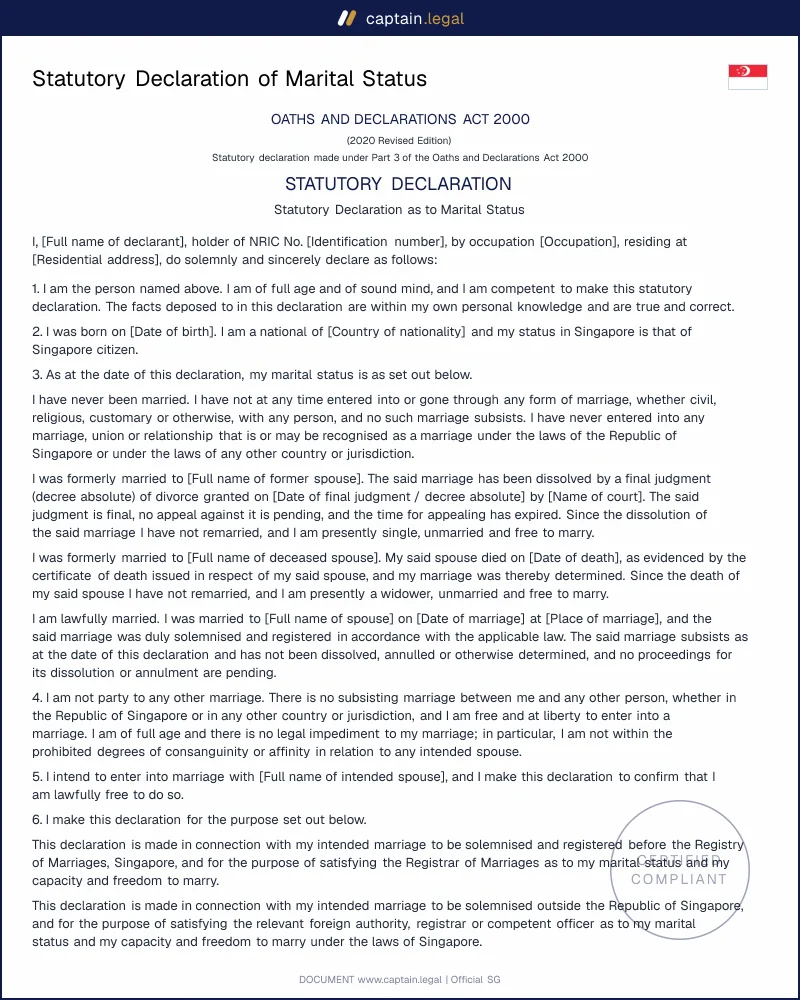
Statutory Declaration Marital Status: Oaths Act

Marital status declaration drafted to the First Schedule of the Oaths and Declarations Act, ready for a Commissioner for Oaths, ROM and immigration use.
4.8/523 reviews50 000+ downloadsInstant download
Share

A Statutory Declaration of Marital Status is a formal written statement, made on oath or affirmation before a Commissioner for Oaths, in which you declare whether you are single, married, divorced, or widowed. In Singapore it is the standard way to put your single status or marital status on record when no other official document proves the point, most often for an overseas marriage, an immigration filing, a property transaction, or a foreign authority that asks for proof you are free to marry. The declaration carries legal weight precisely because it is sworn, not merely signed, and a false statement exposes you to prosecution.

This template gives you the correct statutory wording set out in the First Schedule of the Oaths and Declarations Act, formatted so a Commissioner for Oaths can affirm it without redrafting. You complete the particulars, attend before a Commissioner, and download a clean signed copy in PDF and Word.

Compliant

2026 Legislation

50,000+ clients

trust us

Affordable

From $4.90 / doc

Secure payment

Instant download

Statutory Declaration Marital Status: Oaths Act

Secure payment · No subscription

Fill in the template

What is a statutory declaration of marital status?

A statutory declaration is a written statement of fact that the declarant solemnly affirms to be true, made under the Oaths and Declarations Act before an authorised officer. A statutory declaration of marital status narrows that instrument to one subject: your civil status. You state, in the first person, that you are a bachelor, a spinster, divorced, or widowed, and that no legal impediment prevents you from marrying. The document is used wherever a clerk, registry, or foreign consulate needs a sworn confirmation and no certificate already answers the question.

People frequently confuse this with a few neighbouring documents, and the difference matters. A Search for Marriage Record issued by the Registry of Marriages only tells you whether a marriage is registered with ROM in Singapore; it says nothing about marriages contracted abroad, and ROM does not issue a letter of no impediment. A statutory declaration fills exactly that gap, because it lets you affirm the full picture, including time spent overseas. It also differs from an affidavit: both are signed before a Commissioner for Oaths, but an affidavit is sworn under oath for use in court proceedings, while a declaration is solemnly affirmed and is the usual choice for administrative and registry purposes. When you are assembling a personal-status pack, it often sits alongside a Singapore deed poll and name-change declaration where a recent divorce has also changed the name you use.

2

When do you need this document?

The most common trigger is an overseas marriage. Many foreign registries will not solemnise a Singaporean's marriage without a sworn confirmation that the person is free to marry, variously called a Certificate of No Impediment, a Statutory Declaration of Single Status, or a certificat de coutume. Because ROM does not issue a letter of no impediment, the statutory declaration is how a Singaporean fills that requirement, frequently paired with a Search for Marriage Record to corroborate the affirmation. Watch the validity window: many countries accept these declarations only if they were affirmed within the last three to six months, so timing the declaration to the wedding date matters.

Immigration and consular filings are the next frequent scenario. The Immigration and Checkpoints Authority may ask an applicant for a long-term visit pass to confirm a family relationship or single status by statutory declaration when no certificate exists. Property and financial matters supply another set of cases: a buyer, lender, or the CPF Board may need confirmation of marital status to determine eligibility for a scheme or the correct ownership structure, a point that often arises alongside a Singapore sale and purchase agreement. A more delicate edge case is the remarrying divorcee who must declare existing maintenance obligations, and another is the applicant who has lived abroad for years and must affirm that no foreign marriage was contracted during that time, a fact no Singapore record can ever show.

3

Key clauses included in our template

  • The declarant's particulars open the document with full name as it appears on the NRIC or passport, identification number, address, and occupation, exactly as the First Schedule requires. A declaration that omits the occupation or uses a name inconsistent with the supporting identity document is routinely sent back by registries, so the template prompts each field explicitly.
  • The statement of marital status is drafted to the statutory categories, letting you affirm that you are a bachelor, a spinster, divorced, or widowed, rather than inventing free text. Where a prior marriage existed, the clause records its lawful dissolution by divorce or death, because a bare claim of single status without that history is the most common ground for rejection.
  • The no-impediment affirmation confirms that no legal bar prevents you from marrying the intended spouse, with space to name that person where a foreign registry requires it. This is the operative line for an overseas wedding and is phrased to match what consulates expect.
  • The overseas-residence declaration lets you affirm that you contracted no marriage during any period spent abroad, the gap a Singapore Search for Marriage Record cannot fill on its own.
  • The purpose statement records why the declaration is made (for instance, to enable solemnisation in a named country), which several authorities treat as a condition of acceptance.
  • The jurat and attestation block reproduces the affirmation wording and leaves the date, place, and Commissioner for Oaths signature to be completed in person, since the law forbids signing in advance.
4

Regional and practical considerations

Marital-status declarations in Singapore do not vary by region in the way property or tenancy documents do, because the Oaths and Declarations Act applies uniformly across the country. What changes is the destination authority, and that is where care is needed. A declaration intended for a civil wedding in a Commonwealth country may be accepted once affirmed before a Singapore Commissioner for Oaths, while a non-Commonwealth registry often insists on additional legalisation, meaning notarisation followed by authentication and sometimes an apostille-equivalent endorsement through the Ministry of Foreign Affairs and the destination country's embassy.

Muslim applicants form a distinct track. A declaration affirming status for a marriage in Brunei, Indonesia, or Malaysia is usually made to obtain a letter of permission from the Registry of Muslim Marriages, and the wording is adjusted accordingly. Divorcees remarrying under the Women's Charter 1961 face the extra requirement of declaring any existing maintenance order and whether payments are prompt or in arrears, a clause that should never be left out where it applies. For declarations executed outside Singapore, the officer before whom you appear is dictated by section 12 of the Act, so a Singaporean resident in a non-Commonwealth country generally affirms before a Singapore consul rather than a local notary. When the declaration accompanies a change of name after divorce, it is commonly read together with the broader personal and family legal document templates for Singapore. Always confirm the exact requirements with the receiving authority before you attend, because a clause that satisfies one registry can be insufficient for another.

5

How to fill out this statutory declaration

You start by selecting the purpose of the declaration, since an overseas-marriage version, an immigration version, and a property version each foreground slightly different wording. From there the template asks for your full name as it appears on your identity document, your NRIC or passport number, residential address, and occupation, all of which the First Schedule treats as mandatory. You then state your marital status using the statutory categories and, where relevant, record any prior marriage and its dissolution.

If the declaration is for an overseas wedding, you add the name of your intended spouse and the country of solemnisation, and you complete the overseas-residence affirmation if you have lived abroad. The system leaves the date, place, and Commissioner for Oaths block empty by design, because the law requires you to sign only in the Commissioner's presence. Once the fields are complete, you download the document in Word and PDF, print it, and attend before a Commissioner for Oaths at a law firm, the State Courts, or a relevant statutory board. The Commissioner administers the affirmation, you both sign, and the declaration is then duly affirmed. If a foreign authority is involved, your next step is usually legalisation, a process explained alongside the Singapore affidavit and statutory declaration templates.

6

Common mistakes to avoid

The error that derails the most declarations is signing before attending the Commissioner. A marital-status declaration signed at home and merely shown to a Commissioner for Oaths has not been validly affirmed, because the Oaths and Declarations Act requires the declarant to sign in the Commissioner's presence; once affirmed it also cannot be amended outside that presence, so a typo discovered later means starting again. Closely related is treating a Search for Marriage Record as interchangeable with this declaration. The ROM search only covers marriages registered in Singapore, so relying on it alone leaves an overseas marriage unaddressed, and many foreign registries reject applications that fail to declare time spent abroad.

Two further mistakes recur in practice. The first is using a name or set of particulars that does not match the supporting identity document, which causes the receiving authority to reject the declaration on sight. The second is ignoring the validity window: a declaration affirmed many months before the wedding is often refused by a foreign registry that accepts only recent documents, and a remarrying divorcee who forgets to declare existing maintenance obligations under the Women's Charter 1961 creates a gap that ROM or ROMM will flag. Confirm the precise requirements with the destination authority before you affirm, because correcting a sworn document is far slower than getting it right once.

Key takeaways

Purpose

Your sworn proof you are free to marry

This Statutory Declaration of Marital Status is used when no other Singapore document settles the question, especially for overseas marriage registrations, immigration submissions, property transactions, or foreign consulates. You state, in the first person, whether you are single, divorced, or widowed, and that there is no legal impediment to marriage. It carries weight because it is sworn/affirmed, not just signed.

Form

Use the First Schedule wording

The declaration must follow the form in the First Schedule to the Oaths and Declarations Act. This template is drafted to that statutory wording, so you mainly fill in particulars rather than reinvent the format. If the form is wrong, the receiving authority may reject it and you may have to re-attend before a Commissioner for Oaths, delaying your ROM, immigration, or overseas registry timeline.

Signing

Sign only before a Commissioner for Oaths

A marital status declaration is not effective just because you typed and signed it at home. You must complete it first, then sign in the presence of a Commissioner for Oaths, who administers the affirmation and signs too. After it is affirmed, you cannot edit it casually; corrections usually mean re-doing and re-signing before a Commissioner. A false statement exposes you to prosecution.

Frequently Asked Questions

Yes, once it is properly affirmed. A statutory declaration of marital status becomes legally effective when you sign it in the presence of a Commissioner for Oaths, who administers the affirmation and signs the jurat under the Oaths and Declarations Act. The wording in our template follows the First Schedule to the Act, which is what gives the document its formal status. Because it is a sworn statement, a false declaration is a serious matter that can lead to prosecution, so it carries real legal weight. Note that affirmation is mandatory: an unaffirmed copy, however neatly drafted, has no legal value at all.

No. The Registry of Marriages does not issue a letter of no impediment or a single-status certificate. What ROM can provide is a Search for Marriage Record, which shows only whether a marriage is registered with ROM in Singapore. That search cannot prove you are free to marry, because it does not capture marriages contracted overseas. This is exactly why a statutory declaration exists: it lets you affirm your full marital status, including any time spent abroad, in a form that foreign registries and consulates accept. Many applicants submit both documents together, the search to corroborate and the declaration to affirm, when the Singapore family and divorce templates are part of the wider marriage filing.

In Singapore, the declaration must be affirmed before a Commissioner for Oaths, usually a practising lawyer of at least 35 with 10 or more years of practice. You will find Commissioners at law firms, the State Courts, the Supreme Court, ministries, and statutory boards. If you are abroad, section 12 of the Oaths and Declarations Act applies: in a Commonwealth country you affirm before a notary public or justice of the peace, and in a non-Commonwealth country before a Singapore consul or vice-consul. Affirming before someone without authority makes the declaration void, so verify the officer's standing first.

You can download the declaration as both a Word file and a PDF. The Word version lets you adjust particulars, the intended spouse's name, or the destination country before printing, which is useful when a specific foreign registry asks for tailored wording. The PDF gives you a clean, fixed copy for printing and signing. Because the law requires you to sign only before the Commissioner for Oaths, you print the document with the date and signature block left blank and complete those in person. Keep the affirmed original secure, since registries and consulates almost always require the original rather than a scan.

It depends entirely on the receiving authority, not on Singapore law. Many foreign registries accept a declaration of single status only if it was affirmed within the last three to six months of the intended wedding date, treating older documents as stale. Some countries also require the affirmed declaration to be legalised, meaning notarised and then authenticated through the Ministry of Foreign Affairs and the destination embassy. Because of this, the safest approach is to confirm the validity window and any legalisation steps with the foreign registry before you affirm, then time the declaration so it is still current on your wedding date.

Yes. The template includes the statutory categories of divorced and widowed alongside bachelor and spinster, and it prompts you to record the lawful end of any prior marriage, whether by divorce or by the death of a spouse. Under the Women's Charter 1961, a person with a previous marriage must show that it has been legally dissolved before remarrying. A divorcee who is remarrying must also declare, by statutory declaration, whether any maintenance order exists and whether payments are current or in arrears, and the template accommodates that clause so the declaration is complete for ROM or ROMM purposes.

Both are signed before a Commissioner for Oaths, but the instruments differ in form and use. An affidavit is sworn under oath and is typically used as evidence in court proceedings, while a statutory declaration is solemnly affirmed under the Oaths and Declarations Act and is the usual choice for administrative, registry, and consular matters such as confirming marital status. For an overseas marriage, an immigration filing, or a property transaction, a statutory declaration is almost always the correct document. If a court process is involved, you should check whether the receiving body specifically requires an affidavit instead.

4.8/5

23 verified reviews · 50 000+ downloads

Statutory Declaration Marital Status: Oaths Act
  • Immediate access to the document
  • PDF + Word download
  • Compliant with 2026 legislation
  • Reviewed by lawyers
Fill in the template
Secure payment · No subscription
Updated on June 17, 2026

You might also like

Cohabitation Agreement Singapore
Postnuptial Agreement Singapore