Create my document
Login

Choose country

SingaporeSingaporeChoose country
Family & Divorce

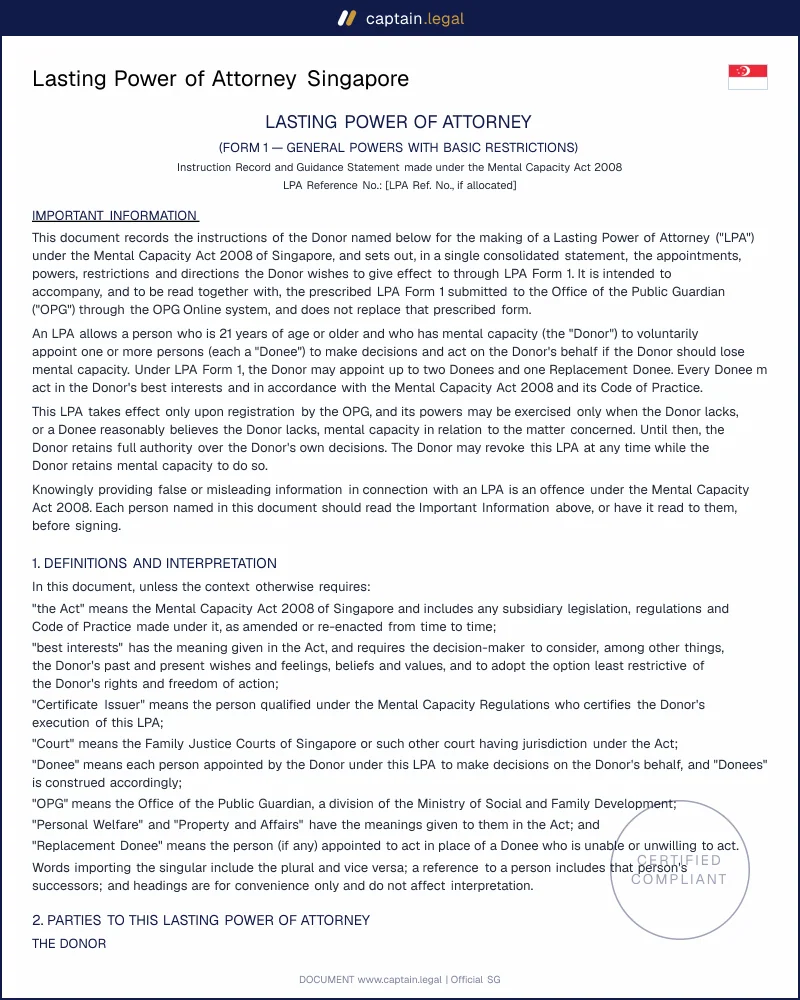
Lasting Power of Attorney Singapore (MCA 2008, Form 1)

LPA guidance under the Mental Capacity Act 2008: donee powers, certificate issuer role and OPG registration. Prepared to firm standard.
4.7/512 reviews50 000+ downloadsInstant download
Share

The Lasting Power of Attorney (LPA) is the cornerstone of incapacity planning in Singapore, and for most families it is the single most important document to have in place before illness or accident strikes. It lets you, the donor, appoint one or more trusted persons as your donee(s) to manage your affairs if you ever lose mental capacity. This guidance pack walks you through the standard LPA Form 1 under the Mental Capacity Act 2008, the role of your certificate issuer, and the decisions you need to settle before you sit down to apply. It is written for Singapore residents who want to understand the instrument properly rather than tick a box.

Without an LPA, nobody, not even a spouse, has an automatic right to step in when capacity is lost. The alternative is a court-supervised deputyship, which is slower and heavier. A well-considered LPA avoids that entirely.

Compliant

2026 Legislation

50,000+ clients

trust us

Affordable

From $4.90 / doc

Secure payment

Instant download

Lasting Power of Attorney Singapore (MCA 2008, Form 1)

Secure payment

Fill in the template

What is a Lasting Power of Attorney in Singapore?

A Lasting Power of Attorney is a legal deed under the Mental Capacity Act 2008 (Cap. 177A) that allows a person aged at least 21, the donor, to voluntarily appoint one or more donees to make decisions and act on the donor's behalf should the donor one day lose mental capacity. The instrument covers two broad areas of authority: personal welfare, meaning healthcare, living arrangements and day-to-day care, and property and affairs, meaning bank accounts, CPF-adjacent transactions, and dealings with immovable property. A donor can grant powers in one area, the other, or both, and can attach restrictions.

An LPA is fundamentally different from an ordinary power of attorney. A conventional power of attorney lapses the moment the person granting it loses capacity, which is precisely when help is most needed. The LPA does the opposite: it is dormant while you are well and only becomes operative once a registered medical practitioner certifies that you have lost capacity. It is also distinct from a Will, which deals with your estate after death, and from an Advance Medical Directive, which refuses extraordinary life-sustaining treatment in terminal illness. If you are weighing how these fit together, our overview of the Advance Medical Directive under the AMD Act 1996 explains where the LPA stops and the AMD begins. The LPA is cancelled automatically on the donor's death.

2

When do you need this document?

The clearest case is anyone with dependants or assets who wants to choose their own decision-maker rather than leave it to a court. Most people who make an LPA are planning for the ordinary risks of ageing: dementia, stroke, or a sudden neurological event that removes the ability to manage a bank account or consent to medical treatment. Doing it while you are well is the entire point, because you cannot make an LPA once capacity is already gone. At that stage the only route left is a deputyship application to the Family Justice Courts, which takes months.

Business owners and sole proprietors have a sharper need. If you alone can sign on the company account and you are hospitalised without capacity, operations can freeze overnight, wages included. Property owners are in a similar position: a donee granted property and affairs powers can sign a deed to sell or lease immovable property, which a family member otherwise cannot do. Couples going through separation should revisit any existing LPA naming a former partner, since it does not lapse automatically on a marriage breakdown; our Deed of Separation guidance under the Women's Charter flags the documents that need updating in parallel. One edge case worth naming: a donee who becomes bankrupt is disqualified from acting on property and affairs matters, so appointing a single donee with shaky finances leaves a dangerous gap that a replacement donee is designed to fill.

3

Key clauses and choices in this guidance pack

  • The appointment of donees is the first decision, and Form 1 permits up to two donees plus one replacement donee. Where two are appointed, you choose whether they act jointly, meaning every decision needs both signatures, or jointly and severally, meaning either can act alone. Jointly and severally is usually more practical, because it keeps decisions moving if one donee is travelling or unwell.
  • The scope of authority clause fixes whether donees hold personal welfare powers, property and affairs powers, or both. Splitting the two areas between different donees is permitted and sometimes sensible, for instance giving healthcare decisions to a spouse and finances to an accountant-minded adult child.
  • The restrictions and conditions section lets you cap the donee's reach, such as barring the sale of a specific property or requiring consultation with a named family member before major medical decisions. Form 1 accommodates basic restrictions; anything genuinely bespoke pushes you into Form 2, which must be drafted by a lawyer.
  • The replacement donee provision is the safety net that many people skip and later regret. It names who steps in if your first-choice donee dies, loses capacity, or becomes bankrupt, and it prevents the whole LPA from collapsing at the worst moment.
  • The certificate issuer's certification is not a clause you draft but a mandatory step built into the form. The issuer meets you, confirms your understanding, and signs as witness. Getting the right issuer for your situation, medical versus legal, is part of the preparation this pack covers.
4

Regional and practical considerations

Singapore administers the LPA nationally through a single registry, so there are no cantonal or state variations of the kind seen in federal systems. What varies in practice is the route you take and the professional you engage. For a straightforward appointment, Form 1 can be completed by the donor through the OPG Online portal using Singpass, then certified by an accredited general-practitioner doctor at a participating clinic. This is the most economical path and suits the majority of ordinary cases.

The Form 2 route is different in character. It exists for donors who need customised powers, unusual restrictions, or complex asset structures, and its clauses must be drafted by a lawyer qualified to practise Singapore law. Business owners with shareholdings, families with trusts, or donors wanting layered conditions on property dealings usually belong here. If your incapacity planning sits alongside company control, our Pte Ltd company constitution guidance under the Companies Act 1967 is worth reading in tandem, since directorship and signing authority interact with a property-and-affairs LPA.

Foreign residents and permanent residents can make an LPA that operates over assets and welfare decisions in Singapore, though recognition of a Singapore LPA abroad depends on the other jurisdiction's own law. If you hold property or accounts overseas, plan for a parallel instrument in that country rather than assume the Singapore LPA will travel. One further point of timing worth marking clearly: registration is not instant. Expect roughly 8 working days of processing followed by a mandatory 3-week waiting period before the LPA is registered and usable, so this is not a document to leave until a crisis is already unfolding.

5

How to complete your LPA

You begin by settling the substance before touching the form: who your donees are, whether they act jointly or jointly and severally, which areas of authority they hold, and whether you want a replacement donee. Getting these decisions clear first makes the rest mechanical. From there, a Singapore citizen or resident logs in to the OPG Online portal with Singpass and completes Form 1, entering personal details for yourself and each donee along with the powers and any restrictions you have chosen. Your donees then receive a notification and must accept their appointment electronically before the application can proceed.

Once the form is prepared, you attend a session with your chosen certificate issuer, a doctor, lawyer, or psychiatrist, who explains the LPA, satisfies themselves that you understand it and are not under pressure, and certifies accordingly. The donees need not be present for this. The completed and certified form is then submitted to the OPG, which processes and registers it after the waiting period. Store the registered copy safely and tell your donees where it is; a document nobody can locate helps no one. If your wider estate plan also needs a Will, our Wills Act 1838 template guidance pairs naturally with the LPA to cover both incapacity and succession.

6

Common mistakes to avoid

The most damaging error is waiting too long. People treat the LPA as a document for later, then a stroke arrives and the window closes, because you must have capacity to make one. Once that moment passes, the family is forced into a deputyship application that costs far more and takes far longer than the LPA it replaced. A close second is skipping the replacement donee: appoint one donee only, and if that person dies or goes bankrupt, the entire LPA can fail exactly when it is needed, sending everyone back to court.

Poorly thought-out appointment terms cause the next tier of problems. Choosing jointly rather than jointly and severally without meaning to can paralyse decisions, since every signature then requires both donees, an obstacle if one is overseas or ill. Vague or contradictory restrictions are another trap; a condition that is unclear invites disputes about what the donee may actually do. Finally, many people register the LPA and then hide it. A registered LPA that nobody can find, or whose existence the donees do not know about, is functionally useless. Tell your donees, record where the document sits, and keep the details current if your circumstances change.

Key takeaways

Purpose

Appoint donees before you lose capacity

An LPA under the Mental Capacity Act 2008 (Cap. 177A) lets you, as the donor (at least 21), appoint trusted donee(s) to act if you later lose mental capacity. You can cover personal welfare (healthcare, living arrangements, daily care), property and affairs (bank accounts and dealings with immovable property), or both, and you may add restrictions. It stays dormant while you have capacity.

Capacity test

Capacity is decision-specific and time-specific

Whether you have capacity is assessed under section 4 of the MCA for the particular decision at the time it needs to be made. The test looks at whether an impairment of the mind or brain stops you from understanding, retaining, weighing relevant information, or communicating a choice. This matters because an LPA is designed to operate only when capacity is lost, and the trigger turns on that assessment.

Registration

No OPG registration, no legal effect

A signed LPA form is not enough. The document has no legal effect until it is registered with the Office of the Public Guardian (OPG), which carries statutory functions under section 31 of the MCA, including supervision and investigating complaints of abuse. If you skip registration, your family may still have to pursue a court-supervised deputyship later, which is slower and more burdensome.

Frequently Asked Questions

Yes, once it is registered. An LPA made on the prescribed Form 1, certified by an accredited certificate issuer and registered with the Office of the Public Guardian, is a binding legal deed under the Mental Capacity Act 2008. The key qualifier is registration: a signed but unregistered form has no legal effect and cannot be relied on by your donee. Registration also is not immediate, so a document prepared today only becomes operative after OPG processing and the mandatory waiting period. Until you actually lose capacity, the LPA sits dormant and you retain full control of your own decisions.

Your donee must be at least 21 years old and, for property and affairs powers, must not be an undischarged bankrupt. Beyond that, you appoint whomever you trust: a spouse, an adult child, a sibling, or a close friend are the usual choices. On Form 1 you may appoint up to two donees plus one replacement donee. If you appoint two, you decide whether they act jointly, requiring both to agree on every decision, or jointly and severally, letting either act alone. Most donors prefer jointly and severally for flexibility, keeping decisions moving even when one donee is unavailable.

The certificate issuer is a mandatory safeguard built into the LPA process. Under the Mental Capacity Act 2008, the issuer must be an accredited medical practitioner, a practising Singapore lawyer, or a psychiatrist. Their job is to meet you, explain what the LPA does, confirm that you understand the authority you are granting, and satisfy themselves that no fraud or undue pressure is at work. They then sign the form as your witness. Your donees do not need to attend this session, though some issuers prefer them present, so it is worth checking in advance.

Yes. This guidance pack and the accompanying preparation materials are provided in both Word and PDF, so you can work through your donee choices, scope of authority, and any restrictions before you sit down at the OPG portal. Word lets you tailor the working notes to your situation; PDF gives you a clean copy to keep alongside your registered LPA. Remember that the binding LPA itself is the prescribed Form 1 submitted and registered through the Office of the Public Guardian, so these documents prepare and support your application rather than replace the statutory form.

Registration takes time, so plan ahead. After you and your certificate issuer complete and submit the form, the OPG typically needs about 8 working days to process an electronic application, followed by a mandatory 3-week waiting period before the LPA is registered. Hardcopy submissions take roughly three weeks to process before that same waiting period. Only after registration is the LPA valid. And even then it stays dormant: your donee can act only once a registered medical practitioner certifies that you have actually lost mental capacity.

Your family cannot simply step in. Nobody, including a spouse or an adult child, has an automatic right to manage your finances or make welfare decisions for you. Banks may freeze accounts, and medical or care arrangements become far harder to organise. The only remaining route is an application to the Family Justice Courts for a deputyship order, which is more expensive, slower, and subject to ongoing court supervision. This is the precise situation the LPA is designed to prevent, which is why making one while you still have capacity is the sensible course.

Yes, as long as you still have mental capacity. You may revoke your LPA or make a new one at any time while you are able to understand what you are doing, for instance after a separation, a falling-out, or the death of a donee. A revocation must be properly executed and notified to the OPG to take effect. This is one reason to review your LPA periodically rather than file it and forget it: the donee who made sense five years ago may not be the right choice today, and an outdated appointment can cause as much trouble as no appointment at all.

4.7/5

12 verified reviews · 50 000+ downloads

Lasting Power of Attorney Singapore (MCA 2008, Form 1)
  • Immediate access to the document
  • PDF + Word download
  • Compliant with 2026 legislation
  • Reviewed by lawyers
Fill in the template
Secure payment
Updated on July 8, 2026

You might also like

Deed of Gift Singapore Template
Deed of Variation of Maintenance