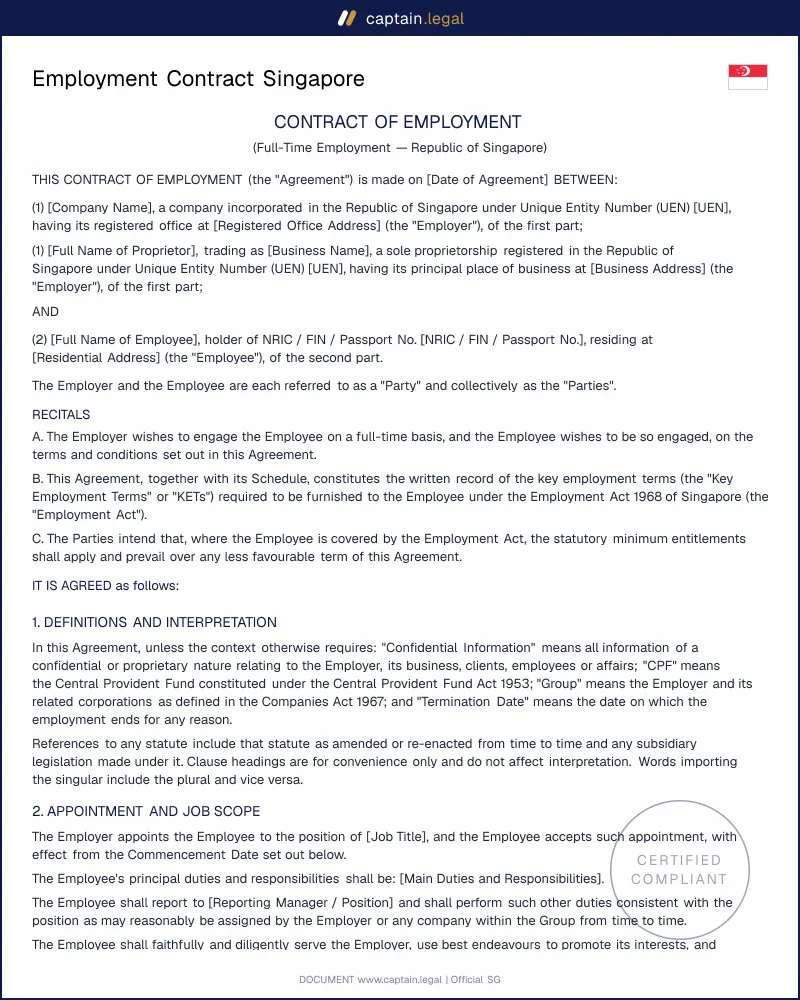
The governing statute is the Employment Act 1968, administered by the Ministry of Manpower (MOM). Since 1 April 2019 it covers all employees under a contract of service regardless of salary, including managers and executives, with only three groups outside its scope: domestic workers, seafarers and statutory board employees or civil servants. A second tier, Part IV of the Act, adds protections on working hours, overtime, rest days and shift work, but applies only to workmen earning up to S$4,500 a month and to non-workmen earning up to S$2,600 a month. Managers and executives never fall under Part IV regardless of pay. The Act sets a floor, not a ceiling: any clause that drops below the statutory minimum is void and replaced by the statutory standard, while better terms remain perfectly valid.
Three obligations sit at the heart of every full-time contract. First, under section 18A the employer must give a written record of the Key Employment Terms within 14 days of the start of employment, covering job title and duties, start date, salary period and basic pay, allowances, deductions, leave, medical benefits, probation and notice. Second, section 21 requires salary to be paid within 7 days after the end of each salary period, with itemised payslips. Third, the Central Provident Fund Act 1953 obliges the employer to pay CPF for Singapore citizens and permanent residents; from 1 January 2026 the Ordinary Wage ceiling is S$8,000 a month. Looking ahead, the Workplace Fairness Act 2025 will codify anti-discrimination protection once it commences, currently projected for 2027, and new Tripartite Guidelines on restraint of trade clauses are expected to follow. MOM publishes the authoritative checklist on what a written contract must contain in its Ministry of Manpower guidance on Key Employment Terms.