Create my document
Login

Choose country

FranceBelgiqueEspañaUnited StatesUnited KingdomMarocDeutschlandItaliaSchweizSingapore
Family & Divorce

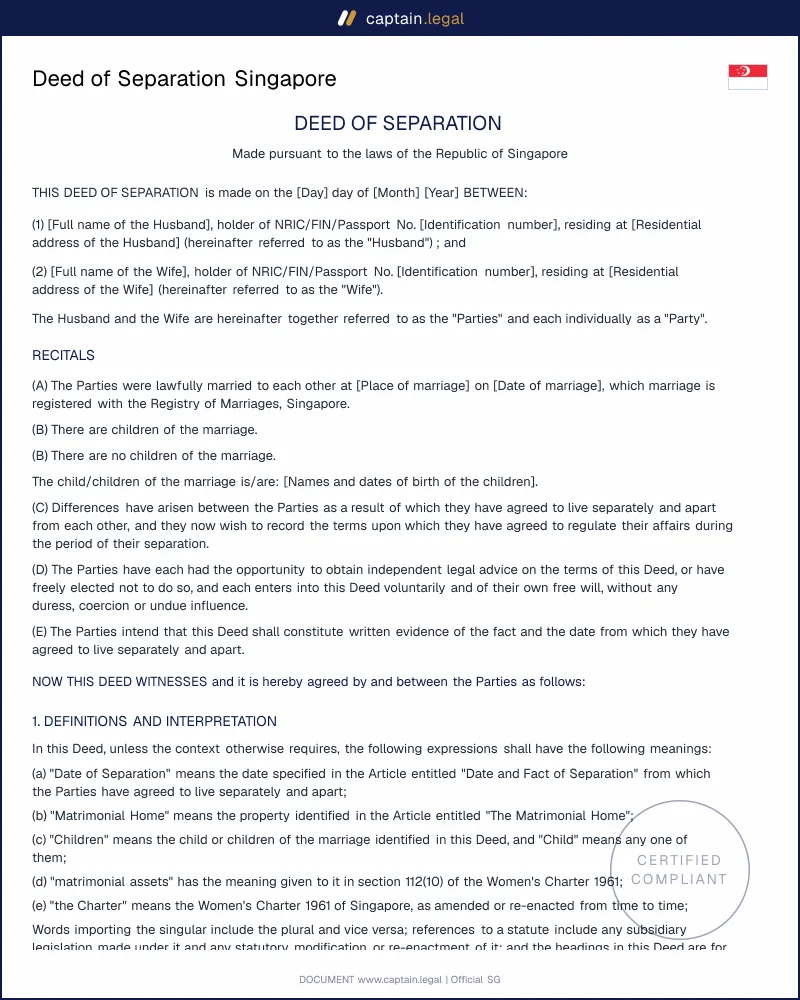
Deed of Separation Singapore | Women's Charter 1961

Binding Deed of Separation under the Women's Charter 1961. Valid evidence of your separation date for divorce under s 95. Maintenance, assets, children.
4.8/520 reviews50 000+ downloadsInstant download
Share

A Deed of Separation is a private written agreement between a married couple in Singapore who decide to live apart while remaining legally married. It records the separation date, living arrangements, maintenance, division of matrimonial assets, and arrangements for any children, all in one signed instrument. Couples use it to bring order to a difficult period, to keep things out of court for as long as possible, and later to support an uncontested divorce. Because it carries a clear separation date, a properly drafted deed is frequently relied on as documentary evidence of separation under the Women's Charter. It is not registered anywhere and stays confidential between the parties.

Most couples reach for this document at the exact moment things start to feel uncertain. One spouse has moved out, or both still share the flat but live separate lives, and nobody wants the cost or the public exposure of immediate court proceedings. A deed gives that situation a written backbone.

Compliant

2026 Legislation

50,000+ clients

trust us

Affordable

From $4.90 / doc

Secure payment

Instant download

Deed of Separation Singapore | Women's Charter 1961

Secure payment · No subscription

Fill in the template

What is a Deed of Separation in Singapore?

A Deed of Separation is a legally binding contract by which a husband and wife agree to live apart, either in different homes or under one roof without maintaining the marital relationship. The marriage itself continues. You are not free to remarry, and your status on official records stays "married" until a court grants a divorce. What changes is the practical arrangement between you: who lives where, who pays what, and how the children are cared for during the period of separation.

People often confuse three different routes, and the confusion costs them. A deed of separation is a private agreement that needs no court approval to come into existence; it simply requires the free consent of both spouses. Judicial separation under section 101 of the Women's Charter 1961 is different, because it is a court application that produces a formal judgment and, like divorce, generally cannot be filed until three years into the marriage. Divorce ends the marriage altogether. A deed sits comfortably before any of these, which is why so many separating couples in Singapore sign one first and decide on the next step later.

The deed also differs from an informal "we're taking a break" understanding. An oral or vague arrangement gives you nothing to point to if a dispute erupts over money or the children. A signed deed, dated and witnessed, fixes the terms and the separation date in writing, and that single fact does a lot of work down the line. If you want to compare it against the formal court track, our Singapore judicial separation and divorce documents explain how each option fits together.

2

When do you need this document?

The most common trigger is a couple who have decided to live apart but are not ready, financially or emotionally, to file for divorce. A deed lets them lock in maintenance, mortgage responsibility, and a parenting routine immediately, instead of leaving everything to drift while resentment builds. The second frequent scenario is the couple heading toward an uncontested divorce who want a clean record of their separation date and agreed terms before lodging papers, because a tidy deed makes later consent orders far smoother to negotiate.

Religious conviction is a real and underrated reason. Some spouses object to divorce on faith grounds yet cannot continue living as a married couple, and a deed gives them a dignified, legally recognised middle path without dissolving the marriage. Others sign one for the breathing space: a defined cooling-off period with clear rules often prevents the small daily frictions, school pick-ups, bill payments, a shared car, from escalating into litigation.

Two edge cases are worth flagging. Where one spouse holds significantly more financial information or legal advantage than the other, an unfair deed can later be challenged and unwound, so genuine disclosure matters from the outset. And where a child has special needs or attends an expensive programme, a generic arrangement almost always fails; the deed has to anticipate orthodontics, therapy, and overseas school trips before they become flashpoints. If property is involved, pairing the deed with our Singapore sale and purchase property documents keeps the asset side coherent.

3

Key clauses included in our template

  • The separation date and declaration to live apart is the single most important clause, because it fixes the moment from which the statutory separation periods run. The deed states plainly that both parties agree to live separately and apart from a specified date, whether in different residences or under the same roof without a marital relationship.
  • The maintenance provisions set out any agreed cash maintenance for a spouse and for each child, the payment date, the method, and the events that trigger a review such as job loss, illness, or a child entering tertiary education. Vague wording here is where most deeds fail, so the template forces concrete figures and timelines.
  • The division of matrimonial assets records the agreed treatment of the home, CPF monies, vehicles, savings, and liabilities, with an annexed schedule so the body of the deed stays readable. It can preserve positions for a later divorce rather than purporting to be a final settlement.
  • The child arrangements distinguish custody (decision-making), care and control (daily living), and access (time with the other parent), because conflating these three terms causes more disputes than almost anything else. The clause covers handover logistics, holiday rotation, and travel consent.
  • The dispute resolution and variation mechanism states how disagreements are managed and how the deed may be amended by mutual consent, which keeps minor friction out of court.
  • The non-molestation and confidentiality terms protect both parties' privacy and conduct during the separation, reflecting the sensitivity of the personal data the deed contains.
4

Regional and practical considerations

Singapore applies one national family law framework, so unlike federal jurisdictions there is no canton or state variation to map. The decisive split instead runs along the line between civil and Muslim marriages. Couples married under Muslim law fall under the Administration of Muslim Law Act and the Syariah Court rather than the Women's Charter, and a deed drafted for the civil regime is the wrong instrument for them. If either spouse was married under Muslim law, the civil deed will not serve, and Syariah Court processes apply instead.

For everyone within the civil system, the practical considerations are about housing type and finances rather than geography. HDB flat owners face occupation and ownership rules that interact with any agreed living arrangement, and a deed that ignores HDB eligibility can create a clause the parties simply cannot perform. Where CPF monies have been used toward the matrimonial home, the deed should acknowledge the CPF refund position rather than pretend the property can be split cleanly in cash. Expatriate couples should also confirm that at least one spouse meets the residence or domicile thresholds before assuming a Singapore court will later take jurisdiction over their divorce. Each of these points is fact-sensitive, which is exactly why the template prompts for them rather than leaving blanks. For the witnessing and execution formalities that give a deed its weight, our Singapore statutory declaration and personal documents follow Singapore signing practice.

5

How to fill out this Deed of Separation

You begin by entering the full legal names and identification details of both spouses exactly as they appear on official records, since a deed naming someone informally invites argument later. From there the template asks for the agreed separation date, the heart of the document, and prompts you to confirm whether the parties will live in separate homes or apart under one roof. You then move through the financial sections, recording maintenance amounts, payment dates, and the treatment of the home and other assets, with space to attach a schedule so the main text stays clean.

If you have children, the form walks you through custody, care and control, and access in plain terms, then captures handover arrangements and holiday rotation. It closes with the variation, dispute resolution, and confidentiality clauses, after which you generate a clean copy for signing. A deed should be signed by each party in the presence of a witness, and many couples take independent legal advice before signing precisely so the agreement cannot later be attacked as one-sided.

6

Common mistakes to avoid

The first and most damaging mistake is leaving the separation date implied rather than stated. Couples write that they "have been living apart" without committing to a date, then cannot prove when the clock started when they reach the three-year or four-year ground. Closely related is treating maintenance as a permanent fixed sum with no review mechanism; incomes change, children grow, and a rigid figure becomes either unenforceable or unfair within a year or two. The template builds in review triggers for exactly that reason.

A third recurring error is sloppy use of the words custody, care and control, and access, which carry distinct meanings under Singapore practice. Parents who blur them sign up to an arrangement they did not intend and discover the gap at the worst possible moment, usually at a handover. Many couples also forget that an unfair or coerced deed can be set aside, so they skip genuine financial disclosure and independent advice, weakening the very document they hoped would protect them. Finally, sensitive details about children and finances get circulated carelessly in group chats; given the Personal Data Protection Act 2012, distribution should stay tight and the signed original stored securely. Browse the full Singapore legal document library for related instruments that work alongside a deed.

Key takeaways

EVIDENCE

A dated deed fixes your separation date

A Deed of Separation is often used later as documentary proof of when separation started. That date matters under the Women’s Charter 1961, because s 95(3) treats separation (three years with consent, four years without) as a fact supporting irretrievable breakdown. If years pass and memories blur, a signed, dated and witnessed deed is usually far easier to rely on than text messages or an oral understanding.

STATUS

You remain married, even if apart

Signing a deed does not end the marriage. You are still legally married and not free to remarry until the Family Court grants a divorce. What the deed does is set out practical terms while you live apart, whether in different homes or under one roof: living arrangements, maintenance, division of matrimonial assets, and how the children are cared for during the separation period.

COURT POWER

Unfair terms can be set aside

A deed is a private contract, not a court order, so it stands or falls on contract principles. If it was signed under misrepresentation, undue influence or duress, it may be set aside. Even where both spouses agreed, the Family Court can disregard or vary provisions it sees as unfair, and no clause can override the child’s welfare, which remains the first and paramount consideration.

Frequently Asked Questions

Yes. Once both spouses voluntarily sign it with the necessary formalities, a deed of separation is a binding contract under Singapore law and the courts will interpret and enforce it using ordinary contract principles. That said, enforceability is not absolute. A deed obtained through misrepresentation, undue influence, or duress can be set aside, and the Family Court can disregard terms it finds unfair to a spouse or harmful to a child's welfare. The safest path is full financial disclosure by both sides and, ideally, independent legal advice before signing, so neither party can later argue they did not understand or were pressured into the agreement.

No. A deed of separation is a private document, and Singapore law does not require it to be registered or filed with the court or any other authority. It comes into effect simply through the consent and signatures of both spouses. This privacy is part of its appeal, because the couple can keep its existence confidential from family, employers, or anyone else for as long as they wish. The trade-off is that an unfiled deed has no court order behind it, so if a serious dispute arises you may still need to bring the matter to the Family Justice Courts for enforcement or variation.

Yes, and this is one of its strongest functions. A dated deed provides clean documentary proof of when the parties began living apart, which supports the separation facts under section 95(3) of the Women's Charter: three years of separation with consent, or four years without. After 1 July 2024, couples can also rely on Divorce by Mutual Agreement under section 95A without proving any separation period, though they must still have been married at least three years. Even then, the financial and child terms already recorded in the deed give the court the arrangements it expects to review, making the eventual divorce faster and less contentious.

A deed is a private contract you create yourselves, needing no court involvement and no minimum marriage duration before signing. Judicial separation under section 101 of the Women's Charter is a court application that ends in a formal judgment, and like divorce it generally cannot be filed until the marriage is at least three years old. Judicial separation lets the court make orders on ancillary matters such as children and finances, whereas a deed relies on the parties' own agreement. Many couples prefer the deed precisely because it is flexible, confidential, and avoids proving any statutory grounds.

You can download your completed Deed of Separation in both Word and PDF. The Word file lets you make responsible adjustments to names, dates, or specific terms before signing, which is useful when your circumstances do not fit a standard template exactly. The PDF gives you a clean, fixed final version suitable for printing, signing in the presence of a witness, and safe storage. Most couples keep the signed PDF as their reference copy and retain the Word version in case the deed needs to be varied later by mutual consent.

Yes. Living apart does not require separate addresses under Singapore practice. Spouses can be treated as separated while sharing the same flat, provided they no longer maintain a marital relationship, do not share a bedroom as a couple, and run separate domestic and financial lives. The deed should state this arrangement clearly, because a court later assessing the separation period will look at the substance of how you lived, not just the address on record. Be specific about sleeping arrangements, meals, finances, and household duties, since a vague "same roof" clause is easy to challenge.

Yes. Because it rests on mutual consent, a deed can be varied or revoked at any time if both spouses agree, which is why a well-drafted deed includes a clear variation clause. Circumstances change, a parent loses a job, a child's needs shift, and a rigid deed quickly stops reflecting reality. Either party can also ask the Family Court to set the deed aside if they believe it is unfair, was signed under pressure, or was based on misrepresented facts. The one exception is a deed that was sanctioned by the court, which carries the weight of an order and cannot simply be torn up.

4.8/5

20 verified reviews · 50 000+ downloads

Deed of Separation Singapore | Women's Charter 1961
  • Immediate access to the document
  • PDF + Word download
  • Compliant with 2026 legislation
  • Reviewed by lawyers
Fill in the template
Secure payment · No subscription
Updated on June 17, 2026

You might also like

Postnuptial Agreement Singapore
Divorce Settlement Agreement Singapore