Create my document
Login

Choose country

FranceBelgiqueEspañaUnited StatesUnited KingdomMarocDeutschlandItaliaSchweizSingapore
Family & Divorce

Postnuptial Agreement Singapore | Women's Charter s.112

Singapore prenuptial agreement drafted around the Women's Charter, section 112 and TQ v TR principles. Includes full financial disclosure. Word & PDF.
4.7/519 reviews50 000+ downloadsInstant download
Share

A prenuptial agreement is a written contract a couple signs before marriage to set out how their assets, property, debts and financial support will be handled if the marriage later ends. In Singapore it is best understood as a planning tool rather than a guarantee, because the courts retain the final say over how matrimonial assets are divided. Used well, it records each party's intentions, protects pre-marriage wealth and family businesses, and reduces the guesswork that fuels expensive disputes during a divorce. This template is drafted with Singapore's Women's Charter and the principles laid down in TQ v TR in mind, and it includes a full financial disclosure schedule so both parties enter the marriage with their finances on the table.

Couples increasingly sign prenups not because they expect to divorce, but because they want certainty about premarital property, inheritance and business interests before they merge their lives. The document below is structured to give that clarity while staying realistic about what a Singapore court will and will not respect.

Compliant

2026 Legislation

50,000+ clients

trust us

Affordable

From $4.90 / doc

Secure payment

Instant download

Postnuptial Agreement Singapore | Women's Charter s.112

Secure payment · No subscription

Fill in the template

What is a prenuptial agreement in Singapore?

A prenuptial agreement is a contract entered into by two people who intend to marry, recording how they will treat their assets, liabilities and financial obligations should the marriage break down. It typically covers the division of matrimonial assets, the treatment of premarital property and inheritance, debts, and sometimes spousal maintenance. Couples often confuse it with a postnuptial agreement, which is the same kind of contract signed after the marriage has taken place. The distinction matters in practice : Singapore courts generally give more weight to a postnuptial agreement, because it is signed without the pressure of an approaching wedding date and reflects the parties' settled financial reality.

It is equally important to separate what a prenup can do from what it cannot. A prenup is not a private divorce decree. It does not bind the court, and it cannot strip a spouse of rights the Women's Charter gives them. What it does is set a clear reference point for the couple's intentions, which carries real persuasive force when the agreement is fair, properly executed and backed by honest disclosure. For couples with a family business, shares in a private company, or assets held before the marriage, that reference point is often the whole reason for signing. Recording those interests early, in the same disciplined way you would when preparing a Singapore shareholders' agreement for a private company, keeps the financial picture coherent across both marriage and business.

2

When do you need this document?

The most common trigger is a clear imbalance in premarital wealth. One partner owns a flat, a portfolio, or a stake in a family company built up before the relationship, and wants that property treated as separate rather than swept into the matrimonial pool on divorce. A prenup lets the couple record that intention while they are still on good terms, which is exactly when these conversations go best. A second frequent scenario involves family businesses and heirlooms, where parents or co-founders want assurance that a divorce will not fragment ownership or force a sale. Founders heading into marriage often pair a prenup with the protections in their Singapore founders' agreement for a startup, so that personal and corporate arrangements pull in the same direction.

Second marriages are another classic case. A spouse with children from an earlier relationship may want to ring-fence assets intended as an inheritance, keeping them outside the reach of a future division. Cross-border couples form a further group : where one party is a foreign national, choosing a governing law and documenting it carefully can be decisive, given how TQ v TR treated foreign-law prenups. One edge case worth flagging is the couple who marry quickly, sign in haste days before the wedding, then wonder why the agreement carries little weight. A prenup signed under time pressure, without independent advice, is the weakest kind, because it invites arguments of duress and undue influence. Equally, a couple expecting children should understand that no prenup clause can lock down custody, care and control, or child maintenance in advance.

3

Key clauses included in our template

  • The identification of the parties and recitals open the agreement, naming both intended spouses, stating the contemplated marriage and date, and recording the shared purpose of the document. Clear recitals matter because they evidence that both parties understood what they were signing and why, which directly counters later claims of confusion or misunderstanding.
  • The full financial disclosure schedule is the backbone of the template. Each party lists assets, liabilities, income, business interests and significant gifts or inheritances, signed and dated. Honest and frank disclosure is treated as essential : a prenup built on hidden or understated assets risks being set aside for misrepresentation, so the schedule is drafted to capture the real position of both sides.
  • The separate property clause defines which assets each party keeps as their own, typically covering premarital property, inheritances and specified business holdings, and explains how growth or income on those assets is treated during the marriage.
  • The division of matrimonial assets clause sets out the couple's agreed approach to property acquired during the marriage, framed as their stated intention under section 112 of the Women's Charter rather than as a binding formula the court must follow.
  • The maintenance provisions address spousal support in measured terms, acknowledging that any clause cannot oust the court's power and that terms purporting to bar a wife's maintenance claim are liable to be disregarded.
  • The independent legal advice and execution clause records that each party had the opportunity to obtain separate legal advice and signed voluntarily, often before a Commissioner for Oaths or Notary Public, which strengthens the agreement against vitiating factors.
4

Regional and practical considerations

Singapore is a single jurisdiction, so there are no canton or state variations to track, but several local practice points shape whether a prenup will hold up. The first concerns execution formalities. While the law does not mandate notarisation, Singapore practitioners commonly have prenups signed before a Commissioner for Oaths or Notary Public, because the formality reinforces that each party understood and freely accepted the terms. Where one party is overseas, attestation arrangements should be planned in advance rather than improvised on signing day.

The second point is independent legal advice, which carries unusual weight here. An agreement where both parties were separately advised is far harder to attack on grounds of duress, undue influence or unconscionability, and an acknowledgment-of-advice clause signals to a future court that each side genuinely understood the implications. Using a single lawyer for both parties is a recurring weakness that can give the court reason to doubt that one party's rights were protected.

The third concerns cross-border and governing-law issues, which are common in Singapore given its international population. Couples should state the governing law expressly and consider how a foreign-law prenup interacts with the Women's Charter, since foreign nationality and a foreign choice of law were significant factors in TQ v TR. Finally, mind data privacy : a financial disclosure schedule contains sensitive information, and the Personal Data Protection Act 2012 shapes how such data should be handled, stored and shared. Couples who also wish to plan their estates often align a prenup with their broader arrangements, including a Singapore will template for personal estate planning.

5

How to complete this prenuptial agreement

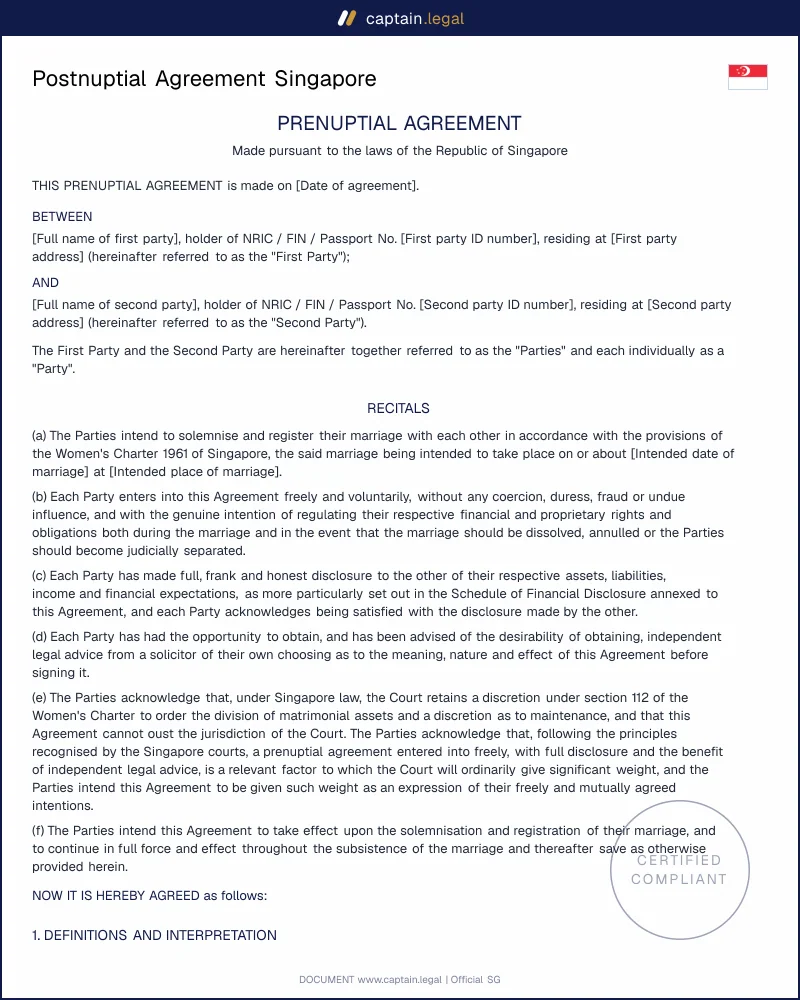
You begin by entering the full particulars of both intended spouses and the contemplated marriage, including the planned date, which the template uses to frame the recitals. From there you work through the financial disclosure schedule, where each party records assets, liabilities, income and business interests as candidly as possible, since the strength of the whole agreement rests on honest disclosure. The form then guides you through the separate property and matrimonial asset clauses, prompting you to specify which holdings stay separate and how each party wishes property acquired during the marriage to be treated under section 112.

Next you address maintenance and any governing-law preference, which matters especially for cross-border couples. The template builds in the independent legal advice acknowledgment and an execution block suited to signing before a Commissioner for Oaths. Once the fields are complete you download the finished agreement in Word and PDF, so you can refine wording with your respective lawyers before signing. If your circumstances involve a tenancy or property you intend to keep separate, it can help to keep related paperwork consistent, much as you would when preparing a Singapore tenancy agreement that is IRAS-ready.

6

Common mistakes to avoid

The most damaging mistake is signing too close to the wedding. A prenup produced days before the ceremony, when one party feels they cannot back out, is wide open to a duress or undue influence challenge, and Singapore courts give little weight to agreements reached under that kind of pressure. The fix is simple but often ignored : start the conversation months ahead, give both parties room to obtain separate advice, and document the timeline. The second frequent failure is incomplete or dishonest disclosure. Understating assets or omitting a business interest can void the agreement for misrepresentation, which defeats the entire purpose of signing one.

A third error is overreaching on children. Clauses that try to fix custody, care and control, or child maintenance in advance run straight into the welfare principle, and the court will set them aside without hesitation. Many couples also wrongly assume a prenup is mechanically binding, then feel cheated when a court reopens the division under section 112. Treating the document as persuasive evidence rather than a guarantee leads to far better drafting. A final mistake is sharing one lawyer between both parties to save time. A prenup where both sides received genuinely independent legal advice is dramatically more resilient than one negotiated through a single adviser. Couples reviewing the wider family documents available in the Singapore family and divorce category often spot related arrangements worth preparing alongside the prenup.

Key takeaways

Court discretion

A prenup guides, it does not bind

In Singapore, a prenuptial agreement is a planning tool, not a private divorce order. Under section 112 of the Women’s Charter, the court divides matrimonial assets in the proportions it thinks just and equitable, and your prenup is only one factor in that assessment. It carries more weight when it is fair, realistic, and aligns with the policy of the Women’s Charter.

Timing

Postnups often carry more weight

Do not confuse a prenup with a postnuptial agreement. A postnup is signed after marriage, and Singapore courts generally give it more weight because it is not signed under the pressure of an imminent wedding and better reflects the parties’ settled financial position. If your aim is certainty around inherited assets or a family business, the signing date can affect credibility.

Validity

Full disclosure and clean consent matter

Because a prenup is contractual in nature, it still has to pass basic contract law scrutiny. It should be supported by consideration and must not involve misrepresentation, fraud, duress, unconscionability or undue influence. This template’s full financial disclosure schedule is not just paperwork; it helps show both parties knew the asset picture when signing, reducing the risk the court gives the agreement little weight.

Frequently Asked Questions

Not automatically. A prenuptial agreement in Singapore is not a self-executing contract that the court must follow. Under section 112 of the Women's Charter, the court has the ultimate power to divide matrimonial assets in proportions it considers just and equitable, and TQ v TR [2009] confirmed that a prenup is one factor in that exercise rather than a binding decree. That said, an agreement which is fair, supported by full disclosure, signed voluntarily with independent legal advice, and consistent with the Women's Charter can be given significant weight, and in some cases full effect. Think of it as strong, persuasive evidence of intention rather than an absolute guarantee.

Several factors carry weight. The agreement must satisfy ordinary contract law, meaning it is supported by consideration and free from misrepresentation, fraud, duress, unconscionability or undue influence. Beyond that, Singapore courts look closely at full and frank financial disclosure, independent legal advice for each party, and whether the terms are fair and reasonable at the time of signing. Agreements that align with the policy of the Women's Charter fare best, while those that try to bar spousal maintenance or override children's welfare are liable to be disregarded. Signing well before the wedding, rather than at the last minute, also reduces the risk of a duress challenge.

No, and this is one of the firmest limits in Singapore family law. The welfare of the child is the court's paramount consideration, and TQ v TR established that agreements touching the maintenance of a wife or children are always open to scrutiny. There is in fact a presumption that terms relating to children's welfare are unenforceable unless the party relying on them proves they serve the child's best interests. Custody, care and control, and child maintenance are decided by the court on the facts at the time of divorce, not locked in years earlier by contract. Including such clauses does no harm as statements of intention, but they cannot bind the court.

Because disclosure sits at the heart of an enforceable prenup. If one party later shows the other hid or understated assets, the agreement can be challenged as having been obtained by misrepresentation, which may render it void. The schedule requires each party to list assets, liabilities, income and business interests, signed and dated, so there is a clear record that both entered the agreement with full knowledge of the other's finances. This protects the agreement and protects both people : nobody can credibly claim afterwards that they were kept in the dark about what they were agreeing to.

It is strongly advisable. While the law does not strictly require separate representation, an agreement where both parties received genuinely independent legal advice is far harder to attack on grounds of duress, undue influence or unconscionability. Using a single lawyer for both sides is a recognised weakness : if a court suspects one party's rights were not properly understood or protected, that alone can be a reason not to enforce the agreement. An acknowledgment-of-advice clause, recording that each party had the opportunity to take separate counsel, adds a further layer of protection and signals that consent was informed.

You download the completed prenuptial agreement in both Word and PDF. The Word version lets you and your respective lawyers refine specific wording, adjust the disclosure schedule, or tailor the separate property clauses to your circumstances before signing. The PDF gives you a clean, fixed final copy suitable for execution and safekeeping. Keeping a securely stored signed original matters, both for evidential value and because the disclosure schedule contains sensitive personal data protected under the Personal Data Protection Act 2012.

As early as you reasonably can. There is no fixed statutory deadline, but timing is one of the most important practical factors in Singapore. A prenup signed comfortably ahead of the ceremony, with time for both parties to obtain independent advice and reflect, is far more resilient than one signed in the final days when one party may feel unable to refuse. Late signing invites arguments of duress and undue influence, which can sink the agreement's weight entirely. A sensible approach is to begin discussions several months before the wedding and aim to have the signed agreement well in hand long before the date.

Yes. Couples can vary or replace a prenuptial agreement by entering into a postnuptial agreement, provided both consent and the new terms are fair and valid. In Singapore this can actually strengthen your position, because courts generally give more weight to a postnuptial agreement : it is signed free of the pressure of an upcoming wedding and reflects the couple's settled financial circumstances. Any variation should follow the same disciplines as the original, with full disclosure, independent advice and careful execution, so that the updated document stands on equally firm ground.

4.7/5

19 verified reviews · 50 000+ downloads

Postnuptial Agreement Singapore | Women's Charter s.112
  • Immediate access to the document
  • PDF + Word download
  • Compliant with 2026 legislation
  • Reviewed by lawyers
Fill in the template
Secure payment · No subscription
Updated on June 17, 2026

You might also like

Child & Spousal Maintenance Agreement
Deed of Separation Singapore