Create my document
Login

Choose country

SingaporeSingaporeChoose country
Real Estate

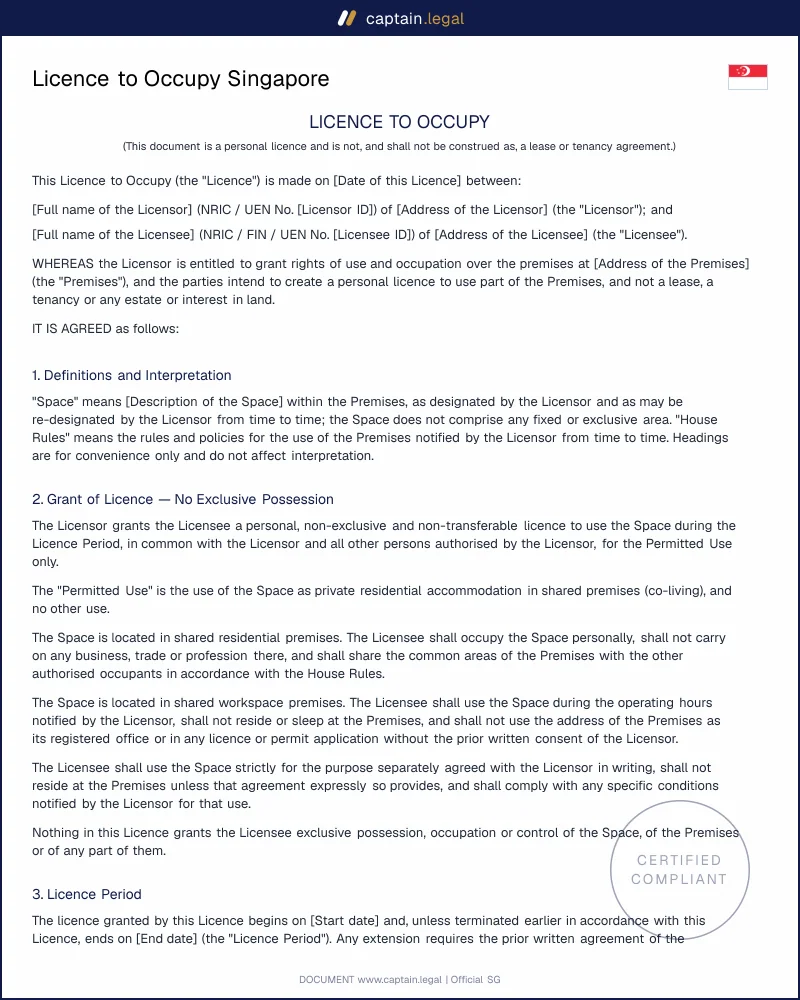
Singapore Licence to Occupy | CLPA 1886 & Street v Mountford

Non-exclusive licence to occupy under the CLPA 1886 and Street v Mountford [1985]. Co-living, hot-desking, short stays. IRAS-aware. Word and PDF.
4.7/522 reviews50 000+ downloadsInstant download
Share

A licence to occupy is a personal, non-exclusive right to use a space that stops short of granting the possession of a tenancy. In Singapore, where co-living operators, hot-desking arrangements and short serviced stays have grown faster than the law that frames them, the difference matters. A tenancy hands the occupier a proprietary interest in land and drags in stamping, HDB subletting rules and holding-over remedies. A licence, if drafted honestly, keeps the arrangement contractual and flexible. This licence to occupy template is built for operators and property owners who want that flexibility without waking up in court to find a judge has recharacterised their document as a lease.

The catch is that Singapore courts, following Street v Mountford [1985] AC 809, look at substance rather than the label on the cover page. Calling a document a licence changes nothing if the terms grant exclusive possession. This page explains where the line sits and how our template stays on the right side of it.

Compliant

2026 Legislation

50,000+ clients

trust us

Affordable

From $4.90 / doc

Secure payment

Instant download

Singapore Licence to Occupy | CLPA 1886 & Street v Mountford

Secure payment

Fill in the template

What is a licence to occupy in Singapore?

A licence to occupy is a contractual permission allowing one party to use premises for a defined purpose, without conferring any estate or interest in the land. The licensee gets a personal right enforceable against the licensor, nothing more. Contrast this with a tenancy, which grants exclusive possession for a term and creates a proprietary interest binding third parties. The practical consequences run deep: a licensee cannot exclude the owner, cannot claim the protections that flow from holding an estate in land, and holds a right that ends if the owner sells the property.

The distinction is not academic. It decides whether Stamp Duties Act 1929 lease duty applies, whether HDB subletting rules bite, and what remedies each side has on termination. A genuine licence sidesteps much of the machinery that governs Singapore tenancies, which is precisely why co-living and flexible-workspace businesses reach for it.

Where people go wrong is assuming the label is decisive. It is not. In Street v Mountford, the House of Lords held that an agreement titled a "licence", with an express clause denying any tenancy, was in law a lease because it granted exclusive possession at a rent for a term. Lord Templeman's image is famous: manufacturing a five-pronged implement for digging produces a fork even if the maker insists he made a spade. Singapore courts apply the same reasoning, so the drafting has to earn the label, not merely assert it. Our tenancy agreement template for HDB and condominium lettings is the correct instrument when exclusive possession genuinely is intended.

2

When do you need this document?

The most common use is co-living. An operator running a shared house or serviced apartment block wants residents in rooms without handing each of them exclusive possession of the whole unit, and wants to keep control of common areas, cleaning, and the ability to move a resident between rooms. A properly drafted licence supports that model where a tenancy would fracture it. The next is hot-desking and flexible workspace, where members buy the right to use a desk or a floating seat rather than a demised office; the operator retains possession, sets the house rules, and reshuffles space as demand shifts.

Short and transitional arrangements are the third pillar. An owner allowing a business associate to use part of premises for a few weeks, a company letting a contractor occupy a corner of a warehouse, a landlord permitting early access before a lease completes: each is better expressed as a licence than a tenancy. Event and pop-up occupation of retail or F&B space, where the operator keeps trading control and the occupier merely uses the site, fits the same mould.

Two edge cases deserve flagging. First, HDB premises: even a "licence" over a room in an HDB flat cannot escape HDB's subletting approval, occupancy caps and Minimum Occupation Period rules, because HDB regulates the reality of who lives there, not the paperwork. Do not use a licence to dodge HDB approval. Second, anything under three months in a private residential property runs into URA's short-term accommodation prohibition, which no label can cure. Where genuine possession is intended for a room, the honest instrument is our room rental agreement for HDB and condominium bedrooms.

3

Key clauses included in our template

  • The non-exclusive possession clause is the spine of the document. It states in plain terms that the licensee has permission to use, not possession of, the premises, that the licensor retains the right to enter at any time without notice, and that the licensor may relocate the licensee to comparable space. This is the clause a court reads first when deciding whether Street v Mountford turns your licence into a tenancy.
  • The grant and permitted use clause defines exactly what the licensee may do and where, tying the permission to a specific purpose (residence in a named room, use of a floating desk, occupation of a defined area) rather than to a demised, bounded property that only the licensee controls.
  • The fee and term provisions frame payment as a licence fee rather than rent and set a duration that reads as a revocable permission, with the licensor's right to terminate on short notice preserved. A perpetual or heavily protected term pushes the document toward a lease.
  • The services and control clause records the attendance the licensor provides (cleaning, utilities, management, reception, security) and the operational control it keeps, because supplying genuine services and retaining control are strong evidence of a licence rather than a tenancy.
  • The shared occupation and house rules clause confirms, where relevant, that the space or building is shared and that the licensor sets and enforces rules, echoing AG Securities v Vaughan where genuine sharing negated exclusive possession.
  • The termination and revocation clause allows the licensor to end the permission cleanly, without the notice-to-quit and forfeiture machinery a tenancy would require, and deals with the licensee's obligation to vacate and remove belongings promptly.
4

Regional and property-type considerations

HDB flats are the sharpest trap. A licence label offers no shelter from the HDB Act framework: whole-flat subletting needs HDB's prior written approval and only after the five-year Minimum Occupation Period, room rental must be registered within seven days, occupancy caps apply (up to six occupants for three-room and larger flats), and the Ethnic Integration Policy and Non-Citizen Quota govern who may occupy. A co-living operator using HDB stock must comply with every one of these regardless of how the occupation document is titled, and unauthorised arrangements risk fines and, in serious cases, compulsory acquisition of the flat.

Private condominiums bring their own layer. The Building Maintenance and Strata Management Act means MCST by-laws can restrict occupancy numbers, short stays and use of common property, so a workspace or co-living licence has to sit within the by-laws as well as the head lease or ownership title. URA's occupancy cap of six unrelated persons for units under 90 square metres applies to sub-occupiers too, and the three-month minimum-stay rule cannot be sidestepped by calling a stay a licence.

Commercial and mixed-use premises are where licences run cleanest, which is why food-court stalls, kiosk operators and flexible-workspace members are the classic IRAS examples of genuine non-exclusive occupation. Even here, a fitted-out, self-contained unit that the occupier alone controls will be read as a lease on Street v Mountford principles, so the operational control and shared-use elements have to be real. For a longer, possession-based commercial letting, our commercial lease agreement drafted to the Stamp Duties Act is the appropriate document.

5

How to fill out this licence to occupy

You begin by identifying the licensor and licensee and describing the premises with care, framing the space as an area the licensee may use rather than a demised property they possess. From there the template guides you through the permitted use, so you state the specific purpose (a named room in a co-living house, a floating desk, a defined workspace) that anchors the arrangement as a permission. You then set the licence fee and the term, keeping the language of a revocable permission and preserving the licensor's short-notice termination and relocation rights.

Next you complete the services and control section, listing the attendance you actually provide and the entry and management rights you retain, because these are the clauses that persuade a court the document is a genuine licence. You address shared occupation and house rules where the space is communal, then confirm how the permission ends and what the licensee must do on leaving. The output downloads in Word and PDF, so you can adapt clauses for a specific site or execute it as it stands. If your arrangement is in truth a letting, the form will steer you toward our letter of intent to rent property in Singapore and the tenancy suite instead.

6

Common mistakes to avoid

The first and gravest mistake is drafting exclusive possession into a document you then call a licence. Owners assume the word "licence" is protective; it is not, and a court applying Street v Mountford will look straight past it to the rights actually granted. If the occupier can lock the owner out and treat the space as their own, you have written a tenancy, with every stamping and HDB consequence that follows. The fix is to keep the owner's entry, relocation and control rights genuine and to make sure they are exercised in practice, not merely recited on paper, because a right of entry that is never used has been read as evidence of a disguised lease.

The second cluster of errors is regulatory. Operators try to use licences to avoid HDB approval, or to run sub-three-month private residential stays, or to overcrowd a unit beyond URA caps. None of these work, and all of them attract enforcement against the property owner. A related mistake is treating the licence as automatically outside stamp duty; a licence that operates as a lease, or is executed alongside one, is chargeable, and getting this wrong leaves you with an instrument not admissible in evidence when you most need it. Finally, some drafters forget the licensee's practical protections and their own recovery route on default, leaving the arrangement lopsided; our letter of demand for rent arrears under the Distress Act shows the disciplined approach to money owed, though a pure licensor relies on contract rather than distress.

Key takeaways

Characterisation

Label does not stop it becoming a lease

Calling it a “licence” is not a shield. Singapore courts follow Street v Mountford [1985] and look at the substance: if the occupier has exclusive possession for a term (often with rent), a judge can treat it as a tenancy even if the document says otherwise. That recharacterisation can trigger lease-style consequences you were trying to avoid.

Exclusive possession

Draft so the owner keeps real control

The dividing line is exclusive possession. A genuine licence should show the occupier cannot exclude the owner, and that use is non-exclusive and tied to a defined purpose. Practical signals include sharing arrangements (co-living or hot-desking), meaningful rights of entry, services and attendance, and ongoing operational control by the operator. If the facts read like “this is my unit”, expect tenancy risk.

Knock-on effects

A tenancy can drag in extra rules

If the arrangement is treated as a tenancy, it can pull in machinery that a licence is meant to sidestep. The excerpt flags lease duty under the Stamp Duties Act 1929, potential HDB subletting rule issues, and different termination and holding-over remedies. The commercial point is simple: misclassifying the deal can turn a flexible short-stay model into a regulated lettings problem.

Frequently Asked Questions

Yes. A licence to occupy is a binding contract enforceable between licensor and licensee under Singapore contract law, provided there is offer, acceptance, consideration (the licence fee) and an intention to create legal relations. What it does not create is a proprietary interest in land, so it does not bind third parties the way a tenancy does, and it ends if the owner disposes of the property. The document is fully valid; its limits are structural, not a question of enforceability. To hold up, it must read as a genuine permission, because a court applying Street v Mountford will enforce the true nature of the arrangement, not the label.

The dividing line is exclusive possession. A tenancy grants the occupier the right to exclude everyone, including the owner, and to treat the space as their own for a term at a rent, which creates an estate in land. A licence grants only permission to use the space for a purpose, with the owner keeping rights of entry, control and often the ability to relocate the occupier. The label on the document does not decide the question. Under Street v Mountford, a Singapore court examines the substance, so an agreement called a licence that in fact confers exclusive possession will be treated as a tenancy, with the tax and regulatory consequences that brings.

Often not, but the answer depends entirely on substance. IRAS treats a genuine, non-exclusive licence that does not operate as a lease as falling outside Stamp Duties Act 1929 lease duty, the food-court stall being the standard example. However, a licence that in truth acts as a lease, or one executed in connection with a lease, becomes chargeable at 0.4% of the rent over the term, payable within 14 days of execution in Singapore. If you are uncertain, IRAS allows you to submit the document for adjudication. Getting this wrong matters: an instrument that should have been stamped is not admissible in evidence until the duty and any penalty are cleared.

Only within HDB's rules, and the licence label buys you nothing here. HDB regulates the reality of occupation, so whole-flat subletting still needs prior approval after the five-year Minimum Occupation Period, room rental must be registered within seven days, and occupancy caps plus the Ethnic Integration Policy and Non-Citizen Quota all apply. A co-living operator cannot use a licence to bypass any of this. Doing so risks fines up to five thousand dollars and, for serious or repeat breaches, compulsory acquisition of the flat. Structure the arrangement to comply with HDB first, then use the licence to define the occupier's non-exclusive rights within that compliant framework.

You download the licence to occupy in both Word and PDF. The Word file lets you tailor clauses to a specific site, adjust the services list, or fine-tune the permitted-use and control provisions for a co-living house, a hot-desking floor or a short commercial occupation. The PDF gives you a clean, signature-ready version for execution. Both are drafted in Singapore English and to Singapore practice, so you can adapt or sign immediately without rebuilding the document from scratch.

A licence is far more flexible on termination than a tenancy, which is much of its appeal. The notice period is whatever the parties agree in the document, and because a licence is a revocable permission rather than an estate in land, the licensor is not tied to the notice-to-quit and forfeiture machinery a tenancy requires. Our template preserves a short-notice termination right for the licensor and sets out the licensee's obligation to vacate promptly. That said, the notice you write must be honoured, and a term drafted to be heavily protected or effectively irrevocable starts to look like a tenancy, so keep the revocability genuine.

Generally yes, because the licensee holds no estate in land and cannot rely on the possession-based protections a tenant enjoys. Once the licence is validly terminated under its terms, the licensee's right to remain ends and they become obliged to leave. The licensor still cannot use self-help unlawfully and should recover the space through proper legal channels if the occupier refuses to go, but the route is contractual rather than the tenancy-eviction process. This is exactly why honest drafting matters: if a court finds the arrangement was really a tenancy, the occupier regains the stronger protections, and the owner loses the very flexibility the licence was meant to secure.

4.7/5

22 verified reviews · 50 000+ downloads

Singapore Licence to Occupy | CLPA 1886 & Street v Mountford
  • Immediate access to the document
  • PDF + Word download
  • Compliant with 2026 legislation
  • Reviewed by lawyers
Fill in the template
Secure payment
Updated on July 11, 2026

You might also like

Tenancy Renewal Agreement Singapore
Notice to Quit Template Singapore