A letter of demand for rent arrears is the formal written notice a Singapore landlord sends to a defaulting tenant before pursuing enforcement, and it is the document that separates a recoverable claim from a stalled one. It sets out the sum owed, the tenancy it arises from, the deadline for payment, and the consequences of non-payment. Practitioners treat it as the mandatory first move: the distress action under the Distress Act 1934, a writ of seizure and sale, forfeiture under the Conveyancing and Law of Property Act 1886, or a statutory demand for an insolvent corporate tenant all begin, in practice, with a properly drafted demand. Get this letter right and the rest of the recovery machinery works; get it wrong and you hand the tenant an argument.
This template is drafted for Singapore landlords, managing agents and their solicitors who need a demand that holds up as evidence and preserves every downstream remedy.
Compliant
2026 Legislation
50,000+ clients
trust us
Affordable
From $4.90 / doc
Secure payment
Instant download
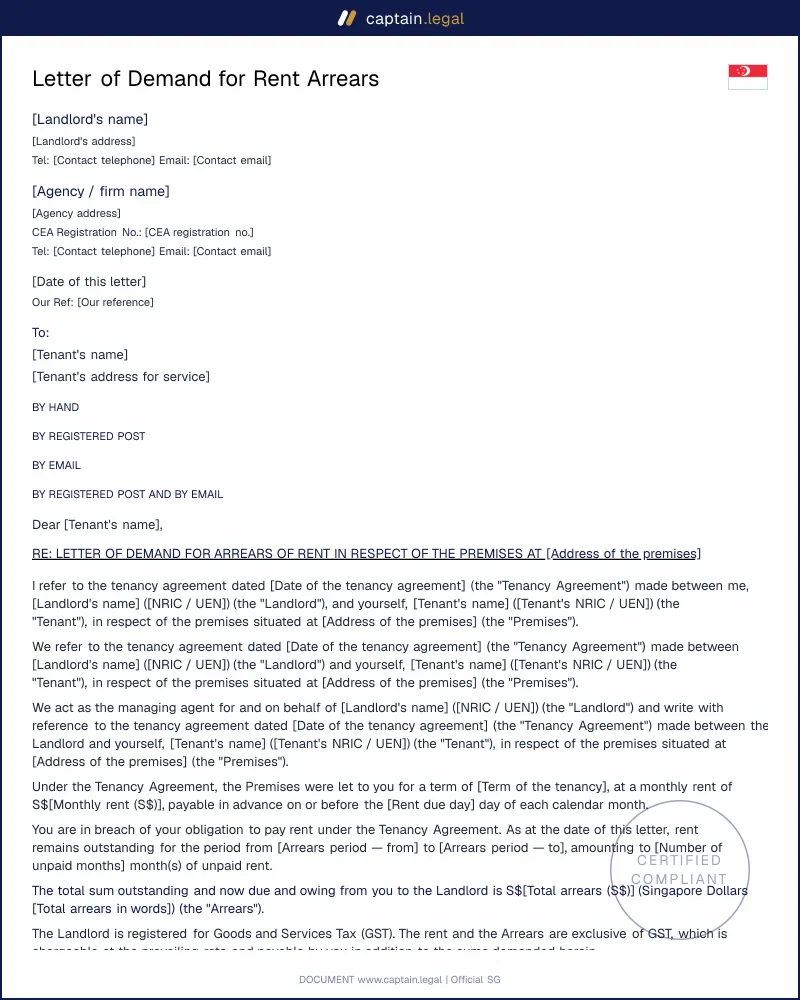
Letter of Demand for Rent Arrears (Distress Act 1934)
Secure payment
What is a letter of demand for rent arrears in Singapore?
A letter of demand is a formal, dated written communication asserting that a specific sum of rent has fallen due and remains unpaid, and requiring payment by a stated deadline. It is not a court document and it does not, by itself, compel anything. Its force is evidential and strategic: it fixes the date the landlord asserted the debt, records the tenant's default in writing, and creates the paper trail that a State Court or the Small Claims Tribunals will expect to see before any claim is filed. A tenant who later argues that no rent was ever demanded runs straight into a dated, served letter.
The demand should not be confused with a notice to quit or a section 18 notice under the Conveyancing and Law of Property Act 1886. A notice to quit ends the tenancy; a section 18 notice is the statutory precondition to forfeiture, which specifies the breach and gives the tenant a chance to remedy it. A letter of demand does neither on its own. It asks for money. The distinction matters because a landlord who wants both the arrears and vacant possession usually needs more than one instrument, and conflating them is a drafting error that surfaces in cross-examination. Our Singapore notice to quit template drafted to section 18 CLPA handles the possession side where re-entry is the goal.
Legal framework
Singapore has no general statutory rent control and no comprehensive landlord-and-tenant code for private lettings, so the relationship is governed primarily by the tenancy agreement and the common law of contract, overlaid by several statutes that shape enforcement. The debt itself is a contractual claim, which means it is subject to the Limitation Act 1959: an action to recover arrears of rent must be commenced within six years from the date each instalment fell due. A demand does not stop time running, so a landlord sitting on old arrears risks watching the earliest instalments become time-barred while the correspondence drags on.
The most powerful landlord remedy sits in the Distress Act 1934. Under section 5, a landlord may apply ex parte to the court for a writ of distress to recover rent due for a period not exceeding 12 completed months of the tenancy immediately preceding the application. Once granted, the court bailiff seizes movable property on the premises, and if the tenant does not pay the arrears, fees and costs within five days, the goods are sold at auction. Certain property is exempt from seizure under section 8, and the twelve-month cap is a real limitation: arrears older than a year cannot be recovered by distress, only by ordinary civil action. This is exactly why speed matters, and why the demand letter is dated and served without delay. The Singapore Courts set out the mechanics of applying for a writ of distress in their official guidance on distress and enforcement against a defaulting tenant, and the process is technical enough that most landlords instruct solicitors.
Where the tenant is a company, non-payment of a debt exceeding S$15,000 can support a statutory demand under the Insolvency, Restructuring and Dissolution Act 2018; if the company fails to pay within three weeks, it is deemed unable to pay its debts, opening the door to a winding-up application. Distress is unavailable once a winding-up application has been presented, which again rewards the landlord who moves early. Formal debt acknowledgements can also assist recovery, and our Singapore debt acknowledgement and IOU template under the Limitation Act 1959 is useful where a tenant admits the sum but needs time.
When do you need this document?
The classic trigger is straightforward non-payment of monthly rent once the contractual grace period has lapsed. Most Singapore tenancy agreements make rent payable in advance on a fixed day, and the moment that day passes without payment the arrears crystallise. A landlord who lets two or three cycles slide before writing weakens the narrative that the breach was treated seriously, and in a distress application the twelve-month clock is quietly eating into what can be recovered. The second common scenario is a partial payment pattern, where a tenant pays some months in full and others short, leaving a running balance that neither party has formally reconciled. A demand letter freezes that balance into a stated, dated figure.
Commercial tenancies produce their own flashpoints. A retail or office tenant negotiating a rental review while withholding rent is a recurring situation, and the Cupid Jewels v Orchard Central litigation confirmed that a landlord can pursue distress even while negotiations are live, provided there is no crystallised dispute over the obligation to pay. Two edge cases justify particular care. First, a holdover tenant who stays after the tenancy ends is treated as a trespasser, not a lessee, so distress may not lie for the holdover period even though double rent may be claimable; the demand must be framed accordingly. Second, where the tenant is a corporate entity showing signs of insolvency, the demand doubles as the precursor to a statutory demand, and the sum and wording need to anticipate that route. If the underlying tenancy terms are unclear, the IRAS-ready Singapore tenancy agreement template for HDB and condominium lettings shows how a well-drafted agreement pins down the payment obligation the demand relies on.
Key clauses included in our template
The identification of the parties and the tenancy names the landlord and every tenant liable under the agreement, cites the tenancy agreement by date and the premises by full address, and states whether the landlord acts personally or through a managing agent. A demand that misdescribes the parties or the property invites a dispute over whether the right person was asked to pay the right debt.
The statement of the debt and its breakdown sets out each unpaid instalment, the period it covers and the running total, distinguishing base rent from any contractual interest, service charge or other sums recoverable as rent under the agreement. Vague phrasing such as "several months outstanding" is replaced by a dated schedule, because a court and a bailiff both work from precise figures.
The deadline for payment fixes a clear date, commonly seven days from the letter, by which the tenant must pay in cleared funds, together with the exact payment method and account details. A firm, reasonable deadline is what converts silence into actionable default.
The reservation of rights and statement of consequences puts the tenant on notice that failure to pay may lead to a writ of distress under the Distress Act 1934, civil proceedings, forfeiture and re-entry, or, for a company, a statutory demand and winding-up. This clause must reserve all remedies expressly, so that pursuing one route later is not read as a waiver of the others.
The service and record clause confirms how the letter is delivered, typically by registered post to the premises and to any registered office, so the landlord can later prove receipt. Tenants who claim they never received a demand are a frequent obstacle, and registered service closes that door.
Regional and property-type considerations
Singapore applies one body of law islandwide, so the variation that matters here is by property type and tenant status rather than geography. HDB flats carry their own overlay: subletting is subject to Housing and Development Board eligibility rules and minimum occupation periods, and a landlord letting a flat in breach of HDB conditions may find the tenancy itself vulnerable, which complicates any demand for rent under it. The arrears remain contractually owed, but the landlord should be alert to the regulatory exposure sitting alongside the claim. The Singapore room rental agreement template for HDB and condo lettings under the Stamp Duties Act reflects those bedroom-rental and occupancy-cap rules.
Private condominium and landed lettings are governed almost entirely by the tenancy agreement and common law, giving the landlord more contractual freedom over interest, deposit forfeiture and remedies, provided the drafting is clear. Commercial premises raise the stakes further: arrears run larger, contractual interest and service charges are common, and the Distress Act 1934 is used heavily, so the demand is often the opening shot in a well-worn enforcement sequence. Unstamped tenancy agreements deserve a specific flag. Under the Stamp Duties Act 1929, an instrument that has not been stamped is not admissible in evidence until the duty and any penalty are paid, which can stall enforcement of the very agreement the demand relies on. A landlord who discovers late that the lease was never stamped should regularise it before filing anything, and the Singapore tenancy stamp duty and IRAS stamping pack explains the 0.4 percent lease duty and the 14-day deadline that governs it.
How to fill out this letter of demand
You begin by entering the landlord's details and confirming whether the letter goes out in the landlord's own name or through a managing agent or solicitor, since that framing affects tone and the reservation of rights. From there you identify the tenant and the tenancy, pulling the agreement date and premises address directly from the lease so the descriptions match. The template then walks you through the arrears schedule, where you enter each unpaid period and amount and let the running total build, keeping base rent separate from interest and other recoverable sums. You set the payment deadline and the payment method, choosing a clear date that is firm without being oppressive. The consequences section is pre-drafted to reference the Distress Act 1934, civil action, forfeiture and, for corporate tenants, the statutory demand route, and you simply keep the limbs that fit your situation. Finally you select the mode of service, and the letter is ready to download in Word and PDF, so you can adjust wording or send it as-is. If the tenant is a company you may want to pair this with the Singapore private loan and debt recovery documents for individuals and businesses where a repayment arrangement is on the table.
Common mistakes to avoid
The most damaging error is delay. Because the Distress Act 1934 caps recovery at the twelve months preceding the application, and because distress becomes unavailable once a winding-up application is presented against a corporate tenant, a landlord who waits until arrears approach a full year has already forfeited leverage. Judges and bailiffs also read prolonged silence as tacit acceptance, so a demand sent promptly and served by registered post does real work. The second frequent mistake is an imprecise figure. A demand that states a round approximation rather than a dated, instalment-by-instalment breakdown is easy to dispute and hard to enforce, and it undermines any later affidavit that must swear to an exact sum.
Landlords also routinely confuse remedies. Serving a letter of demand and assuming it terminates the tenancy, or that it substitutes for a section 18 notice before forfeiture, leaves the possession claim exposed. Another trap is self-help: changing the locks, seizing the tenant's goods personally, or cutting utilities. None of these is lawful, and a landlord who distrains without a court-issued writ can face liability, as the wrongful-distress case law makes plain. A final, avoidable error is ignoring stamping. Discovering at the courthouse that the tenancy was never stamped, and is therefore inadmissible, is a self-inflicted delay that a quick check would have caught.
Frequently Asked Questions
14 verified reviews · 50 000+ downloads
- Immediate access to the document
- PDF + Word download
- Compliant with 2026 legislation
- Reviewed by lawyers
You might also like