Singapore has no dedicated statute governing letters of intent or residential tenancies. The document sits squarely within general contract law, supplemented by the Civil Law Act 1909 and the Conveyancing and Law of Property Act 1886, which together govern how interests in land are dealt with and what formalities a dealing must observe. There is no rent-control legislation, which means the commercial terms in your LOI, the rent, the escalation on renewal, the deposit, are set entirely by negotiation and market practice rather than by statute. That freedom cuts both ways: nothing in the law protects you from a one-sided term you signed, so the LOI must say exactly what you mean.
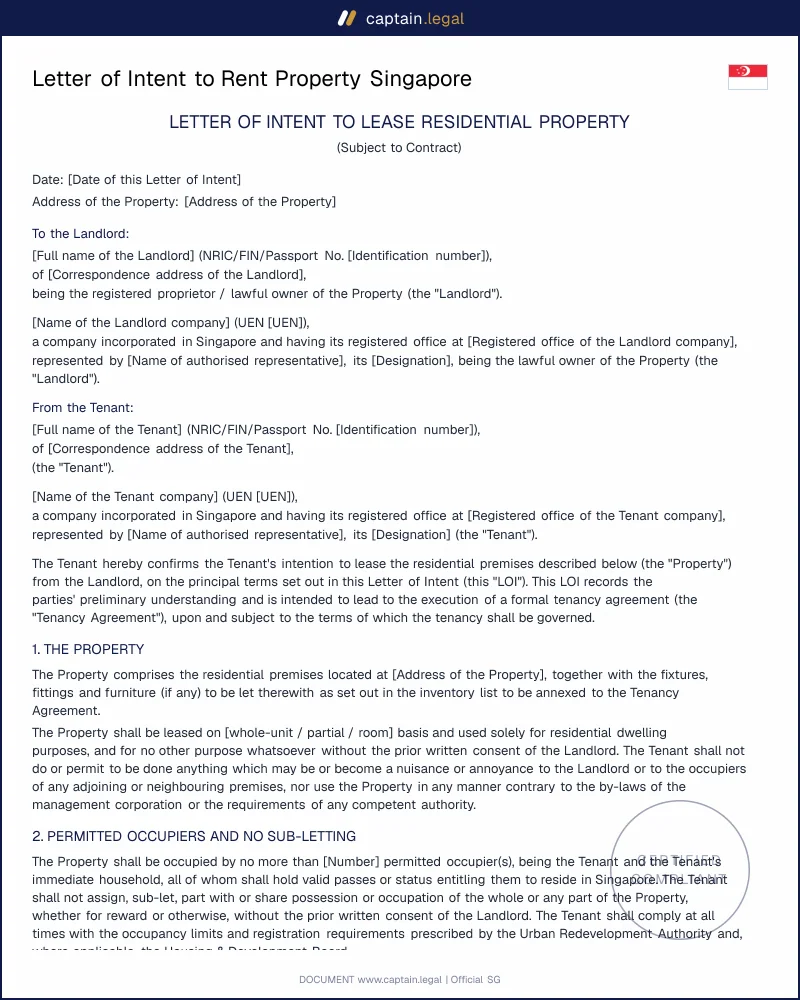
The central legal feature of an LOI is that it is generally not binding as a lease. A signed letter of intent expresses an intention to enter into a tenancy agreement; it does not, by itself, transfer any interest in the property or oblige either party to complete. Singapore practitioners almost always mark the document "subject to contract" to make this beyond argument, so that the binding obligations crystallise only when the tenancy agreement is executed. The one part of the LOI that does carry real bite is the good-faith deposit clause: the terms governing whether that deposit is forfeited or refunded are themselves contractual and enforceable, which is why they deserve the most precise drafting in the whole document.
Stamp duty is a common source of confusion. Under the Stamp Duties Act 1929, lease stamp duty is charged on the tenancy agreement at 0.4% of the total rent over the lease term, and the obligation arises on the lease, not on the LOI. The tenant pays by market convention, e-stamping through IRAS within fourteen days of signing the agreement, and an unstamped lease is not admissible as evidence in court until the duty and any penalty are paid. The official position on stamping is set out in the IRAS guidance on lease stamp duty for tenancy agreements. For HDB flats, the Housing and Development Board rules and sublet-approval requirements apply on top of the general law, so an HDB LOI should always be made conditional on HDB approval.