Create my document
Login

Choose country

SingaporeSingaporeChoose country
Real Estate

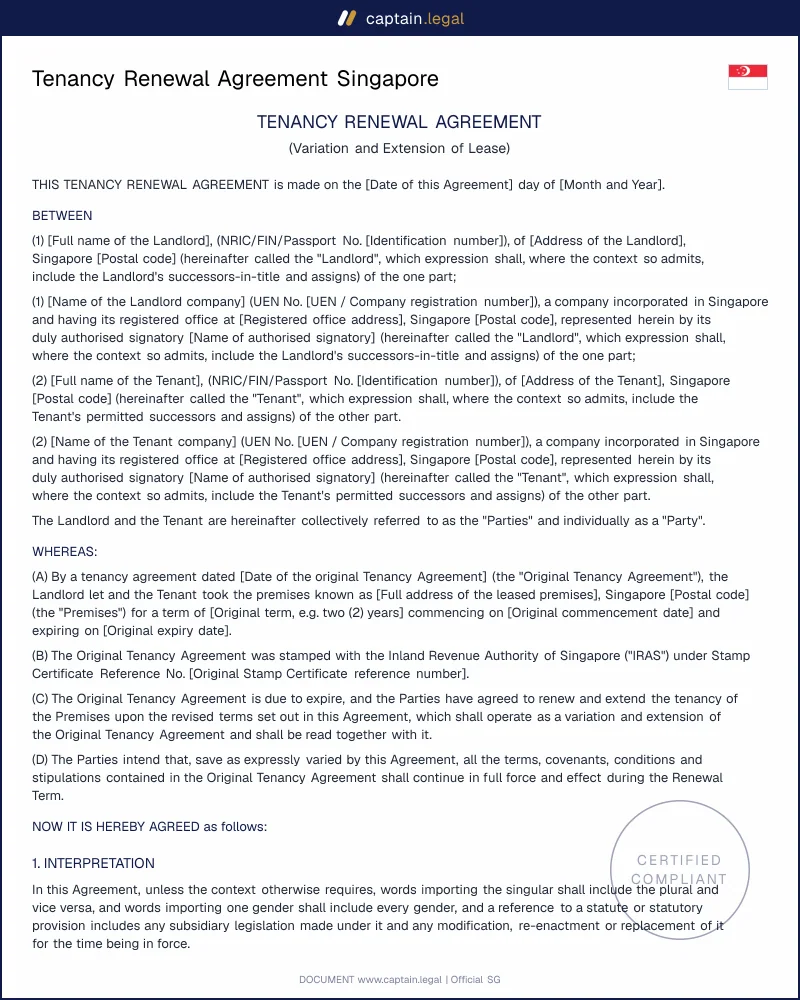
Tenancy Renewal Agreement Singapore | IRAS Compliant

Renewal template drafted to the Stamp Duties Act 1929, with 0.4% lease duty and the 14-day IRAS re-stamping deadline explained. Word and PDF.
4.6/523 reviews50 000+ downloadsInstant download
Share

A tenancy renewal agreement is the document Singapore landlords and tenants use to continue an existing lease when the fixed term is about to expire, usually with a revised rent and a fresh block of security. It sits between two options that practitioners keep confusing: a full new tenancy agreement that starts the relationship again, and a short variation or supplemental agreement that simply amends the running lease. Getting the label right matters, because it decides how the document is stamped with the Inland Revenue Authority of Singapore and whether the earlier stamping carries over. This template is drafted for HDB and private residential renewals, with a built-in rent-adjustment mechanism and the re-stamping guidance that keeps the renewed term admissible in court.

Most renewals in Singapore happen quietly. The agent circulates a one-line email, both sides agree to carry on for another year at a slightly higher rent, and nobody papers it properly until a dispute exposes the gap. That informal habit is where deposits get lost and arrears claims stall. A renewal handled on a clean instrument, correctly re-stamped, protects both parties at exactly the moment the original goodwill runs out.

Compliant

2026 Legislation

50,000+ clients

trust us

Affordable

From $4.90 / doc

Secure payment

Instant download

Tenancy Renewal Agreement Singapore | IRAS Compliant

Secure payment

Fill in the template

What is a tenancy renewal or extension agreement?

A tenancy renewal agreement extends an existing residential lease for a further fixed term once the original term ends, on terms the parties agree afresh. In Singapore practice it typically resets the rent, renews the security deposit position, and confirms that the tenant stays in exclusive possession without a break in occupation. It is the natural sequel to the original tenancy agreement, and it usually references that first contract by date so the two read together as one continuous letting.

The distinction that trips people up is renewal versus variation. A renewal creates a new term that begins when the old one ends, so IRAS treats it as a fresh lease document requiring its own stamping. A variation, by contrast, changes a term of a lease that is still running, most often a mid-term rent increase, and is stamped as a Variation of Lease on the difference. An extension agreement is closer to a renewal where the same parties simply prolong the current arrangement without renegotiating everything. Getting this classification right is not academic. It determines the Nature of Transaction you select in the IRAS e-Stamping portal, the base on which duty is charged, and whether you can lean on the original Stamp Certificate or need a new one. A landlord who papers a genuine new term as a mere variation risks under-stamping, and an under-stamped renewal is the document a court will refuse to look at when it counts.

2

When do you need this document?

The everyday trigger is a fixed term about to expire where both sides want to continue. The lease has three or four weeks left, the tenant intends to stay, and the landlord wants a modest rent adjustment to reflect the market. Rather than let the tenancy drift into an unstamped month-to-month holdover, the parties sign a renewal that locks the new rent and term and re-secures the deposit. This is the cleanest and most common scenario, and it is where a properly drafted renewal earns its keep.

A second situation is the mid-term extension, where the tenant asks to prolong an eleven-month lease into a longer commitment before it ends, sometimes to secure a fixed rent ahead of a rising market. Here the drafting has to be careful about whether you are creating a new term or varying the existing one, because the two are stamped differently. A third case involves the diplomatic clause: expatriate tenants renewing often want to carry forward or renegotiate the early-termination right, and the renewal is the moment to reset that clause rather than assume it survives untouched from the original.

Edge cases sharpen the point. Where a landlord grants an extension but offers a rent-free period equal to the extension, IRAS still expects the document to be assessed, and adjudication may be needed to confirm the duty position. And an HDB flat renewal carries its own layer: the tenancy must stay within HDB's approved rental framework and occupancy caps, which a renewal should reconfirm rather than silently inherit. When occupancy details change on renewal, cross-check them against the base Singapore tenancy agreement for HDB and condo lettings so the two documents stay consistent.

3

Key clauses included in our template

  • The recital of the original tenancy identifies the first agreement by date, parties and premises, and confirms the renewal reads together with it as one continuous letting. This is what lets you rely on the earlier deposit and inventory position instead of rebuilding it from scratch, and it is the anchor a court uses to read both documents as a single relationship.
  • The rent adjustment clause states the new rent in figures and words, the effective date, and the basis of any increase, so there is no ambiguity when the revised amount first falls due. Where the parties have agreed a rent-step structure across the renewed term, the clause records each step, which also matters because IRAS computes Average Annual Rent on the total contracted rent divided by the lease years, not the opening month.
  • The security deposit provision confirms whether the existing deposit rolls over, is topped up to match the higher rent, or is returned and re-paid, closing off the most frequent renewal dispute. It ties the deposit to the reinstatement and minor-repair thresholds so the exit position is clear before the new term even starts.
  • The re-stamping acknowledgement records which party attends to IRAS stamping of the renewed term and the fourteen-day deadline, since the Stamp Duties Act 1929 makes landlord and tenant jointly liable even though the tenant pays by convention.
  • The diplomatic and early-termination clause is re-stated for the renewed term rather than assumed, with the minimum occupation period and notice recalculated against the new dates, which is the point expatriate renewals most often get wrong.
4

Regional and property-type considerations

HDB flats sit under their own framework. A renewal of an HDB flat or bedroom letting must stay within the HDB Act rental approval regime and the occupancy caps that apply to the flat type, and the tenancy still needs to be a registered rental with HDB. A renewal is the right moment to reconfirm that the approved rental period is being extended and that occupier numbers remain within the cap, because a renewal that quietly exceeds the approved headcount can expose the landlord to enforcement independent of any stamp duty question. Where the letting is a single room rather than a whole flat, the renewal should mirror the structure of a room rental agreement for HDB and condo bedrooms so the house rules and shared-space terms carry forward intact.

Private condominiums and landed homes are freer on rent but tighter on building rules. A renewal should confirm that the tenant remains bound by the current by-laws of the management corporation, which can change between the original term and the renewal, and that any facility deposits or access arrangements are refreshed. For landed lettings, garden, pool and external-maintenance responsibilities are worth restating, since these are the terms most likely to have drifted in practice during the first term.

Commercial and mixed-use lettings raise a further wrinkle. Where a renewal covers premises let partly for business use, the duty computation can involve turnover-linked rent, and the Average Annual Rent has to reflect the higher of contractual and market rent across the renewed period. In every case, if there is genuine doubt about whether the document is a renewal, a variation, or something IRAS would treat as a fresh lease, the sensible course is to submit it for adjudication rather than guess, accepting that an adjudication fee applies. Renewals that touch title or long terms should be read against the sale and purchase framework for Singapore property where a longer interest is being created.

5

How to fill out this tenancy renewal agreement

You begin by identifying the original tenancy, entering its date, the parties and the premises, so the renewal locks onto the first agreement rather than floating free. From there the form asks for the renewed term, the new rent and the effective date, and it lets you set out a single flat rent or a stepped structure across the term. You then confirm the deposit treatment, choosing whether the existing sum rolls over, is topped up, or is refunded and re-paid, and the template carries that choice through to the reinstatement wording so the exit position stays consistent. Next you set the re-stamping responsibility and record the fourteen-day IRAS deadline, and you decide whether the diplomatic clause is renewed, dropped or renegotiated for the new dates. The template then assembles a clean instrument that references the original, states the revised terms, and leaves space for both signatures. Once signed, you download it in Word to make any final adjustment and in PDF as the fixed copy to sign and store alongside the new Stamp Certificate. If the renewal has prompted the parties to re-examine early exit, the Notice to Quit drafted to section 18 CLPA is the companion document to keep on hand.

6

Common mistakes to avoid

The most expensive error is treating a renewal as a formality that needs no fresh stamping. A renewal is a new chargeable document, and the renewed term must be stamped within fourteen days of signing, with duty at 0.4 percent on the Average Annual Rent of that term. Landlords who assume the original Stamp Certificate still covers them discover, when they try to enforce arrears, that the renewed period is unstamped and the document is shut out of court until duty and penalty are paid. Late stamping is not trivial either: the penalty escalates with the delay, running from a modest fixed sum for a short lapse up to several times the duty once the delay stretches out. The second common failure is mislabelling. Papering a genuine new term as a Variation of Lease to save duty, or the reverse, selects the wrong IRAS transaction type and under-stamps the instrument, which is precisely the defect adjudication is designed to catch.

Beyond stamping, renewals go wrong on the deposit and the diplomatic clause. Parties who never state whether the deposit rolls over or is topped up leave the exit undefined, and a rent rise without a matching deposit adjustment quietly under-secures the landlord for the whole renewed term. Expatriate tenants who assume the early-termination right survives the renewal untouched often find the minimum occupation period was never recalculated against the new dates, leaving the clause unenforceable when they actually need it. A renewal that touches occupancy on an HDB flat without reconfirming the approved headcount is a further trap, since it can breach HDB rules independently of any tax point. When occupancy or eligibility shifts on renewal, it is worth reading the terms against the letter of intent to rent property in Singapore that framed the original deal.

Key takeaways

STAMP DUTY

Renewals need fresh IRAS stamping

A tenancy renewal is treated as a fresh lease document under the Stamp Duties Act 1929, so you generally cannot rely on the earlier Stamp Certificate. If the renewed term is not properly e-Stamped, you risk under-stamping and a court may refuse to look at the document when enforcing rent arrears or deposit claims. The label you choose affects the IRAS “Nature of Transaction” and duty basis.

DEADLINE

Pay duty within 14 days

Stamp duty must be paid within 14 days of signing if the renewal is signed in Singapore, or 30 days if signed overseas. Miss the timeline and you create unnecessary friction right when the lease rolls over, especially if a dispute erupts early in the renewed term. Treat stamping as part of completion, not an admin afterthought, and keep the Stamp Certificate with the signed renewal.

DUTY BASIS

Know what 0.4% is charged on

For a renewed term, the lease duty rate stated is 0.4%, applied to the Average Annual Rent over the renewed period. IRAS takes the higher of the contractual rent or the open-market rent, so an “under-market” renewal can still attract duty based on market level. If it is a true mid-term change to a lease still running, stamp it as a Variation of Lease and duty is on the incremental rent, not the whole.

Frequently Asked Questions

Yes. IRAS treats a renewal as a fresh lease document, so the renewed term must be stamped in its own right even though the original agreement was already stamped. The lease duty rate is 0.4 percent, applied to the Average Annual Rent over the renewed term, and it must be paid within fourteen days of signing if the document is signed in Singapore. You stamp it through the IRAS e-Stamping portal by selecting the Lease/Tenancy category. The earlier Stamp Certificate does not extend to the new term, so keep the renewal's own certificate with the signed document.

A renewal creates a new term that starts when the old one ends, and IRAS stamps it as a fresh lease on the full rent of that term. A variation of lease changes a term of a lease that is still running, most often a mid-term rent increase, and duty is charged only on the incremental rent, not the whole amount. You select Variation of Lease as the Nature of Transaction in the e-Stamping portal for the latter. Choosing the wrong category under-stamps the document, and if you are genuinely unsure, IRAS lets you submit the instrument for adjudication for a fee.

Lease duty on a renewal is 0.4 percent of the Average Annual Rent for the renewed term, capped at four years' worth of rent for longer leases. Average Annual Rent is the total rent contracted over the term divided by the number of years, so a stepped rent is averaged rather than taken at its opening rate. Where the renewal only raises the rent on a running lease, duty is charged on the difference in rent rather than the full amount. The IRAS e-Stamping portal computes the figure once you enter the lease dates and rent, so manual calculation is rarely necessary.

Yes, once both parties sign it, the renewal is a binding contract under Singapore common law, governed by the Conveyancing and Law of Property Act 1886 like any residential letting. Its enforceability in court, though, depends on stamping. An unstamped renewal cannot be admitted in evidence until the outstanding duty and any penalty are paid, which means an arrears or deposit claim can stall at the courtroom door. The template is drafted to Singapore practice, but the binding force in a dispute rests on you stamping the renewed term within the fourteen-day window and keeping the certificate with the signed copy.

The renewal is available in both Word and PDF. The Word version lets you make any last adjustments, such as a bespoke rent-step schedule or an amended diplomatic clause, before signing. The PDF gives you a clean, fixed copy to sign and store. It is good practice to keep the signed renewal together with the new IRAS Stamp Certificate, since you may need to produce both if a dispute arises or when the tenancy is renewed again down the line.

By convention the tenant pays, and the renewal should say so expressly. The Stamp Duties Act 1929 makes the parties jointly liable, though, so a landlord cannot safely treat the matter as none of their concern. If the tenant fails to stamp the renewed term, IRAS can look to either party for the duty and any penalty, and the landlord is the one who suffers when an unstamped renewal is later shut out of court. Recording the responsibility and the deadline in the document keeps the obligation clear on both sides.

Yes. There is no statutory rent control on private residential lettings in Singapore, so the renewal rent is whatever the parties agree. The stamping follows the structure of the document: a clean new term is stamped on the full rent of that term, while a mid-term rent rise on a running lease is stamped as a Variation of Lease on the difference. Either way, the higher rent feeds into the Average Annual Rent and the 0.4 percent duty, so a rent increase almost always means additional duty on the renewed or varied period.

If the tenant holds over with the landlord's consent but without a signed renewal, the tenancy usually continues as a periodic month-to-month arrangement on the old terms. That sounds convenient, but it leaves the parties without an updated, stamped document, and a cumulative holdover running beyond a year can itself attract stamp duty. Worse, the deposit, diplomatic clause and rent position all stay frozen at last year's terms, which rarely suits either side. Signing a proper renewal converts a vague holdover into a clear, stamped fixed term and closes off the disputes that informal continuation invites.

4.6/5

23 verified reviews · 50 000+ downloads

Tenancy Renewal Agreement Singapore | IRAS Compliant
  • Immediate access to the document
  • PDF + Word download
  • Compliant with 2026 legislation
  • Reviewed by lawyers
Fill in the template
Secure payment
Updated on July 9, 2026

You might also like

Tenancy Diplomatic Clause Notice
Rent Receipt & Deposit Acknowledgement