Create my document
Login

Choose country

FranceBelgiqueEspañaUnited StatesUnited KingdomMarocDeutschlandItaliaSchweizSingapore
Real Estate

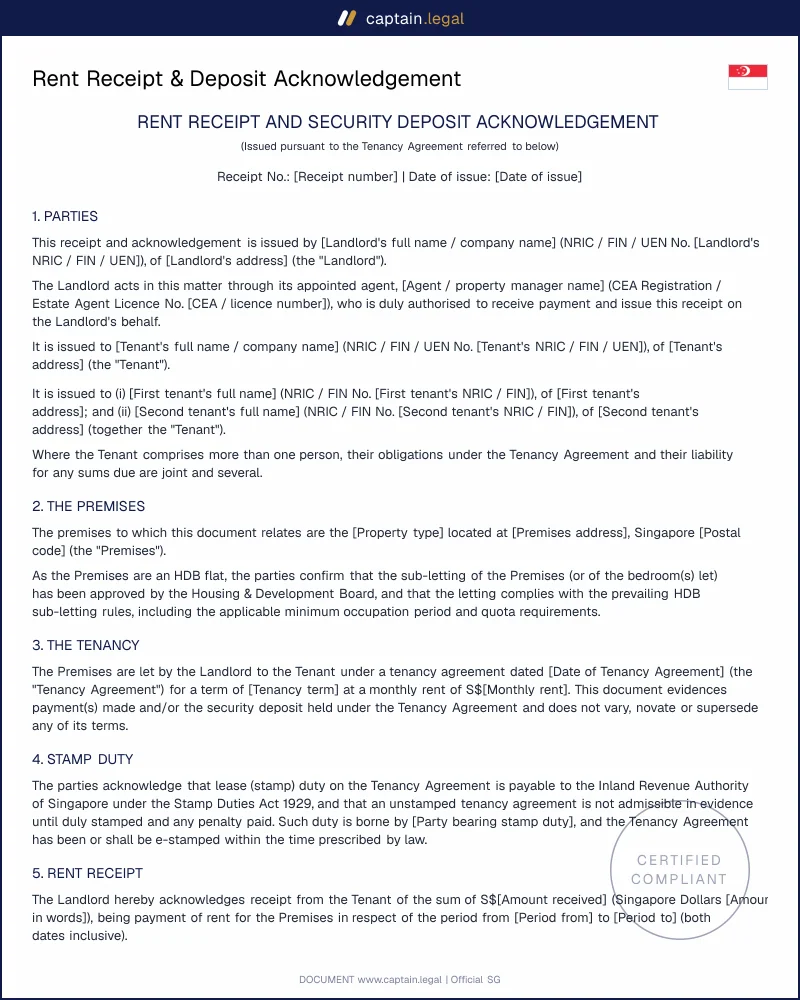
Singapore Rent Receipt & Deposit Acknowledgement

Rent receipts and deposit acknowledgements drafted for Singapore tenancy practice under the Stamp Duties Act 1929 and Conveyancing and Law of Property Act.
4.8/528 reviews50 000+ downloadsInstant download
Share

A rent receipt is the written acknowledgement a landlord gives a tenant confirming that a payment of rent has been received, for a stated period, in a stated amount. Paired with a security deposit acknowledgement, it forms the documentary backbone of any Singapore tenancy: one proves the rent was paid, the other proves the deposit was lodged and on what terms it will be returned. Both matter far more here than most landlords assume, because Singapore has no central rental register and no statutory rent control, so the paper trail you keep is the only record a tribunal will look at. This template lets a landlord, agent or self-managing owner issue a clean, professional rent receipt and deposit acknowledgement in minutes, as an editable Word file or an instant PDF.

Compliant

2026 Legislation

50,000+ clients

trust us

Affordable

From $4.90 / doc

Secure payment

Instant download

Singapore Rent Receipt & Deposit Acknowledgement

Secure payment · No subscription

Fill in the template

What is a rent receipt and deposit acknowledgement?

A rent receipt is a short instrument that records four things with precision: who paid, how much, for which rental period, and by what method. In Singapore practice it is issued each time rent changes hands, whether the tenant pays by PayNow, GIRO, bank transfer or, less commonly now, cheque or cash. The receipt is not the tenancy agreement and does not replace it; it is the running evidence that the agreement is being performed month after month.

The security deposit acknowledgement is a different animal. It is signed once, near the start of the tenancy, and confirms that the landlord holds a specific sum (typically one month's rent for a one-year lease, capped at two months for a two-year term) against the tenant's obligations. A well-drafted acknowledgement states the exact amount held, the conditions under which deductions may be made, and the window for return after handover. People conflate the two documents constantly, but they answer different questions. The receipt answers was the rent paid? The acknowledgement answers what happens to my deposit at the end? A landlord who issues both consistently rarely ends up before the Small Claims Tribunals, and a tenant who collects both walks into any dispute holding the stronger hand. You will find both built into our Singapore tenancy agreement templates, drafted to sit alongside the lease itself.

2

When do you need this document?

The everyday trigger is simple rent collection. Every time the tenant pays, a receipt should follow, because cash and even bank transfers can be disputed months later when memories fade and a tenancy sours. The second scenario is the start of the tenancy, when the deposit changes hands and the landlord should issue the acknowledgement on the spot rather than promising one "later" that never materialises. The third is the deposit return at handover, where a final reconciliation receipt records what was refunded, what was deducted, and why.

Beyond these, the document earns its keep in the awkward situations. A tenant on a diplomatic clause who terminates early needs clean records to recover the unused portion of any prepaid rent. A landlord facing a tenant who has gone quiet wants a documented payment history before serving a notice to quit. And the edge case worth flagging: where rent is paid by a third party, such as an employer relocating staff or a parent paying for a student, the receipt should name both the payer and the tenant of record, or the payment may later be argued to fall outside the tenancy. For the staff-relocation scenario, our Singapore employment and HR templates handle the contractual side of housing allowances.

3

Key clauses included in our template

  • The payment identification block captures the date of receipt, the exact sum in Singapore dollars, the rental period it covers, and the payment method. This is the load-bearing part of the receipt; an entry reading "received with thanks" and nothing more is worth very little when a tenant claims a month was never paid.
  • The deposit acknowledgement statement confirms the precise amount held, expressed as a figure and a number of months' rent, and records the date it was received. It ties the deposit to the underlying tenancy by reference, so there is no argument later about which agreement the money belongs to.
  • The deduction and return terms set out the limited grounds on which the landlord may retain part of the deposit, such as unpaid rent, repair of damage beyond fair wear and tear, or outstanding utilities, and fix a clear return window after handover, commonly 14 days.
  • The running balance and arrears note lets the landlord record any shortfall or advance, so the receipt doubles as a simple ledger rather than a one-off scrap of paper.
  • The signature and counterparty fields name the landlord or authorised agent and the tenant, with space for both to sign, because an acknowledgement signed by only one side invites the very dispute it was meant to prevent.
4

Regional and property-type considerations

Singapore is a single jurisdiction, but the property type changes what the document must reflect. For an HDB flat, subletting is permitted only with prior approval through the HDB portal, and the tenancy is subject to occupancy caps and a minimum tenant profile under the HDB Act. A deposit acknowledgement for an HDB sublet should record that the requisite HDB approval is in place, because a tenancy that breaches HDB rules is exposed regardless of how clean the receipts are. The maximum number of unrelated occupants is tightly controlled, and exceeding it is a frequent and costly mistake.

For private condominiums and landed property, there is no portal approval, but foreign-ownership restrictions under the Residential Property Act govern who may take landed property, and the deposit and rent figures feed directly into the IRAS stamp-duty calculation. Commercial and mixed-use premises sit outside the residential Small Claims route entirely, so disputes go to the State Courts and the documentary standard is higher still. Whatever the property, the deposit norm holds steady across the island: roughly one month's rent per year of lease, capped at two months, refundable within the window the agreement specifies. Where the landlord is a society or charity letting out premises it owns, the governance side is covered by our Singapore non-profit and association documents.

5

How to fill out this rent receipt

You begin by choosing whether you are issuing a rent receipt, a deposit acknowledgement, or the combined document that covers both, since the same template adapts to all three. From there you enter the landlord or managing agent details and the tenant of record, then the property address exactly as it appears on the tenancy agreement so the two documents reconcile. Next comes the financial core: the amount received, the period it covers, and the payment method, with the deposit figure expressed both as a sum and as a number of months' rent. You then set the deduction grounds and the return window for the deposit section, and the form carries those terms onto the document in plain language. Once the fields are complete you download an editable Word version for your records or a finalised PDF to hand or email to the other party. The whole sequence takes a few minutes, and you can reuse the saved details for every subsequent month's receipt rather than rebuilding from scratch. The wider catalogue of Singapore legal document templates covers the notices and inventories that often accompany a tenancy.

6

Common mistakes to avoid

The most common error is issuing a receipt that records a sum but not the period it covers, which leaves the door open for a tenant to argue a payment was for a different month or for arrears rather than current rent. Closely behind it is the landlord who takes the deposit but never signs an acknowledgement, then finds at handover that there is no agreed record of how much was held or on what terms it returns. A third recurring failure is vague deduction language: a deposit clause that lets the landlord retain "any amount the landlord deems necessary" will not survive scrutiny at the Small Claims Tribunals, which expects deductions to be substantiated with receipts or invoices for actual repairs.

Landlords also stumble by treating fair wear and tear as damage, charging tenants for the ordinary ageing of paint, flooring or fittings that a tribunal will not allow. Tenants, for their part, accept partial deposit returns under pressure at move-out without getting the full position in writing, and then discover the two-year limitation window is the only thing standing between them and a lost claim. The cure for every one of these is the same: issue dated, specific, signed documents at the moment money changes hands, and keep them.

Key takeaways

Paper trail

Receipts prove rent was actually paid

A rent receipt is the running proof of performance: who paid, how much, which rental period, and the payment method (PayNow, GIRO, bank transfer, cash or cheque). In Singapore there is no central rental register and no rent control system keeping records for you. If a dispute arises, failing to produce receipts can leave you unable to show the payment ever happened.

Deposit terms

Acknowledge the deposit once, clearly

A security deposit acknowledgement is signed near the start of the tenancy and confirms the landlord holds a stated sum against the tenant’s obligations. It should state the exact amount held (often one month’s rent for a one-year lease, up to two months for a two-year term), when deductions may be made, and the return window after handover. Do not treat it as a rent receipt; they answer different questions.

Stamp duty

Stamp the lease or risk inadmissibility

Stamp duty is where the law bites. Under section 33 of the Stamp Duties Act 1929, a tenancy or lease of 12 months or longer must be e-Stamped with IRAS within 14 days of signing, at 0.4% of total rent over the term. An unstamped agreement is not admissible in a Singapore court until duty and any penalty are paid, and late stamping can attract up to 4x duty.

Frequently Asked Questions

A rent receipt is not a contract in itself, so it does not create obligations the way a tenancy agreement does, but it is admissible and persuasive evidence that a payment was made. In a country with no statutory rent control and no central register, that evidential value is the whole point. A signed deposit acknowledgement carries more contractual weight because it records agreed terms for holding and returning the deposit. Both documents are routinely relied on at the Small Claims Tribunals, which decide tenancy disputes up to 20,000 dollars on the strength of exactly this kind of documentary record. Issued consistently and dated accurately, they are among the strongest evidence a landlord or tenant can bring.

Yes. The template generates both an editable Word file and a ready-to-use PDF. The Word version is useful when you manage several properties and want to adjust wording or save a master copy you reuse each month, while the PDF is the clean, final form you hand or email to the other party. Many landlords keep the Word document as their working ledger and send the tenant a PDF for each payment, which keeps the tenant's copy tamper-evident while leaving the landlord room to maintain a running record. Both formats carry the same fields and the same legal substance.

There is no statutory deadline in Singapore, so the tenancy agreement governs. Market practice is a return within 14 days of handover, less any reasonable, substantiated deductions, and a well-drafted deposit acknowledgement states this window expressly so neither side is guessing. If the landlord withholds the deposit beyond the agreed period without itemised reasons, the tenant can send a letter of demand and, failing resolution, file at the Small Claims Tribunals within the two-year limitation period. The tribunal expects the landlord to substantiate deductions with receipts or invoices, which is why a clear acknowledgement and good photographic records at handover usually settle the matter before it reaches a hearing.

No. Stamp duty under the Stamp Duties Act 1929 attaches to the tenancy or lease agreement, not to the rent receipt or the deposit acknowledgement. The agreement must be stamped through IRAS within 14 days of signing where the term is twelve months or longer, at 0.4% of the total rent, and the tenant ordinarily bears this cost. The receipt is separate, but it proves the rent figure on which the duty was assessed, so keep it alongside your stamp certificate. An unstamped tenancy is inadmissible in court until the duty and any penalty are paid, so stamping is the one deadline you cannot afford to miss.

It should state the exact deposit amount as a figure and as a number of months' rent, the date received, and a clear reference to the underlying tenancy so there is no confusion about which agreement the money secures. It must set out the specific grounds for deductions, such as unpaid rent, damage beyond fair wear and tear, or unpaid utilities, and fix a return window after handover. Crucially, it should be signed by both landlord and tenant. An acknowledgement signed by only one party, or one that uses open-ended deduction language, is the document most likely to fail when a tribunal examines it.

Yes, and it happens often when an employer relocates staff or a parent funds a student's accommodation. The receipt should name both the actual payer and the tenant of record, because a payment made by a third party can otherwise be argued to fall outside the tenancy. Recording both protects the tenant's payment history and avoids a later claim that rent for a given month was never received from the contracting party. Where an employer covers housing as part of a relocation package, the arrangement is best documented on the employment side as well, so the housing benefit and the tenancy line up cleanly.

The party asserting that rent was or was not paid will need to prove it, and this is where a consistent run of dated, period-specific receipts is decisive. A landlord with a clean receipt history can show precisely which months were paid and which were not, while a tenant holding receipts can rebut a false arrears claim outright. Residential disputes not exceeding two years go to the Small Claims Tribunals, where the process is designed for self-representation and turns almost entirely on documentary evidence. Photographs, dated communications and signed receipts win these cases; unsupported assertions lose them.

4.8/5

28 verified reviews · 50 000+ downloads

Singapore Rent Receipt & Deposit Acknowledgement
  • Immediate access to the document
  • PDF + Word download
  • Compliant with 2026 legislation
  • Reviewed by lawyers
Fill in the template
Secure payment · No subscription
Updated on June 16, 2026

You might also like

Letter of Intent to Rent Property Singapore
Sale & Purchase Agreement Template Singapore