Create my document
Login

Choose country

FranceBelgiqueEspañaUnited StatesUnited KingdomMarocDeutschlandItaliaSchweizSingapore
Non-Profit & Associations

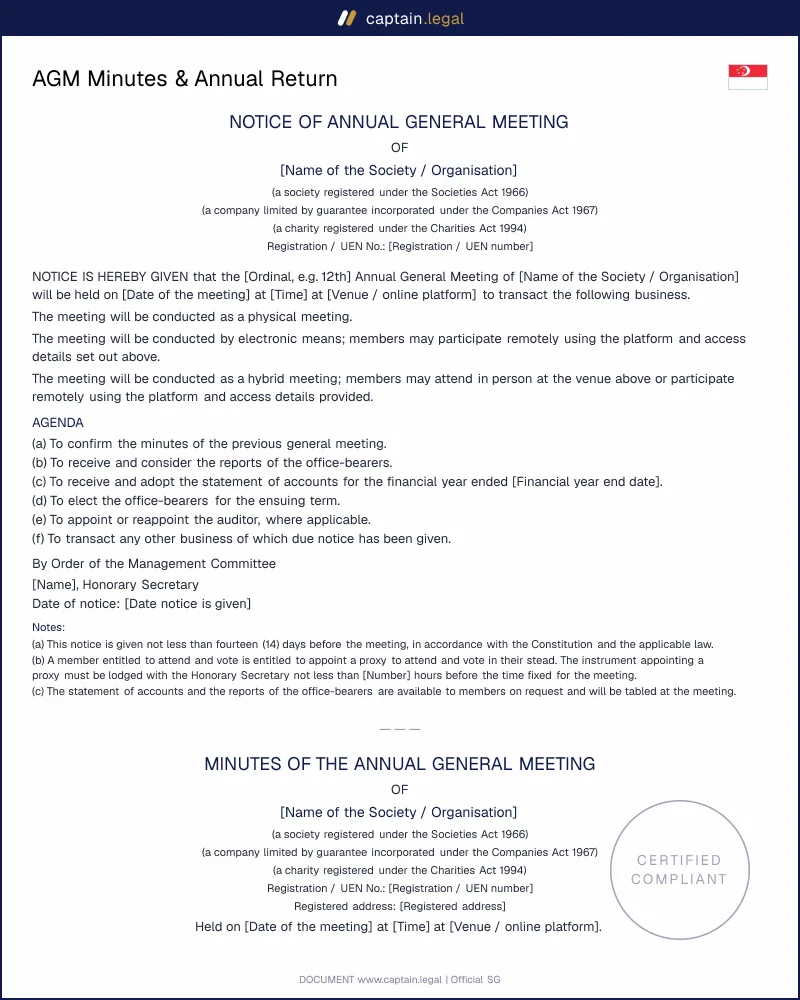
AGM Minutes & Annual Return: Societies Act 1966

Society AGM pack built to Regulation 7 of the Societies Regulations: minutes, audited accounts and signed ROS annual return. Word and PDF.
4.8/531 reviews50 000+ downloadsInstant download
Share

An AGM Minutes and Annual Return Pack is the documentary record a Singapore registered society produces around its annual general meeting: a properly structured set of minutes, the adoption of audited accounts, the election of office-bearers, and the supporting paperwork that feeds your annual return to the Registrar of Societies (ROS). For societies registered under the Societies Act 1966, this is the file that proves the committee met, the members approved the accounts, and the leadership was lawfully appointed. Charities and companies limited by guarantee run a parallel governance cycle, but the society AGM and its one-month filing deadline are the spine of this pack. Built for Singapore practice and downloadable as editable Word and PDF.

Compliant

2026 Legislation

50,000+ clients

trust us

Affordable

From $4.90 / doc

Secure payment

Instant download

AGM Minutes & Annual Return: Societies Act 1966

Secure payment · No subscription

Fill in the template

What is an AGM minutes and annual return pack?

The pack is two related instruments working together. The minutes are the contemporaneous written record of what was decided at the annual general meeting: who chaired, whether a quorum was present, how the audited accounts were received, and which members were elected to the management committee. The annual return is the form your society lodges with the Registrar of Societies afterward, signed by the president, secretary and treasurer, and accompanied by the audited statement of accounts for the last financial year. One documents the meeting; the other reports its outcome to the regulator.

People often confuse minutes with an agenda or a transcript. An agenda is the running order circulated before the meeting; minutes are the approved record made after it. They are not a word-for-word transcript either. Good Singapore society minutes capture resolutions, proposers, seconders and voting outcomes, not the back-and-forth of debate. The distinction matters because under the Societies Act 1966 the committee carries personal responsibility for accurate records, and a society is not a separate legal person in the way a company is. Vague or missing minutes leave individual office-bearers exposed if a dispute or a regulatory query arises later. This pack keeps the two instruments aligned so the annual return reflects exactly what the minutes record.

2

When do you need this document?

The obvious trigger is the yearly AGM itself. Every registered society has to convene the meeting its constitution prescribes, and the moment that meeting closes a one-month clock starts running toward the ROS filing. A society that holds its AGM in March is reporting to the Registrar by April, accounts and all. The second common situation is the annual return with no meeting held: if for some reason the society does not convene an AGM in a given year, Regulation 7 still requires a return within one month of the financial year-end, so the obligation never simply lapses because the committee was inactive.

A third scenario is the change of office-bearers. Most society constitutions tie the election of the president, secretary, treasurer and committee to the AGM cycle, and ROS expects the annual return to reflect the current leadership; stale committee details are a frequent reason returns are queried. The fourth is the adoption of audited accounts, which the members must formally receive at the meeting before those accounts can be lodged.

Two edge cases legitimately complicate matters. A society that ran a fund-raising appeal during the year carries a separate duty under Regulation 6 to file an audited statement within 60 days of the appeal's conclusion, distinct from the annual return, and the minutes should note it. And a society whose income crosses the S$500,000 line mid-cycle suddenly needs a qualified company auditor rather than its usual lay auditor, which changes the certification on the accounts the AGM adopts.

3

Key clauses included in our template

  • The meeting particulars and quorum confirmation open the minutes by recording the date, time, venue and chairperson, then state expressly that the quorum fixed by your constitution was present. Singapore society constitutions commonly set the quorum as a percentage of members, often around a quarter, and a meeting that proceeds without quorum risks having its resolutions challenged, so this entry is load-bearing rather than decorative.
  • The adoption of the audited accounts records that the income-and-expenditure account and balance sheet for the financial year were tabled, that the auditor's certification was noted, and that members resolved to receive and adopt them. This is the resolution that authorises the accounts you attach to the annual return under Regulation 7.
  • The election of office-bearers captures each appointment to the president, secretary, treasurer and committee roles, with proposer, seconder and the voting method used. Because the Societies Act 1966 requires certain office-bearers in specified categories of society to be Singapore Citizens or Permanent Residents, the wording leaves room to confirm eligibility on the record.
  • The standard voting and resolution wording gives clean, reusable language for ordinary and special resolutions, recording numbers for, against and abstaining rather than a narrative of the discussion. Clear voting records are what distinguish minutes that survive scrutiny from notes that do not.
  • The annual return cover and signatory block assembles the return for ROS with the signature lines for all three office-bearers required by Regulation 7, plus a checklist of the certified accounts and any fund-raising statement that must travel with it.
4

Regional considerations

Singapore is a single national jurisdiction, so there is no state or cantonal layer the way there is in federal systems; the Societies Act 1966 and the ROS apply island-wide without local variation. The real divergence is by legal form, and getting that right matters more than any geographic distinction. A body registered as a society under the Act reports to the Registrar of Societies on the AGM-plus-one-month cycle described above, and this pack is built for that path.

A charity registered with the Commissioner of Charities under the Charities Act 1994 sits on a different reporting rhythm, with submission timelines keyed to its financial year-end and obligations under the Code of Governance, and an Institution of a Public Character faces stricter rules again. A company limited by guarantee incorporated with ACRA under the Companies Act 1967 holds its AGM and files its annual return with ACRA, not ROS, and follows the Companies Act timelines rather than Regulation 7. Many Singapore non-profits hold more than one status at once, a society that is also a registered charity being the classic combination, in which case both reporting tracks run in parallel and the AGM minutes need to satisfy each regulator. Confirm which regulator you answer to before you file, because lodging society paperwork on a charity timeline, or the reverse, is a common and avoidable error. Our Singapore company incorporation and corporate resolution templates cover the ACRA-facing documents for the corporate route.

5

How to fill out this AGM minutes and annual return pack

You start by identifying the society and confirming the legal form, since the pack is drafted for a registered society reporting to ROS. From there you enter the meeting particulars, the date, venue and chairperson, and record whether the quorum required by your constitution was met before any business was transacted. The template then walks you through the substantive resolutions in the order a Singapore AGM usually takes them: receiving the audited accounts, adopting them, and electing the management committee with proposers, seconders and vote counts captured for each item.

Once the minutes are settled, you move to the annual return half of the pack, where the signatory block for the president, secretary and treasurer is laid out to match Regulation 7, and a checklist prompts you to attach the certified accounts and any fund-raising statement. You then export the finished file in Word to make final edits or in PDF for signature and lodgement. Because employment of staff and volunteers often surfaces at the AGM, you may also want our Singapore Employment Act contracts and HR letters on hand.

6

Common mistakes to avoid

The most damaging error is treating the one-month deadline as flexible. Regulation 7 gives the society a single month after the AGM to lodge the return, and since S 359/2024 each of the three office-bearers can be individually fined for a default, so a return that drifts into a second month is not a paperwork delay but a personal exposure for named individuals. Closely related is the quorum slip: committees frequently start the meeting, transact business, and only later realise the constitutional quorum was never present, which can unravel the very resolutions the annual return reports. A second recurring problem is mismatched audit certification, where a society whose income has crossed S$500,000 files accounts certified by its old lay auditor instead of the qualified company auditor Regulation 4 now requires.

Other mistakes are quieter but just as real. Minutes that summarise debate instead of recording resolutions, proposers and votes leave no clean evidence of what the members actually decided. Committees forget that a fund-raising appeal carries its own 60-day audited filing separate from the annual return, and then scramble when ROS asks for it. And many societies file a return that still names last year's committee, because the election outcomes in the minutes were never carried through to the return. Each of these is avoidable with a pack that keeps the minutes and the return in step. For broader paperwork, browse the full catalogue of Singapore legal document templates.

Key takeaways

FILING

Annual return due within one month

Under Regulation 7 of the Societies Regulations, the president, secretary and treasurer must lodge the society’s annual return with the Registrar of Societies within one month after the AGM. If no AGM is held, the filing is still required yearly within one month after the close of the financial year. Miss the window and you risk a compliance breach tied to named office-bearers.

RECORDS

Minutes must capture resolutions and votes

AGM minutes are not an agenda or a word-for-word transcript. They are the approved record of decisions: quorum, adoption of audited accounts, election of office-bearers, plus the resolutions, proposers, seconders and voting outcomes. This matters because a society is not structured like a company, and vague or missing minutes can leave individual office-bearers exposed if members dispute an appointment or ROS raises queries.

ACCOUNTS

Audit requirement depends on the S$500,000 threshold

Regulation 4 links your accounts filing to an audit rule. If gross income or expenditure does not exceed S$500,000, the society’s appointed auditor can certify the income-and-expenditure account and balance sheet. Once you exceed S$500,000, the accounts must be audited by a qualified company auditor under the Companies Act 1967, and Regulation 5 specifies what the auditor’s report must state.

Frequently Asked Questions

The templates produce documents that are valid for use under the Societies Act 1966 and the Societies Regulations once they are completed accurately and signed by the office-bearers the law names. The minutes become the society's official record when adopted, and the annual return becomes a regulatory filing the moment the president, secretary and treasurer sign it under Regulation 7. What gives them legal force is correct completion and proper signing, not the format itself, so the responsibility for accurate figures and genuine resolutions stays with your committee. The pack gives you a structure that matches what the Registrar of Societies expects, drafted to current Singapore requirements.

Regulation 7 of the Societies Regulations requires the return to reach the Registrar of Societies within one month after the AGM is held. If your society holds its AGM on 15 March, the return is due by 15 April. Where no AGM is held in a given year, the same regulation still requires a return once in that calendar year, within one month after the close of the financial year, so the duty does not disappear. Because the S 359/2024 amendment makes each office-bearer personally liable on conviction to a fine for a default, treating that one-month window as a firm deadline rather than a target protects the named individuals as much as the society.

Yes. The pack exports as an editable Word file and as a PDF. The Word version is the working copy you adapt to your society's constitution, meeting particulars and committee names before the AGM. The PDF is the clean, lockable version you circulate for signature and keep with the society's records once the office-bearers have signed. Most committees draft and revise in Word, then export to PDF for the final signed minutes and the return that goes to ROS, so both formats earn their place in a single governance cycle.

They need to be audited before they can be adopted and lodged, and the AGM is where members formally receive them. Regulation 4 sets the threshold: where the society's gross income or expenditure does not exceed S$500,000 in the financial year, the society's own appointed auditor can certify the accounts; once that figure is exceeded, a qualified company auditor under the Companies Act must audit them, and Regulation 5 prescribes what that auditor's report must state. The audited accounts then travel with the annual return as the certified statement Regulation 7 requires, which is why the audit has to be finished in time for the meeting.

The return must be signed by the president, the secretary and the treasurer of the society, or by the officers holding the equivalent positions, as Regulation 7 expressly requires. All three signatures are needed because the law places the duty, and the corresponding liability, on each of them jointly. This is also why the election of office-bearers recorded in your AGM minutes feeds directly into the return: the people who sign must be the people lawfully holding those offices. The pack lays out the signatory block to match this requirement so no signature is missed.

Failure to file the annual return as Regulation 7 requires is an offence, and following the S 359/2024 amendment each defaulting office-bearer is liable on conviction to a fine. Persistent non-compliance can draw further regulatory attention from the Registrar, since the ROS maintains a public repository of society filings and monitors societies for compliance. Not holding an AGM does not switch off the duty either, because the regulation provides the alternative deadline of one month after the financial year-end. The practical takeaway is to convene the meeting your constitution requires, adopt the accounts, elect the committee, and lodge on time.

The pack is built for a registered society reporting to the Registrar of Societies, which is the most common Singapore non-profit form and the one tied to the AGM-plus-one-month cycle. A charity registered under the Charities Act 1994 answers to the Commissioner of Charities on a different timeline and under the Code of Governance, and a company limited by guarantee files its AGM paperwork and annual return with ACRA under the Companies Act 1967. Many organisations hold more than one status, so the minutes can be adapted to satisfy more than one regulator, but you should confirm which body you are filing with before you lodge anything.

4.8/5

31 verified reviews · 50 000+ downloads

AGM Minutes & Annual Return: Societies Act 1966
  • Immediate access to the document
  • PDF + Word download
  • Compliant with 2026 legislation
  • Reviewed by lawyers
Fill in the template
Secure payment · No subscription
Updated on June 16, 2026

You might also like

Charity Governance Pack Singapore
Society Constitution Singapore