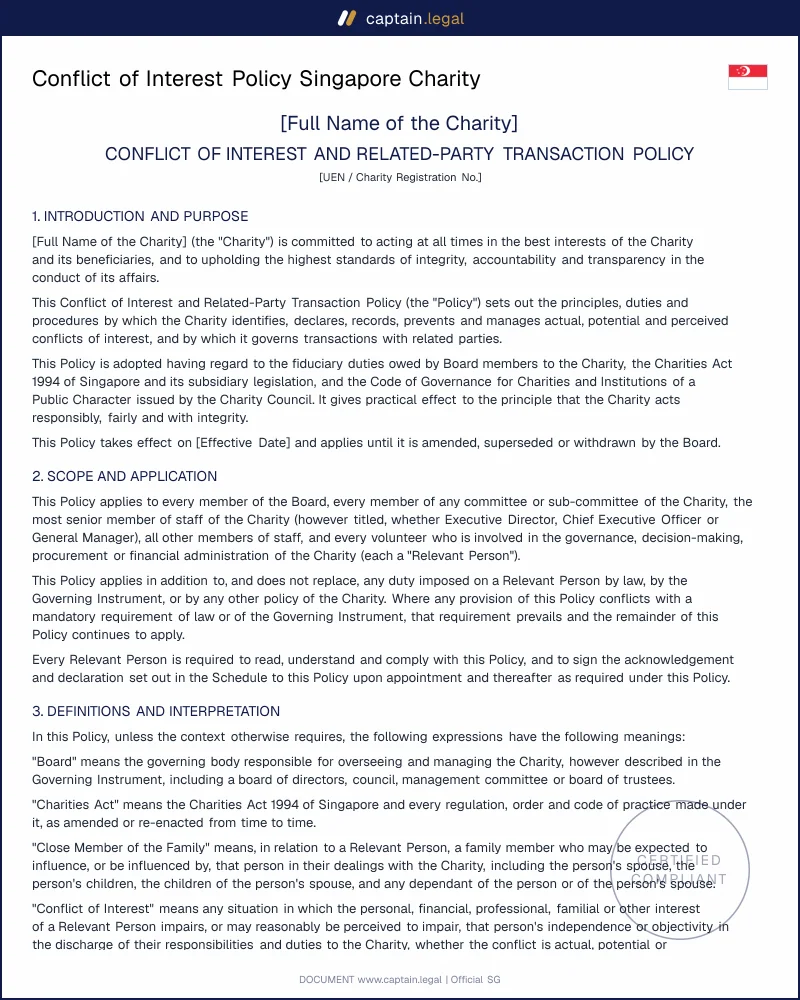
Charity governance in Singapore rests on the Charities Act 1994 and its subsidiary legislation, principally the Charities (Accounts and Annual Report) Regulations, both administered by the Commissioner of Charities under the Ministry of Culture, Community and Youth. The Act imposes fiduciary duties on governing board members, who must act honestly and reasonably in the charity's best interests, and it is from that fiduciary baseline that the obligation to manage conflicts flows. A board member who profits from a transaction they helped approve, without proper disclosure and recusal, breaches that duty regardless of whether the charity suffered actual loss.
The operational standard comes from the Code of Governance for Charities and IPCs, whose current edition took effect for financial years beginning on or after 1 January 2024. Conflict of interest is one of the Code's distinct governance areas, and the general principle is unambiguous: board members and staff should act in the best interests of the charity, and clear policies and procedures should be set to declare, prevent and address conflicts. The Code operates on a comply or explain basis, so a charity that departs from a guideline must justify the departure publicly rather than ignore it. Every charity above the small-entity threshold submits an annual Governance Evaluation Checklist through the Charity Portal, and the checklist asks directly whether a documented conflict of interest policy exists and whether board members make regular declarations. You can read the governing provisions on the official Singapore Statutes Online Charities Act 1994 as published by Singapore Statutes Online.
Financial reporting law closes the loop. Charities preparing accounts under the Charities Accounting Standard, and larger entities under SB-FRS 24 Related Party Disclosures, must disclose material transactions with related parties in their financial statements. A related-party transaction that was never declared to the board is almost impossible to disclose accurately at year end, which is why the policy and the accounts are two halves of the same compliance obligation. For a company limited by guarantee, the Companies Act 1967 adds a statutory layer, since section 156 requires directors to disclose any interest in a transaction or proposed transaction with the company.