Create my document
Login

Choose country

FranceBelgiqueEspañaUnited StatesUnited KingdomالمغربDeutschlandItalia
Employment

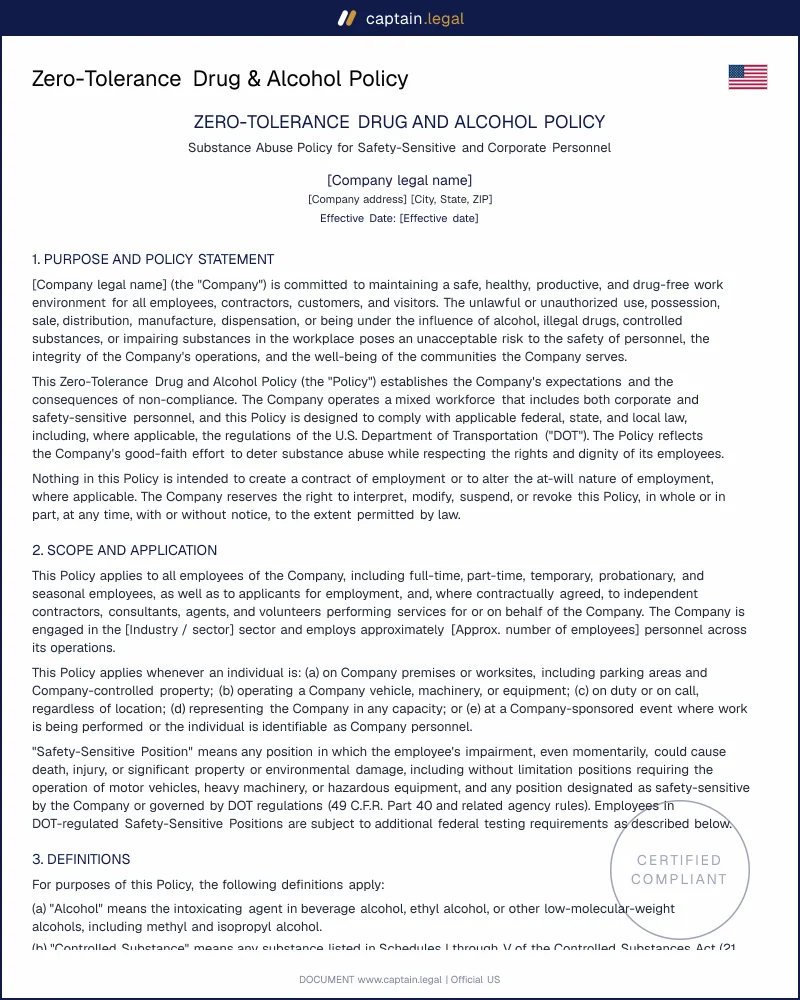
Drug-Free Workplace Policy Template (US) — Word & PDF

Build a defensible zero-tolerance drug and alcohol policy in minutes. Covers testing, ADA accommodations, marijuana clauses and all 50 states.
4.8/518 reviews50 000+ downloadsInstant download
Share

A Zero-Tolerance Drug and Alcohol Policy is the document that tells every worker, in writing, where your company draws the line on substance use and what happens when someone crosses it. It applies whether the role is safety-sensitive (forklift operators, drivers, machine techs) or strictly corporate, and it gives HR the legal backbone to test, discipline, and terminate without improvising under pressure. A clear drug-free workplace policy also protects the employer: it shows you acted consistently, it satisfies insurers and many government contracts, and it shrinks the window for a disgruntled employee to claim selective enforcement.

Most companies discover they need one only after an incident, a near-miss on the floor or a manager who smells alcohol on a sales rep before a client meeting. By then the absence of a written rule is itself the problem. This template is built to be defensible the day you adopt it, not patched together the week after something goes wrong.

Compliant

2026 Legislation

50,000+ clients

trust us

Affordable

From $4.90 / doc

Secure payment

Instant download

Drug-Free Workplace Policy Template (US) — Word & PDF

Secure payment · No subscription

Fill in the template

What is a zero-tolerance drug and alcohol policy?

A zero-tolerance drug and alcohol policy is a written workplace standard that prohibits the use, possession, sale, or impairment from drugs and alcohol during work, on company property, and while conducting company business. "Zero tolerance" describes the consequence side of the equation: a confirmed violation results in discipline up to and including termination, with little or no graduated warning ladder of the kind you would see in an ordinary progressive-discipline policy. That is the feature employers want for safety-sensitive operations, and it is also the feature plaintiffs' lawyers scrutinize most closely, so the drafting has to be precise.

People often confuse this document with a generic substance abuse policy or a single handbook paragraph. The difference matters. A handbook paragraph states a principle; a standalone zero-tolerance policy operationalizes it, defining prohibited substances, the testing circumstances (pre-employment, reasonable suspicion, post-accident, random where lawful), the chain-of-custody expectations, and the employee's rights during the process. It also separates prohibited conduct from protected status, a distinction that keeps the policy lawful under the Americans with Disabilities Act. An employee currently using illegal drugs is not protected; an employee in recovery, or one with an alcohol use disorder who is not impaired at work, often is. A policy that blurs those two categories is the single most common way a well-intentioned employer creates liability. Our template keeps them in separate clauses on purpose, and pairs naturally with a broader all-in-one US employee handbook covering harassment and discipline.

2

When do you need this document?

The clearest trigger is operating any safety-sensitive function where impairment can injure people: warehouses with powered equipment, manufacturing lines, construction, healthcare, anything involving vehicles. Here the policy is less a formality than an insurance and OSHA-defense instrument, because after a serious accident the first question investigators and plaintiffs ask is whether you had a substance program and enforced it. The second trigger is winning or bidding on federal contracts and grants, where the Drug-Free Workplace Act makes a written program a condition of eligibility, and a missing policy can cost you the award.

Corporate and office environments need one too, for different reasons. A purely white-collar firm rarely faces forklift accidents, but it faces client-facing reputation risk, fitness-for-duty questions, and the awkward reality that "we never wrote anything down" is a weak position when you finally have to discipline a senior employee. Adopting the policy company-wide, then layering stricter testing only on safety-sensitive roles, is the structure most employment counsel recommend.

Two edge cases legitimize careful drafting. The first is the recovering employee who voluntarily discloses a problem and asks for help before any test or incident; the policy must route that person toward accommodation and treatment, not automatic termination, or you invite an ADA claim. The second is the prescription medication scenario, where an employee taking a lawfully prescribed Schedule II drug fails a panel; the policy needs a Medical Review Officer step so a verified prescription is not treated as a violation. A document that cannot handle these two situations will fail exactly when it is tested.

3

Key clauses included in our template

  • The scope and definitions clause sets out who is covered, what counts as "company property" and "work time," and which substances are prohibited, listing the standard five-panel drugs and adding alcohol, marijuana, and misused prescriptions. Vague scope is how employers lose enforcement disputes, so the language ties coverage to specific times, places, and conduct rather than a loose "while employed" phrasing.
  • The prohibited conduct clause separates use, possession, sale, and impairment as distinct violations, because an employee can be impaired without possessing anything on site, and the policy needs to reach both. It states plainly that a confirmed violation results in discipline up to termination, which is the operative zero-tolerance language.
  • The testing circumstances clause distinguishes pre-employment, reasonable-suspicion, post-accident, random, and return-to-duty testing, and conditions each on what state law allows. Random testing in particular is restricted or banned for non-DOT roles in several states, so the clause is drafted to switch off where it is unlawful.
  • The reasonable suspicion documentation clause requires a trained supervisor to record specific, observable signs before ordering a test. This is the clause that defeats a wrongful-termination claim, because "I just had a feeling" is not defensible while a dated, witnessed observation sheet is.
  • The ADA and accommodation clause carves out recovering employees and protected medical conditions, directing them to a confidential self-referral path. This clause is what keeps zero tolerance from colliding with disability law.
  • The consequences and self-disclosure clause ties the discipline ladder to the violation type and gives a one-time voluntary disclosure option, which courts view favorably as evidence of good faith. It also references final-pay timing so termination is handled cleanly, an issue the US employee termination letter template addresses in detail.
4

State-specific considerations

State law decides whether several of your clauses are even enforceable, so the template includes a conformity field you complete for each operating state.

California is the most restrictive environment. Random testing of non-safety-sensitive employees is generally unlawful, courts require an actual safety or business justification, and Proposition 64 plus Government Code §12954 bar most employers from penalizing lawful off-duty cannabis use and from relying on tests that detect non-psychoactive THC metabolites. A national zero-tolerance template applied unmodified in California will produce unenforceable testing and exposure to discrimination claims, so the policy switches to an impairment-based standard there.

Texas sits at the other end. The state imposes few restrictions on private-employer testing, recognizes no recreational cannabis protections, and even offers workers' compensation premium incentives for employers who adopt a Texas Workforce Commission-style drug-free workplace program. Here the standard zero-tolerance language operates close to its full strength, and the main drafting task is making sure the policy qualifies for the insurance discount.

Florida mirrors Texas in its employer-friendly posture and maintains a voluntary Drug-Free Workplace Program under §440.101–440.102 Florida Statutes that, when followed precisely, grants a workers' comp premium credit and a rebuttable presumption against benefits for an employee injured while impaired. The catch is procedural: the statutory notice, testing, and employee-assistance steps must be met exactly, or the presumption evaporates.

New York restricts testing more tightly and, through Labor Law §201-d, treats off-duty recreational cannabis use as protected lawful activity, prohibiting adverse action absent articulable impairment at work. New York City layers on its own limits on pre-employment marijuana testing for many positions. The template therefore disables random and pre-employment THC testing for covered New York roles and leans on observed impairment instead.

5

How to fill out this zero-tolerance drug and alcohol policy

You begin by selecting the state or states where you employ people, because that choice drives which testing clauses stay active and which switch to an impairment-only standard. From there the form asks whether any roles are DOT safety-sensitive; answering yes layers in the 49 CFR Part 40 testing panel, the federal alcohol thresholds, and the mandatory return-to-duty language, while answering no keeps the policy on the lighter corporate track. You then name your Designated Employer Representative and, where relevant, your Medical Review Officer, so the document identifies the people authorized to act on results.

Next you choose which testing circumstances apply, pre-employment, reasonable suspicion, post-accident, random, and the template automatically suppresses any option your selected states prohibit. You set the discipline ladder, deciding whether a first verified violation means immediate termination or a last-chance agreement, and you complete the self-disclosure and accommodation language. The final step generates the policy in Word and PDF, ready to attach to your handbook or distribute as a standalone acknowledgment, alongside the independent contractor agreement if your workforce mixes employees and 1099 contractors.

6

Common mistakes to avoid

The error that sinks the most policies is treating "zero tolerance" as license to skip documentation. Employers fire on a positive test, then discover in litigation that no one recorded the reasonable-suspicion signs, the chain of custody was broken, or the result never passed through a Medical Review Officer who could have caught a valid prescription. A second frequent failure is the one-size-fits-all national rollout, applying identical random-testing and marijuana clauses in California and New York that those states forbid, which converts a protective document into evidence of unlawful practice. Employers also routinely confuse current illegal use with protected disability status, terminating a recovering employee who disclosed voluntarily and walking straight into an ADA claim that a properly drafted self-referral clause would have prevented.

The remaining mistakes are quieter but costly. Companies forget to obtain a signed acknowledgment, leaving no proof the employee ever saw the rule. They let managers enforce inconsistently, disciplining a warehouse worker while ignoring an executive, which hands a plaintiff the selective-enforcement argument. And many adopt the policy once and never revisit it, even as state cannabis statutes change yearly, so a clause that was lawful at signing quietly becomes a liability. Pairing the policy with a documented workplace harassment complaint and HR intake process keeps your enforcement records consistent across every conduct issue, not just substance use.

Key takeaways

Zero tolerance

Spell out the line and consequences

A zero-tolerance policy is more than a values statement: it defines what is prohibited (use, possession, sale, or impairment) during work, on company property, and while conducting company business. The point of “zero tolerance” is the consequence: a confirmed violation can lead to discipline up to and including termination, without a typical progressive-warning ladder. Drafting must be precise because this is where disputes usually land.

Testing process

Define when and how testing happens

A defensible policy operationalizes enforcement instead of leaving HR to improvise after an incident. It should specify testing circumstances such as pre-employment, reasonable suspicion, post-accident, and random testing where lawful, and it should set expectations for chain of custody and the employee’s rights during the process. That detail helps you act consistently when a near-miss occurs or a manager suspects impairment before a client meeting.

Compliance

Separate ADA issues and DOT rules

Two legal pressure points drive risk: disability law and transportation regulations. The policy must separate prohibited conduct from protected status under the Americans with Disabilities Act, because current illegal drug use is treated differently than recovery or an alcohol use disorder without on-the-job impairment. If you have DOT-covered safety-sensitive roles, 49 CFR Part 40 requirements apply, including the 0.02 and 0.04 alcohol thresholds, immediate removal, and the Substance Abuse Professional return-to-duty process.

Frequently Asked Questions

The policy becomes binding once you adopt it, distribute it, and have employees sign an acknowledgment confirming they received and understood it. The acknowledgment is what makes enforcement defensible, because it proves notice. A policy sitting unsigned in a drawer carries little weight in a dispute. Keep in mind that binding does not mean immune from challenge: a clause that violates state testing or cannabis law is unenforceable in that state regardless of the signature, which is why completing the state-conformity fields correctly matters as much as collecting the signature itself. For multi-state employers, the 50-state employee handbook provides the surrounding policies that reinforce enforceability.

In most at-will states with employer-friendly testing laws, yes, provided the test was lawful, properly administered, and verified by a Medical Review Officer. The caution lies in three areas: states like California and New York that protect off-duty cannabis use, prescription medications that produce a valid positive, and employees whose positive stems from a protected disability or recovery status. The zero-tolerance standard lets you terminate, but it does not override those protections. Run every first-positive termination through the Medical Review Officer step and the ADA accommodation check before acting, so the discipline holds up if challenged.

A DOT policy is a narrower, federally mandated layer that applies only to safety-sensitive transportation roles and must follow 49 CFR Part 40 to the letter, including the specific drug panel, the 0.02 and 0.04 alcohol thresholds, and the Substance Abuse Professional return-to-duty process. This zero-tolerance policy is the broader company-wide document. If you employ DOT-covered workers, you need both: the federal procedures for those roles and the general policy for everyone else. The template lets you toggle the DOT layer on for the relevant positions while keeping the corporate standard for the rest of your staff.

Yes. The completed document downloads in both Microsoft Word and PDF. The Word file lets you edit clause language, insert your company name and Designated Employer Representative, and adjust the discipline ladder before circulation. The PDF is the clean version you distribute to employees and file with signed acknowledgments. Most employers keep the Word master internally for future amendments, since state cannabis and testing rules change often, and hand out the locked PDF for signature. Both formats carry the same legally operative text.

Speed protects you, but accuracy protects you more. After a confirmed positive or a post-accident situation, remove a safety-sensitive employee from duty immediately, before any final disciplinary decision, to limit risk. Do not terminate until the Medical Review Officer has verified the result and ruled out a valid prescription, which usually takes a few business days. For reasonable-suspicion situations, document the observed signs the same day, while memories are fresh, and order testing promptly so the sample reflects the suspected impairment. Acting fast on removal yet deliberately on termination is the sequence that survives scrutiny.

Not a separate document, but a separate clause, which the template includes. Marijuana requires special handling because it is federally illegal yet protected to varying degrees under state law. In employer-friendly states you can treat a THC positive like any other violation; in states protecting off-duty or medical use, you must shift to an observed-impairment standard and cannot rely on a metabolite test alone. The policy's marijuana clause is drafted to flex with the states you select, so you adopt one document while remaining compliant in each jurisdiction where you operate.

Often, yes. The ADA and many parallel state laws protect employees with alcohol use disorder or those recovering from addiction who are not currently using illegally and can perform the job. A worker who voluntarily discloses and seeks treatment before any incident generally cannot be fired for the disclosure alone, and you may owe a reasonable accommodation such as leave for counseling. Current illegal use and on-the-job impairment remain unprotected. The policy's self-referral and accommodation clause is built precisely to keep these two categories separate, letting you enforce zero tolerance on conduct while honoring the protections recovery status carries.

4.8/5

18 verified reviews · 50 000+ downloads

Drug-Free Workplace Policy Template (US) — Word & PDF
  • Immediate access to the document
  • PDF + Word download
  • Compliant with 2026 legislation
  • Reviewed by lawyers
Fill in the template
Secure payment · No subscription
Updated on May 29, 2026

You might also like

Employee Handbook Template
Final Paycheck & Offboarding Checklist