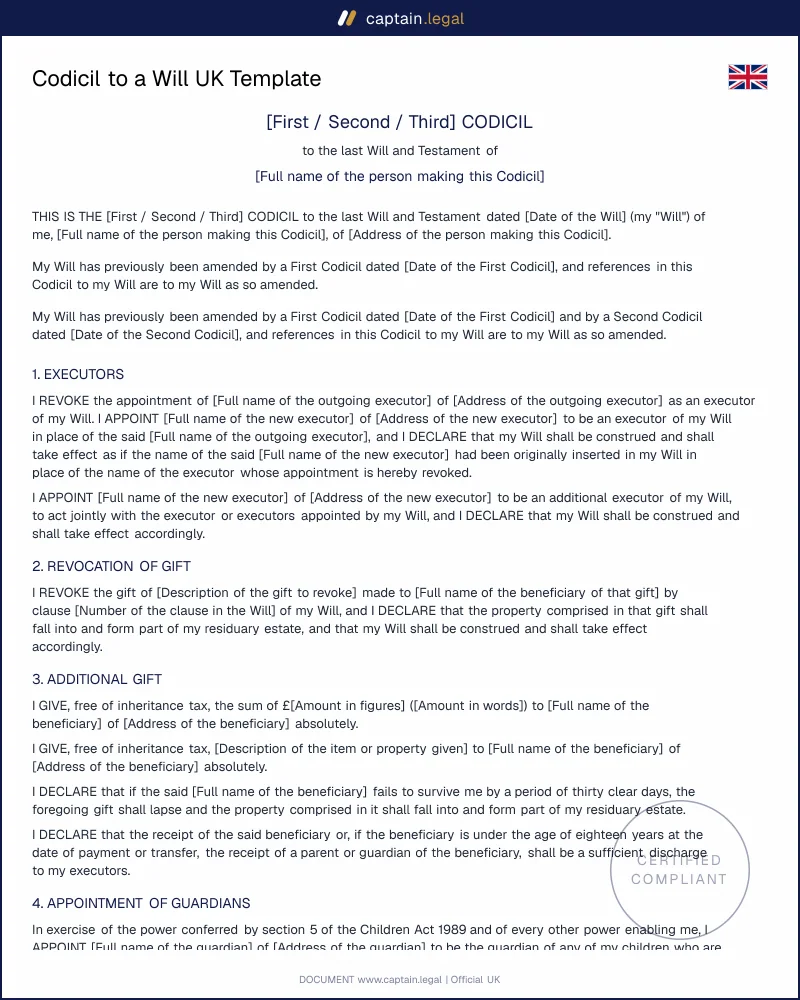
This template is drafted for wills governed by the law of England and Wales, where the Wills Act 1837 and the Administration of Justice Act 1982 set the execution rules. The section 9 formalities, the two-witness requirement, and the section 15 rule voiding gifts to witnessing beneficiaries all apply uniformly across these two jurisdictions, so there is no internal variation to worry about between, say, London and Cardiff.
Northern Ireland follows substantially the same execution framework. The Wills Act 1837 extends there, and the two-witness rule and beneficiary-witness prohibition operate in the same way, which is why this codicil is suitable for Northern Irish wills as well. The practical machinery of probate is administered separately through the Northern Ireland Courts and Tribunals Service, so while the codicil's validity turns on the same statute, the administration of the estate afterwards runs through a different registry.
Scotland is the important exception. Scots succession law is a separate legal system built on different principles, and the concept of a codicil operates under Scottish rather than Wills Act 1837 rules, including distinct requirements around subscription and, historically, self-proving arrangements. Scotland also recognises legal rights (legitim) that protect certain family members from disinheritance in a way English law does not. Do not use an England and Wales codicil for a Scottish will. If your original will was made under Scots law, you need a document drafted specifically for that jurisdiction. When in doubt about which law governs your will, check the will itself, since a well-drafted will states its governing law on its face. For estate-related debts and money matters that sit outside the will, our private loan agreement template for individuals covers a common adjacent need.