Create my document
Login

Choose country

United StatesUnited StatesChoose country
Business

Partnership Dissolution Agreement | RUPA, All 50 States

Wind down your partnership under RUPA Section 807 priority rules. Lawyer-grade settlement of accounts, mutual release and liability allocation.
4.8/525 reviews50 000+ downloadsInstant download
Share

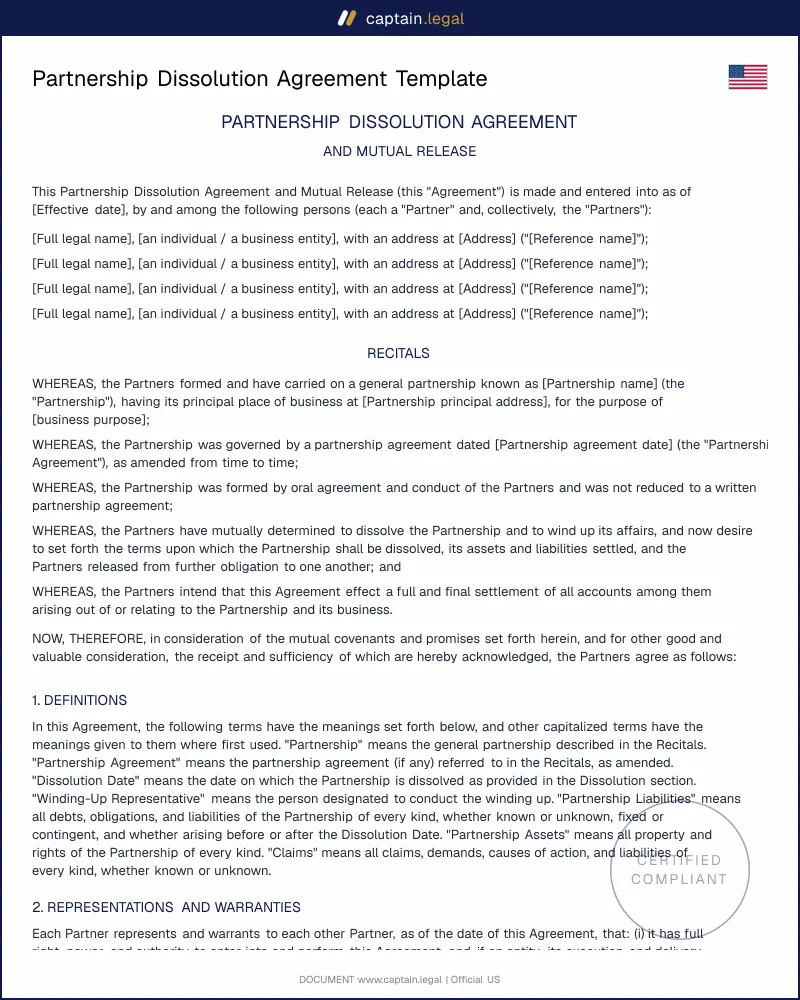
A partnership dissolution agreement is the written contract two or more partners sign when they decide to wind down a business they built together. It records how the partnership's remaining assets are divided, how outstanding debts are allocated, and how each partner releases the others from future claims arising out of the venture. For general and limited partnerships across all 50 states, this document turns an emotional, often tense breakup into an orderly settlement that holds up if a creditor, the IRS, or a former partner later comes asking questions. Whether you are dissolving a two-person consulting shop or a multi-partner real estate venture, a clean dissolution agreement is what separates a quiet wind-down from years of litigation.

Compliant

2026 Legislation

50,000+ clients

trust us

Affordable

From $4.90 / doc

Secure payment

Instant download

Partnership Dissolution Agreement | RUPA, All 50 States

Secure payment · No subscription

Fill in the template

What is a partnership dissolution agreement?

A partnership dissolution agreement is the instrument that formally ends the business relationship between partners and sets the terms for winding up the firm's affairs. It is not the same thing as dissolution itself. Under modern partnership law, dissolution is the legal event that starts the wind-down clock, while winding up is the process of liquidating assets, paying creditors, and settling accounts. The agreement is the document that governs that process and records what everyone agreed to.

People routinely confuse three terms that mean very different things. Dissociation is one partner leaving while the business continues. Dissolution is the decision to stop carrying on the business altogether and wind it up. Termination is the final moment when winding up is complete and the partnership legally ceases to exist. A dissolution agreement lives squarely in the second and third stages: it documents the choice to dissolve and maps out the path to termination. Signing one does not, by itself, extinguish your liability to outside creditors; it allocates that liability among the partners and creates a contractual record of who promised to pay what. A well-drafted agreement also distinguishes itself from a simple buyout agreement, which keeps the firm alive while one partner exits. If your goal is to keep operating with fewer partners, you want a different document entirely, which is why many founders pair this with a partnership agreement covering general and limited structures.

2

When do you need this document?

The clearest trigger is a mutual decision to close the business for good. Two partners who have run a profitable shop for a decade and now want to retire need a written settlement that divides the remaining cash, equipment, and goodwill and releases each from future claims. The handshake that started the partnership is exactly what you do not want governing its end, because memory fades and incentives shift the moment money is on the table.

A second common scenario is the breakdown of the working relationship. When partners no longer agree on direction and neither wants to buy the other out, dissolution is often the cleanest exit. Here the agreement does double duty: it settles accounts and it contains the mutual release language that stops one partner from suing the other six months later over a deal that soured. A third trigger is the departure or death of a partner in a small firm where the others have no appetite to continue. If the partnership agreement did not provide for continuation, RUPA Section 801 may force a winding up by default.

Two edge cases deserve attention. First, a term partnership formed for a fixed period or a specific project. In a partnership for a definite term, dissolution after a partner's dissociation requires at least half of the remaining partners to express the will to wind up within 90 days. Miss that window and the business may continue against your wishes. Second, partnerships holding real property: transferring title during wind-up often requires its own instrument, which is why dissolving partners frequently need a quit claim deed to convey property between partners as part of the settlement.

3

Key clauses included in our template

  • The recital of dissolution and effective date states plainly that the partners agree to dissolve the partnership and fixes the date winding up begins. This date matters because it cuts off the partners' authority to take on new obligations except those needed to wind up, a limit drawn directly from RUPA Section 804. Vague language like "sometime this spring" invites disputes over which debts the partnership is responsible for.
  • The settlement of accounts and asset distribution provision tracks the statutory priority of RUPA Section 807, applying assets first to outside creditors, then to partner loans, then to capital, and finally to profit shares. Each partner's capital account is reconciled, and the agreement records the exact dollar figure or formula governing the final distribution rather than leaving it to later argument.
  • The allocation of remaining liabilities assigns responsibility for known debts, contingent obligations, and taxes among the partners. Because the dissolution agreement binds only the partners and not third-party creditors, this clause is paired with indemnification so that a partner who pays more than their share can recover from the others.
  • The mutual release and waiver of claims is the heart of a litigation-proof dissolution. Each partner releases the others from claims arising out of the partnership, subject to carve-outs for fraud, undisclosed liabilities, and obligations created by the agreement itself. Drafting the carve-outs correctly is what keeps the release enforceable.
  • The wind-up authority and final accounting clause names who is responsible for collecting receivables, selling assets, filing the final tax return, and lodging the Statement of Dissolution with the state. It also requires a closing accounting that every partner signs off on, which is your evidentiary record if a dispute surfaces years later.
4

State-specific considerations

California codifies RUPA in the California Corporations Code, and the winding-up priority sits in §16807, mirroring the uniform rule that creditors are paid before any partner sees a distribution. Under California Corporations Code Section 16801, a partnership can avoid dissolution if a majority of the remaining partners agree to continue the business within 90 days of a triggering dissociation. California also values a departing partner's interest at fair value rather than fair market value under §16701, which typically avoids minority and marketability discounts and can meaningfully raise the buyout figure if your dissolution turns into a continuation.

Texas does not follow RUPA's section numbering. Partnership dissolution is governed by the Texas Business Organizations Code, Chapter 152, the same chapter that controls partnership formation and operation. Texas uses the term "winding up" and requires that a partnership wind up its business on events including the express will of all partners or the occurrence of an event specified in the partnership agreement. Texas practitioners should draft to the BOC's specific language on events requiring winding up rather than importing RUPA section citations that have no counterpart in the Texas code.

Florida adopted RUPA as Chapter 620, Florida Statutes. The state follows the uniform distribution priority and recognizes the Statement of Dissolution mechanism for cutting off third-party reliance on a partner's authority. Florida courts read the fiduciary duties of loyalty and care strictly during winding up, so a partner who diverts a partnership opportunity while the business is being liquidated risks personal liability even after the dissolution agreement is signed.

New York is one of the minority of states that never adopted RUPA and instead applies its older New York Partnership Law, which derives from the 1914 UPA. The practical difference is significant: under the older statute, a partner's withdrawal can dissolve the partnership more readily, and the continuation mechanics RUPA created do not apply in the same way. A New York dissolution agreement should never be drafted from a RUPA template without adjustment, because the default rules on dissolution events and partner authority are genuinely different. New York partners winding up a venture often coordinate the settlement with a broader shareholder or stockholders' agreement when the partnership also held equity in an affiliated corporation.

5

How to fill out this partnership dissolution agreement

You start by selecting the state where your partnership was formed, because that single choice drives the statutory citations, the distribution priority language, and the notice requirements the rest of the document depends on. From there you identify the partnership by its legal name and the partners by name, and you specify whether this is a general or limited partnership, since limited partnerships carry additional filing obligations. The form then walks you through the effective date of dissolution and asks you to confirm whether all partners consent, which is the cleanest basis for a wind-up.

Next you reconcile the financial picture. You list the partnership's assets, its known debts, and each partner's capital account balance, and the document applies the Section 807 priority automatically so distributions follow the statutory order. You then choose how remaining liabilities are allocated and whether partners indemnify one another. The final steps cover the mutual release, name the partner responsible for winding up, and prepare the signature blocks. If your state requires a Statement of Dissolution filing, the document flags it so the wind-up is recorded with the appropriate authority. The output is an editable Word file and a clean PDF, both ready to sign without a lawyer redrafting from scratch.

6

Common mistakes to avoid

The most expensive error is paying the partners before the creditors. Partners closing a business often want their capital back first, but RUPA Section 807 puts outside creditors ahead of every partner, and a distribution that ignores this order can be clawed back, leaving the partners personally exposed. A related mistake is treating the dissolution agreement as if it binds the firm's lenders. It does not. The agreement allocates debt among the partners, but a creditor who was not a party can still pursue any partner for the full obligation, which is precisely why the indemnification and contribution clauses matter so much. Skipping them turns a tidy settlement into a one-sided exposure for whichever partner the creditor happens to sue first.

Founders also forget to formally cut off authority and notice. Without a Statement of Dissolution on file, a former partner can still appear to bind the partnership to new contracts, and the firm may be on the hook. Another frequent oversight is a release with no carve-outs, which either fails for overbreadth or accidentally waives claims for fraud and undisclosed debts that should survive. Finally, many partners neglect the final tax return and the closing accounting. The IRS treats dissolution as a taxable event with reporting obligations, and a missing final Form 1065 or unreconciled capital account is the kind of loose end that resurfaces during an audit long after everyone thought the business was closed. Partners winding up an LLC-structured venture should align this document with their LLC operating agreement governing member buyouts to keep the entity-level paperwork consistent.

Key takeaways

Purpose

Put the wind-down terms in writing

A partnership dissolution agreement is the contract that documents how you will wind up the business: who gets which remaining assets, who pays which debts, and what each partner is releasing. It turns a messy breakup into an audit-friendly record that can matter later if a creditor, the IRS, or a former partner challenges the settlement.

Definitions

Dissociation is not dissolution or termination

These terms drive what you actually need to do. Dissociation can mean one partner exits while the business continues. Dissolution is the legal event that starts winding up, and termination is the end point when winding up is complete and the partnership ceases to exist. If you want the firm to keep operating, a buyout is often the right tool, not a dissolution agreement.

Liability

Signing does not erase outside creditor claims

The agreement can allocate liability among partners, but it does not, by itself, wipe out what you owe to third parties. If a vendor, lender, or other creditor has a valid claim, they can still pursue the partnership and, depending on the structure and state law, the partners. The document mainly protects you internally by locking in who promised to pay what.

Frequently Asked Questions

Yes. A partnership dissolution agreement is a binding contract among the partners once it is signed by everyone with authority and supported by the partners' mutual promises to settle accounts and release claims. It governs how assets and liabilities are divided between the partners and is enforceable in court like any other contract. What it cannot do is bind people who never signed it. Outside creditors, the IRS, and other third parties are not parties to the agreement, so it allocates responsibility among the partners rather than extinguishing the firm's obligations to the outside world. That distinction is why the indemnification and contribution clauses do the real protective work.

It depends on the structure and the state. A general partnership formed without any state filing can often dissolve without a formal filing, though most states allow you to file a Statement of Dissolution to give third parties constructive notice and cut off a former partner's authority to bind the firm. Limited partnerships and limited liability partnerships, which were created by filing with the secretary of state, generally must file a certificate of cancellation or equivalent to complete termination. You can review related formation paperwork through the articles of incorporation and entity formation templates to understand what your state expects.

The partnership dissolution agreement is delivered in two formats. You receive an editable Microsoft Word file so you can adjust partner names, dollar figures, asset descriptions, and any state-specific clauses before signing, and you receive a clean, print-ready PDF for signature and recordkeeping. Having both means you can negotiate the terms in Word with the other partners, then lock the final version as a PDF that every partner signs. Both formats reflect the same state-aware language you selected during the questionnaire, so nothing is lost when you move from draft to final.

There is no fixed statutory deadline, because winding up lasts as long as it takes to collect receivables, sell assets, pay creditors, and settle the partners' accounts. A simple two-partner service business with no outstanding debt can wind up in a few weeks. A partnership holding real estate, inventory, or contingent liabilities can take many months. One timing rule does bite: in a term partnership, the remaining partners must express their will to wind up within 90 days of a triggering dissociation, or the business may continue by default. The dissolution agreement should fix an effective date and a target completion date to keep the process moving.

Dissolution does not erase debts. During winding up, the partnership's assets are applied first to creditors, following the priority in RUPA Section 807, before any partner receives a distribution. If the assets are not enough to cover the debts, partners in a general partnership remain personally liable, and each must contribute in proportion to how they share losses. The dissolution agreement allocates that responsibility internally and adds indemnification so a partner who overpays can recover from the others, but it cannot stop a creditor from pursuing any individual partner for the full amount of a partnership obligation incurred before dissolution.

Often, yes, though it depends on your structure and state. In an at-will partnership under RUPA, a single partner's express will to withdraw can trigger dissolution and a mandatory winding up. In a term partnership, one partner alone usually cannot force a wind-up; it takes at least half the remaining partners agreeing within the 90-day window. A court can also order dissolution for cause, such as serious misconduct or when continuing the business has become impracticable. Because the answer turns on whether your partnership is at-will or for a term, and on your state's statute, the dissolution agreement should record which basis applies.

Not automatically. A partner remains liable for partnership obligations that arose while they were a partner, and signing a dissolution agreement does not change that as to outside creditors. What protects you going forward is proper notice. Filing a Statement of Dissolution and giving actual notice to known creditors limits your exposure for new obligations, while the agreement's release and indemnification provisions govern claims between you and your former partners. To fully close the loop, you also settle the final accounting and file the partnership's final federal tax return so no reporting obligation lingers after termination.

4.8/5

25 verified reviews · 50 000+ downloads

Partnership Dissolution Agreement | RUPA, All 50 States
  • Immediate access to the document
  • PDF + Word download
  • Compliant with 2026 legislation
  • Reviewed by lawyers
Fill in the template
Secure payment · No subscription
Updated on June 30, 2026

You might also like

Privacy Policy Template
Demand Letter for Payment Template