Create my document
Login

Choose country

SingaporeSingaporeChoose country
Real Estate

End Your Singapore Lease Early Without Losing Your Deposit

Diplomatic and break clause termination notice for Singapore lease practice: notice calculation, proof of trigger and IRAS-stamped security deposit refund.
4.7/518 reviews50 000+ downloadsInstant download
Share

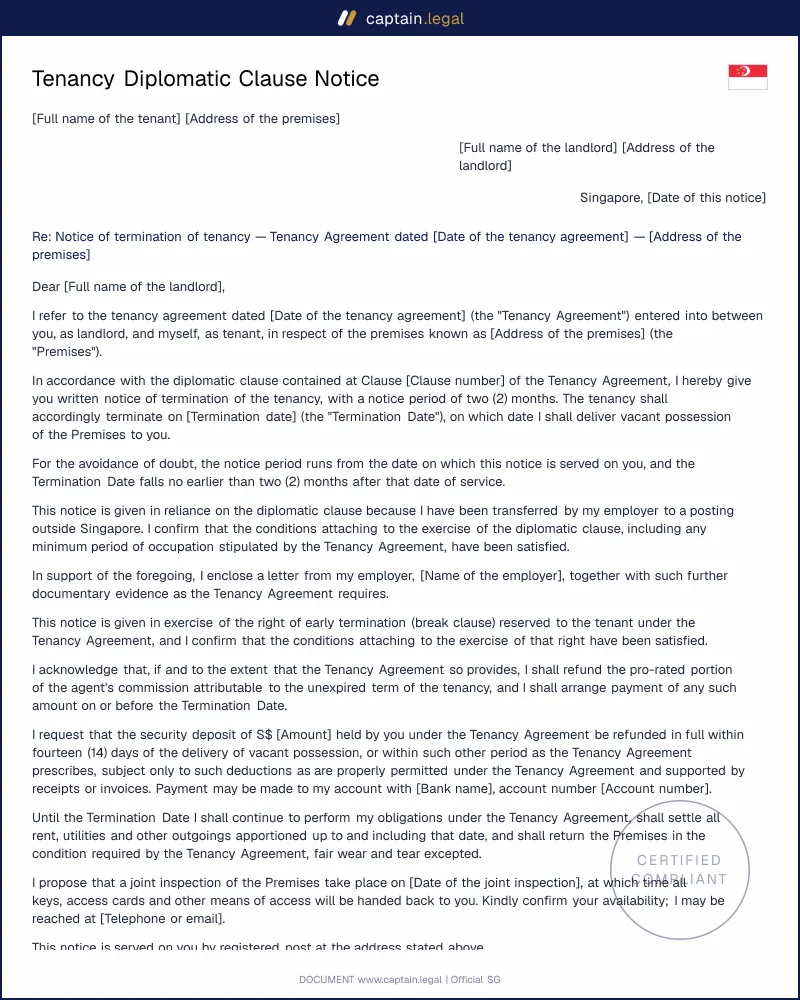
A Tenancy Termination and Diplomatic Clause Notice is the written notice a tenant serves on a landlord to bring a Singapore tenancy to an end before its fixed term expires, relying on the diplomatic clause or a negotiated break clause in the tenancy agreement. It is the instrument that turns a contractual right into an actual exit: without a correctly drafted and correctly served notice, an expatriate posted out of Singapore or a professional whose Employment Pass has been cancelled remains liable for every remaining month of rent. This page explains how the notice works under Singapore lease practice, how the two-month notice period is calculated, and how the security deposit is meant to come back to you.

Compliant

2026 Legislation

50,000+ clients

trust us

Affordable

From $4.90 / doc

Secure payment

Instant download

End Your Singapore Lease Early Without Losing Your Deposit

Secure payment

Fill in the template

What is a tenancy termination and diplomatic clause notice?

A tenancy termination and diplomatic clause notice is a formal letter from the tenant invoking a specific early-exit provision already written into the tenancy agreement. It is not a general right to walk away. Singapore has no statute that lets a tenant end a fixed-term lease at will, so the notice only works if the agreement contains the clause it relies on. The most common trigger is the diplomatic clause, which lets a tenant terminate after a minimum occupancy (conventionally twelve months on a two-year lease) when the tenant or a named household member is transferred out of Singapore, made redundant, or has an Employment Pass, S Pass or Work Permit cancelled by the Ministry of Manpower for reasons not attributable to them.

People often confuse this with a break clause (sometimes called an exit or escape clause), which is broader. A diplomatic clause is triggered only by an involuntary departure from Singapore, whereas a break clause can be negotiated to allow early exit for reasons the parties define upfront, including buying a home or relocating within Singapore. Both are served the same way, through a dated written notice, but the trigger event and the proof they demand differ. Getting the label right matters because a landlord who receives a "diplomatic clause" notice for a voluntary move can reject it and treat the departure as a breach. The Singapore tenancy agreement template is where these clauses are first negotiated, and the notice simply activates what was agreed there.

2

When do you need this document?

The textbook scenario is an involuntary posting out of Singapore. A tenant on a two-year lease is transferred to another office after fourteen months, has served the twelve-month minimum, and serves a diplomatic clause notice with the employer's transfer letter attached. The next most frequent trigger is pass cancellation: an Employment Pass or S Pass not renewed or withdrawn by MOM for reasons outside the tenant's control, evidenced by the MOM cancellation letter or IR21 tax-clearance documents. Redundancy sits in the same category, provided the clause is drafted to cover loss of employment rather than only relocation.

A break clause notice covers the cases a diplomatic clause deliberately excludes. A tenant who decides to buy an HDB flat, move in with family, or downsize to a cheaper unit has no diplomatic right to leave, but may have negotiated a break clause allowing exit on defined notice. One edge case worth flagging is the en bloc situation, where a collective sale forces the tenant out. If the agreement has no en bloc clause, a tenant evicted by a collective sale can claim compensation from the landlord for the unexpired term, so read whether that protection exists before assuming the deposit is your only exposure. Another trap is serving notice before the minimum occupancy has run: a notice dated one day early is a notice served under the wrong clause, and the landlord can treat the whole thing as an ordinary breach. The letter of intent to rent property stage is where a careful tenant first secures these protections, well before any notice is needed.

3

Key clauses reflected in this notice

  • The identification of the terminating provision states plainly which clause you are invoking, quoting the clause number and the exact language of the tenancy agreement. A notice that merely says "I am leaving" gives the landlord room to dispute which right you are exercising, so the notice names the diplomatic clause or break clause and reproduces its trigger wording.
  • The statement of the trigger event sets out the qualifying fact: the transfer, the redundancy, or the pass cancellation, with the date it occurred. This is the fact the landlord will test, and vague phrasing invites rejection. The notice ties the event to the clause and confirms the minimum occupancy has been served.
  • The notice period and effective date fix the day the tenancy ends. The Singapore convention is two months' written notice, and the notice states both the service date and the termination date so there is no argument about when rent stops. Where the clause allows payment of rent in lieu of notice, the notice records which option the tenant elects.
  • The proof of the trigger is listed and attached: an employer's transfer or termination letter, the MOM pass-cancellation notice, or immigration confirmation. Some landlords will not accept a company letter alone and require immigration evidence, so the notice references what the clause specifies as acceptable proof.
  • The security deposit and handover paragraph confirms the tenant's expectation of a full refund less genuine deductions, and proposes a joint inspection date. It also addresses any reimbursement clause, under which the tenant refunds the landlord a pro-rata share of the agent's commission for the unexpired term.
4

Regional and property-type considerations

Private condominiums and landed homes are the most flexible setting for these notices. The minimum rental period for private residential lettings is three months, and diplomatic clauses are near-universal on 24-month expatriate leases in areas like Orchard, Tanjong Pagar and the CBD. The notice follows the contract wording directly, and the two-month convention almost always applies. Where the tenant used their own agent, the notice should anticipate the reimbursement clause and offer the pro-rata commission figure rather than wait for the landlord to raise it.

HDB flats and rooms carry an extra layer. Subletting a whole flat or a bedroom needs HDB approval, the minimum sublet period is six months, and early termination must respect the terms on which HDB approved the sublet. A diplomatic clause can still be included, but the notice should confirm that the approved sublet arrangement is being wound down correctly, because an irregular exit can affect the landlord's standing with HDB. The occupancy caps that apply to HDB rentals mean the departing tenant's exit may also affect remaining occupants, so the room rental agreement for HDB and condo units should be checked for how shared arrangements unwind.

For corporate and diplomatic leases, the clause is often stronger and the proof requirements clearer, because the tenant is an institution rather than an individual. These leases frequently name the occupant by passport and FIN number, and the notice must match that named individual to the triggering event. In every property type, the deposit refund window is a contractual figure, commonly 14 days after handover, and the notice should restate it so the deadline is on the record.

5

How to fill out this tenancy termination notice

You begin by identifying the exact clause you are relying on, copying its number and trigger wording from your signed tenancy agreement so the notice speaks the same language as the contract. From there you state the qualifying event and its date, then confirm the minimum occupancy has been served, since a notice served a day early fails. You set the service date and count forward the contractual notice period, usually two months, to fix the termination date, and you decide whether you are giving notice or paying rent in lieu where the clause offers that choice. You then attach the proof the clause demands, whether an employer letter, an MOM pass-cancellation notice, or immigration confirmation, because a notice without documentation lets the landlord defer release of the deposit. Finally, you propose a joint inspection and restate the deposit-refund window and any reimbursement obligation, so the handover and the money are settled in the same document. The rent receipt and deposit acknowledgement then records the return of the deposit once the inspection is done, closing the tenancy cleanly.

6

Common mistakes to avoid

The single most damaging error is serving notice before the minimum occupancy has run. A diplomatic clause that activates after twelve months means twelve full months from the commencement date, and a tenant who counts from the wrong date, or who forgets that a mid-month start pushes the earliest exercise date later, hands the landlord a reason to reject the notice and keep the deposit. The second recurring mistake is inadequate proof. A landlord entitled to immigration evidence will not accept a bare company email, so a tenant who serves notice with weak documentation buys weeks of delay and sometimes a refused release. Confusing a diplomatic clause with a break clause is the third: a tenant leaving voluntarily who cites the diplomatic clause is in breach, because that clause covers only involuntary departure from Singapore.

Two further errors surface at handover. Tenants frequently forget the reimbursement clause, then dispute the pro-rata commission the landlord deducts, when the obligation was in the agreement all along. And many overlook stamping: because an unstamped agreement is inadmissible, a tenant who never stamped the lease cannot rely on it if the deposit dispute reaches the Small Claims Tribunals. Serving notice by an untracked channel is the quiet fifth mistake, since a tenant who cannot prove the landlord received the notice on a given date cannot prove when the two-month clock started.

Key takeaways

NO STATUTORY EXIT

You can only leave early if the clause exists

Singapore residential leases are governed mainly by contract and common law, with no general legal right to end a fixed-term tenancy at will. Your termination notice works only if your tenancy agreement contains a diplomatic clause or a negotiated break clause, and you follow its minimum stay and notice requirements. Without that clause, moving out early can still leave you liable for the remaining months’ rent.

TRIGGER & PROOF

Match your notice to the right trigger

A diplomatic clause is not the same as a break clause. The diplomatic clause usually applies only to involuntary departure from Singapore, such as a transfer, redundancy, or MOM cancellation of an Employment Pass, S Pass or Work Permit for reasons not attributable to the tenant. If you label a voluntary relocation as “diplomatic”, the landlord can reject it and treat your departure as a breach, so attach the correct supporting documents.

STAMPING

An unstamped lease can weaken your deposit claim

Stamping is the hard statutory touchpoint. Under the Stamp Duties Act 1929, lease duty of 0.4% of total rent for the term must be paid to IRAS within 14 days of signing, and an unstamped tenancy agreement is not admissible in evidence until duty and penalties are settled. If a security deposit dispute follows your notice, check the IRAS e-stamp certificate exists before you proceed.

Frequently Asked Questions

The notice is binding to the extent the tenancy agreement authorises it. Singapore has no statutory right to break a fixed lease, so a diplomatic clause or break clause notice takes effect only if that clause exists in your signed agreement and you meet its conditions: the minimum occupancy served, a qualifying trigger, correct notice length, and the proof the clause requires. When those boxes are ticked, the notice validly ends the tenancy and the deposit is returned in the normal way. If any element is missing, the landlord can treat the departure as a breach and pursue rent for the unexpired term, which is why the wording and the timing carry so much weight.

The convention in Singapore leases is two months' written notice, counted from the date the landlord actually receives the notice, not the date you wrote it. If you serve a valid notice on 10 March, the tenancy ends on 10 May, and rent runs to that termination date. Some clauses let the tenant pay two months' rent in lieu of serving notice, which suits a tenant with a hard departure date who cannot wait out the full period. Because the start of the clock depends on receipt, serving through a channel that proves delivery matters. The Notice to Quit template covers the landlord-side equivalent where the roles are reversed.

You attach whatever the clause defines as acceptable proof, and this varies. The common documents are an employer's transfer or termination letter, the Ministry of Manpower notice cancelling or not renewing your Employment Pass or S Pass, and sometimes IR21 tax-clearance papers. A number of landlords will not accept a company letter on its own and require immigration confirmation of the pass cancellation. Read your clause before you draft the notice, because attaching the wrong document, or too little, gives the landlord grounds to hold the deposit until proper evidence arrives. The safest approach is to over-document rather than under-document.

If the notice is validly served, the deposit is returned in the ordinary way, subject to the usual deductions. In Singapore the deposit is conventionally one month's rent per year of lease, and it comes back less genuine deductions for damage beyond fair wear and tear, unpaid rent, and outstanding utility bills. The typical refund window is 14 days after handover, giving the landlord time to inspect. A joint inspection with dated photographs is your best protection, because deposit deductions are the most common tenancy dispute the Small Claims Tribunals see. Fair wear and tear cannot lawfully be charged to you if the agreement excludes it.

Yes. The tenancy termination and diplomatic clause notice is available in both Word and PDF formats, so you can adjust the clause reference, the trigger event, the dates and the proof list to match your own tenancy agreement, then produce a clean copy to serve. The Word version is useful where your clause wording differs from the market standard and you need to quote it exactly, while the PDF is the fixed copy you send and keep for your records. Having a dated, editable draft also makes it easier to align the notice with the specific occupancy and notice figures in your lease.

It can, but with conditions. Subletting an HDB flat or room requires HDB approval, the minimum sublet period is six months, and any early termination has to respect the terms on which the sublet was approved. A diplomatic clause can be written into an HDB tenancy, yet the exit needs to be handled so the landlord's standing with HDB is not compromised. Because HDB rules sit on top of the contract, an HDB tenant should confirm both the clause and the approval position before serving notice. You can browse related property documents in the full Singapore legal document catalogue.

Then you have no automatic right to leave early. Without the clause, a tenant who vacates before the fixed term ends is in breach and remains liable for rent until the end of the lease or until the landlord re-lets, and the landlord may forfeit the deposit toward that loss. Your realistic options are to negotiate an early surrender with the landlord, often by offering to cover the re-letting costs, or to find a replacement tenant the landlord will accept. This is why the clause is negotiated at signing rather than invoked later, and why a tenant likely to be posted out should insist on it before the tenancy agreement is drafted. Employment-related evidence such as your key employment terms statement can help substantiate the circumstances of a job-driven departure when you open that negotiation.

4.7/5

18 verified reviews · 50 000+ downloads

End Your Singapore Lease Early Without Losing Your Deposit
  • Immediate access to the document
  • PDF + Word download
  • Compliant with 2026 legislation
  • Reviewed by lawyers
Fill in the template
Secure payment
Updated on July 11, 2026

You might also like

Room Rental Agreement Singapore
Rent Receipt & Deposit Acknowledgement