Create my document
Login

Choose country

United StatesUnited StatesChoose country
Real Estate

Pet Addendum Template | Deposit Caps & Fair Housing Rules

Pet addendum drafted to state law: Civil Code 1950.5 deposit caps, NY GOL 7-108, Florida Statute 760.27 support animals, Fair Housing wording. Word & PDF.
4.6/517 reviews50 000+ downloadsInstant download
Share

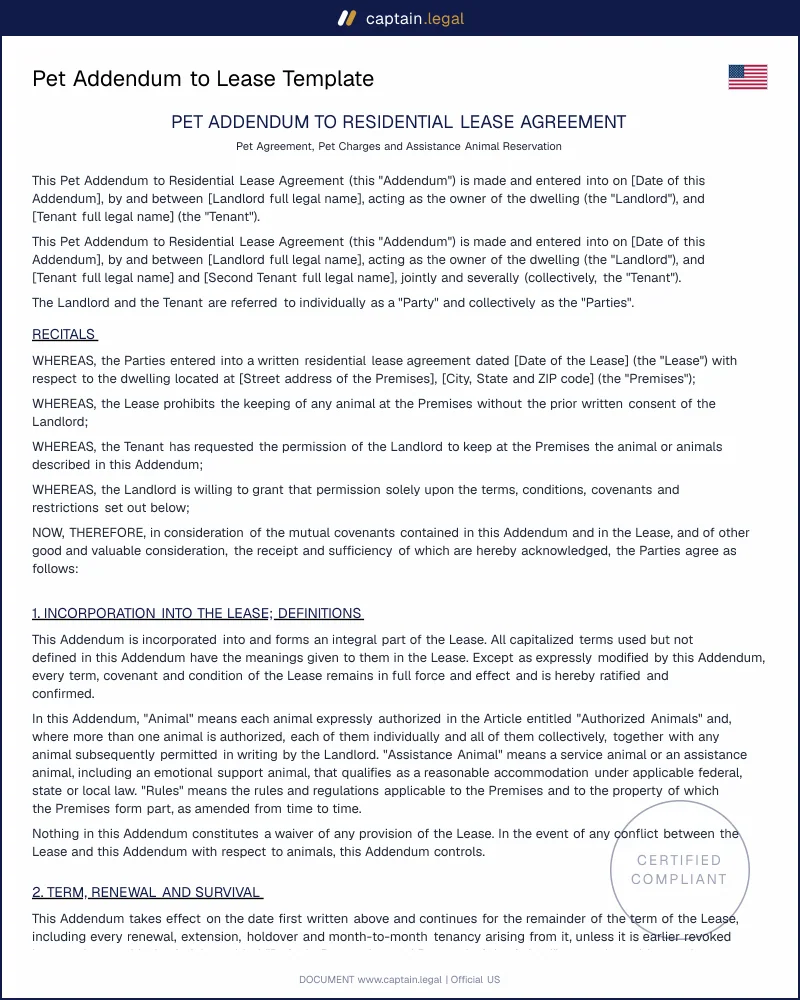
A pet addendum to lease is a short signed agreement that attaches to an existing residential lease and fixes the terms under which a tenant may keep an animal: which animal, what the tenant pays, who pays for the damage, and what happens when the neighbors complain. Landlords use it when a tenant adopts a dog mid-term, when a no-pets building relaxes its policy for one household, or when a tenancy needs a pet policy that can be revoked without reopening the lease. Tenants use it to hold written permission that survives a sale of the building. It is also where service animals and support animals are carved out, because fair housing law treats them as something other than pets.

Compliant

2026 Legislation

50,000+ clients

trust us

Affordable

From $4.90 / doc

Secure payment

Instant download

Pet Addendum Template | Deposit Caps & Fair Housing Rules

Secure payment

Fill in the template

What is a pet addendum to a lease?

A pet addendum is a supplemental contract, not a rewrite of the lease. It sits on top of an agreement that already exists, identifies it by execution date and property address, and adds a narrow set of obligations tied to one specific animal. Everything else survives untouched, which is why landlords prefer an addendum to re-executing a twelve page lease over a golden retriever. Courts read the two instruments together, so the addendum inherits the lease's governing law, notice mechanics, and remedies unless it says otherwise.

The distinction from neighboring documents matters. A lease amendment changes a term the lease already contains, such as rent or expiration date; an addendum adds a subject the lease never addressed. Where the lease contains a no-pets clause, the addendum must say in plain words that the clause is waived for the named animal and no other, otherwise you hold two provisions that contradict each other and a judge who will read the ambiguity against the drafter. Silence is not consent. When the tenancy is new, pair the addendum with a state-compliant residential lease agreement signed the same day.

2

When do you need this document?

The classic trigger is the mid-term adoption. A tenant a year into a lease brings home a rescue, the lease is silent on animals or forbids them outright, and both sides want the arrangement documented before the first complaint reaches the office. Signing fixes the date from which the tenant is liable for animal damage.

The second scenario is the no-pets building that grants exceptions one household at a time. The addendum authorizes the animal and records that the waiver is personal, non-transferable, and limited to the animal described. Periodic tenancies raise a sharper problem, since a month-to-month rental agreement rolls over automatically and an undocumented dog quietly becomes part of the tenancy with every renewal.

Two edge cases separate careful drafters from the rest. In New York City, a tenant who keeps a pet openly for three months while the landlord knows and does nothing can rely on the Pet Law at NYC Administrative Code §27-2009.1 to defeat the no-pets clause permanently. Landlords who let it go for now lose the clause entirely.

3

Key clauses included in our template

Six blocks carry the legal weight.

  • The animal description names species, breed, adult weight, age, license number, and microchip identifier. Permission attaches to that animal and does not travel to a replacement: a tenant whose approved cat dies cannot install a second under the same paper.
  • The incorporation and waiver clause identifies the underlying lease by date and premises, confirms every other term survives, and suspends the no-pets clause for the named animal alone. That is what stops a tenant arguing the restriction was abandoned.
  • The financial terms separate refundable deposit, non-refundable fee, and monthly pet rent, because states treat the three very differently and a lease that blends them invites a refund claim. The pet deposit is tied to the statute governing the security deposit, which sets the deadline for the itemized security deposit return letter at move out.
  • The damage and indemnity clause makes the tenant liable for repair, flea and odor treatment, and injury to third parties, with an option to require renters liability coverage naming the owner as additional insured. Carpet padding and subfloor absorption are named for a reason.
  • The conduct and revocation clause sets leash, waste, noise, and common area rules, then defines the cure period and the notice needed to withdraw permission. Without it, an owner facing a biting dog runs a full lease default.
  • The assistance animal carve-out excludes service and support animals granted as an accommodation from the fees, the breed list, and the weight cap, and keeps that request in a separate file from the pet approval.
4

State-specific considerations

California collapses the analysis into one number. Since Assembly Bill 12 amended Civil Code §1950.5, most landlords may collect no more than one month's rent as total security, and a pet deposit sits inside that ceiling rather than beside it. A narrow exception survives for a natural person owning at most two residential properties totaling four units. Non-refundable pet fees are not lawful: all security in California is refundable by statute, whatever the lease calls it. Civil Code §1942.7 separately forbids conditioning occupancy on declawing or devocalization, and the Fair Employment and Housing Act protects support animals independently of federal guidance.

Texas leaves far more room. Chapter 92 of the Property Code caps neither security nor pet deposits, and non-refundable pet fees are lawful when the lease labels them clearly. The discipline comes at the end: §92.103 gives thirty days after surrender to refund or itemize, and §92.109 exposes bad faith withholding to treble damages plus attorney fees.

Florida codified the support animal analysis. Florida Statutes §760.27 lets a housing provider request reliable supporting information when the need is not readily apparent, and bars any requirement of a specific form or a notarized letter. No fee or deposit may be charged for a qualifying emotional support animal, and §817.265 makes knowingly furnishing false documentation a second degree misdemeanor.

New York effectively removes the pet deposit from the table. General Obligations Law §7-108 caps total security at one month's rent for unregulated units, leaving monthly pet rent as the only workable charge. Breed restrictions also collide with Insurance Law §3421, which bars homeowners insurers from refusing or surcharging a policy based solely on the breed of dog kept.

5

How to fill out this pet addendum

You begin by naming the state where the property sits, and the form reshapes itself around that answer. Deposit fields disappear where the state caps them, the non-refundable fee line is suppressed where all security must be refundable, and the statutory citations change to match. Next you identify the underlying lease by execution date, parties, and full address, which is what ties the two instruments together for a court.

The animal section follows: species, breed, weight, age, license and rabies tag, microchip, veterinarian of record. You then set the financial terms the state allows, decide whether liability coverage is required, and pick the conduct rules for the building. The last screen handles revocation, with a defined cure period and a notice method matching the lease.

Everything downloads in editable Word and signature ready PDF, and each party keeps a signed original with the lease. Landlords running several units build the addendum alongside the rest of the tenancy file, using the full catalog of US legal document templates to keep paperwork consistent.

6

Common mistakes to avoid

The most expensive error is treating a support animal request as a pet application. An accommodation request goes in its own file, gets its own written response, and never touches the pet deposit ledger. Charging pet rent for an animal that turns out to qualify creates liability dwarfing the money collected. The second failure is the vague animal description. "One dog" is not a description, and it is why landlords end up with a mastiff where they approved a beagle. The third is silence: an owner who knows about an unauthorized animal and waits is building the tenant's waiver argument, in some jurisdictions on a statutory timetable.

Landlords also mislabel money constantly. A deposit is refundable, a fee is not, pet rent recurs, and calling one by another's name is how a tenant wins back a lawful charge. Finally, plenty of owners paper a pet with an addendum when the change belongs in the lease itself. If rent is rising, the term is extending, or the parties are changing, that is a lease amendment agreement. The addendum answers one question: may this animal live here, and on what terms.

Key takeaways

Document role

An addendum adds terms without rewriting

A pet addendum is a supplemental contract attached to an existing residential lease, identified by the lease date and property address. It adds narrow rules for one named animal while leaving the rest of the lease in place. Courts read the two documents together, so the addendum usually inherits the lease’s governing law, notice procedures, and remedies unless the addendum says otherwise.

No-pets clause

Say the waiver clearly and narrowly

If the lease has a no-pets clause, the addendum must expressly waive it for the specific animal and no other. If you rely on vague language, you can end up with two conflicting provisions and ambiguity that a judge may interpret against the drafter. The practical fix is simple: identify the animal, state the waiver in plain words, and keep all other pet restrictions intact.

Fair Housing

Assistance animals are not “pets”

Fair housing rules change what you can charge and restrict. Under the Fair Housing Act, 42 U.S.C. §3604(f)(3)(B), a qualifying assistance animal is treated differently than a pet, so pet rent, pet deposits, breed lists, and weight caps typically cannot be applied. Even though HUD withdrew certain guidance notices, that does not equal permission to deny support-animal requests; federal and state fair housing obligations still apply.

Frequently Asked Questions

Yes. An addendum signed by the parties to the lease is an enforceable contract, and continued occupancy plus the waiver of the no-pets clause supply the consideration. It binds successors, so a buyer who takes the building takes the pet permission with it. What weakens an addendum is drafting: an unnamed animal, no reference to the underlying lease, or a term the parties cannot lawfully agree to, such as a non-refundable pet deposit where all security must be returnable.

That depends on the state. Several allow a refundable deposit, a non-refundable fee, and monthly pet rent to run together provided the lease labels each one honestly. Others cap total security at one month's rent, so a pet deposit competes with the ordinary deposit for the same space. A few prohibit non-refundable charges outright. None of it reaches a service animal or a support animal granted as a reasonable accommodation.

No, and requiring one as a condition of approval is risky. An assistance animal is not a pet, so it belongs in an accommodation file rather than a pet agreement. You may confirm the approval in writing, require the animal to stay under the handler's control, and keep the tenant liable for actual damage. You cannot impose a pet deposit, pet rent, a breed restriction, or a weight cap. Co-owners of an animal sometimes also want a pet custody agreement between themselves.

An ordinary pet request has no statutory clock, so the lease governs, and most well drafted leases allow ten to fifteen days for a written answer. A disability accommodation request is different: fair housing law requires a prompt response, and courts have treated unexplained delays of several weeks as constructive denials. Decide in writing within ten days, and send the request in a traceable way, because the timeline only helps you if you can prove when it started.

The addendum downloads in editable Word and print ready PDF. The Word file lets you adjust a clause, change a conduct rule, or add a second animal before signature, while the PDF holds the layout for signing and filing. Once signed, further changes go in a new written addendum rather than an edit to the original file, because a document altered after execution invites an authenticity fight.

Only on the grounds the addendum provides. A well drafted revocation clause lists the triggers, aggression, repeated noise complaints, unaddressed waste, or a lapsed vaccination, sets a cure period, and specifies how notice is delivered. Without that clause, withdrawing permission means treating the animal as a lease violation and running the full default process, which is slower and easier to lose.

4.6/5

17 verified reviews · 50 000+ downloads

Pet Addendum Template | Deposit Caps & Fair Housing Rules
  • Immediate access to the document
  • PDF + Word download
  • Compliant with 2026 legislation
  • Reviewed by lawyers
Fill in the template
Secure payment
Updated on July 29, 2026

You might also like

Residential Lease Agreement Template
Late Rent Notice Template