Create my document
Login

Choose country

United StatesUnited StatesChoose country
Real Estate

Lease Amendment Agreement | CA, TX, FL & NY Compliant

Lease amendment drafted to state law, from Cal. Civ. Code 1698 to NY Gen. Oblig. Law 15-301. The signed writing that keeps your original lease in force.
4.8/522 reviews50 000+ downloadsInstant download
Share

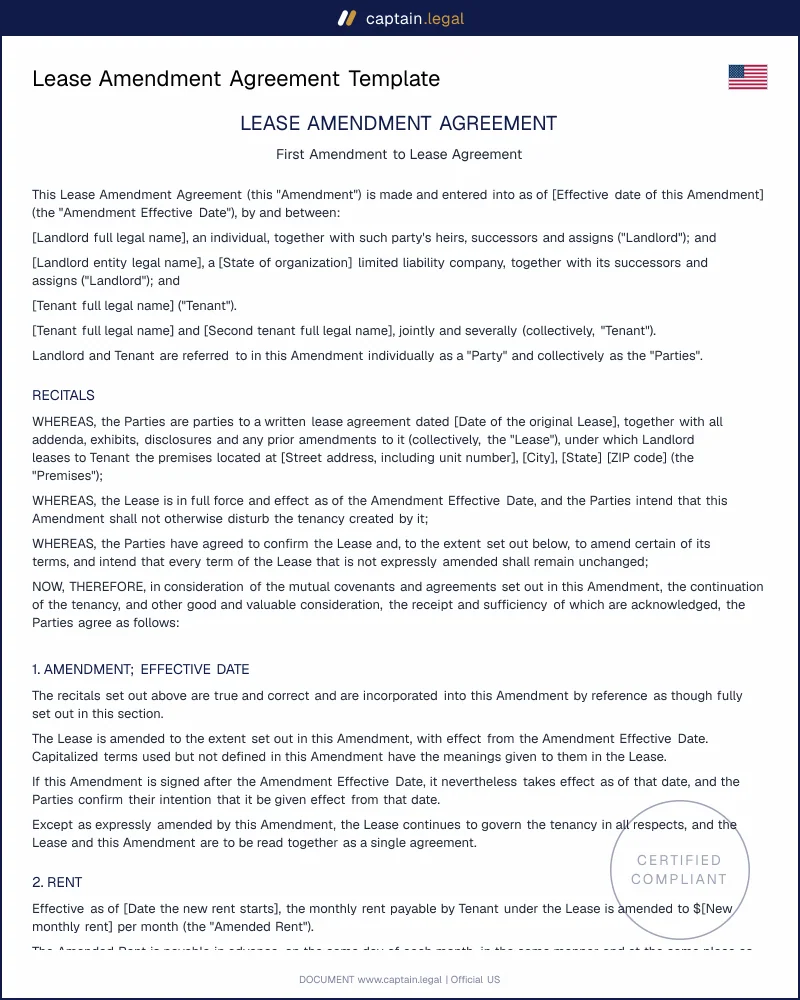
A lease amendment agreement changes one or more terms of a lease already in force, without cancelling the original contract or sending both parties back to a blank page. Landlords reach for it when rent goes up at renewal, when a partner moves in, when a tenant finally asks about the dog, or when a clause written two years ago no longer matches how the tenancy runs. The document is deliberately short. It identifies the original lease, states which provisions are replaced, confirms that everything else survives, and carries the signature of every person bound by the first agreement. Handled properly, amendment and lease read as one enforceable package. Handled casually, you end up with two documents that contradict each other.

Compliant

2026 Legislation

50,000+ clients

trust us

Affordable

From $4.90 / doc

Secure payment

Instant download

Lease Amendment Agreement | CA, TX, FL & NY Compliant

Secure payment

Fill in the template

What is a lease amendment agreement?

A lease is both a conveyance of a possessory interest and a contract, so changing it is a contract modification governed by state law, not the start of a new tenancy. The amendment does not replace the lease. It edits it, and the sentence that makes that work is the ratification clause: except as expressly modified, the lease remains in full force and effect. That single line preserves the guaranty, the default remedies, the notice provisions and every disclosure attached to the original residential lease agreement. Practitioners number their amendments in sequence, because a unit that has changed rent, occupants and pet status over four years will accumulate several.

Terminology gets loose, and the distinctions matter once a dispute reaches a judge. An addendum is normally attached at signing and adds subject matter the lease never covered. An amendment changes language that already exists, after execution. An assignment transfers the tenant's whole interest to someone else, a sublease creates a second tenancy underneath the first, and a novation substitutes a new contract while releasing the original obligations. To keep a signed state-specific residential lease agreement template alive while adjusting one number or one occupant, the amendment is the right instrument.

2

When do you need this document?

Rent is the trigger in most files. On a fixed-term lease the landlord cannot raise rent mid-term without the tenant's actual agreement, so the amendment is the only clean route. Occupancy changes come next. A partner moves in and wants to be on the lease rather than on sufferance, a roommate leaves and wants out of joint liability, an adult child ages into a signatory. Each is a different legal act, and the amendment has to say which one is happening. Pets come third, usually after the animal has arrived, and the instrument records the species, the pet rent or deposit within statutory limits, and responsibility for damage.

Amendments also handle parking spaces, storage units, utility responsibility and corrections to the notice addresses after a building is sold. An owner who sells mid-tenancy does not need the tenant's consent to transfer the lease, but does need a written record of the new payment address before enforcing anything. Two edge cases justify slowing down. An owner abroad who signs through an agent needs a valid power of attorney authorizing someone to act on your behalf, and several statutes require that authority to be written and signed. Subsidized housing is the other, because a unit under a Housing Assistance Payments contract usually needs the housing authority to approve a rent change first.

3

Key clauses included in our template

  • The recital identifying the original lease pins the target by execution date, the legal names of landlord and tenant, and the property address including unit number. A lease amended before also needs the new instrument numbered in sequence, because two undated amendments touching the same clause are a real problem in litigation.
  • The effective date clause separates the day the parties sign from the day the change operates. Rent adjustments almost always start on a billing cycle rather than mid-month, and leaving the first prorated payment to interpretation is how amendments turn into small claims files.
  • The amended provisions are drafted by section number, with deletion and replacement language rather than a summary of intent. The clause states that Section 4 is deleted in its entirety and replaced with the new text, which is how a court reads a modified contract.
  • The ratification clause confirms every remaining term survives unchanged. Without it a tenant can argue the parties intended a novation, wiping out the guaranty and the service provisions behind a later 3-day or 30-day notice to quit.
  • The consideration recital records what each side receives. Where the change runs one way, such as a temporary rent reduction, the template pairs it with a term extension or a repayment schedule, so the modification rests on more than goodwill.
  • The occupant clause treats additions and departures separately. Adding a co-tenant creates joint and several liability going forward; removing one requires an express release, and where a guarantor signed the original lease, that guarantor consents in the same instrument or the guaranty can fail.
  • The signature block carries every adult who signed the original lease, every incoming party and any guarantor, with optional notary lines.
4

State-specific considerations

California treats the written modification of a written contract as a contract in its own right under Civil Code § 1698(a). Mid-term increases on a fixed lease need the tenant's agreement, while month-to-month increases run on the ladder in Civil Code § 827(b): thirty days for a cumulative increase of ten percent or less over the preceding twelve months, ninety days above that. Units covered by the Tenant Protection Act of 2019 also sit under the cap in Civil Code § 1947.12, five percent plus regional CPI with a ceiling of ten percent. An amendment cannot lift a security deposit above the statutory limit. Since July 1, 2024, Civil Code § 1950.5(c) caps deposits at one month's rent, with a narrow exception for natural-person owners of no more than two properties totaling four units.

Texas gives more room on economics and less on procedure than owners expect. There is no statewide rent cap and no statutory notice period for a change the tenant signs, so an amendment raising rent takes effect on the date written into it. Some terms are not amendable at all. Property Code § 92.006 shields the landlord's repair duty from casual waiver, and the early termination rights given to victims of family violence under § 92.016 and of certain sexual offenses or stalking under § 92.0161 cannot be signed away. Converting a fixed term into a month-to-month tenancy quietly changes the exit math, because termination then runs on the one month rule in Property Code § 91.001.

Florida rewrote much of its rulebook recently, and amendments are where the changes land first. Section 83.47 voids any provision purporting to waive a right that Chapter 83, Part II grants. Month-to-month tenancies now require thirty days written notice for termination or a rent change under § 83.57, raised from fifteen by the 2023 reform, while § 83.425 preempts the local ordinances that once imposed longer periods in Miami-Dade and Broward. The provision practitioners watch most is § 83.505, effective July 1, 2025, letting the parties exchange statutory notices by email only after both sign an addendum carrying the exact language the Legislature drafted. That election belongs in a separate addendum, not the body of the lease, and it does not reach commercial tenancies.

New York enforces no oral modification clauses more strictly than almost anywhere else, and the Appellate Division has held parties to that language even where they had negotiated written amendments before. Real Property Law § 226-c requires advance written notice whenever a landlord offers a renewal with an increase of five percent or more, or declines to renew, running thirty, sixty or ninety days according to how long the occupant has lived in the unit. Miss it, and the tenancy continues on existing terms until the period expires. Adding an occupant deserves care, because Real Property Law § 235-f already lets a tenant share the unit with immediate family plus one additional occupant and that person's dependent children, which is not the same act as adding a co-tenant.

5

How to fill out this lease amendment agreement

You start by selecting the state where the property is located, because that choice drives the statutory citations, the notice language and the deposit ceiling the form applies. The next screen asks about the original lease: the date it was signed, the parties named on it, the property address, and whether an earlier amendment exists, which generates the correct sequence number. From there you pick what is changing. Rent, term, occupants, pets, deposit, utilities and notice addresses each open a short set of questions, and you can select more than one in a single instrument.

The form then drafts the deletion and replacement language, quoting the section being modified rather than paraphrasing it, and inserts the ratification and consideration recitals automatically. You set the effective date separately from the signature date, which is where most people appreciate the prompt. Signature blocks populate from the party names, guarantors included, and the finished amendment downloads in editable Word and in a ready-to-sign PDF.

6

Common mistakes to avoid

The classic error is treating email as an amendment. A landlord writes "no problem on the cat, just add a bit to the rent" and considers the matter closed, then discovers eight months later that the lease still prohibits animals and the extra payments look like an unexplained overcharge. The second error is the opposite instinct, rewriting the whole lease when only the rent changed. A fresh lease can be read as a novation, which resets the term, extinguishes the guaranty and can pull the tenancy into rules that did not apply before. The third is leaving somebody out: every adult on the original lease signs, every guarantor consents, and a departing co-tenant needs an express release rather than a quiet deletion of their name.

Backdating is the fourth, and more dangerous than it looks, because an amendment dated before the day it was signed invites a fraud argument that contaminates the whole tenancy record. The last mistake is agreeing to something the statute forbids. Deposit ceilings, late fee limits and waivers of repair or early termination rights are not negotiable, and a signature does not cure them. Anyone running several units is better served by a consistent set of landlord and property documents than by amending each lease in a different style.

Key takeaways

IN WRITING

Use a signed amendment, not a handshake

If the lease term is longer than one year, any meaningful change needs a signed writing to hold up under the statute of frauds. The excerpt flags California Civil Code 1624(a)(3), New York General Obligations Law 5-703(2), and Texas Business and Commerce Code 26.01, and notes Texas courts have refused to enforce oral material modifications. A quick email thread is not the same as a properly signed amendment.

SCOPE

Amend terms while keeping the lease alive

A lease amendment is not a reset. It identifies the original lease, replaces specific provisions, and then locks in a ratification clause: except as expressly modified, the lease stays in full force and effect. That one line keeps the guaranty, default remedies, notice rules, and disclosures intact. Done carefully, the lease and amendment read as one package; done casually, you create contradictions.

LIMITS

You cannot waive statutory tenant protections

Even a perfectly drafted amendment cannot override legal minimums. The excerpt highlights that “statutory floors survive private agreement,” pointing to California Civil Code 1953 and Florida Statutes 83.47, which void certain waivers or prohibited lease provisions. That matters when someone tries to bargain away a right in exchange for a concession. If a clause is void by statute, putting it in an amendment does not save it.

Frequently Asked Questions

Yes, provided it is in writing, identifies the lease it modifies and is signed by every party bound by the original. Courts treat a properly executed amendment as part of the lease, so the rent figure, occupant list or pet clause it contains is enforced exactly like the terms it replaced. Two things undermine it: a missing signature from a co-tenant or guarantor, and a modification that conflicts with a statutory protection, which is void regardless of consent. Where the lease contains a no oral modification clause, a signed writing is the only mechanism that works.

Not unilaterally. A fixed term locks the rent for the duration unless the lease contains an escalation clause, so any mid-term increase requires the tenant to agree and sign, and that agreement is what the amendment records. Month-to-month tenancies work differently, because the landlord can change terms prospectively with statutory notice: thirty days in Florida under § 83.57, thirty or ninety days in California under Civil Code § 827(b) depending on the size of the increase, and thirty, sixty or ninety days in New York under Real Property Law § 226-c.

An amendment both parties sign can take effect on any date they choose, including the next day, because consent replaces notice. The statutory notice periods bite when one side imposes a change rather than negotiating it. In practice, set the effective date on the first day of a rent period rather than mid-month. It avoids proration disputes and lines up cleanly with any notice you also served. For a deposit increase, give the tenant a reasonable window to fund the difference and write that deadline into the instrument.

Both. The Word file lets you adjust wording, add a clause your situation needs or correct a name before circulation, and the PDF is formatted for signature and filing. Most landlords keep the Word version in the tenancy file and send the PDF out for e-signature. If you manage a portfolio, the same approach applies across the rest of the US legal document catalog, which keeps formatting consistent when a judge or a lender eventually reads the file.

An addendum is normally attached at signing and covers subject matter the lease did not address, such as a pool rules sheet, a bed bug disclosure or a lead paint form. An amendment changes language that already exists in a lease the parties have executed. The practical consequence is drafting style: an addendum stands alone and adds obligations, while an amendment quotes a section number and replaces text. Florida's electronic notice election under § 83.505 illustrates the difference, since the statute requires that consent to sit in an addendum.

Residential amendments are enforceable on signature alone in every state, and notarization is a formality rather than a validity requirement. It becomes worthwhile in three cases: a lease that will be recorded, an amendment signed by an attorney-in-fact under a power of attorney, and an institutional landlord whose internal policy demands it. Electronic signature is fully effective under the E-SIGN Act and state versions of the Uniform Electronic Transactions Act. Keep the audit trail the platform generates, because it proves who signed and when if the date is later disputed.

4.8/5

22 verified reviews · 50 000+ downloads

Lease Amendment Agreement | CA, TX, FL & NY Compliant
  • Immediate access to the document
  • PDF + Word download
  • Compliant with 2026 legislation
  • Reviewed by lawyers
Fill in the template
Secure payment
Updated on July 26, 2026

You might also like

Lease Renewal Agreement
Real Estate Purchase Agreement Template | Buy or Sell a Home