Real Estate

Move-In Move-Out Inspection Checklist | Word & PDF

Condition report drafted to Civil Code 1950.5(g) photo rules, GOL 7-108 inspection rights, Tex. Prop. 92.104 and Fla. Stat. 83.49 itemization. Word and PDF.
4.5/513 reviews50 000+ downloadsInstant download
Share

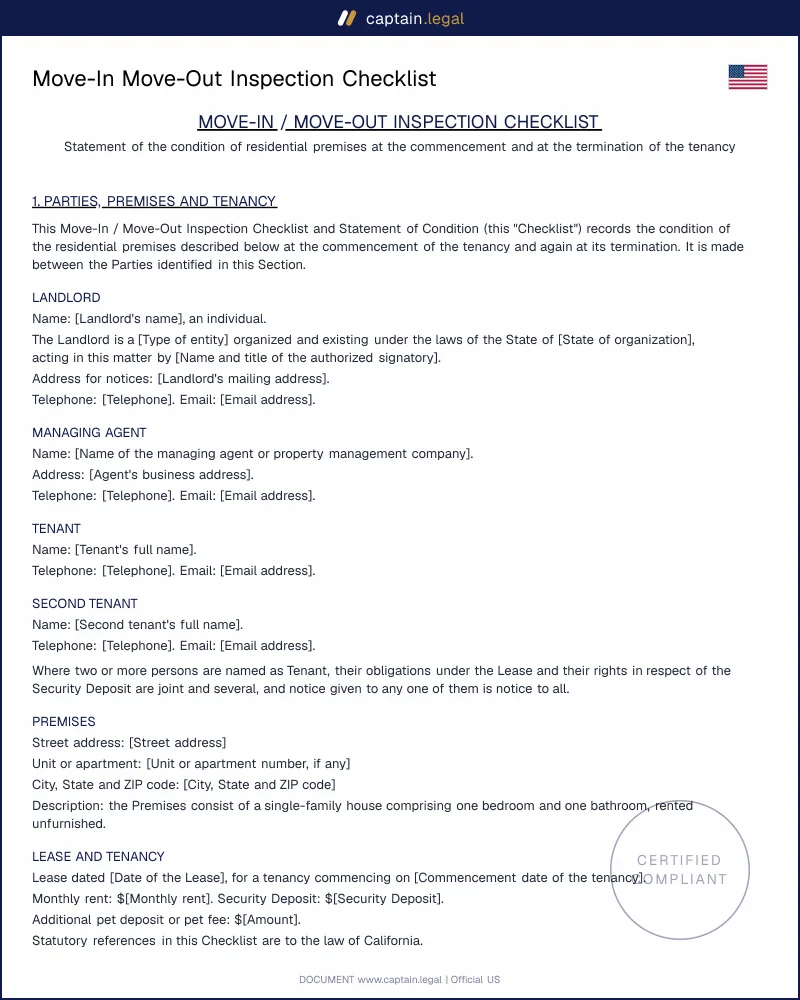
A move-in move-out inspection checklist is the signed condition report that records the state of a rental unit room by room at the start of a tenancy and again when the keys come back. Landlords, property managers and tenants use it as the baseline for every later argument about damage, cleaning and deposit deductions, and it is usually the most persuasive exhibit in a small claims file. This template produces a rental property condition report with statutory itemization wording for California, Texas, Florida and New York, plus a photographic annex built to the documentation rules those states now impose.

Compliant

2026 Legislation

50,000+ clients

trust us

Affordable

From $4.90 / doc

Secure payment

Instant download

Move-In Move-Out Inspection Checklist | Word & PDF

Secure payment

Fill in the template

What is a move-in move-out inspection checklist?

The document is a two-state condition record. One column captures each room, fixture, appliance and surface when the tenant takes possession; the second captures the same items when possession returns. Both parties sign both columns, and the gap between them is what a court treats as tenant-caused damage. Nothing in the form creates a claim by itself. It creates evidence, and in these four states its absence is usually fatal to a landlord hoping to keep any part of a deposit.

Two neighboring documents get confused with it. The initial inspection under California Civil Code section 1950.5(f) is a statutory event, requested by the tenant in the last two weeks of the tenancy, producing a list of curable deficiencies; the checklist is the form used to conduct it, not a substitute. The itemized statement of deductions is the accounting document sent after the tenant vacates, governed by hard deadlines in every state below.

2

When do you need this document?

The obvious trigger is the first day of a tenancy, before keys change hands and before a deposit is banked. The second is a landlord who has just realized there is no move-in record for a unit about to turn over, a recoverable position if the move-out side is documented with rigor. A pre-vacating walkthrough is the third, and in New York it is not optional once either party gives notice of termination.

Mid-tenancy events matter more than most owners expect. A roommate substitution, a partial assignment, or a new occupant added to a state-specific residential lease agreement should trigger a fresh condition record, because the departing occupant is entitled to know what they are being released from. Sales and management transfers raise the same problem: a buyer taking a building with tenants in place inherits every deposit obligation and every undocumented scratch.

Two edge cases justify extra care. Furnished and corporate-let units need a contents inventory alongside the condition grid, since missing furniture is a chattel claim rather than damage. And a unit under a housing choice voucher has already been inspected by the housing authority; that inspection covers habitability, not deposit liability, and it does not replace your own condition report.

3

Key clauses included in our template

  • The identification block names the premises by street address and unit number, every adult occupant in possession, and the landlord or managing agent with a service address. Naming only the lease signatory creates a gap when a roommate causes the damage and denies signing anything.
  • The room-by-room condition grid breaks each space into walls, ceiling, flooring, windows, doors and hardware, lighting, outlets and built-in fixtures, using a standardized condition code rather than free text. Kitchens and bathrooms carry extra appliance and plumbing rows, each with a repair-estimate column left blank at move-in.
  • The photographic and video annex logs a file reference and capture date against each defect, which is what Civil Code section 1950.5(g) now requires California landlords to produce with their itemized statement.
  • The normal wear and tear acknowledgment reproduces the statutory definition, tracking Texas Property Code section 92.001(4), so both parties sign against the same standard. Faded paint and traffic patterns in carpet sit on one side of that line; burns, pet stains and holes on the other.
  • The keys and access inventory counts keys, fobs, garage remotes, mail keys and gate codes, with a replacement cost line completed at move-out only. It pairs with the written notice of intent to vacate that starts the inspection clock in most states.
  • The attestation and signature block carries dual signature lines, a date field per column, and optional wording tracking General Obligations Law section 7-108(1-a)(c) so a New York move-in record functions as the written agreement the statute contemplates.
4

State-specific considerations

California is the most documentation-heavy state in the country for this document. Civil Code section 1950.5 requires written notice of the tenant's option to request an initial inspection within a reasonable time after either party gives notice of termination, and that inspection cannot occur earlier than two weeks before the end date. The resulting statement of deficiencies gives the tenant a right to cure before vacating, and anything visible and unlisted cannot later be deducted. The photographs required by section 1950.5(g) must be taken before any cleaner or contractor touches the unit, because a mopped floor destroys the baseline the statute exists to preserve.

Texas imposes no inspection procedure, which makes the private checklist proportionally more important. Everything turns on section 92.104: a written description and itemized list, delivered inside the 30-day window that opens when the tenant surrenders the premises and gives a written forwarding address. Because section 92.109 presumes bad faith when that deadline slips, a modest deduction can become a treble-damages judgment. The clock starts on actual surrender, not the lease end date.

Florida is a notice state. A landlord claiming anything must send written notice under section 83.49(3)(a) by certified mail to the last known address, or by email where the parties signed the electronic delivery addendum under section 83.505, within 30 days, in the statutory form, telling the tenant they have 15 days to object.

New York treats the inspection as a right. Beyond the pre-occupancy inspection, section 7-108(1-a)(d) obliges the landlord to give written notice of the pre-vacating inspection right, schedule it between one and two weeks before the end of the tenancy, and give at least 48 hours written notice of the appointment. The landlord bears the burden of proving the reasonableness of anything retained under paragraph (f), and a willful violation exposes them to punitive damages of up to twice the deposit. Owners running several buildings through an entity should file these records beside their business formation and governance templates for US landlords.

5

How to fill out this move-in move-out inspection checklist

You begin by selecting the state where the property sits, and the form adjusts the deadlines, the wear and tear wording, and whether a pre-vacating inspection notice is generated alongside the checklist. Next you describe the unit: address, unit number, bedroom and bathroom count, and whether it is furnished, which controls whether the contents inventory appears. You then add each adult occupant, and the signature block builds itself from that list.

The room builder comes next. You keep or remove standard rooms, add unusual ones such as a basement, garage or balcony, and the grid populates with the right rows. The photographic annex is generated as a numbered schedule you complete on site, so file names in your phone match line items in the document. At the end you choose the move-in column, the move-out column, or both on one form, then download in editable Word and signature-ready PDF alongside the rest of the catalogue of US legal document templates.

6

Common mistakes to avoid

The most damaging entry in any condition report is the word "good". A tenant who signed a form describing an entire apartment as good has effectively signed nothing. Write the defect, its location in the room, and its approximate size. The second failure is undated photography, or photography taken after cleaning, which in California now risks losing the deduction entirely. The third is a single signature: a form the tenant never countersigned is a landlord's own memorandum, and courts treat it as one.

Two mistakes belong to the move-out side. Landlords routinely mail the completed checklist and assume they have satisfied the itemization requirement, but the checklist records condition while the statute demands a costed statement of deductions supported by receipts or estimates. The two documents are not interchangeable in any of these four states. Deducting for wear and tear is the other classic error. Carpet has a depreciable life, paint fades, drawer runners wear out, and charging for them turns a defensible deduction into a bad-faith finding.

Key takeaways

EVIDENCE

The checklist decides what counts as damage

This report is not a claim by itself; it is the evidence file courts lean on when a deposit fight turns into small claims. You document each room and item at move-in and again at move-out, with both parties signing both snapshots. The differences between those two columns are what a judge is likely to treat as tenant-caused damage, cleaning, or wear.

STATE RULES

Some states demand photos and inspections

Documentation rules are now state-driven and strict. California ties deposit deductions to an initial inspection process under Civil Code 1950.5(f) and, for covered tenancies, requires photographs at specified points under 1950.5(g), with photos sent with the itemized statement due within 21 days of surrender. New York’s GOL 7-108 requires offering pre-occupancy and pre-vacating inspections, and recorded defects cannot support deductions.

DEADLINES

Miss the window, lose the deposit claim

Security deposit deductions rise or fall on timing and itemization. Texas runs a 30-day deadline to refund the deposit after surrender plus a written forwarding address (Prop. Code 92.103 and 92.107), and deductions must be described in a written itemized list (92.104); bad-faith retention triggers statutory damages and attorney fees (92.109). Florida gives 15 days to return in full or 30 days to send a claim notice under 83.49(3)(a), and missing it forfeits the claim.

Frequently Asked Questions

It binds both parties as an admission about the property's condition on the dates signed, and is admissible evidence in a deposit dispute. In New York a move-in agreement executed under General Obligations Law section 7-108(1-a)(c) bars the landlord from later deducting for any defect noted in it. What it cannot do is create a right to deduct: that comes from your state security deposit statute and depends on serving a proper itemized statement inside the deadline.

Both formats download together. The PDF is laid out for printing and signing on site, with room grids sized for handwriting and a signature page that survives scanning. The Word file is fully editable, which matters when a property has rooms the standard grid does not anticipate. Most users print the PDF for the walkthrough and keep the Word file as the master.

The deadline depends on the state and runs from surrender of possession, not from the inspection. New York allows 14 days for the itemized statement and any balance under section 7-108(1-a)(e), California 21 days under Civil Code section 1950.5(g)(1), and Texas 30 days from surrender plus a written forwarding address under Texas Property Code section 92.103. Florida requires full return within 15 days if no claim is made, or a claim notice within 30 days. Once it passes, a security deposit demand letter citing the missed statutory deadline is the usual next step.

No, and every state covered here says so in the statute. Texas Property Code section 92.001(4) defines the term as deterioration from intended use, including breakage or malfunction due to age, but excluding damage from negligence, carelessness, accident or abuse. New York draws the same line in section 7-108(1-a)(b), which also prohibits charging a tenant for damage caused by a prior occupant.

The landlord loses the baseline, and the burden of proof usually follows. New York places the burden of showing the reasonableness of any retained amount on the landlord under paragraph (f), and a California landlord who cannot produce inception photographs for a covered tenancy is in a weak evidentiary position. Where no move-in record exists, document the move-out condition with unusual care and expect a court to resolve ambiguity in the tenant's favor.

In California and New York, yes, and the landlord must tell you so in writing. Both statutes give the tenant the right to request an inspection before vacating and to attend it, scheduled in the final two weeks of the tenancy, with New York adding a 48-hour notice requirement for the appointment. Texas and Florida create no such right, so attendance is negotiated rather than owed. Ask in writing anyway and keep the reply.

4.5/5

13 verified reviews · 50 000+ downloads

Move-In Move-Out Inspection Checklist | Word & PDF
  • Immediate access to the document
  • PDF + Word download
  • Compliant with 2026 legislation
  • Reviewed by lawyers
Fill in the template
Secure payment
Updated on September 5, 2026

You might also like

Real Estate Purchase Agreement Template | Buy or Sell a Home
Tenant Estoppel Certificate Template