Real Estate

Tenant Estoppel Certificate | Evid. Code 622 Drafted

Estoppel certificate drafted to Cal. Evid. Code 622, Tex. Prop. 93.007 and NY GOL 7-105. Lease terms, rent, deposit and defaults certified. Word & PDF.
4.6/516 reviews50 000+ downloadsInstant download
Share

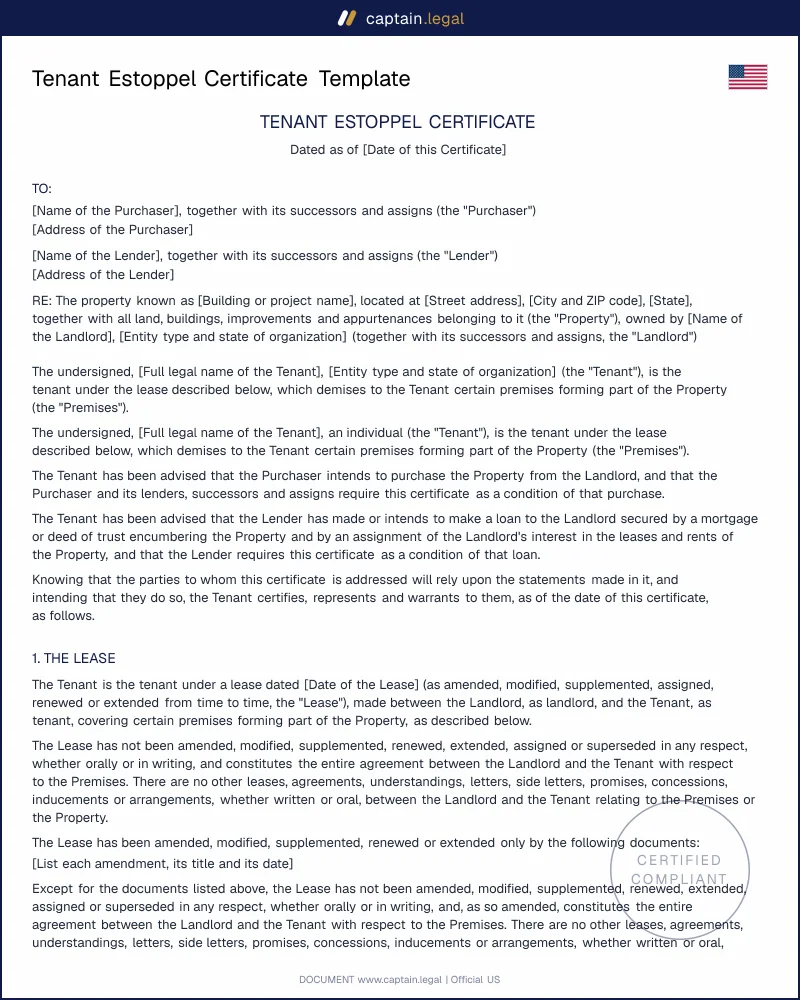
A tenant estoppel certificate is a signed statement in which a tenant confirms, for a buyer or a lender, the facts that govern its lease: commencement and expiration dates, current rent, the deposit the landlord holds, every amendment in effect, and whether either side is in default. Landlords collect them during due diligence, on a deadline set by the purchase agreement or the loan commitment. It runs two or three pages and carries more weight than its length suggests. Once signed and delivered, it binds the tenant to what it says, even when the lease file says something different. Our form is drafted to the certifications commercial lenders and institutional buyers ask for at closing.

Compliant

2026 Legislation

50,000+ clients

trust us

Affordable

From $4.90 / doc

Secure payment

Instant download

Tenant Estoppel Certificate | Evid. Code 622 Drafted

Secure payment

Fill in the template

What is a tenant estoppel certificate?

The certificate is a representation of fact, not a new contract. The tenant answers a fixed set of questions about its own lease and hands the answers to a third party about to spend money in reliance on them. A buyer paying for a rent roll needs to hear from the tenants that the roll is accurate, because the seller's representations are capped and time limited while the tenant's certification survives the closing. The binding effect comes from estoppel, the rule that stops a party from contradicting a statement someone else has acted on.

Two documents get confused in the same closing binder. The certificate confirms facts. A subordination, non-disturbance and attornment agreement, shortened to SNDA, changes rights: the lease sits behind the mortgage, the lender agrees not to terminate on foreclosure, and the tenant agrees to recognize the foreclosure purchaser as its landlord. An SNDA is not an estoppel, and a tenant should review the two separately. The covenant to sign one sits inside the commercial lease agreement template for office, retail and industrial space.

2

When do you need this document?

The trigger in most files is a sale. A purchase agreement for a leased building conditions closing on estoppels from a defined list of tenants, usually everyone above a square footage threshold plus a share of the rent roll, each dated within thirty to sixty days of closing. Loan commitments say the same, and the requirement returns on every refinancing because the old certificates have gone stale. A real estate purchase agreement for a tenant occupied property with no estoppel condition leaves the buyer relying on the seller's word alone.

One request runs in reverse. A ground lessee financing its leasehold needs a certificate from the fee owner in favor of the leasehold mortgagee, so the landlord is the one signing. Whoever signs, the recitals protect the party that relied on them. One edge case is worth flagging: a tenant operating under Chapter 11 protection cannot certify away the estate's rights, and a certificate signed without court authority gives a lender very little.

3

Key clauses included in our template

  • The identification of the lease and every amendment opens the form, because this is where most certificates fail. Each amendment, extension and side letter is listed by title and date, and the tenant confirms nothing else modifies the lease. A certificate reciting an unamended lease when three amendments exist misstates the rent, the term and the options at once.
  • The term and option block captures commencement, rent commencement where it differs, expiration, and every renewal, expansion, right of first refusal and early termination right with its notice deadline. Miner is the reason our form points back to the lease instead of inviting a bare yes or no.
  • The rent and escalation certification covers base rent, the next scheduled increase, percentage rent and CAM reconciliation status, and confirms whether rent has been paid more than a month ahead. Prepaid rent is rent the new owner never collects, so lenders read this line first.
  • The security instrument line states the exact deposit held, or the face amount and issuing bank of a letter of credit. Successor liability rules pass that obligation to the buyer, so the figure must match the closing statement.
  • The landlord obligation and offset section asks whether any improvement allowance, work letter item, free rent period or repair obligation remains open, and whether the tenant claims an offset. This is the box tenants leave blank by reflex and regret later.
  • The reliance and authority provisions name who may rely, including successors, assigns and loan servicers, and require signature by an officer, manager or authorized agent. The wording tracks our lease amendment agreement template.
4

State-specific considerations

California gives these certificates the sharpest teeth in the country through Evidence Code section 622 and the Plaza Freeway line of authority. A commercial tenant that certifies a date, a rent or the absence of a claim will be held to it against the landlord's successor. Residential practice differs: Civil Code section 1953 voids lease provisions waiving a residential tenant's statutory rights, including those under section 1950.5, so a residential certificate drafted as a general release fails to that extent.

Texas leaves commercial landlord and tenant relations largely to the lease, and Chapter 93 of the Texas Property Code is thin by design, so the estoppel covenant and its deemed-approval remedy stand as written. One statutory hook matters at closing. Under section 93.007, the buyer assumes liability for the commercial security deposit, and the seller stays liable until the buyer delivers the tenant a signed statement acknowledging receipt and stating the exact amount. The deposit certified in the estoppel is the number that statement must match.

Florida uses one name for two unrelated documents. The tenant certificate is a creature of the lease. The association estoppel certificate is statutory: Florida Statutes section 718.116(8) for condominiums and section 720.30851 for homeowners associations require issuance within 10 business days of a written request, with a capped fee and waiver of any understated balance against a good faith purchaser.

New York adds a deadline unrelated to the lease. Under General Obligations Law section 7-105, a landlord conveying leased property must turn deposits over to the grantee at delivery of the deed or within five days and notify each tenant by registered or certified mail of the transferee's name and address. Non-compliance is a misdemeanor. Tenants should also weigh the no default certification against their Yellowstone exposure.

5

How to fill out this tenant estoppel certificate

You start by choosing the state where the property sits and whether the tenancy is commercial or residential, since those two answers control the successor liability language and the deposit wording. The form then asks who is requesting it, because a purchaser, a mortgage lender, a mezzanine lender and a loan servicer each take a different reliance paragraph.

Next comes the lease: parties, premises, square footage, commencement, expiration, and a repeating field for each amendment. The economic block follows, covering rent, escalations, operating expenses, prepaid rent and the deposit or letter of credit. Options and open landlord obligations come after that, with an exceptions field that stays blank rather than defaulting to none. The last screen builds a signature block for an entity signer, with title and authority stated, and you download in editable Word and signature ready PDF. Related forms sit in the US real estate document library.

6

Common mistakes to avoid

The most expensive mistake is signing from memory. Tenants certify a commencement date taken from the rent ledger rather than the lease, omit the second amendment that added parking, or write none in the exceptions box while an unpaid improvement allowance sits on their own balance sheet. The mirror image belongs to landlords who send a blank form and a cover email, then lose two weeks to markups because nobody pre-filled the data.

Authority is the other recurring problem. A leasing manager or on-site property manager rarely has power to bind the entity, and lenders reject certificates signed by someone whose title appears nowhere in the operating agreement or the board resolutions; those governance documents live in our business and corporate template library. Missing the deadline matters too, since the lease may let the landlord sign for you or treat the delay as a default. And watch the qualifiers: an unqualified statement that no landlord default exists is far broader than to the best of tenant's knowledge.

Key takeaways

Binding effect

What you certify can override the file

A tenant estoppel certificate is a representation of lease facts delivered to a buyer or lender, and once signed it can bind the tenant even if the underlying lease paperwork is messy or inconsistent. California highlights the risk: Evidence Code section 622 can treat recited facts as conclusively true between the parties and their successors. In Plaza Freeway, the certified expiration date controlled even though it was inaccurate.

Timing

Your lease may force a fast response

There is no federal rule that makes tenants sign. The obligation usually comes from an estoppel covenant in the lease, and commercial forms often require delivery within 10 to 20 days after a written request during due diligence. Many leases also include a self-help backstop: if the tenant stays silent, the landlord’s form may be deemed approved, or the landlord may sign as attorney-in-fact.

Do not confuse

An estoppel confirms facts; an SNDA changes rights

Two closing documents look similar but do different jobs. The estoppel certificate confirms specific lease facts: dates, current rent, deposit held, amendments, and whether either side is in default. An SNDA, by contrast, reorders priorities and relationships around the mortgage: the lease becomes subordinate, the lender agrees not to disturb the tenant after foreclosure, and the tenant agrees to attorn to the new owner. Review them separately.

Frequently Asked Questions

Yes, and more firmly than most people assume. It is not a contract in the ordinary sense, but the facts it recites become conclusive against the signer in favor of the party that relied. California codifies this in Evidence Code section 622, and Plaza Freeway Ltd. Partnership v. First Mountain Bank applied it to hold a tenant to an expiration date the lease documents did not support. If the certificate and the lease conflict, the party that relied wins.

Check the estoppel covenant in your lease, because the deadline lives there and not in any statute. Commercial leases commonly allow 10 to 20 days from written request. Two consequences follow a missed deadline: the lease may deem your silence to be confirmation of the landlord's version, or it may appoint the landlord as your attorney in fact to sign for you. If the window is too short to check the numbers, ask in writing for an extension before it runs.

Only if the lease does not require one. Where an estoppel covenant exists, refusal is a breach, and remedies run from a damages claim to a default declaration. In practice these disputes settle, because a buyer will not close on a building with a tenant in default and the seller has a date to hold. Where the lease is silent, the tenant owes nothing and often ends up certifying accurate facts while striking the release language some landlord forms slip in.

The certificate reports the current state of the lease and freezes the tenant's ability to contradict it. An SNDA changes the relationship going forward: subordination puts the lease behind the mortgage, non-disturbance protects possession if the lender forecloses, and attornment obliges the tenant to recognize the foreclosure purchaser as landlord. An SNDA can cost a great deal, because lender forms often relieve the successor landlord of liability for the prior landlord's defaults.

You can, and careful tenants do. Fixing a wrong date or rent figure is self-protection, not a favor to anyone. Standard edits add a knowledge qualifier to statements about the landlord's conduct, delete blanket releases of existing claims, preserve outstanding allowances in the exceptions field, and limit reliance to the named parties. Resistance appears when a tenant tries to add new rights, which this document is not the place for.

It downloads as an editable Microsoft Word file and as a print ready PDF. Use Word when a lender or buyer sends its own form and you need to merge your lease data into their wording, and the PDF when the document goes straight to signature. Both carry a notary block you can delete if your file does not need one. The same options apply across the full catalogue of US legal document templates.

4.6/5

16 verified reviews · 50 000+ downloads

Tenant Estoppel Certificate | Evid. Code 622 Drafted
  • Immediate access to the document
  • PDF + Word download
  • Compliant with 2026 legislation
  • Reviewed by lawyers
Fill in the template
Secure payment
Updated on September 5, 2026

You might also like

Month-to-Month Rental Agreement
Residential Lease Agreement Template