Create my document
Login

Choose country

United StatesUnited StatesChoose country
Real Estate

Late Rent Notice | Compliant with RPL 238-a & Sec 92.019

Late rent notice drafted to state law: NY RPL 238-a caps, Texas Property Code 92.019 safe harbors, California Civil Code 1671 reasonableness. Word and PDF.
4.8/527 reviews50 000+ downloadsInstant download
Share

A late rent notice is the written record a landlord creates the moment rent goes unpaid, stating how much is owed, which rental period it covers, what late fee the lease authorizes, and how many days the tenant has to bring the account current. It is not an eviction notice, and in most states it starts no statutory clock. What it does is build the paper trail that makes every later step defensible: the pay or quit notice, the ledger attached to a complaint, the judge who wants proof the tenant was told. Landlords and property managers use this past due rent notice as the first and least adversarial step in a nonpayment sequence.

Compliant

2026 Legislation

50,000+ clients

trust us

Affordable

From $4.90 / doc

Secure payment

Instant download

Late Rent Notice | Compliant with RPL 238-a & Sec 92.019

Secure payment

Fill in the template

What is a late rent notice?

It is a dated written demand identifying rent that has not been received and setting a short window to pay before the landlord escalates. It travels under several names: past due rent notice, late rent reminder letter, notice of delinquent rent. The label matters less than the content: anything naming the tenant, the premises, the rental period, the unpaid balance, the applicable late fee and a payment deadline does the job.

What trips people up is the line between this document and a statutory pre-eviction notice. A three day notice to pay rent or quit in California, a three day notice in Florida, a notice to vacate in Texas and a fourteen day rent demand in New York are creatures of statute, with prescribed wording, prescribed service and prescribed counting rules. A defect in any of them voids an eviction case. The courtesy notice sits upstream and is contractual rather than jurisdictional, which is why landlords have real freedom in how they write it and why judges still read it closely. New York is the exception: there it is not optional, because Real Property Law §235-e(d) requires certified mail notice once rent is five days late.

2

When do you need this document?

The ordinary trigger is rent that has not landed once the lease's grace period closes. Send it the same week, not the following month. A landlord who lets two or three cycles slide before writing anything invites the argument that the late payments were tacitly accepted, and where a course of dealing can modify a lease that argument sometimes wins. Partial payment is the second scenario and the more dangerous one, because accepting part of the rent can waive the default for that period unless the letter says otherwise.

Chronic lateness with no intention of evicting is the third case, and most owners handle it badly. A tenant who pays on the ninth every month is not someone you want to lose, but you do want a file. Six dated notices across a year turn a vague complaint into documented grounds for declining renewal. Landlords holding property through an entity have a further reason to keep this clean, since the formalities that protect the owner personally depend on the entity behaving like one, the same discipline running through US business and corporate agreement templates.

Two edge cases complicate matters. Where the tenant holds a Housing Choice Voucher, only the tenant portion is in default and the notice must say so; demanding the full contract rent is a standard reason these letters fail. At a property covered by the CARES Act, the federal thirty day clock runs alongside the state clock.

3

Key clauses included in our template

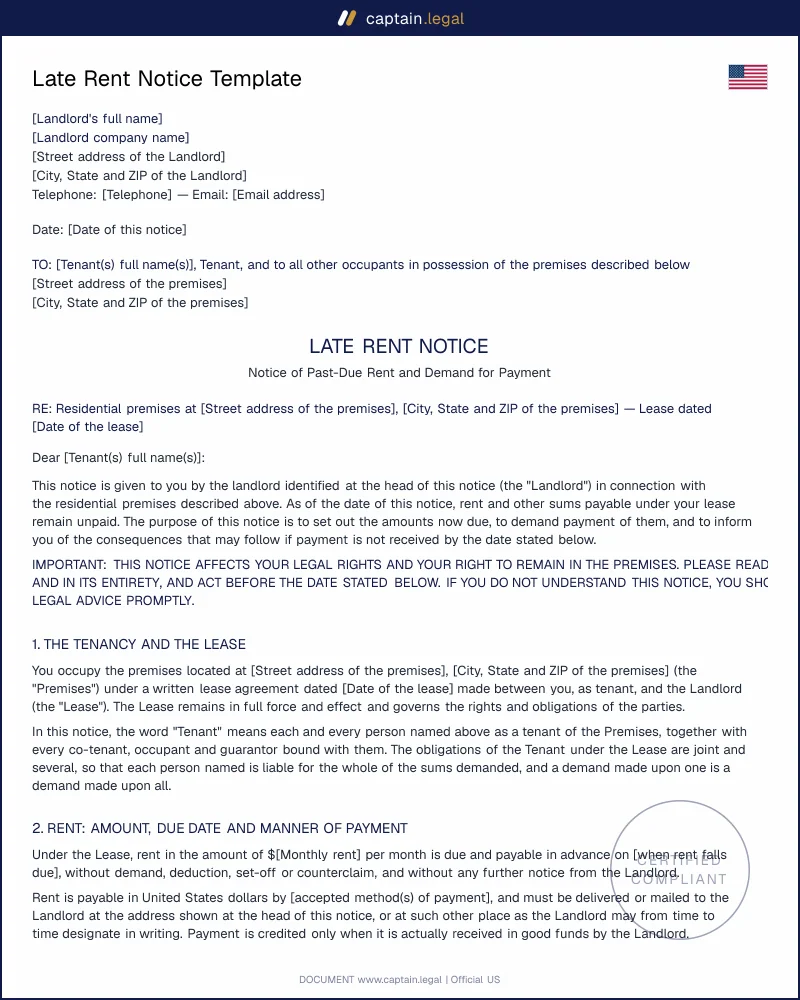
  • The identification of the parties and the premises names every adult tenant on the lease, not only the person who writes the checks. Courts read notices narrowly, and a demand addressed to one of three co-tenants is treated as notice to one of three co-tenants.
  • The itemized statement of amounts due separates base rent from late fees, utility reimbursements and other charges. In Florida and California, mixing non-rent items into a later statutory demand is one of the most reliable ways to lose an eviction.
  • The late fee calculation shows the lease clause it comes from, the trigger date and the arithmetic. Where the state supplies a safe harbor or a cap the template applies it: twelve or ten percent in Texas, the lesser of the two limits in New York, a reasonableness statement in California and Florida.
  • The cure deadline and accepted payment methods give a calendar date rather than a count of days, with the address, portal or account the tenant must use. Vague deadlines produce disputes about when the clock started.
  • The non-waiver and reservation of rights language states that accepting a partial payment does not waive the balance, reinstate the tenancy or bar a statutory notice. Leave this clause out and a partial payment can cost you the whole default.
  • The statement of next steps and proof of delivery tells the tenant which statutory notice follows and records how, when and by whom it was delivered. That record is what a judge looks at when a tenant testifies they never received anything.
4

State-specific considerations

California gives landlords no statutory grace period and no percentage safe harbor, which makes the fee the weakest part of most notices. Under Civil Code §1671(d) the burden sits entirely on the landlord to justify the amount, and Orozco voided a flat charge worth well over half a month's rent. Practitioners keep residential fees at or below five percent and keep a file note explaining the administrative cost behind the number. Timing downstream matters too: a notice under Code of Civil Procedure §1161(2) must state the exact rent due, and since AB 2347 a tenant has ten court days to answer an unlawful detainer rather than five.

Texas is the most predictable state in the country here. Property Code §92.019 bars any fee until rent has stayed unpaid two full days past the due date, requires it to be written into the lease, and permits an initial charge plus a daily charge so long as the combined total stays inside the safe harbor. A landlord who overcharges owes the tenant one hundred dollars, three times the fee wrongly collected, and reasonable attorney's fees. The late rent notice therefore doubles as a compliance check before you reach the §24.005 notice to vacate.

Florida caps nothing, which is less generous than it sounds, because a fee a county judge reads as punitive falls as an unenforceable penalty. The trap sits in Florida Statutes §83.56(3), whose three day notice follows a statutory form, excludes Saturdays, Sundays and legal holidays from the count, and demands rent only. Notices bundling a late charge into the amount demanded are voided regularly.

New York runs the strictest regime and the only one that makes this document mandatory. Real Property Law §235-e(d) requires certified mail once rent is five days late, §238-a(2) caps the fee, and RPAPL §711(2) requires a fourteen day written demand before a nonpayment proceeding. Late fees cannot go into that demand and cannot alone support an eviction. Rent stabilized units carry further restrictions, and periodic tenancies have their own tiered termination timelines, covered in our month to month rental agreement template.

5

How to fill out this late rent notice

You begin by selecting the state where the property sits, because that choice drives the fee logic, the grace period language and the statutory references printed at the foot of the page. The form then takes the parties and the premises, pulling tenant names and address into the header exactly as they must appear. Next comes the money: the rental period in default, the base rent unpaid, any partial payment already received and the date rent was originally due. The tool computes the charge against your state's rule and flags it if the result lands outside the safe harbor or the cap.

The final screens handle timing and delivery. You choose the cure date, the payment channels and the delivery method, and a matching proof of service block generates with the document. Keep the lease open alongside the form, since the fee clause and the payment address should match word for word; the same field structure appears in our residential lease agreement template for all fifty states.

6

Common mistakes to avoid

The mistake that costs the most money is treating a late rent notice as the statutory notice. It is not, and serving it starts none of the three day, fourteen day or thirty day clocks your state requires before filing. Landlords who count from the courtesy letter arrive in court having served nothing. The second recurring error is arithmetic: demanding a figure that folds in late fees, utility charges or a prior balance the lease never converted into rent. Keep the base rent clean, because the number here is the number you carry forward.

Delivery is the third failure point. Slipping a page under the door with no record works until the tenant testifies otherwise, and in New York it is affirmatively non-compliant. The fourth is emotional drafting: accusations, references to the tenant's personal circumstances, or threats of credit reporting you do not actually carry out. Never promise a bureau filing you have not arranged. Tenant attorneys collect those lines, and once an agency handles the debt they create exposure under the Fair Debt Collection Practices Act. Finally, a security deposit is not a rent reserve and cannot cover an unpaid month mid tenancy. It carries its own deadlines and remedies, set out in our security deposit demand letter template.

Key takeaways

Purpose

A record, not an eviction notice

A late rent notice is a dated written demand that documents what is unpaid, which rental period it covers, what the lease allows as a late fee, and a short deadline to cure. It usually does not start the legal eviction clock, but it builds the paper trail judges look for later, such as the ledger attached to a complaint and proof the tenant was told before escalation.

State rules

Late fees are heavily state-limited

Late fees are where compliance problems show up. New York limits late charges to $50 or 5% of monthly rent (whichever is less) and bars any fee during the first five days under RPL 238-a(2). Texas Property Code 92.019 creates safe harbors: 12% of monthly rent (4 units or fewer) or 10% (larger buildings). California treats late fees as liquidated damages under Civil Code 1671(d), requiring reasonableness.

Exceptions

Federal and NY triggers can apply

Most states do not require a courtesy demand before serving a statutory pay-or-quit style notice, but New York is an outlier: Real Property Law 235-e(d) requires certified-mail notice once rent is five days late. Federal law can also change the timeline. The CARES Act notice-to-vacate rule at 15 U.S.C. 9058(c) still requires 30 days’ notice for nonpayment at federally backed or federally assisted properties.

Frequently Asked Questions

The document itself creates no obligations. What binds is the lease, which sets the due date and authorizes the fee, and the statute governing how large that fee may be. A properly drafted notice makes those obligations enforceable in practice by proving the tenant received a dated, specific demand, and courts treat it as evidence that often decides whether late fees survive. New York goes further: the notice required by Real Property Law §235-e(d) is a precondition to a clean nonpayment proceeding.

Both formats come with the document. The Word version stays editable, which matters when you want to soften the tone for a reliable tenant who is late for the first time, add a payment plan paragraph, or rework the delivery block for a state requiring certified mail. The PDF is the version you sign and serve, formatted so page breaks fall between sections rather than through the itemized figures.

Three to five days is the working standard, and the reason is procedural rather than generous. The cure window here runs before the statutory clock, so a long one delays everything downstream. Texas builds in two full days before a fee can attach, New York five, California and Florida none. Match the window to the lease's grace period where one exists, state a calendar date, and keep the interval consistent across tenants.

Usually not, and this is the most common reason nonpayment cases collapse. Florida's notice under §83.56(3) demands rent, and county courts void notices bundling in a charge the lease never defined as additional rent. New York bars late fees from the fourteen day demand under RPAPL §711(2). California requires the exact rent due, so an inflated figure is a defect. Charge the fee here and pursue it as a contract claim.

Partial payment is the trap. In most states, accepting rent for a period in which the tenant is in default can waive that default and reset the process, which is why the template carries non-waiver language. Record the amount received, the date and the remaining balance in writing, and state that acceptance applies to the outstanding balance without reinstating the tenancy. Related landlord paperwork sits in the complete US legal document library.

Only New York makes certified mail mandatory, through Real Property Law §235-e(d). Everywhere else the method is a question of proof rather than compliance, but the advice is the same: use something that generates a record. Certified mail with return receipt, a tracked courier, personal delivery witnessed by a third party, or hand delivery paired with an emailed copy all work. Posting on the door alone is the easiest to deny.

4.8/5

27 verified reviews · 50 000+ downloads

Late Rent Notice | Compliant with RPL 238-a & Sec 92.019
  • Immediate access to the document
  • PDF + Word download
  • Compliant with 2026 legislation
  • Reviewed by lawyers
Fill in the template
Secure payment
Updated on July 26, 2026

You might also like

Month-to-Month Rental Agreement
Property Management Agreement