Create my document
Login

Choose country

CanadaCanadaChoose country
Real Estate

Sell or Buy a Home Without Costly Drafting Mistakes

Agreement of purchase and sale drafted to the Statute of Frauds writing rule and provincial title systems, with BC rescission and NRST flagged. Word and PDF.
4.8/513 reviews50 000+ downloadsInstant download
Share

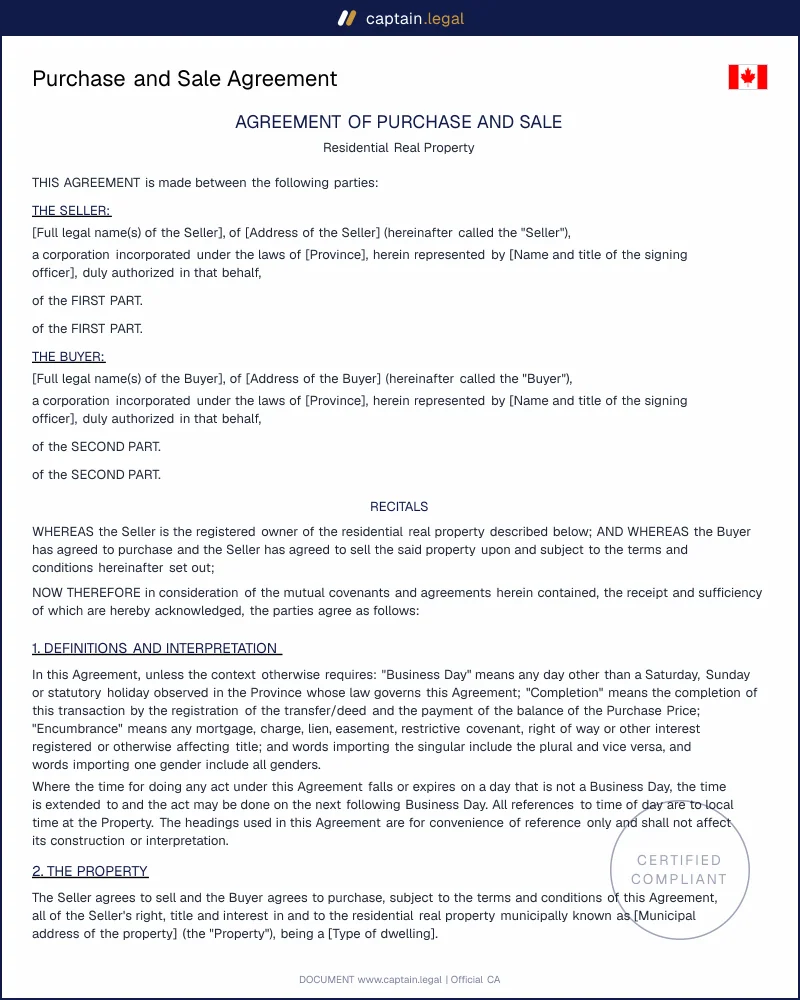
A residential purchase and sale agreement, known across most Canadian common-law provinces as an agreement of purchase and sale (APS), is the binding contract that fixes the terms on which a home changes hands: the purchase price, the deposit, the conditions, the closing date, and the representations the seller stands behind. It is the single most consequential document a buyer or seller signs in a real estate deal, because once both parties have signed and conditions are waived, neither side can walk away without consequences. This template is drafted for private residential transactions in the common-law provinces, where land is held under common-law principles and title is recorded through provincial registration systems. Whether you are selling a freehold house, buying a condominium unit, or closing a transaction between family members without an agent, the APS is what turns a handshake into an enforceable obligation.

Compliant

2026 Legislation

50,000+ clients

trust us

Affordable

From $4.90 / doc

Secure payment

Instant download

Sell or Buy a Home Without Costly Drafting Mistakes

Secure payment · No subscription

Fill in the template

What is a residential purchase and sale agreement?

A residential purchase and sale agreement is a written contract under which one party agrees to sell, and another to buy, a defined residential property at an agreed price on agreed terms. In Canadian common-law practice the document carries different labels depending on the province. Ontario, Alberta, and most of the Atlantic provinces call it an agreement of purchase and sale; British Columbia uses the contract of purchase and sale. The substance is identical: it is the contract that creates the legal obligation to convey title, not the conveyance itself. The agreement and the transfer are two separate steps. Signing the APS binds the parties, but legal ownership passes only later, at closing, when the transfer (deed) is registered against title in the provincial land registry.

People often confuse the agreement with an offer to purchase, and the distinction matters. An offer is a one-sided proposal. It becomes an agreement only when the other party accepts it without changes, at which point a binding contract exists. A counter-offer is a fresh offer that the original offeror is then free to accept or reject. Buyers should also distinguish a firm deal from a conditional one: an agreement subject to financing, inspection, or the sale of the buyer's existing home is not fully binding until those conditions are waived or fulfilled. Until that happens, the deposit is at stake but the obligation to close is not yet absolute. For longer arrangements that grant possession without transferring ownership, a residential lease or tenancy agreement is the correct instrument rather than a purchase contract.

2

When do you need this document?

The obvious trigger is the private sale of a home between a buyer and seller who have agreed on a price and want the deal in writing without an agent's standard form. Family transfers fall squarely here: a parent selling to a child, or a transfer between siblings or spouses, still needs a properly drafted APS to establish the price, the closing date, and the tax position, even where everyone trusts everyone. A below-market family sale that is not documented carefully can trigger unexpected land transfer tax or attract scrutiny from a lender, so the paperwork protects the relationship as much as the parties. The second common scenario is the for-sale-by-owner transaction, where neither side is using a brokerage and there is no realtor to supply a form. Here the agreement is the only thing standing between the parties and a dispute.

A third situation is the assignment-friendly purchase, where a buyer wants the right to assign the contract before closing, common in pre-construction or investment deals. The agreement must say so expressly, because the right to assign is not automatic and many sellers will refuse it. Investors buying a rental property need an APS that addresses existing tenancies and the assignment of any residential tenancy agreements already in place, since the new owner steps into the landlord's shoes on closing. One edge case worth flagging: a purchase made through a corporation rather than an individual changes both the foreign-buyer analysis and the way representations are given, and the agreement should name the correct contracting entity. Buyers who plan to incorporate a holding company for the property should sort that out before signing, not after, and may need business incorporation and corporate documents in place first.

3

Key clauses included in our template

  • The identification of the parties and the property opens the agreement and must be exact. Every legal owner on title has to be named as a seller, and the property is described by its municipal address together with its legal description and parcel identifier as it appears on title. A vague description is the single most common reason a court refuses to enforce a land contract, because the Statute of Frauds essential terms include a clear identification of what is being sold.
  • The purchase price, deposit, and balance clause sets the total price, the amount of the deposit, when it is payable, and who holds it in trust pending closing. It confirms that the deposit forms part of the price on completion and addresses what happens to it if the buyer defaults, which is usually forfeiture, or if the deal collapses on an unmet condition, which is usually return.
  • The conditions precedent turn an offer into a conditional agreement. Financing, home inspection, status certificate review for a condominium, and the sale of the buyer's existing property are the standard ones, each with a deadline by which the condition must be waived or the deal ends. Miss a condition deadline and the protection disappears: silence is treated as waiver in many standard forms, so the buyer who forgets to extend an inspection condition can find themselves firmly bound.
  • The closing and possession clause fixes the completion date, the adjustment date, and the date the buyer takes vacant possession. It sets out how property taxes, utilities, and condominium fees are apportioned between the parties as of closing.
  • The representations and warranties record what the seller affirms about the property: that they have authority to sell, that the chattels and fixtures included are owned free of liens, that there are no undisclosed work orders or encroachments, and, where applicable, the property's status as a principal residence for tax purposes.
  • The title and requisitions clause gives the buyer a defined period to search title and raise objections, and obliges the seller to convey clear title or to discharge registered encumbrances on or before closing.
4

Regional considerations

British Columbia is the province where the contract behaves differently from everywhere else. Under section 42 of the Property Law Act and B.C. Reg. 175/2022, a buyer of covered residential property has three business days after the seller accepts the offer to rescind for any reason, on payment of a rescission fee of 0.25% of the purchase price. The right cannot be waived by either party and the clock does not count weekends or statutory holidays. A seller in BC should treat an accepted offer as firm only once the rescission window has closed. Leasehold land, court-ordered sales, and properties sold at auction are exempt, and pre-sale developments are governed instead by the seven-day right under the Real Estate Development Marketing Act. The contract of purchase and sale used in the province must disclose this right.

Ontario has no cooling-off period for resale homes, though pre-construction condominiums carry a ten-day rescission right under the Condominium Act, 1998. The province's defining feature for an APS is tax. The Land Transfer Tax Act imposes provincial land transfer tax on every purchase, Toronto layers a municipal land transfer tax on top within city limits, and the Non-Resident Speculation Tax adds 25% province-wide for foreign buyers, with a further 10% municipal NRST inside Toronto since January 2025. An agreement involving any non-resident party should address these costs explicitly. Ontario buyers commonly use the OREA standard form, but a private APS is equally valid provided it meets the Statute of Frauds writing requirement.

Alberta operates a land titles (Torrens) system through which registration is conclusive of ownership, and it imposes no land transfer tax, only modest registration fees, which makes the closing arithmetic simpler than in Ontario. There is no cooling-off period. The Atlantic and prairie provinces vary in registration model and in whether they charge a deed transfer tax, so the closing-cost section of any agreement should be checked against the specific province. Across all common-law provinces the contractual essentials remain constant: a signed writing, a clear property description, an agreed price, and a defined closing date. Buyers handling their own paperwork may also want supporting personal and family legal documents such as powers of attorney where a party cannot attend closing in person.

5

How to fill out this residential purchase and sale agreement

You begin by selecting the province where the property is located, because that choice drives the statutory references, the registration language, and whether a rescission right applies. From there the template asks you to identify the parties exactly as they hold or will hold title, then to describe the property by its municipal address and legal description so that the contract satisfies the writing requirement. You enter the purchase price, the deposit amount, who will hold the deposit in trust, and the closing and possession dates. The form then lets you build in the conditions that protect you, financing, inspection, status certificate, or the sale of an existing home, each with its own waiver deadline, so the agreement reflects whether your deal is firm or conditional. You set out the chattels and fixtures included in the sale, record the seller's representations, and add any special clauses your transaction needs, such as an assignment right or a holdback. Once the fields are complete, you download the agreement as a Word file you can still edit or as a print-ready PDF, review it carefully, and have every party sign. For complex or high-value deals, having a real estate lawyer review the draft before signing remains the sensible course.

6

Common mistakes to avoid

The most expensive mistake is treating an accepted offer as a finished deal when conditions are still outstanding. A buyer who removes the financing condition before the lender has confirmed the mortgage, or who waives the inspection to win a bidding war, is fully bound the moment the condition is gone, and a failed appraisal afterward is the buyer's problem, not the seller's. The same trap catches sellers who accept a strong price without checking that the buyer's conditions are realistic. A close cousin is the missed deadline. Condition periods are calculated in days and many standard forms treat a deadline that passes in silence as an automatic waiver, so a buyer who forgets to deliver a waiver or an extension can lose the protection they negotiated. Diarize every date in the agreement the day it is signed.

Vague drafting is the other recurring failure. An agreement that describes the property loosely, omits an owner who is on title, or leaves the included chattels to memory invites a dispute that the Statute of Frauds essential-terms rule may resolve against the careless party. Sellers frequently forget to disclose known latent defects, work orders, or encroachments, and a misrepresentation discovered after closing can support a claim for damages or rescission. Finally, cross-border parties routinely overlook the foreign-buyer ban and the non-resident speculation taxes, signing an agreement that is either prohibited outright or saddled with a 25% to 35% tax nobody budgeted for. Screening residency status and the property's location against the federal prohibition before signing avoids a deal that cannot legally close.

Key takeaways

Binding contract

Once signed and conditions waived, you are in

An agreement of purchase and sale (APS) is the contract that locks in price, deposit, conditions, closing date, and seller representations. Once both sides sign and any financing or inspection conditions are waived or satisfied, the deal becomes firm. At that point, walking away is not a casual option; there are consequences, and the deposit can be at risk.

Writing rule

A handshake sale is usually unenforceable

In common-law provinces, a home sale contract generally must be in writing and signed to be enforceable. Ontario’s Statute of Frauds (s. 4) is a common example of this rule. Courts may enforce an oral deal only in narrow cases like part performance, but that is heavily litigated and uncertain. Do not rely on a verbal promise to buy or sell.

Title transfer

Signing the APS is not the transfer

The APS creates the obligation to convey title, but it is not the conveyance itself. Ownership changes later, at closing, when the transfer/deed is registered in the provincial land title or registry system. Treat these as two separate steps: contract now, title later. Confusing them can lead to misplaced assumptions about possession, rights, and what is actually registered on title.

Frequently Asked Questions

Yes. Once both parties sign and any conditions are waived or fulfilled, the agreement is a binding contract enforceable in the courts of the common-law provinces. It satisfies the core requirement of the Statute of Frauds, which is a signed writing that identifies the parties, describes the property, and states the price. A binding contract for the sale of land exists, on the authority of the Supreme Court of Canada, once that signed writing contains the essential terms with nothing left to negotiate. The template gives you that writing; the binding force comes from both parties signing and from conditions being satisfied or waived in accordance with their deadlines.

In practice, yes. The Statute of Frauds in force in Ontario and the other common-law provinces requires that a contract for the sale of land be evidenced in writing and signed by the party to be charged, or it cannot be enforced through an ordinary action. Courts have occasionally enforced unwritten deals under the equitable doctrine of part performance, where a buyer or seller has irremediably acted on the contract while the other looked on, but that is a costly exception decided case by case. No sensible buyer or seller relies on it. A signed written agreement is the only reliable way to make a residential sale enforceable.

It depends entirely on the province. British Columbia is the only province with a mandatory cooling-off period for resale homes: under section 42 of the Property Law Act and B.C. Reg. 175/2022, a buyer of covered residential property has three business days after acceptance to rescind for any reason, on payment of 0.25% of the price. Ontario, Alberta, and the others have no such right for resale homes, though Ontario gives buyers of pre-construction condominiums a ten-day rescission right under the Condominium Act, 1998. Outside BC, a signed and condition-free agreement is firm immediately, so do your due diligence before you sign rather than after.

Yes. The agreement is available both as a Microsoft Word document and as a print-ready PDF. The Word version lets you adjust clauses, add transaction-specific terms, and tailor the language to your province before printing, which is useful where you want to insert an assignment right, a holdback, or unusual conditions. The PDF is formatted for immediate printing and signature. Most buyers and sellers keep the editable Word file for drafting and use the PDF as the final signing copy, with each party retaining a fully executed counterpart for their records and for the lawyer handling the closing.

There is no statutory amount; the deposit is whatever the parties agree, and the template lets you set it. In practice deposits commonly run in the range of a few percent of the purchase price, held in trust by the seller's brokerage or a lawyer pending closing, and credited toward the price on completion. A larger deposit signals a serious buyer and gives the seller more security, while the agreement should state clearly whether the deposit is forfeited on buyer default and returned where a condition fails. The clause holding the deposit in trust matters as much as the amount, because it determines who controls the money if the deal collapses.

Once the agreement is firm, walking away is a breach of contract. A defaulting buyer typically forfeits the deposit and can be sued for the seller's losses, including any shortfall if the home later sells for less. A defaulting seller can be ordered to pay damages, and because every parcel of land is treated as unique, a court may order specific performance, compelling the seller to complete the sale. The position is different while conditions are unmet: a buyer who properly invokes an unsatisfied financing or inspection condition can usually walk away with the deposit returned. In British Columbia, the three-day rescission right offers a separate, fee-based exit that no other province provides.

Yes, and the issue should be sorted out before signing. The federal Prohibition on the Purchase of Residential Property by Non-Canadians Act bans many non-Canadians from buying residential property in census metropolitan areas until January 1, 2027, with narrow exceptions for certain work-permit holders, students, and spouses of Canadians. Even where a non-resident can buy, provincial non-resident speculation taxes apply: 25% across Ontario and an additional 10% inside Toronto, plus a separate additional property transfer tax in parts of British Columbia. A foreign buyer should confirm both that the purchase is permitted and what tax applies before committing, because neither the ban nor the tax can be drafted around in the agreement.

For most residential transactions a lawyer's review is strongly advisable, and in every common-law province a lawyer or notary handles the closing and registration in any event. The template produces a complete, properly structured agreement, but a lawyer can confirm that the conditions protect you, that the property description matches title, and that the tax and residency position is correct for your situation. High-value deals, family transfers, assignments, corporate purchases, and any cross-border element are the cases where review pays for itself. Engaging a real estate lawyer early, before the offer is firm rather than after, gives you room to fix problems while you still can.

4.8/5

13 verified reviews · 50 000+ downloads

Sell or Buy a Home Without Costly Drafting Mistakes
  • Immediate access to the document
  • PDF + Word download
  • Compliant with 2026 legislation
  • Reviewed by lawyers
Fill in the template
Secure payment · No subscription
Updated on June 18, 2026

You might also like

Commercial Lease Agreement Template
Notice to Terminate Tenancy Canada