Create my document
Login

Choose country

CanadaCanadaChoose country
Business

Service Agreement Template Canada | Sagaz 2001 SCC

Service Agreement built on Canadian common law and the Sagaz contractor test. Scope, IP assignment, liability cap and termination. Word & PDF download.
4.6/521 reviews50 000+ downloadsInstant download
Share

A service agreement is the contract that governs the relationship between a business and the supplier it hires to perform work, fixing the scope, the deliverables, the fees and the conditions under which either side can walk away. In Canadian practice it is the everyday workhorse of commercial dealings: a marketing agency retaining a freelancer, a software firm engaging a consultant, a landlord hiring a property manager. It rests on the common law of contract in the common-law provinces and on the Civil Code of Québec in Quebec, and a well-drafted version does more than record a handshake. It allocates risk, protects intellectual property and keeps a contract for service from being mistaken for an employment relationship, which is the single most expensive error a Canadian business makes when engaging outside help.

Compliant

2026 Legislation

50,000+ clients

trust us

Affordable

From $4.90 / doc

Secure payment

Instant download

Service Agreement Template Canada | Sagaz 2001 SCC

Secure payment · No subscription

Fill in the template

What is a service agreement?

A service agreement is a legally binding contract under which one party, the service provider, agrees to perform defined work for another party, the client, in exchange for payment. Lawyers also call it a contract for service, and that label carries weight in Canada. It is the deliberate opposite of a contract of service, the technical name for an employment relationship. The distinction is not cosmetic. A contract for service signals that the provider runs an independent business, controls how the work gets done, supplies its own tools and carries the financial risk and reward of the engagement.

People often confuse a service agreement with a few neighbouring documents, and the differences matter when you draft. A service agreement is broader than a simple statement of work, which usually sits inside or alongside it and itemizes specific tasks and milestones. It is narrower than a master services agreement, the umbrella contract large organizations use to govern a series of future engagements through successive work orders. It also differs from an independent contractor agreement, which is really a species of service agreement focused on a single individual rather than a corporate supplier. Calling a document a "service agreement" does not, on its own, make the relationship a contractor relationship. Canadian courts and the Canada Revenue Agency look past the title to the day-to-day reality of how the parties behave, a point developed in the legal framework below.

2

When do you need this document?

The most common trigger is the simplest: you are about to pay someone outside your payroll to do work, and you want the terms in writing before they start. A web developer building a site, an accountant handling year-end, a cleaning company servicing an office. In each case the agreement fixes what is owed, when it is owed and what counts as finished, which is what prevents the dispute that otherwise surfaces only when the invoice arrives. Putting the scope on paper before the work begins is the cheapest insurance a business can buy.

A second scenario is ongoing or repeat work, where the relationship is open-ended and the real exposure is termination. Property management, IT support and retained consulting all fall here, and the clause that matters most is the one setting notice of termination and what happens to work in progress. A third, increasingly common situation is engaging a freelancer or solo consultant where the misclassification risk is live. Here the agreement does double duty, recording the commercial terms and building the evidentiary record that the provider is independent, controlling their own hours, free to take other clients and invoicing through their own business.

Two edge cases deserve a flag. When the work produces something the client needs to own outright, like custom code, branding or written content, the intellectual property assignment clause becomes the heart of the deal rather than boilerplate, because under Canadian copyright law the creator owns the work by default unless it is assigned in writing. And when a provider will touch personal information of the client's customers, PIPEDA obligations flow through the contract, so a confidentiality and non-disclosure arrangement often needs to sit alongside the service terms.

3

Key clauses included in our template

  • The scope of services is the spine of the agreement and the clause most disputes turn on. Our template forces specificity: what the provider will deliver, what is expressly excluded, and how change requests are handled, so that "redesign the website" never becomes an open-ended obligation that swallows the budget.
  • The fees and payment terms set the amount, the schedule and the consequences of late payment. The template distinguishes fixed-fee, hourly and milestone billing, addresses expenses and disbursements separately, and lets you set interest on overdue accounts so a slow-paying client carries the cost of the delay rather than the provider.
  • The intellectual property clause assigns ownership of deliverables to the client on payment, which Canadian law requires to be in writing to be effective. Without it the Copyright Act leaves ownership with the creator, a trap that catches businesses who assume that paying for work means owning it.
  • The limitation of liability clause caps the provider's exposure, commonly at the fees paid, and excludes indirect and consequential losses. Courts will enforce a clearly drafted limitation clause between commercial parties, so this is where a provider genuinely controls its downside risk.
  • The confidentiality clause protects information disclosed during the engagement and survives termination, which matters when a provider sees pricing, customer lists or unreleased products.
  • The termination clause sets out termination for convenience on notice and termination for cause on breach, and dictates payment for work completed up to the termination date, the point that otherwise produces the messiest exits.
4

Regional considerations

Ontario sits squarely in the common-law tradition, and its courts apply the Sagaz test rigorously when a provider later claims to have been an employee or dependent contractor. Ontario's Electronic Commerce Act, 2000 confirms the validity of electronic signatures for service contracts, though it carves out wills and powers of attorney. Businesses should note that a misclassified relationship can pull the worker under the Employment Standards Act, 2000, exposing the client to vacation pay, overtime and termination entitlements never contemplated in the contract.

British Columbia governs electronic execution through its Electronic Transactions Act, which aligns closely with the federal approach. BC's courts have been notably willing to find dependent contractor status, a middle category that entitles a long-serving exclusive provider to reasonable notice of termination even without employee status, so the termination clause in a BC service agreement deserves particular attention.

Alberta applies its own Electronic Transactions Act and the common law of contract. Alberta practice places weight on the genuine independence of the provider, and a service agreement that recites independence while the parties behave like employer and employee will not survive a CRA review. Clear invoicing through the provider's own business name is among the more persuasive indicators.

Quebec is the outlier. The Civil Code of Québec governs the contrat de service under articles 2098 to 2129, and its concepts do not map cleanly onto common-law drafting. Notably, article 2125 gives the client a right to terminate the contract unilaterally even where the provider is not at fault, subject to indemnifying the provider for work done and expenses incurred. A service agreement used in Quebec should be reviewed against the Code rather than simply translated from a common-law template.

5

How to fill out this service agreement

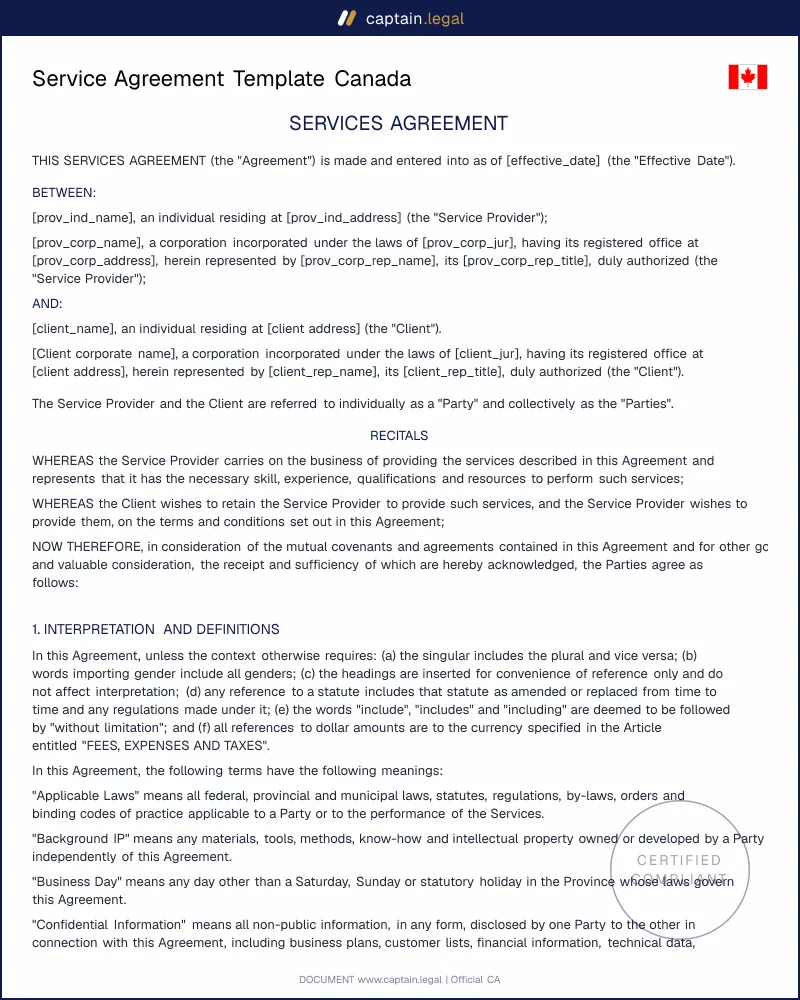
You begin by identifying the two parties, entering the legal names and addresses of the client and the service provider, and confirming whether the provider is an individual or an incorporated business, since that choice shapes the classification language the template applies. From there you describe the scope of services in your own words, and the document prompts you to separate the core deliverables from anything you want expressly excluded, which is where most future disputes are quietly headed off.

The next stage covers the commercial terms. You select the fee structure, whether fixed, hourly or tied to milestones, set the payment schedule and decide how expenses are handled. The template then walks you through the protective clauses, letting you choose the level of intellectual property assignment, the cap on liability and the length of the confidentiality obligation. Finally you set the term and the notice of termination, and the document assembles a clean, signature-ready contract in both Word and PDF so you can adapt the wording or sign it as it stands. If you also need to formalize a worker relationship more tightly, the platform's independent contractor agreement for Canadian businesses follows the same guided process.

6

Common mistakes to avoid

The most damaging mistake is treating the title as the protection. A business that writes "independent contractor" at the top of a service agreement, then directs the provider's daily hours, supplies all the equipment and forbids other clients, has built an employment relationship the CRA will recognize regardless of the heading. The defence against reclassification lives in the substance of the arrangement, not the label, and the contract should describe a relationship the parties actually intend to live by. A close cousin of this error is leaving the scope of services vague, which converts a fixed-fee project into an open-ended commitment the moment the client's expectations drift.

The other recurring failures cluster around the clauses people skip because they seem like boilerplate. Forgetting the written intellectual property assignment leaves the client paying for deliverables it does not legally own. Omitting a limitation of liability cap exposes a provider to losses far exceeding the contract value. Relying on a verbal agreement and a friendly email trail works right up until it does not, usually when a payment is missed or a deliverable rejected, and at that point the absence of a written termination and payment clause turns a simple disagreement into a costly standoff. Reviewing a sister document such as a Canadian commercial confidentiality template alongside the service terms helps catch the gaps before they cost anything.

Key takeaways

Classification risk

A title will not make them a contractor

Calling the document a service agreement does not settle worker status in Canada. Courts and the Canada Revenue Agency look at the real relationship using the Sagaz factors: control, who supplies tools, chance of profit and risk of loss, and how integrated the provider is in the client’s operations. If the facts look like employment, the contract label will not save you.

Money exposure

Misclassification can trigger CPP and EI arrears

Getting the relationship wrong tends to hit the business side hardest. If a “supplier” is later treated as an employee or dependent contractor, the client may face back remittances for Canada Pension Plan and Employment Insurance, plus interest and penalties. In parallel, the worker may claim notice-type entitlements, turning a routine engagement into an expensive dispute.

Drafting levers

Lock down scope, fees, liability, termination

A service agreement is the workhorse contract that sets the scope, deliverables, fees and the conditions to end the engagement. In the common law provinces, it is enforced on ordinary contract principles (offer, acceptance, consideration, intent), so the words you choose on liability caps, intellectual property protection and termination rights often define the risk allocation when something goes wrong.

Frequently Asked Questions

Yes. A service agreement is enforceable on ordinary contract principles in every common-law province, requiring only offer, acceptance, consideration and an intention to create legal relations, none of which depend on a lawyer's letterhead. Once both parties sign, whether by hand or electronically, the document binds them to its terms. In Quebec the same contract is governed by the Civil Code of Québec under articles 2098 and following. The template is drafted to those standards, so what makes it binding is not the source of the form but the agreement of the parties to its scope, fees and conditions. You can review the broader Canadian business document framework for related corporate contracts.

Yes, and most Canadian businesses do. Electronic signatures are legally valid for commercial service contracts under PIPEDA at the federal level and under provincial statutes such as Ontario's Electronic Commerce Act, 2000, British Columbia's Electronic Transactions Act and Alberta's Electronic Transactions Act. A contract signed through an e-signature platform or exchanged by email carries the same legal weight as a paper copy with wet ink. The narrow exceptions, such as wills and certain land transfers, do not touch service agreements, so you can sign and exchange the document entirely online without weakening its enforceability in any province.

Both. The service agreement downloads as a Microsoft Word file and as a PDF, so you can choose between editing and signing. The Word version lets you adjust the scope, fees or termination wording to fit a specific engagement, add your own clauses or insert a detailed statement of work. The PDF is the clean, signature-ready version you send to the other party when the terms are settled. Having both means you can negotiate in Word and execute in PDF without rebuilding the document, and either format can be signed electronically.

That depends on what your contract says, which is exactly why the termination clause matters. A well-drafted service agreement states the notice period for termination for convenience, often thirty days, and allows immediate termination for cause on a material breach. Where the contract is silent and a court later finds the provider was a dependent contractor, Canadian courts may imply a right to reasonable notice based on the length and exclusivity of the relationship, which can run to several months. In Quebec, article 2125 of the Civil Code lets a client terminate unilaterally subject to indemnifying the provider. Setting the notice expressly in writing removes this uncertainty.

A service agreement is a contract for service with an independent provider who runs their own business, while an employment contract is a contract of service creating an employer-employee relationship. The difference drives tax, liability and entitlements. An employee has Canada Pension Plan, Employment Insurance and income tax deducted at source and is protected by employment standards legislation, whereas a service provider invoices for the work and handles their own remittances. Misclassifying one as the other exposes a business to back remittances and penalties, so the agreement should reflect a genuinely independent relationship in substance, not just in name.

For most routine engagements, no. A clearly drafted template that nails the scope, fees, intellectual property, liability and termination covers the great majority of commercial service relationships, and using one lets a business move quickly without waiting on bespoke drafting. Legal advice earns its cost on the higher-stakes deals: large contract values, complex intellectual property, unusual liability exposure or a relationship straddling the contractor-employee line. The value of a solid template is that it handles the standard case reliably and tells you when your situation has outgrown it.

By default under the Copyright Act, yes, the creator owns the copyright in what they produce, which surprises many businesses who assume that paying for work means owning it. To transfer ownership to the client, the service agreement must include a written intellectual property assignment, signed by the provider. Our template includes this clause and assigns the deliverables to the client on payment, so custom code, designs, written content or branding become yours rather than the provider's. Without that written assignment you hold only a licence to use the work, not ownership of it, a distinction that becomes critical if you later want to resell or modify it.

As detailed as you can make it. The scope is the clause that most disputes turn on, and vagueness almost always favours the party trying to expand the obligation. A strong scope lists the specific deliverables, names what is expressly excluded and sets out how additional requests are priced and approved. For a large or phased engagement, pair the agreement with a separate statement of work that itemizes tasks, milestones and acceptance criteria. The discipline of writing the scope precisely before the work starts is what keeps a fixed-fee project from quietly turning into an open-ended one.

4.6/5

21 verified reviews · 50 000+ downloads

Service Agreement Template Canada | Sagaz 2001 SCC
  • Immediate access to the document
  • PDF + Word download
  • Compliant with 2026 legislation
  • Reviewed by lawyers
Fill in the template
Secure payment · No subscription
Updated on June 20, 2026

You might also like

Shareholder Agreement Canada
Sales Agreement Canada