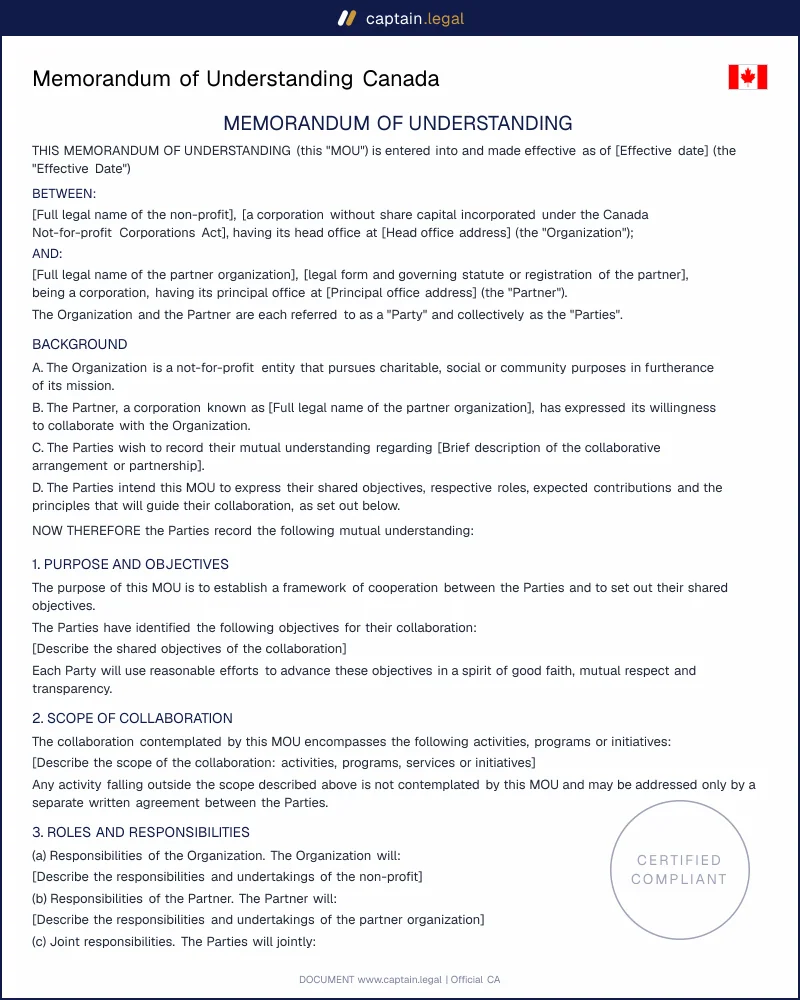
There is no single "MOU statute" in Canada. The enforceability of a memorandum of understanding is governed by ordinary contract principles, which in the nine common-law provinces flow from centuries of judicial decisions, and in Quebec from the Civil Code of Québec. A valid contract in Canada generally requires offer, acceptance, consideration, capacity, legality of object, and an intention to create legal relations. That last element is the hinge on which most MOU disputes turn: where the document expresses only an intention to cooperate, courts will usually treat it as non-binding, but where the terms are precise and the parties act as though committed, the same document may be read as an enforceable agreement.
Two doctrinal points deserve attention from any Canadian board. First, the Supreme Court of Canada in Bhasin v. Hrynew recognised a duty of honest performance in common-law contracts, and a pre-contractual relationship of reliance (the typical posture of an MOU) can carry a duty to negotiate in good faith rather than walk away arbitrarily after inducing reliance. Second, in Quebec, article 1375 of the Civil Code of Québec has long imposed good faith on the formation, performance and termination of obligations, so a Quebec non-profit signing an MOU should expect that standard to apply regardless of how preliminary the document feels.
The MOU also has to fit the organisation's governing instruments. A federal corporation incorporated under the Canada Not-for-profit Corporations Act (NFP Act), an Ontario corporation under ONCA, or a British Columbia society under the Societies Act can only enter arrangements consistent with its stated objects and by-laws, and the board must authorise the MOU by resolution. A registered charity carries an extra layer: any collaboration must advance its charitable purposes, and partnership terms that drift into private benefit or unrelated business can jeopardise its registration with the Canada Revenue Agency. The full text of the federal statute is published on the Department of Justice site, the official consolidation of the Canada Not-for-profit Corporations Act on the Justice Laws Website, and is the natural reference point when an MOU touches a federally incorporated non-profit. For organisations refining their internal governance, our Canadian non-profit by-laws and governance templates provide the constitutional backbone an MOU assumes is already in place.