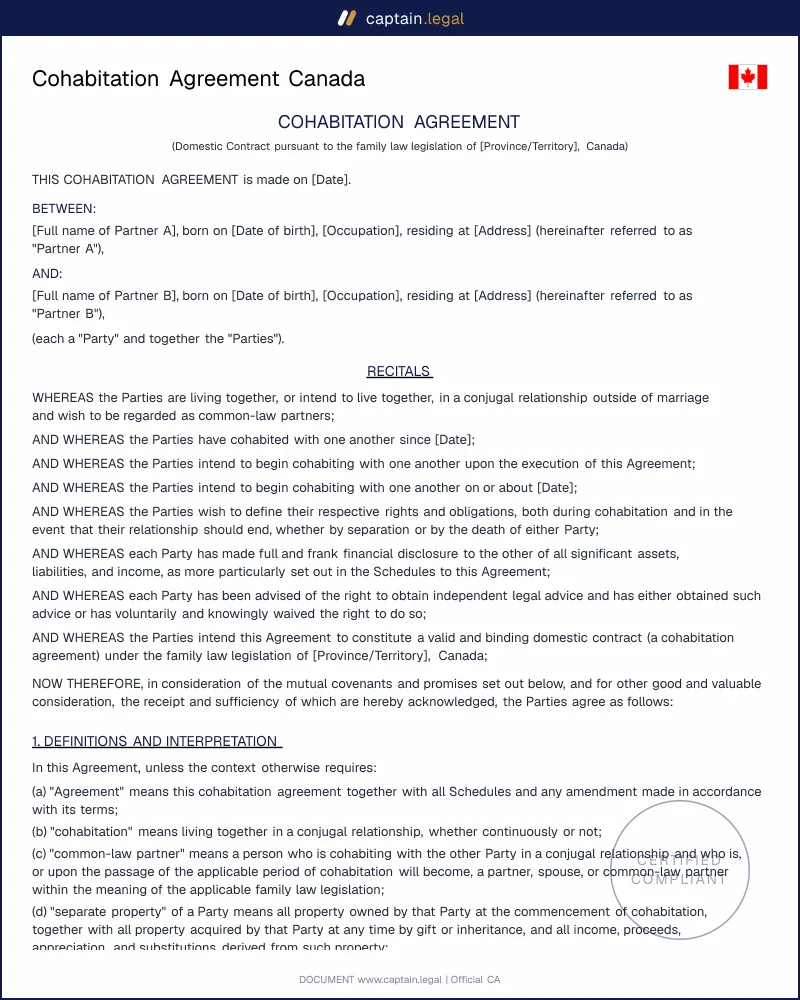
Ontario offers no statutory property division to common-law partners, which makes the cohabitation agreement the main tool for creating property rights the law does not otherwise supply. The agreement is governed by section 53 of the Family Law Act and must satisfy the writing, signature, and witness rule in section 55(1). Couples should remember the section 53(2) deeming rule: if they marry, the agreement becomes a marriage contract unless they opt out in writing. Without an agreement, a partner seeking a share of property is left to unjust enrichment or constructive trust claims, which Ontario courts treat as fact-intensive and uncertain.
British Columbia is the outlier among common-law provinces. Under the Family Law Act, SBC 2011, c. 25, partners who cohabit for two years in a marriage-like relationship gain property and support rights close to those of married spouses, with family property generally divided equally. A cohabitation agreement in BC is therefore used to contract out of that default sharing, and the courts will respect it only where disclosure was full and the terms are not significantly unfair. Drafting that simply mirrors an Ontario agreement misses the point, because the starting position is opposite.
Alberta recognises common-law couples as adult interdependent partners under the Adult Interdependent Relationships Act, with property dealt with under the Family Property Act. Status arises after three years of cohabitation, on having a child together, or by signing a formal adult interdependent partner agreement. An agreement executed before that status exists can be vulnerable, so Alberta documents often declare the partners adult interdependent or provide for re-execution once the threshold is met. For families weighing how an agreement fits with later estate planning, our Canadian wills and powers of attorney documents cover the succession side that a cohabitation agreement deliberately leaves alone.
Other provinces follow their own thresholds. Saskatchewan extends family property rules after two years of continuous cohabitation, while Manitoba does so after three years or on registration of the relationship with its Vital Statistics Agency. The practical lesson is consistent across the country: the agreement must be drafted to the province where the couple actually lives, because the default rights it modifies are different in each one.