Create my document
Login

Choose country

CanadaCanadaChoose country
Non-Profit

Conflict of Interest Policy Canada | NFP Act s.141

Conflict of interest policy built on NFP Act section 141 and ONCA section 41. Covers disclosure, abstention and director duties. Word and PDF download.
4.7/528 reviews50 000+ downloadsInstant download
Share

A conflict of interest policy is the written governance instrument that tells your directors, officers and senior staff what to do the moment their personal, financial or professional interests collide with the interests of the non-profit they serve. Every Canadian board faces these moments, a director whose company bids on a service contract, a treasurer whose spouse applies for a grant, an executive director who sits on the board of a partner charity. The conflict of interest policy sets out how those situations are declared, recorded and resolved before they damage the organization. This template is drafted for federal and provincial non-profit corporations and for registered charities, and it sits alongside your by-laws as a working compliance tool, not a decorative appendix.

A policy that gathers dust helps no one. What follows explains the legal duties behind the document, the situations that trigger it, and how a well-built conflict of interest policy for directors and officers protects both the people who govern and the mission they answer to.

Compliant

2026 Legislation

50,000+ clients

trust us

Affordable

From $4.90 / doc

Secure payment

Instant download

Conflict of Interest Policy Canada | NFP Act s.141

Secure payment · No subscription

Fill in the template

What is a conflict of interest policy?

A conflict of interest policy is an internal governance document that defines what counts as a conflict, requires the people who run the organization to disclose those conflicts, and prescribes how the board manages them once disclosed. It is narrower than a full code of conduct but broader than a single statutory clause, because it captures real, potential and perceived conflicts rather than only the material contracts that legislation singles out. A conflict exists whenever a personal, occupational or financial consideration may affect, or merely appear to affect, a director's objectivity or ability to act in the organization's best interests. Full disclosure does not by itself dissolve the conflict; it simply opens the door to managing it properly.

People often confuse this document with the statutory disclosure rule buried in their incorporating Act, and they are related but not identical. The legislation tells a director with an interest in a material contract to declare it and abstain from voting. A policy goes further, addressing gifts, outside employment, board interlocks, confidential information and the appearance of bias, none of which the statute fully covers. It also confuses with a gift acceptance policy, which governs incoming donations rather than the loyalties of insiders. Think of the conflict of interest policy as the operating manual that turns abstract fiduciary duty into a repeatable board procedure. Organizations building out their wider governance suite often pair it with the Canadian non-profit by-laws and governance templates that define how directors and members actually make decisions.

2

When do you need this document?

Most boards adopt the policy at incorporation, because lenders, major funders and grant agencies increasingly ask to see one before they release money, and a brand-new organization that cannot produce a governance policy looks unprepared. The next common trigger is a board interlock, where a director also sits on the board of a supplier, a partner charity or a competing organization, and needs a clear rule about when to step out of the room. Procurement is the classic flashpoint: the moment your non-profit considers a contract with a company owned by a director, a relative or a close business associate, the policy converts a potential scandal into a documented, defensible decision.

Hiring and remuneration raise the same question from a different angle. When a director's family member applies for a paid role, or when the board sets executive compensation, an unmanaged interest can taint the whole process. Grant-making organizations face it constantly, since a director affiliated with an applicant must be walled off from the funding decision. One edge case worth flagging is the perceived conflict, where no actual financial interest exists but a reasonable, well-informed observer would still doubt a director's impartiality. Perception alone can erode donor trust and trigger a complaint, which is why mature policies treat appearance as seriously as reality. Organizations refreshing their broader compliance posture often review the policy at the same time as their Canadian non-profit privacy and PIPEDA-compliant forms, since both turn on disciplined internal handling of sensitive information.

3

Key clauses included in our template

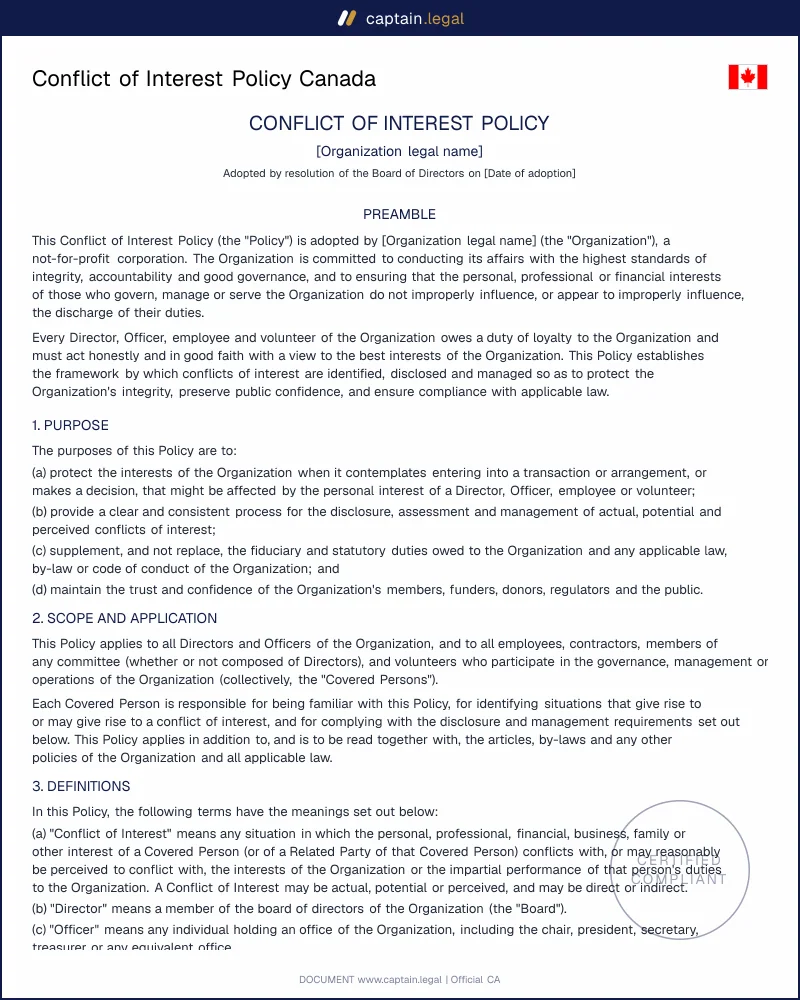
  • The definitions clause establishes what a conflict actually is, covering real, potential and perceived conflicts, and extending to the interests of a director's relatives, spouse, employer and business associates. This breadth matters because the NFP Act deliberately leaves "conflict of interest" undefined, leaving the common law and your own policy to fill the gap.
  • The disclosure obligation requires directors, officers and designated staff to declare any interest in writing and to do so promptly, mirroring the section 141 timing rules that demand declaration at the first board meeting where the matter arises. It includes an annual written declaration so that standing interests are captured before they cause a problem.
  • The abstention and recusal procedure sets out exactly what a conflicted person must do: declare the interest, leave the discussion, refrain from voting, and have the board record all of it in the minutes. It tracks the statutory carve-outs for remuneration, indemnity and affiliate transactions so the board does not over-recuse where the law permits a vote.
  • The gifts and benefits clause draws the line between modest, properly disclosed hospitality and anything that could be read as influencing a decision, prohibiting cash and negotiable instruments outright.
  • The confidentiality and no-personal-benefit clause stops directors from using information obtained through their board role for private advantage, a duty that survives even after they leave the board.
  • The enforcement and consequences clause explains what happens when the policy is breached, from formal censure to removal, and ties the breach back to the court remedies available under the governing statute.
4

Regional considerations

Federal (NFP Act) corporations answer to the Canada Not-for-profit Corporations Act and its section 141 disclosure regime, administered through Corporations Canada. A soliciting corporation, broadly one that takes in significant funds from the public, must have at least three directors, and at least two of them cannot be officers or employees, which itself reduces the conflict surface. The Act's due-diligence defence rewards directors who document their reliance on professional advice, so your policy should require that reasoning to be minuted.

Ontario (ONCA) governs provincially incorporated non-profits through the Not-for-Profit Corporations Act, 2010, with conflict disclosure at section 41 and a codified duty of care at section 43. ONCA introduced specific disclosure requirements for both directors and officers and enhanced members' rights to inspect financial records, so an Ontario policy should anticipate that members may scrutinize how conflicts were handled.

British Columbia operates under the Societies Act, which obliges a director with a material interest in a contract or transaction to disclose it fully and abstain from voting, and which requires that the disclosure be entered in the society's records. BC societies that are also registered charities should align the policy with the constraints on directors receiving payment.

Registered charities in any province carry an extra burden. The Income Tax Act and CRA expectations mean that an undisclosed director benefit can put charitable registration at risk, and provinces including Ontario restrict or prohibit paying charity directors for their services as directors. For a charity, a poorly managed conflict is not just a governance lapse, it is a threat to the organization's tax status. This is the area where boards most often need to tailor the template to their specific province before adoption.

5

How to fill out this conflict of interest policy

You begin by selecting the governing statute that matches how your organization is incorporated, federal under the NFP Act, Ontario under ONCA, British Columbia under the Societies Act, or another provincial equivalent, and the template adjusts the statutory citations and the recusal language accordingly. From there you enter the legal name of the corporation exactly as it appears on your articles, and you identify who the policy binds, typically directors, officers and any senior employees with decision-making authority. The next stage asks you to define the disclosure mechanics that suit your board, whether interests are declared verbally and minuted, filed in writing with the secretary, or both, and how often the annual written declaration is collected. You then choose the consequences that attach to a breach, scaling them from a recorded warning to removal, and you decide whether modest gifts are permitted and at what threshold they must be reported. Once the fields are complete the document assembles into a clean, board-ready policy you can download in Word and PDF, circulate to directors for adoption, and reference in your board minutes. Many organizations finalize it the same day they approve their Canadian charity governance and resolution documents, so the whole governance package takes effect together.

6

Common mistakes to avoid

The most frequent error is treating disclosure as the finish line rather than the starting point. A director who announces an interest and then stays in the room to argue for the contract has complied with the letter of nothing; the policy and the statute both require abstention from the vote and, in most cases, withdrawal from the discussion. Boards also routinely fail to minute the conflict, which is fatal when a funder, a member or a court later asks how a decision was reached, because an undocumented recusal is, evidentially, a recusal that never happened. A third mistake is drafting the policy so narrowly that it captures only direct financial interests, leaving family relationships, board interlocks and perceived conflicts entirely unaddressed even though those are the situations that most often blow up.

Many organizations copy a generic American policy off the internet and cite the wrong law, which undermines the document's credibility the moment a lawyer reads it. Equally common is the charity that ignores its provincial restrictions on paying directors and quietly approves remuneration that the law forbids. The last and most damaging mistake is adopting the policy once and never enforcing it, leaving a paper shield that collapses under the first real test. A policy works only when the chair actively models it, the board reviews declarations annually, and every recusal lands in the minutes. Boards that take governance seriously usually keep their conflict policy current alongside their other Canadian employment and HR contract templates, since the same disclosure discipline runs through hiring and procurement.

Key takeaways

NFP Act s.141

Disclose conflicts in writing and early

Under the Canada Not-for-profit Corporations Act, section 141, a director or officer who has an interest in a material contract or transaction must disclose the nature and extent of that interest in writing. Treat disclosure as the first step, not the solution: it triggers a board process to assess the deal and protect the corporation’s best interests before reputational harm or governance drift sets in.

Board process

Step out of the vote when conflicted

Once a conflict is declared, the default rule is abstention. A conflicted director cannot vote on the resolution approving the contract, with limited exceptions noted in the document (such as matters tied primarily to their own remuneration, or to indemnity or insurance, or transactions with an affiliate). Minute the disclosure and the abstention so the decision stands up to scrutiny later.

Fiduciary duties

By-laws cannot erase director obligations

This policy is built on fiduciary duties of loyalty and care: acting honestly, in good faith, and with the care of a reasonably prudent person in comparable circumstances. The NFP Act reinforces that internal rules do not let directors off the hook; section 148 states that no by-law or resolution can relieve them of these duties. A practical policy turns that standard into repeatable, defensible board conduct.

Frequently Asked Questions

The policy becomes binding on directors, officers and covered staff once the board formally adopts it by resolution and records that adoption in the minutes. Its authority flows from two sources: the corporation's power to make internal rules under its governing statute, and the underlying fiduciary duties that bind directors regardless of any policy. Because section 148 of the NFP Act provides that no by-law or resolution can relieve a director of the statutory duties, the policy reinforces obligations that already exist at law rather than creating new ones from nothing. For full effect, reference the policy in your by-laws and have each director acknowledge it in writing.

The statutory rule, section 141 of the NFP Act federally or section 41 of ONCA in Ontario, is narrow: it addresses a director's interest in a material contract or transaction and requires written disclosure plus abstention from the vote. A conflict of interest policy is broader. It captures real, potential and perceived conflicts, addresses gifts, outside employment, board interlocks and confidential information, and sets out an enforcement procedure. The statute is the floor; the policy is the working structure your board builds on top of it. A good policy explicitly states that it complements, and never overrides, the governing legislation.

In most cases the conflicted director must declare the interest, leave the discussion and abstain from the vote, and the board records all of this. The governing statutes carve out narrow exceptions: under section 141(5) of the NFP Act a director may still vote where the matter relates primarily to their own remuneration, to indemnity or insurance, or to a transaction with an affiliate. Outside those exceptions, voting while conflicted exposes the contract to being set aside and the director to repaying any gain. When in doubt, the safe course is full recusal, documented in the minutes.

The conflict of interest policy is available in both Microsoft Word and PDF. The Word version lets your secretary or legal counsel adjust definitions, disclosure timing and enforcement language to match your by-laws before the board adopts it, while the PDF gives you a clean, signature-ready copy for circulation and the minute book. Most boards edit the Word file, finalize it, then archive a signed PDF alongside the adopting resolution. Both formats are formatted to read as a professional governance instrument rather than a generic checklist.

Best practice is an annual written declaration from every director, officer and covered employee, collected at the start of the governance year, plus an ongoing duty to declare new interests the moment they arise. The NFP Act requires disclosure at the first board meeting where a relevant matter is considered, which means standing interests should already be on file before any contentious vote. Many boards add the declaration as a recurring agenda item so that conflicts surface routinely rather than only under pressure. Reviewing declarations annually also creates the documented trail that funders and regulators expect to see.

A registered charity should tailor the policy to two extra layers. First, the Income Tax Act and CRA expect charities to manage director benefits carefully, because an undisclosed or improper benefit can put charitable registration at risk. Second, several provinces, including Ontario, restrict or prohibit paying charity directors for acting as directors. The template lets you tighten the gifts, remuneration and benefit clauses accordingly. If your organization issues donation receipts, treat conflict management as a registration-protection measure, not merely a governance nicety, and consider legal review before adoption.

If a director fails to disclose an interest in a material contract, the corporation or any member can apply to a court under the governing statute to have the contract set aside, and the court can order the director to account for and repay any profit realized. The director may also face personal liability for resulting losses and breach of fiduciary duty. For a charity, the fallout can extend to scrutiny of its charitable status. The policy's enforcement clause lets the board respond internally as well, through censure or removal, before matters reach a courtroom.

At minimum it binds every director and officer, since they carry the statutory fiduciary duties. In practice you should extend it to senior staff with real decision-making or purchasing authority, particularly the executive director and anyone involved in procurement, hiring or grant-making, because those roles generate the most frequent conflicts. Some organizations also apply a lighter disclosure obligation to committee members and key volunteers. Define the covered group clearly in the policy so there is no ambiguity about who must file an annual declaration and who must recuse when a conflict arises.

4.7/5

28 verified reviews · 50 000+ downloads

Conflict of Interest Policy Canada | NFP Act s.141
  • Immediate access to the document
  • PDF + Word download
  • Compliant with 2026 legislation
  • Reviewed by lawyers
Fill in the template
Secure payment · No subscription
Updated on June 18, 2026

You might also like

Volunteer Agreement Template Canada
Membership Application Form Canada