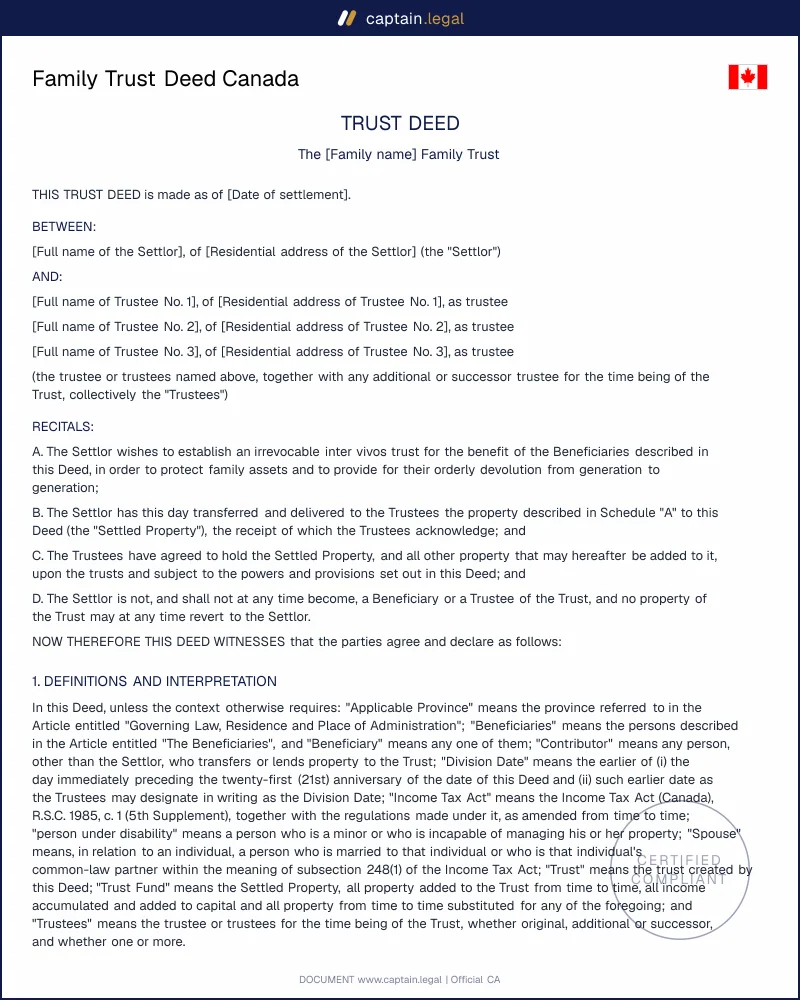
Trust law in Canada is provincial, but taxation of trusts is federal, and both layers apply to every family trust deed. On the provincial side, each common-law province has a Trustee Act governing investment powers, delegation, trustee liability and court intervention: the Trustee Act, RSO 1990, c T.23 in Ontario, the Trustee Act, RSBC 1996, c 464 in British Columbia, and Alberta's modernized Trustee Act, SA 2022, c T-8.1, which replaced its predecessor with a statutory duty of care and default investment rules. A well drafted deed overrides most default provisions, which is why the powers schedule matters as much as the distribution clauses. The rule against perpetuities also varies: Ontario applies a wait and see regime under its Perpetuities Act, British Columbia fixes an 80 year perpetuity period under the Perpetuity Act, RSBC 1996, c 358, and Manitoba has abolished the rule outright.
On the federal side, the Income Tax Act treats the trust as a separate taxpayer under section 104, taxed at the top marginal rate on income it retains, while income made payable to beneficiaries is deducted by the trust and taxed in their hands. Three provisions shape every deed. Subsection 75(2) attributes trust income back to a settlor who keeps a reversionary interest or veto control, which is why the settlor must be excluded from any benefit. Sections 74.1 and 74.2 attribute income and capital gains on property transferred to a spouse, and income on property transferred to related minors. And subsection 104(4) imposes the 21 year deemed disposition rule: every 21st anniversary, the trust is deemed to sell its capital property at fair market value, triggering accrued gains. Since the enhanced trust reporting rules took effect, most family trusts must also file an annual T3 return with Schedule 15 disclosing settlors, trustees and beneficiaries, with late filing penalties reaching $25 per day. The Canada Revenue Agency's guidance on the enhanced trust reporting rules sets out who must file and which listed trusts are exempt.