Create my document
Login

Choose country

CanadaCanadaChoose country
Business

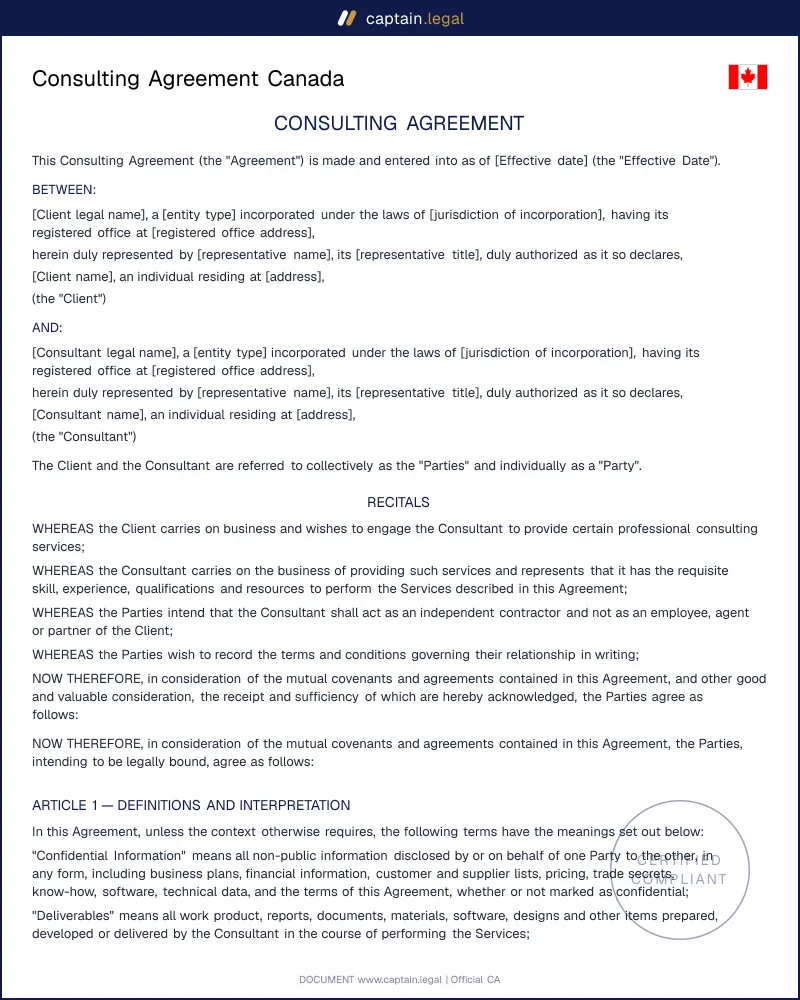
Consulting Agreement Canada | Sagaz & Copyright Act

Consulting agreement built on the Sagaz test and Copyright Act s.13: written IP assignment, moral rights waiver, contractor status. Word and PDF.
4.8/512 reviews50 000+ downloadsInstant download
Share

A consulting agreement is the contract a Canadian business signs when it brings in an outside expert to deliver a defined result rather than to fill a job. It sets out the scope of services, the fee, who owns what the consultant produces, what stays confidential, and the single point that decides everything else: that the consultant is an independent contractor, not an employee. Most disputes over consulting work do not start with the quality of the work. They start with a vague scope, a missing intellectual property clause, or a relationship that drifted close enough to employment that the Canada Revenue Agency took an interest. A clean consulting agreement fixes those exposures before the first invoice is sent, and it does so under the common law of contract that governs every Canadian province outside Quebec.

Compliant

2026 Legislation

50,000+ clients

trust us

Affordable

From $4.90 / doc

Secure payment

Instant download

Consulting Agreement Canada | Sagaz & Copyright Act

Secure payment · No subscription

Fill in the template

What is a consulting agreement?

A consulting agreement is a contract for services, which Canadian law treats very differently from a contract of service. The distinction is not cosmetic. A contract of service creates an employment relationship and pulls in source deductions, the Canada Pension Plan, Employment Insurance, vacation pay and the protections of the applicable Employment Standards Act. A contract for services creates a commercial relationship between two businesses, where the consultant invoices for a result and carries their own tax, insurance and overhead. The document you are drafting belongs firmly in the second category, and every clause should reinforce that footing.

People often use consulting agreement, independent contractor agreement and service agreement as if they were the same thing, and the overlap is real. The practical difference is one of emphasis. A consulting agreement is built around advisory or specialist work where judgment is the product: strategy, technical review, marketing direction, financial modelling. It leans harder on confidentiality and intellectual property than a generic independent contractor agreement aligned with CRA classification rules would, because consultants routinely see sensitive information and create deliverables the client expects to own outright. Get the label right, then make sure the substance of the relationship actually matches it.

2

When do you need this document?

The most common trigger is engaging a specialist for a finite mandate where the deliverable matters more than the hours. A company that retains a fractional CFO to rebuild its financial reporting, a marketing strategist to run a six-month campaign, or an engineer to audit a production line all need the same thing: a written scope that says what "done" looks like and a fee that attaches to it. Founders reach for a consulting agreement again when they bring on an advisor who will see the cap table, the customer list or the product roadmap, because the confidentiality and IP terms are the entire point of putting it in writing.

A second scenario is the conversion of an informal arrangement that has been running on handshake terms and invoices. This is the most dangerous version, because a consultant who has worked exclusively for one client for two years, used the client's equipment and reported to a manager looks like an employee to the CRA no matter what the invoices say. Documenting the relationship properly, and adjusting how it actually operates, is what protects both sides from a reassessment. Cross-border work raises the stakes further: a Canadian client engaging a consultant abroad, or vice versa, should pin down governing law and the IP regime, because Copyright Act rules apply to uses occurring in Canada even when the work was created elsewhere. Businesses formalizing several outside relationships at once often pair this contract with a standalone common-law NDA for protecting confidential information when the confidentiality exposure runs deeper than a single mandate.

3

Key clauses included in our template

  • The independent contractor status clause is the spine of the agreement. It states plainly that the consultant is not an employee, controls their own methods and schedule, supplies their own tools, and is responsible for their own income tax, CPP, EI and any GST/HST registration. It carries a tax indemnity so that if the CRA reassesses, the cost does not land on the client by surprise.

  • The scope of services defines the deliverables, milestones and acceptance criteria with enough precision that "complete" is not a matter of opinion. A vague scope is the single most litigated failure in consulting work, so the clause ties payment to defined outputs and reserves a written change process for anything beyond them.

  • The intellectual property assignment is drafted to do what a bare "work for hire" recital cannot under Canadian law. It assigns copyright in the deliverables to the client in writing, includes a present assignment of future works created under the mandate, and adds an express waiver of moral rights so the client can edit, adapt and commercialize the output without the author's consent.

  • The confidentiality clause defines confidential information, sets a survival period that outlasts the engagement, and carves out information that is public or independently developed. For advisory work this clause often matters more than the fee.

  • The compensation and expenses clause sets the fee structure, the invoicing cadence, payment terms and which expenses are reimbursable, keeping the consultant on a commercial footing rather than a payroll one.

  • The term and termination clause lets either party end the relationship on notice, addresses payment for work completed to the termination date, and confirms that confidentiality and IP terms survive.

4

Regional considerations

Ontario governs most consulting relationships through the common law and the Employment Standards Act, 2000, but the live risk is classification rather than the ESA itself. The Ontario Working for Workers legislation and ongoing scrutiny of misclassification mean a consultant who functions like staff can trigger ESA entitlements retroactively, so the agreement should reinforce genuine independence and the operational reality should match it.

British Columbia applies its Employment Standards Act and an aggressive Employment Standards Branch approach to disguised employment. The province's Personal Information Protection Act also governs how a consultant handles personal data, which makes the confidentiality and privacy terms more than boilerplate when the mandate touches customer records.

Alberta relies on the common law and the Employment Standards Code, with courts there receptive to the Sagaz analysis. Alberta businesses engaging consultants in regulated trades or professional services should confirm that any required licensing or professional liability coverage sits with the consultant, and the template's insurance clause is where that belongs.

Quebec is the genuine outlier. The Civil Code of Québec governs the contract of enterprise or for services under articles 2098 and following, the language obligations of the Charter of the French language can apply to the contract itself, and the analysis of subordination differs from common-law control. A consulting agreement used in Quebec should be reviewed against the Civil Code rather than adapted from a common-law form, and the governing-law clause should be set deliberately. Businesses operating across provinces frequently keep their broader suite of CBCA and provincial business documents aligned so that consulting terms do not contradict shareholder or governance arrangements.

5

How to fill out this consulting agreement

You start by identifying the two parties and confirming which province's law will govern, because that single choice shapes the classification analysis and, in Quebec, the entire legal frame. From there the form walks you through the scope of services, prompting you to describe the deliverables and milestones in concrete terms rather than generalities, then sets the fee, the invoicing schedule and the expense rules. The intellectual property section asks whether the client takes full ownership or a licence, and it builds in the written assignment and the moral rights waiver automatically so you are not relying on language that Canadian courts will ignore. The confidentiality fields let you set the survival period and any carve-outs, and the closing sections handle term, notice and termination. Throughout, the independent contractor provisions are written to reinforce a contract for services, and the output is ready to sign as Word or PDF. If your consultant relationship sits closer to a recurring staffing arrangement, compare it against a full employment agreement built on the ESA and Labour Code before you decide which document fits.

6

Common mistakes to avoid

The most damaging error is treating the contract's label as conclusive. Writing "the consultant is an independent contractor" means little if the consultant works set hours, uses the client's equipment, takes daily direction and has no other clients, because the CRA and the courts look at substance under the Sagaz and Wiebe Door tests, not at the recital. The second classic failure is the intellectual property clause that borrows American language. A Canadian agreement that calls the deliverables "work made for hire" and stops there leaves copyright with the consultant, and the client discovers the gap only when it tries to license or resell the work. Assignment in writing plus a moral rights waiver is the only reliable fix.

The remaining mistakes are quieter but costly. A scope written in adjectives instead of deliverables invites a fee dispute and makes "completion" unprovable. Confidentiality clauses that expire with the engagement leave trade secrets exposed at the exact moment the consultant moves to a competitor. And businesses routinely forget the tax indemnity, so when a reassessment lands they absorb the CPP and EI the agreement should have placed on the consultant. Reviewing the relationship annually, especially as a short mandate stretches into an ongoing one, is what keeps the document honest. Companies hiring consultants alongside staff often standardize their wider Canadian employment and HR documents so that contractor terms and employee terms never blur into each other.

Key takeaways

Worker status

Reality beats labels on contractor status

Calling someone an independent contractor does not make it so. Under 671122 Ontario Ltd. v. Sagaz Industries Canada Inc., 2001 SCC 59, the test is whether they are in business on their own account, weighed using factors like control, tools, profit and loss, and integration. If the day-to-day relationship looks like employment, CRA and courts can treat it that way.

Employment exposure

Misclassification triggers payroll and ESA duties

If the relationship drifts into a contract of service, the business can be pulled into source deductions, CPP, EI, vacation pay and the protections under the applicable provincial Employment Standards Act. The dispute often starts after the work begins, when the scope is vague and control increases. Budget 2024 also strengthened federal prohibitions against employee misclassification, raising the stakes for getting the structure right.

IP and confidentiality

Lock down ownership of deliverables in writing

Consultants often create strategy decks, code, models, and other deliverables the client expects to own. Without a clear intellectual property clause, the parties can end up arguing about who owns what and what can be reused. This template is built around Copyright Act, s.13 concepts, with written IP assignment and moral rights waiver, plus confidentiality terms to protect sensitive business information.

Frequently Asked Questions

Yes. A consulting agreement is enforceable as an ordinary commercial contract under the common law of every province outside Quebec, and under the Civil Code of Québec within it, provided it contains offer, acceptance, consideration and an intention to create legal relations. A written, signed version supplies the evidence courts look for. Electronic signatures are valid for this kind of agreement under PIPEDA and the provincial electronic commerce acts, so a signed PDF binds the parties. What gives the document real force is not the signature alone but a scope, fee and IP structure precise enough to be enforced without guesswork.

Yes. The template generates in both Microsoft Word and PDF so you can sign immediately or adapt the wording first. The Word version is useful when you need to tailor the scope of services, adjust milestones or insert sector-specific terms, since consulting mandates rarely look identical. The PDF version is the clean, ready-to-sign output for a finalized agreement. Many businesses keep the Word file as their internal master and issue the PDF to each consultant, which keeps the governing terms consistent across engagements while leaving room to change the deliverables for each mandate.

No, and this is the most misunderstood point in Canadian consulting law. Under the Copyright Act, the consultant is the first owner of copyright in what they create, because Canada has no contractor "work made for hire" doctrine like the United States. The client acquires ownership only through a written assignment in the agreement. Because moral rights cannot be assigned, the consultant must also waive them in writing, otherwise the client may be unable to alter or commercialize the deliverable freely. A properly drafted consulting agreement includes both the assignment and the waiver so ownership is never in doubt.

The agreement helps, but conduct decides it. The CRA applies the Sagaz test, asking whether the consultant is in business on their own account, and weighs control, ownership of tools, chance of profit and risk of loss, and integration into your business. To stay on the right side, let the consultant control how and when the work gets done, ensure they use their own equipment, avoid making them work exclusively for you for long stretches, and keep them off your organizational chart and benefit plans. Budget 2024 strengthened the misclassification rules under the Canada Labour Code, so the operational reality matters more than ever.

The confidentiality clause defines what counts as confidential information, restricts the consultant from using or disclosing it, and survives the end of the engagement, usually for a defined period of years. This matters because consultants routinely see customer lists, financial data, pricing and product plans. For deep or standalone confidentiality needs that extend beyond a single mandate, a dedicated non-disclosure agreement gives broader and more durable coverage. The two documents work together: the consulting agreement governs the work and ownership, while a separate NDA can ring-fence sensitive information shared before, during and after the relationship.

A consulting agreement should match the mandate. Project-based work ends on delivery and acceptance, while ongoing advisory work usually runs for a fixed term or continues until either party gives notice, commonly between two weeks and one month depending on the arrangement. The termination clause should confirm that the client pays for work completed to the termination date, that completed deliverables are handed over, and that the confidentiality and intellectual property terms survive. Building in a clean notice period protects both sides and avoids the abrupt cutoffs that turn a routine wind-down into a dispute.

For a standard mandate with a clear scope, a well-drafted template that addresses classification, IP assignment with a moral rights waiver, confidentiality and termination is generally enough for a Canadian business to proceed on its own. The value is speed and completeness: you get a contract that reflects current law without rebuilding it from scratch. Independent legal advice becomes worthwhile when the engagement is high-value, crosses borders, sits in Quebec under the Civil Code, or involves intellectual property that is central to your business. For everyday consulting relationships, the template gives you a defensible agreement you can sign the same day.

4.8/5

12 verified reviews · 50 000+ downloads

Consulting Agreement Canada | Sagaz & Copyright Act
  • Immediate access to the document
  • PDF + Word download
  • Compliant with 2026 legislation
  • Reviewed by lawyers
Fill in the template
Secure payment · No subscription
Updated on June 20, 2026

You might also like

Shareholder Agreement Canada
Letter of Intent Template Canada