Create my document
Login

Choose country

CanadaCanadaChoose country
Business

Business Purchase Agreement Canada | CBCA & ESA

Business Purchase Agreement built on the Canada Business Corporations Act and provincial law. Asset and share deals, lawyer-grade, Word and PDF.
4.8/511 reviews50 000+ downloadsInstant download
Share

A Business Purchase Agreement is the binding contract that transfers ownership of a business from a seller to a buyer, recording the purchase price, the assets or shares being sold, the liabilities assumed, and the representations and conditions each side must satisfy before closing. In Canada it is the central document in almost every private acquisition, whether you are buying a corner restaurant, a professional practice, or a manufacturing company. The agreement does two jobs at once. It moves the business across the table, and it allocates the risk of everything that could be wrong with it. A well drafted contract is the difference between a clean handover and a lawsuit two years later over an undisclosed tax bill or a customer contract that quietly walked out the door.

Most Canadian deals take one of two shapes. The buyer either purchases the assets of the business, picking and choosing what to take, or purchases the shares of the corporation that owns it, inheriting everything the company carries. The structure you choose drives the entire document, the tax outcome, and what happens to the staff on day one.

Compliant

2026 Legislation

50,000+ clients

trust us

Affordable

From $4.90 / doc

Secure payment

Instant download

Business Purchase Agreement Canada | CBCA & ESA

Secure payment · No subscription

Fill in the template

What is a business purchase agreement?

A business purchase agreement is a written contract that records the sale of a business and sets out the legally enforceable terms of the transfer. It identifies the parties, defines exactly what is being bought, fixes the price and how it is paid, and lists the promises the seller makes about the state of the business. In a private Canadian acquisition it is the controlling document: the letter of intent that came before it is usually non-binding, and the closing deliverables that follow it simply execute what the agreement already requires.

The label covers two distinct instruments, and Canadian practitioners rarely use them interchangeably. An asset purchase agreement transfers specified assets such as equipment, inventory, intellectual property, goodwill and assigned contracts, leaving the seller's corporate shell and most of its history behind. A share purchase agreement transfers the issued shares of the corporation itself, so the buyer takes the company whole, with every contract, employee, license and liability still attached. Buyers usually prefer the asset route because it lets them leave old debts, lawsuits and unknown tax exposure with the vendor. Sellers usually push for a share sale, since selling qualifying shares can let an individual claim the Lifetime Capital Gains Exemption and shelter a large part of the gain. The agreement you sign reflects who won that negotiation, and the rest of the drafting follows from it. A standalone bill of sale sometimes accompanies an asset deal to evidence the transfer of tangible goods, but it does not replace the full agreement.

2

When do you need this document?

The classic trigger is a straightforward change of ownership: an owner ready to retire or move on sells the whole operation to a buyer who wants to step into a working business rather than build one from scratch. Here the agreement carries the entire transaction, from the price down to the seller's promise not to open a competing shop across the street. A second common scenario is the partial sale or carve-out, where a company sheds one division, one location or one product line and keeps the rest. That deal is almost always structured as an asset purchase, because only some of the company's assets are leaving, and the agreement has to draw a precise line around what travels and what stays.

Family successions and partner buyouts make up much of the rest. When a founder transfers the business to the next generation, or one shareholder buys out a departing co-owner, a share purchase agreement records the transfer and the price even though the faces around the table are familiar. Skipping the paperwork because everyone trusts each other is how families end up in court. Distressed and creditor-driven sales are an edge case worth flagging: when a business is sold out of financial trouble, the buyer wants airtight representations that the assets are free of registered security under the Personal Property Security Act, and the agreement leans heavily on indemnities. Another edge case is the deal where key customer or supplier contracts contain change-of-control clauses, which can be triggered by a share sale and require third-party consent before closing, something the agreement must address head-on. If your transaction also reshuffles ownership among continuing owners, a shareholder agreement for Canadian corporations governs the relationship going forward.

3

Key clauses included in our template

The agreement opens with the identification of the parties and the subject of the sale, naming the buyer, the seller and the business, then defining with precision whether shares or specific assets are changing hands. In an asset deal this clause schedules every category being transferred, from equipment and inventory to goodwill and assigned contracts, and lists the excluded assets the seller keeps. Vagueness here is the single most expensive drafting error in the document.

  • The purchase price and payment terms fix the total consideration, the deposit, the amount payable at closing, and any vendor take-back or earn-out tied to future performance. A working-capital adjustment is built in so the price reflects the actual state of the business on the closing date rather than a stale balance sheet from the negotiation.
  • The representations and warranties are the heart of the contract. The seller makes a detailed set of factual promises about the corporation, its financial statements, tax filings, contracts, litigation and title to the assets, and these statements survive closing so the buyer has recourse if one proves false.
  • The conditions precedent list everything that must happen before either side is obliged to close, including satisfactory due diligence, third-party and regulatory consents, and the release of registered security. If a condition is not met or waived, the deal does not close.
  • The indemnification clause allocates post-closing risk, setting out how long the warranties survive, the financial thresholds before a claim can be made, and the cap on the seller's total liability. This is where the asset-versus-share choice shows its teeth, because an asset buyer carries far less inherited exposure.
  • The restrictive covenants protect the value the buyer is paying for, with non-competition and non-solicitation promises that stop the seller from rebuilding the same business or poaching its customers and staff. Canadian courts enforce these only where they are reasonable in scope, duration and geography.
4

Regional considerations

Ontario anchors most Canadian deal practice. Share transfers run through the Business Corporations Act (R.S.O. 1990, c. B.16), and asset deals are simpler than they once were because the province repealed its Bulk Sales Act in 2017. Employment is the live issue: under section 9 of the Employment Standards Act, 2000, an employee who is offered and accepts work with the buyer in an asset sale is deemed to have continuous service, so the buyer inherits accrued service for vacation, notice and severance and cannot treat long-service staff as fresh hires. This single section reshapes how asset buyers handle the workforce and why the agreement must address employee offers explicitly.

British Columbia corporations fall under the Business Corporations Act, S.B.C. 2002, c. 57, which uses a notice-of-articles and articles structure rather than the older letters-patent model, and any share deal must work within transfer restrictions set out in those articles. The province has its own Employment Standards Act with comparable successor-employer protection for staff who continue after an asset sale.

Alberta governs corporations through the Business Corporations Act, R.S.A. 2000, c. B-9, broadly aligned with the federal CBCA model, and its Employment Standards Code carries forward employee service on the sale of a business. Buyers of resource or licensed operations should confirm that sector permits and licenses can be transferred or reissued, which often becomes a condition of closing.

Quebec stands apart. The transaction is governed by the Civil Code of Québec rather than common law, the vocabulary and default rules differ, and language obligations under the Charter of the French Language can affect contracts and employee communications. A purchase agreement drafted for a common-law province should never be used in Quebec without civil-law review.

5

How to fill out this business purchase agreement

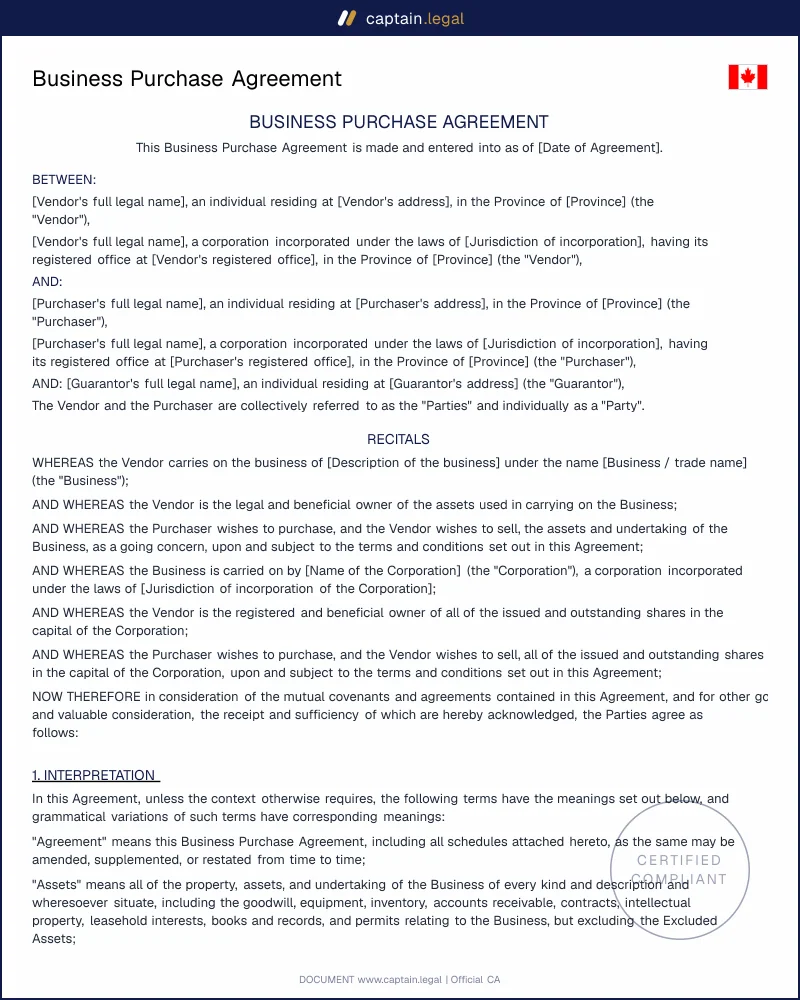
You start by choosing the structure, because the form adapts to your answer. Selecting an asset purchase opens schedules for the specific assets and excluded items, while selecting a share purchase shifts the document toward the corporation, its share capital and its full slate of liabilities. From there you identify the parties and the business, then enter the purchase price together with the deposit, the closing payment and any holdback, earn-out or working-capital adjustment you have negotiated. The form prompts you for the representations the seller is prepared to give and lets you tailor their survival period.

Next you set the conditions to closing, such as completion of due diligence, landlord or lender consents, and regulatory clearances where the deal size or a foreign buyer makes them necessary. You then decide whether restrictive covenants apply and define their reasonable scope and duration. The document assembles your choices into a clean agreement with the matching schedules, ready to download in Word and PDF so you can circulate it for signature or hand it to your lawyer for a final review. If your deal also involves transferring staff, our employment agreement template for Canadian employers and the related non-compete and non-solicitation agreement pair naturally with the purchase contract.

6

Common mistakes to avoid

The most damaging error is leaving the structure ambiguous or choosing it without advice. An owner who agrees to a share sale to save tax, then discovers the buyer has inherited a contingent liability, learns the hard way that share deals transfer the bad with the good. Equally common is a thin schedule of assets in an asset deal, where a transferred contract or a critical piece of equipment is simply never listed and the buyer finds out after closing that it was never theirs to use. Underbaked representations and warranties cause the next wave of disputes, because a buyer with vague seller promises has almost nothing to claim against when the financials turn out to be wrong, and the survival period expires before the problem even surfaces.

Buyers also forget the people side of the deal. In an asset sale, treating the vendor's employees as new hires ignores the deemed-continuity rules in provincial employment legislation and can produce unexpected severance liability for inherited service. A related slip is missing third-party consents: customer contracts and commercial leases frequently require the other side's approval before they can be assigned or before a change of control, and a closing that ignores them can leave the buyer without the very revenue they paid for. The last frequent mistake is skipping or rushing due diligence, then relying on indemnities that are capped so low they never make the buyer whole. Strong contracts protect a buyer who looked carefully; they rarely rescue one who did not. The same discipline applies to any related non-disclosure agreement governing the due diligence process you sign before the books are opened.

Key takeaways

Core deal

This agreement both transfers and allocates risk

A Business Purchase Agreement is the binding contract that actually moves the business to the buyer and sets who wears the risk if something is wrong. It locks down the price, what is included, which liabilities are assumed, and the seller’s representations and closing conditions. If a tax bill or missing contract shows up later, the outcome usually turns on what this agreement says, not the earlier letter of intent.

Structure

Asset sale vs share sale changes everything

Most Canadian acquisitions are either an asset purchase or a share purchase, and the choice drives the whole document. In an asset deal the buyer picks specific assets (equipment, inventory, IP, goodwill, assigned contracts) and can often leave old debts and unknown tax exposure with the seller. In a share deal the buyer buys the corporation’s shares and inherits the company as-is, with its contracts, licences, employees and liabilities still attached.

Legal frame

No single statute fills in gaps

Canada does not have one law that governs selling a business. In the common-law provinces and territories, the agreement sits on contract common law, with corporate statutes shaping the mechanics when shares are sold. If the target is federally incorporated, the CBCA governs share transfer rules; if provincial, a Business Corporations Act applies. There is no prescribed form and no mandatory registration of the agreement itself, so anything you do not write down may simply be missing.

Frequently Asked Questions

Yes. A business purchase agreement is a binding contract the moment the parties sign it and the usual elements of a valid contract are present: offer, acceptance, consideration and an intention to create legal relations. It is enforceable under the common law of contract in the common-law provinces and under the Civil Code of Québec in Quebec. There is no requirement to file or register the agreement itself with any government body, and electronic signatures are valid under provincial electronic commerce legislation. To be enforceable in practice, the document should clearly identify the parties, define what is being sold, and state the price and the closing terms with enough precision that a court could give effect to the bargain.

It depends on which side of the table you sit on and the tax and risk profile of the deal. Buyers generally prefer an asset purchase because they choose which assets to take and can leave the seller's debts, lawsuits and unknown tax exposure behind. Sellers usually prefer a share purchase, since selling qualifying small-business shares can let an individual shelter a large part of the gain through the Lifetime Capital Gains Exemption. Share deals also keep contracts, licenses and employees in place without individual assignments. The right answer turns on liabilities, tax position and continuity, so the structure should be settled early, often in the letter of intent, before the full agreement is drafted.

It depends on the structure. In a share sale the corporate employer does not change, so employment simply continues unaffected. In an asset sale the seller and buyer are different legal employers, and staff may be terminated by the seller at closing and offered new jobs by the buyer. Where they accept and keep working, provincial employment law deems their service continuous: in Ontario, section 9 of the Employment Standards Act, 2000 requires the buyer to recognize prior service for vacation, notice and severance. The buyer cannot treat long-serving employees as new hires, so the agreement should set out exactly which employees are offered work and on what terms.

Due diligence is the buyer's investigation of the business before committing, and it shapes the representations and conditions in the agreement. You confirm title to the assets or shares, review financial statements and tax filings, check registered security under the Personal Property Security Act, read the material customer and supplier contracts for change-of-control or assignment clauses, and verify leases, licenses and permits. For a share deal you also examine the corporation's minute book, share register and any existing litigation. Findings either become conditions the seller must clear before closing or specific indemnities, so thorough diligence directly strengthens your protection and reduces the risk of an unpleasant surprise after the keys change hands.

Most private deals close without any regulatory filing, but two regimes can apply to larger transactions. The Competition Act (Canada) requires pre-closing notification once the size-of-transaction and size-of-parties thresholds are crossed, and the Investment Canada Act governs acquisitions by non-Canadian buyers, with review triggered above certain values. Sector-specific rules can also apply where the business holds regulated licenses, such as in financial services, telecommunications or natural resources. Where any of these apply, clearance becomes a condition precedent in the agreement and the deal cannot close until it is obtained, so identifying them early is part of structuring the transaction properly.

You can download the completed business purchase agreement in both Word and PDF. The Word version lets you or your lawyer make final edits, adjust schedules, or tailor the representations to your specific deal, while the PDF gives you a clean, ready-to-sign copy for circulation. Because provincial electronic commerce legislation recognizes electronic signatures for this kind of commercial contract, many parties sign and exchange the agreement remotely. For a complex or high-value acquisition it is always sensible to have the draft reviewed by a Canadian lawyer before signing, and you can find related instruments in the full catalogue of Canadian legal documents.

There is no fixed timeline, and it varies widely with the size and complexity of the deal. A small, clean asset sale between motivated parties can move from signed agreement to closing in a few weeks, while a larger share acquisition with extensive due diligence, financing, third-party consents and regulatory clearances can take several months. The agreement itself sets the schedule by specifying a closing date and listing the conditions that must be satisfied or waived beforehand. Building realistic deadlines into the conditions precedent keeps the deal on track and gives both sides a clear marker for when each step has to be done.

4.8/5

11 verified reviews · 50 000+ downloads

Business Purchase Agreement Canada | CBCA & ESA
  • Immediate access to the document
  • PDF + Word download
  • Compliant with 2026 legislation
  • Reviewed by lawyers
Fill in the template
Secure payment · No subscription
Updated on June 20, 2026

You might also like

Service Agreement Template Canada
Partnership Agreement Template