Create my document
Login

Choose country

CanadaCanadaChoose country
Real Estate

Notice to End Tenancy | RTA-Compliant Template CA

Lawyer-grade Notice to Terminate Tenancy drafted to each province Residential Tenancies Act. Ontario, BC and Alberta notice periods built in. Word and PDF.
4.8/521 reviews50 000+ downloadsInstant download
Share

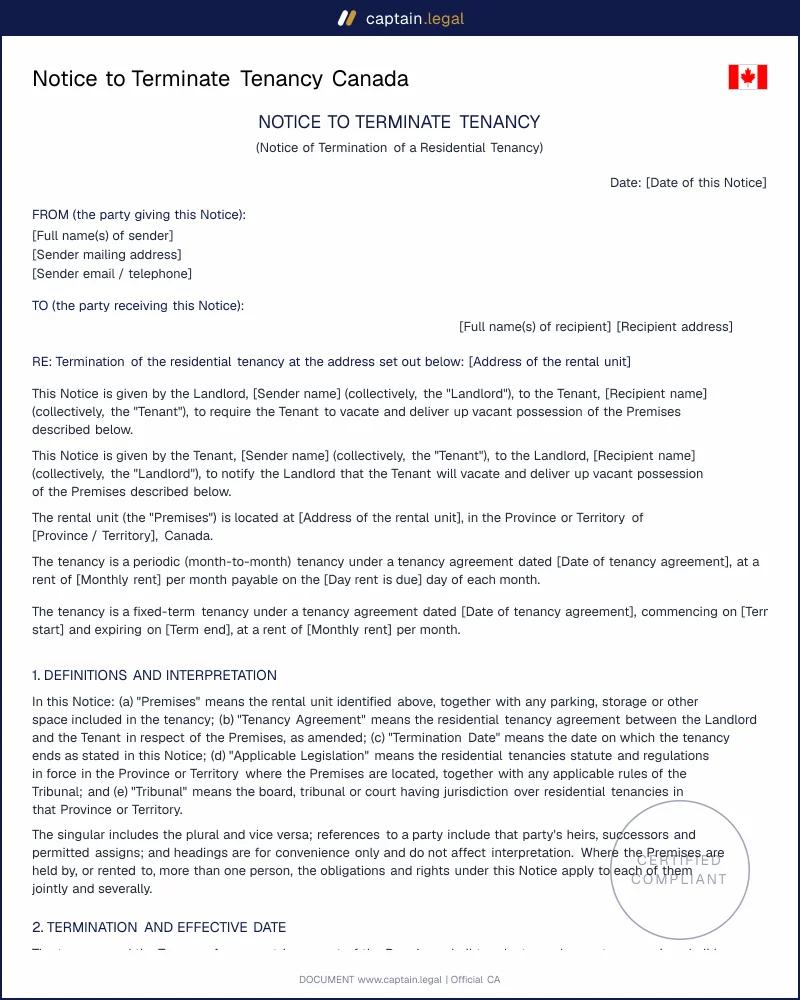
A Notice to Terminate Tenancy is the written instrument a landlord or tenant uses to bring a residential lease to an end, stating the ground relied on and the effective date in line with the notice period set by the province's residential tenancy statute. Across Canada's common-law provinces, tenancies are creatures of legislation, and a casual letter or a verbal warning rarely satisfies the law. Whether you are a landlord recovering a unit for your own occupation or a tenant moving on at the end of a term, the eviction notice has to be drafted to the right form, the right ground and the right number of days, because a small error on the termination date is enough to send the whole process back to square one. This template is built for that standard of precision.

Compliant

2026 Legislation

50,000+ clients

trust us

Affordable

From $4.90 / doc

Secure payment

Instant download

Notice to End Tenancy | RTA-Compliant Template CA

Secure payment · No subscription

Fill in the template

What is a Notice to Terminate Tenancy?

A Notice to Terminate Tenancy is a formal, dated document that ends a residential tenancy on a stated ground, served by one party on the other in the manner the law allows. Tenants generally call it a notice to end the tenancy; landlords and the public often call it an eviction notice, though the two describe the same family of instruments seen from opposite sides of the lease. The label matters less than the substance: the notice must identify the parties and the rental unit, state the reason, fix a termination date that complies with the statutory minimum, and be signed and served correctly.

It is worth separating this document from two neighbours it is often confused with. A mutual agreement to end the tenancy, where landlord and tenant simply consent to a closing date, is not a notice at all and carries no minimum notice period because nobody is being compelled. A landlord's application to the tribunal for an order of possession comes later, and only if the tenant does not leave voluntarily after a valid notice. A notice does not, by itself, force anyone out. In most provinces a landlord who serves a for-cause notice and meets resistance must still apply to the provincial tribunal, prove the ground at a hearing and obtain an order before the sheriff can enforce it. The notice opens the process ; it does not close it. Our Canadian real estate and rental document library keeps the supporting paperwork, such as move-out condition reports, in step with the notice itself.

2

When do you need this document?

The most common trigger on the landlord side is non-payment of rent, where a short-fuse notice puts the tenant on terms to pay or face an application to the tribunal. In Ontario this is the N4, carrying 14 days for a monthly or yearly tenancy and 7 for a weekly one ; in British Columbia, a 10 Day Notice. The next most frequent scenario is landlord's own use, served when the owner, a purchaser or a close family member genuinely intends to occupy the unit for at least a year. This ground attracts the longest notice periods and the strictest good-faith scrutiny, because it is the one most open to abuse.

Tenants reach for the document too. A tenant ending a periodic tenancy, or declining to renew at the end of a fixed term, must give written notice on the prescribed form rather than relying on the lease simply expiring. A fixed term that is not formally ended does not vanish on its own ; in most provinces it rolls over into a month-to-month tenancy on the same terms, leaving a tenant who assumed they were free still on the hook for rent.

Two edge cases regularly catch people out. Where a tenant has been served a landlord's own-use notice, many provinces let that tenant leave early on a much shorter notice, so the long period the landlord chose is a ceiling, not a floor. And in cases involving domestic or sexual violence, several provinces grant an abbreviated notice path that overrides the usual term, a humane exception that landlords cannot refuse. Either situation rewards getting the document right the first time. If the end of the tenancy is connected to a job, our Canadian employment and HR templates cover the parallel paperwork for accommodation tied to employment.

3

Key clauses included in our template

  • The identification of the parties and the rental unit names every landlord and every adult tenant bound by the lease, with the full municipal address of the premises. Tribunals routinely reject notices that name only the lease signer when other adult occupants are in possession, so the template prompts you to list each one explicitly rather than hide behind a vague "and all other occupants".
  • The ground for termination is drafted to the statutory language of the chosen province, not to loose description. Instead of "breach of lease", the notice states the specific default, such as substantial interference or unpaid rent, with the amount and the period it covers, so the reason can survive challenge at a hearing.
  • The termination date is the clause that decides most disputes. The template aligns the date to the rental period for a periodic tenancy and to the end of the term for a fixed lease, and applies the statutory minimum for the ground you selected, removing the single most common reason notices are thrown out.
  • The compensation and good-faith statements appear where the ground is landlord's own use, recording the one-month compensation or alternative-unit offer that several provinces require to be paid by the termination date, without which a tribunal will not grant possession.
  • The service and proof block records how and when the notice was delivered, since personal service, mail and other permitted methods carry different deemed-receipt rules, and mailed notices often require extra days to be added before the clock starts.
4

Regional considerations

Ontario. Tenancies fall under the Residential Tenancies Act, 2006 and the Landlord and Tenant Board's numbered forms. A tenant ending a periodic tenancy uses Form N9 and must give at least 60 days, with the termination date landing on the last day of a rental period and never before the end of a fixed term. Non-payment runs on Form N4 at 14 days for monthly tenancies. Landlord's own use is Form N12 at 60 days, and the landlord must pay the tenant compensation equal to one month's rent by the termination date or the Board will not order eviction. A tenant served an N12 may leave early on just 10 days' notice. A defective N12 cannot be amended once served, so the date discipline here is unforgiving.

British Columbia. The Residential Tenancy Act governs, with notices managed through the Residential Tenancy Branch. A 10 Day Notice handles unpaid rent, and a tenant has 5 days to pay or dispute. A One Month Notice covers cause such as serious breach. The headline change concerns landlord's and purchaser's own use: since June 18, 2025, the period is three months with a 21-day window to dispute, and the notice must be generated through the RTB's online Landlord Use portal rather than drafted freehand. A tenant ending a periodic tenancy gives at least one month's written notice timed to the end of a rental period.

Alberta. The Residential Tenancies Act applies to most private rentals, with disputes heard by the Residential Tenancy Dispute Resolution Service or the courts. For a periodic tenancy, the notice period turns on the rental cycle: a month-to-month tenancy generally needs at least one tenancy month ending on the last day of a month, while a weekly tenancy needs one week. Termination for substantial breach and for non-payment follow their own statutory timelines, and Alberta does not run a single prescribed government form the way Ontario does, which makes precise drafting to the statute all the more important. Beyond these three, every common-law province sets its own periods, so the template asks for the province before it fixes any date.

5

How to fill out this Notice to Terminate Tenancy

You start by choosing whether you are serving as the landlord or the tenant, since that selection drives every later field, from the available grounds to the minimum number of days. From there you select the province where the unit is located, and the form narrows the grounds to those the local statute actually recognises and loads the matching notice period. You then enter the parties and the full address of the rental unit, taking care to name each adult tenant in possession rather than the lead signer alone. Next you pick the ground, and the template asks only for the facts that ground requires, such as the rent arrears and the period for non-payment, or the intended occupant for landlord's own use. The system then proposes a compliant termination date built from the rental cycle and the statutory minimum, which you can confirm or adjust within the legal limits. A final step records how the notice will be served and prompts you to keep dated proof of delivery. The finished notice downloads as Word and PDF, ready to sign and serve. If you need related agreements, our full catalogue of Canadian legal documents sits one click away.

6

Common mistakes to avoid

The error that sinks more notices than any other is the wrong termination date. People count calendar days instead of clear days, forget to land the date on the end of a rental period, or try to end a fixed term early, and the tribunal treats the notice as void rather than merely late. Closely related is choosing the wrong ground or the wrong form: serving a cause notice for what is really non-payment, or using a generic letter where the province mandates a prescribed form, hands the other side an easy defence. A surprising number of landlords also forget the compensation step on an own-use notice, then discover at the hearing that the application fails because the one-month payment was never made by the deadline.

Service is the other graveyard. A notice that was never properly delivered, or delivered by a method the statute does not permit, has no legal effect no matter how perfectly it reads, and mailed notices frequently need extra days added before the period even begins. Landlords routinely under-name the tenants, leaving adult occupants off the document and giving the tribunal a reason to refuse possession. Treat every field as load-bearing, because in residential tenancy law a single defect is usually fatal to the whole notice. For tenancies run by community organisations or housing co-operatives, our Canadian non-profit and association templates handle the governance side that often sits behind the lease.

Key takeaways

Statutory notice

A casual letter rarely meets RTA rules

A Notice to Terminate Tenancy only works if it matches the provincial residential tenancy statute where the unit is located. These are legislative regimes, not informal guidelines, so a verbal warning or generic letter often fails. The notice must name the parties and unit, state the ground, set a termination date that meets the minimum notice period, and be properly signed and served.

Province-specific

Ontario, BC and Alberta are not interchangeable

Residential tenancies are governed province by province. Ontario uses the Residential Tenancies Act, 2006 with numbered, prescribed forms administered by the Landlord and Tenant Board; British Columbia and Alberta run their own statutes and processes. A notice that is valid in one province can be a nullity in another because the allowed grounds, required wording, and notice periods differ.

Process

A notice starts the file, not eviction

Serving a notice does not, by itself, force anyone out. If the tenant does not leave after a valid notice, the landlord typically must apply to the provincial tribunal, prove the ground at a hearing, and obtain an order of possession before enforcement. Errors are costly: the termination date is often constrained (for example, tied to the end of a rental period) and a defective date cannot be fixed after service.

Frequently Asked Questions

The template produces a notice that is legally effective when it is filled in correctly, signed and served in the manner the province allows. A notice is binding because the Residential Tenancies Act of the relevant province gives it effect, not because of any particular letterhead. What makes or breaks validity is compliance: the right ground, a termination date that meets the statutory minimum and falls on the correct day, the parties named in full, and proper service with proof. Our template is drafted to those provincial requirements, so a notice completed accurately stands on the same legal footing as one prepared in a law office, provided you follow the service steps it sets out.

It depends on the province and the reason. A tenant ending a periodic tenancy in Ontario gives at least 60 days on Form N9, while in British Columbia the minimum is one month and in Alberta it is generally one tenancy month for a monthly lease. For landlords, non-payment runs short, at 14 days in Ontario and 10 in British Columbia, whereas landlord's own use runs long: 60 days in Ontario and, since June 18, 2025, three months in British Columbia. The termination date must also land on the last day of a rental period for a periodic tenancy, and cannot fall before the end of a fixed term.

You receive the finished Notice to Terminate Tenancy in both Microsoft Word and PDF. The PDF is ready to print, sign and serve as it stands, which suits most straightforward situations. The Word version lets you make last-minute adjustments, add a clause or correct a detail before signing, which is useful where a tribunal in your province expects a particular layout or where you want to keep an editable copy on file. Having both means you are not locked into one workflow, and you can re-open the Word file if circumstances change before service.

In most provinces an informal letter or text message will not safely end a tenancy. Where the statute prescribes a form, such as Ontario's numbered N-forms or British Columbia's portal-generated notices, an unofficial message can be rejected outright. Even where a province allows a written notice in your own words, as British Columbia does for tenants, the message must still contain the address, the signature, the termination date and the correct number of days, and you must be able to prove it was received. An email or text rarely holds up if the matter reaches a hearing, so a properly drafted and served notice is the safer route every time.

No. In the common-law provinces a fixed-term lease does not simply disappear on its last day. Unless a party serves proper written notice to end it, or both sides sign a mutual agreement to terminate, the tenancy continues, almost always converting to a month-to-month arrangement on the same terms. A tenant who moves out assuming the term ended itself, without giving notice, can find themselves liable for further rent until proper notice is given. Serving the notice on time, even when the end date feels obvious, is what actually closes the tenancy.

A notice does not authorise a self-help eviction. If a tenant who has been validly served does not move out by the termination date, the landlord must apply to the provincial tribunal, such as Ontario's Landlord and Tenant Board or British Columbia's Residential Tenancy Branch, for an order of possession, and only an enforcement officer may carry it out. Changing the locks or removing belongings without an order exposes the landlord to serious liability. The valid notice is the foundation of that application, which is exactly why getting its ground, date and service right at the outset saves weeks of delay later.

For a tenant-initiated notice, generally yes. Where two or more tenants signed the lease, a notice to end the tenancy usually needs the signatures of all of them, because each is a party to the agreement and one tenant cannot unilaterally end an obligation the others share. For a landlord-initiated notice, the landlord serves all tenants in possession and should name each adult occupant on the document. The template prompts for every party precisely because leaving someone off is one of the quickest ways to have a notice rejected at the tribunal.

4.8/5

21 verified reviews · 50 000+ downloads

Notice to End Tenancy | RTA-Compliant Template CA
  • Immediate access to the document
  • PDF + Word download
  • Compliant with 2026 legislation
  • Reviewed by lawyers
Fill in the template
Secure payment · No subscription
Updated on June 18, 2026

You might also like

Residential Lease Agreement Canada
Roommate Agreement Template Canada