Create my document
Login

Choose country

CanadaCanadaChoose country
Employment

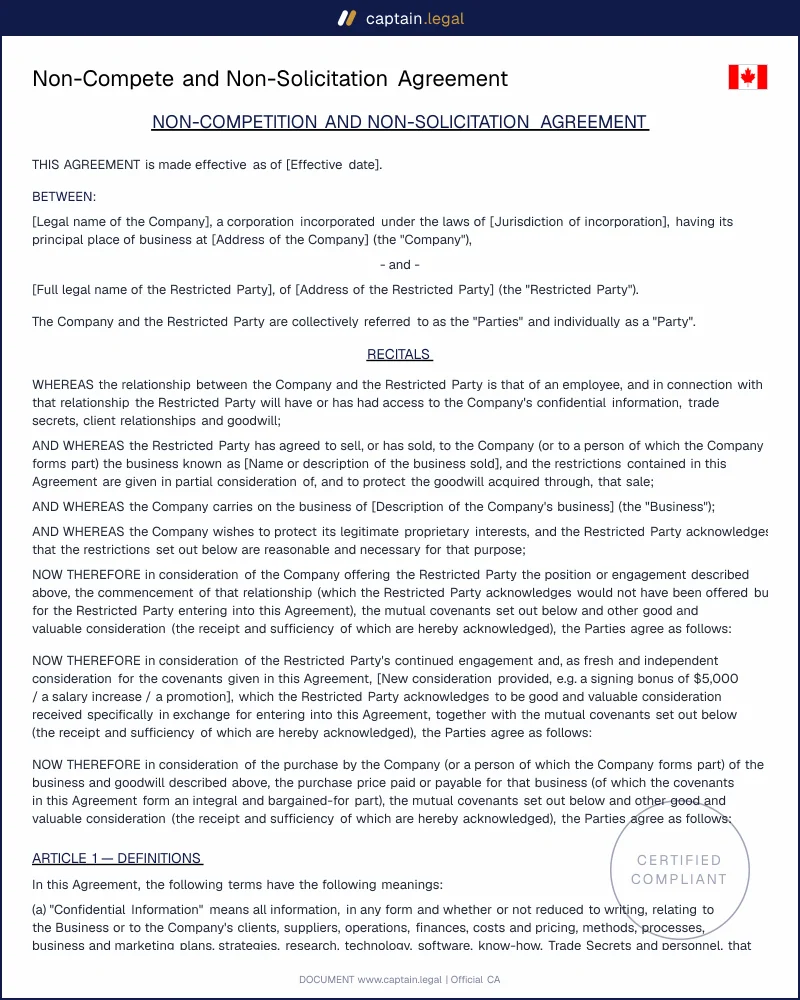
Non-Compete and Non-Solicitation Agreement | ESA s.67.2

Restrictive covenant agreement built on Elsley, Shafron and Ontario ESA section 67.2. Enforceable non-solicitation and non-compete clauses for Canada.
4.7/514 reviews50 000+ downloadsInstant download
Share

A non-compete and non-solicitation agreement is a restrictive covenant that limits where a departing employee or contractor can work, and which clients and colleagues they can approach, for a set period and within a defined territory after the working relationship ends. Employers in Canada reach for it to protect trade secrets, client goodwill and a stable workforce. The catch most business owners discover too late is that Canadian courts treat these restraints as presumptively unenforceable. A non-compete and non-solicitation agreement survives only if it is reasonable, narrowly drafted and tied to a genuine proprietary interest, and in Ontario most employee non-competes are now void by statute. Getting the scope right is the whole game.

This template is built to give you the strongest defensible position the common law allows, with separate non-compete and non-solicitation covenants you can switch on or off depending on the province, the seniority of the worker and whether the restriction arises from a sale of business.

Compliant

2026 Legislation

50,000+ clients

trust us

Affordable

From $4.90 / doc

Secure payment

Instant download

Non-Compete and Non-Solicitation Agreement | ESA s.67.2

Secure payment · No subscription

Fill in the template

What is a non-compete and non-solicitation agreement?

A non-compete and non-solicitation agreement bundles two distinct restrictive covenants into one instrument, and the distinction matters more in Canada than almost anywhere else. The non-competition covenant bars the former worker from carrying on or joining a competing business within a stated geographic area for a stated time. The non-solicitation covenant is narrower: it stops the person from poaching the employer's clients, customers, suppliers or staff, but leaves them free to compete generally. Courts treat the two very differently, and that difference often decides whether you have an enforceable document or a worthless one.

Canadian judges start from the position that any restraint of trade is contrary to public policy and void unless the party seeking to enforce it proves the restraint is reasonable. A non-solicitation clause, because it interferes far less with a person's ability to earn a living, clears that bar much more readily than a non-compete. A blanket non-compete will rarely be enforced where a well-drafted non-solicitation clause would have protected the same interest. This is why our template lets you rely on the non-solicit alone in most employment situations and reserve the non-compete for the narrow cases where it genuinely holds up, such as the shareholder and partnership arrangements covered by our corporate agreements. Treating the two covenants as interchangeable is the most common drafting error we see.

2

When do you need this agreement?

The classic trigger is hiring someone who will hold the keys to your client relationships. A sales lead, an account manager, a senior consultant: these are the roles where a departing worker can walk straight to a competitor with a book of business in their head. Here a non-solicitation covenant does the heavy lifting, because it protects the client list without the heavy-handed reach of a non-compete that a court would likely refuse to enforce. Most employers in this situation overprotect and end up with nothing.

The second scenario is engaging an independent contractor with access to proprietary methods or confidential pricing, where you want to stop them taking what they learned to a direct rival. Contractors are not "employees" for the purposes of Ontario's section 67.2 ban, which gives slightly more room for a reasonable non-compete, though the Elsley reasonableness test still applies in full and ambiguity is still fatal. A third common use is protecting your existing team: a non-solicitation of employees clause stops a departing manager from hollowing out a department by recruiting former colleagues, a restriction courts treat sympathetically because it protects workforce stability rather than suppressing competition.

The edge case worth flagging is the sale of a business. When a vendor sells their company and stays on, a non-compete tied to that sale is judged under the gentler Payette standard and is far more likely to survive, even in Ontario, because it falls within the statutory exception. If your restriction is really about protecting goodwill in a share or asset purchase, draft it inside the sale agreement, not the employment contract. A second edge case: federally regulated workers (banks, telecoms, interprovincial transport) fall under the Canada Labour Code rather than provincial ESAs, so the Ontario non-compete ban does not reach them, though the common-law reasonableness test still does.

3

Key clauses included in our template

  • The definition of the restricted business and activities is drafted to the specific line of business the worker actually touched, never to "any business in which the employer is engaged." Shafron makes ambiguity fatal, so the template forces you to name the activity precisely rather than reach for vague catch-all language that a court will void on sight.
  • The geographic scope ties the restriction to the territory where the employer genuinely operates and the worker had influence. A national radius for a regional firm is the single most common reason covenants fail, so the field prompts you to match the area to your real proprietary interest rather than your ambitions.
  • The duration of the restraint is set to the shortest period that protects the interest, typically six to twelve months for non-solicitation and rarely longer. Courts read excess duration as evidence the clause is punitive rather than protective, which undermines the whole covenant.
  • The non-solicitation of clients and customers is separated from the non-compete so you can rely on it independently, and it is limited to clients the worker actually dealt with, not the entire customer base, which mirrors how courts narrow these clauses themselves.
  • The non-solicitation of employees prevents the departing worker from recruiting your staff, drafted to active solicitation rather than a blanket ban on hiring, because an absolute no-hire term reaches too far.
  • The consideration and acknowledgement provision records that the worker received something of value for the restraint and understood it, addressing the recurring argument that a covenant signed mid-employment lacks fresh consideration. This pairs naturally with the confidentiality protections in our confidentiality and non-disclosure templates.
4

Regional considerations

Ontario is the strictest jurisdiction and the one most users need to get right. Section 67.2 of the Employment Standards Act, 2000 makes employee non-competes void, full stop, unless the worker is a true executive or the covenant flows from a sale of business. Drafting a non-compete for an ordinary Ontario employee is not merely risky, it is unenforceable by statute. The practical answer is to rely on non-solicitation and confidentiality covenants, which the ban leaves untouched, and to reserve any non-compete for genuine C-suite hires or commercial transactions.

British Columbia has no statutory ban, so the common-law Elsley and Shafron framework governs in full. BC courts are demanding on geographic precision, as Shafron itself, a BC case, demonstrates. A covenant that is vague about territory will not be rescued by the court, which refuses to apply notional severance to restrictive covenants.

Alberta likewise relies on common law and applies the reasonableness test strictly, with particular scrutiny of duration. Alberta courts have shown willingness to enforce narrow non-solicitation clauses while striking broad non-competes, reinforcing the template's split structure.

Quebec stands apart, governed by the Civil Code of Québec rather than common law. Article 2089 expressly allows non-competition stipulations but requires them to be limited as to time, place and type of employment to what is necessary to protect the employer's legitimate interests, and the employer bears the burden of proof. Quebec also has specific rules under article 2095 that bar enforcement where the employer terminated without a serious reason. If you operate in Quebec, the employment contract templates aligned to provincial law account for these distinct civil-law requirements.

5

How to fill out this agreement

You begin by selecting the province where the worker is based, because that single choice changes everything downstream. Choose Ontario and the form steers you away from an employee non-compete and toward the non-solicitation and confidentiality covenants that survive the section 67.2 ban, while flagging the executive and sale-of-business exceptions if they apply. From there you identify the parties and classify the relationship as employment or independent contractor, since that classification affects which restrictions are available to you. The template then asks you to describe the specific business activity to be restricted in plain, narrow language, and it prompts you against the catch-all phrasing that Shafron tells us will be read as ambiguous. You set the geographic area to match where you actually operate, and the duration to the shortest period that protects your interest. Finally you decide whether to include client non-solicitation, employee non-solicitation, or both, and the document assembles a clean, signature-ready agreement in Word and PDF. You can revisit any field and regenerate, which is useful when you are testing a tighter scope against a broader one before committing.

6

Common mistakes to avoid

The first and most damaging mistake is reaching for a non-compete when a non-solicitation clause would have done the job. Employers assume a broader restriction gives more protection, but in Canada the opposite is true: the broader the restraint, the more likely a court voids it entirely and leaves you with nothing, whereas a tightly drawn non-solicitation clause is enforced routinely. The second mistake is ambiguity, the very flaw that sank the covenant in Shafron. Phrases like "the Greater Toronto Area" or "the businesses in which the company is involved" feel precise but are not, and judges will not rewrite them to make sense. A third recurring error is overreach on duration and territory, where a firm operating in one city imposes a two-year nationwide ban that reads as punishment rather than protection.

Then there is the Ontario blind spot. Plenty of employers still slip a non-compete into standard employment contracts without realising it has been void since October 2021 for anyone below executive rank. Including a void non-compete can also taint the surrounding clauses and invite an employee to argue the whole restrictive-covenant package is unenforceable. The final mistake is failing to provide fresh consideration when a covenant is introduced after employment has already begun. A signature alone is not enough; the worker must receive something of value, or the covenant can be challenged for want of consideration. Pair the agreement with proper offer and employment documentation so the consideration is recorded from the outset.

Key takeaways

Scope

Non-solicit and non-compete are not twins

A non-solicitation clause targets client, supplier, and employee poaching, while a non-compete blocks working for or running a competitor. Canadian courts treat the non-compete as a much heavier restraint on earning a living, so it is harder to enforce. If a carefully drafted non-solicit would protect goodwill and workforce stability, a blanket non-compete will usually fail.

Common law

Reasonableness is the price of enforcement

Restrictive covenants are presumptively void as restraints of trade unless the employer proves they are reasonable. Under Elsley, the court asks whether there is a proprietary interest to protect, whether time and geography are reasonable, and whether the clause harms the public interest by restricting competition. Miss any branch and the clause is struck, leaving you with no leverage after departure.

Ontario ESA

Most employee non-competes are void

In Ontario, section 67.2 of the Employment Standards Act, 2000 (added by the Working for Workers Act, 2021) prohibits employers from entering into non-compete agreements with employees. Any non-compete made with an Ontario employee on or after 25 October 2021 is void, subject only to narrow statutory exceptions (for example, genuine executives). Plan to rely on non-solicitation instead.

Frequently Asked Questions

It can be, but it is presumptively void and enforceable only if reasonable. Canadian courts treat every restrictive covenant as a restraint of trade contrary to public policy, so the burden falls on the employer to prove the restriction is no wider than necessary to protect a genuine proprietary interest. The Elsley test from the Supreme Court asks whether you have a protectable interest, whether the time and geographic limits are reasonable, and whether the covenant unduly restricts competition. A narrowly drafted non-solicitation clause is binding far more often than a non-compete. In Ontario, an employee non-compete is void by statute regardless of how reasonable it looks, unless an executive or sale-of-business exception applies.

Generally no. Since 25 October 2021, section 67.2 of the Employment Standards Act, 2000 prohibits employers from entering into non-compete agreements with employees, and any such clause is void. Two exceptions survive: where the worker is a genuine executive, meaning a C-suite officer such as a CEO or CFO, and where the non-compete forms part of a sale of business and the seller becomes an employee of the buyer. For everyone else, the clause is unenforceable no matter how carefully drafted. The sensible course in Ontario is to rely on non-solicitation and confidentiality covenants, which the ban does not affect, and reserve non-competes for true executives or commercial transactions.

A non-compete bars the worker from joining or starting a competing business at all, within a defined area and period. A non-solicitation clause is narrower: it leaves the person free to compete but stops them from approaching your clients, customers or staff. The distinction is decisive in Canada because courts treat a non-solicit as far less of an interference with a person's right to earn a living, so it clears the reasonableness test much more easily. As a rule, if a non-solicitation clause would protect your interest, a court expects you to use that rather than the heavier non-compete. Our template separates the two so you can rely on the non-solicit independently.

There is no fixed statutory maximum, because reasonableness is assessed case by case against the interest you are protecting. In practice, non-solicitation periods of six to twelve months are commonly upheld, while longer terms attract scrutiny and anything beyond two years is difficult to defend in an employment context. Courts read excessive duration as a sign the clause is punitive rather than genuinely protective, which can void the whole covenant. The safest approach is to set the shortest period that realistically protects your client relationships or confidential information, and to match the duration to the seniority and influence of the particular worker rather than applying a uniform term to everyone.

Yes, and the analysis differs slightly from employees. Ontario's section 67.2 non-compete ban applies to "employees," so a genuine independent contractor falls outside it, leaving more room for a reasonable non-compete. That said, the common-law Elsley reasonableness test still applies in full, ambiguity is still fatal under Shafron, and courts will look past the label to the true nature of the relationship. A contractor who is economically dependent on a single client may be treated as a dependent contractor or even an employee. The template lets you classify the relationship and adjusts the available covenants accordingly, but you should be confident the contractor classification is genuine.

You can download the completed agreement in both Microsoft Word and PDF. The Word version lets you make further edits, adjust definitions or add schedules if your circumstances are unusual, while the PDF is a clean, signature-ready copy suitable for execution and record-keeping. Both versions are generated from the same answers, so they stay consistent. Because restrictive covenants depend so heavily on precise wording, having the editable Word file is useful when a lawyer reviews the draft or when you need to tailor the geographic and activity definitions to a specific role before the parties sign.

If the covenant is part of the original offer of employment or engagement, the job itself is the consideration and nothing more is required. The problem arises when an employer asks an existing worker to sign a new restrictive covenant mid-employment, because continued employment alone is often not enough to support it. In that situation the worker must receive something of value, such as a raise, a bonus or a promotion, for the covenant to be enforceable. The template includes an acknowledgement of consideration, but you should make sure the value actually changes hands and is documented, otherwise the covenant can later be challenged for want of consideration.

4.7/5

14 verified reviews · 50 000+ downloads

Non-Compete and Non-Solicitation Agreement | ESA s.67.2
  • Immediate access to the document
  • PDF + Word download
  • Compliant with 2026 legislation
  • Reviewed by lawyers
Fill in the template
Secure payment · No subscription
Updated on June 19, 2026

You might also like

Performance Improvement Plan Template
Employment Agreement Template Canada