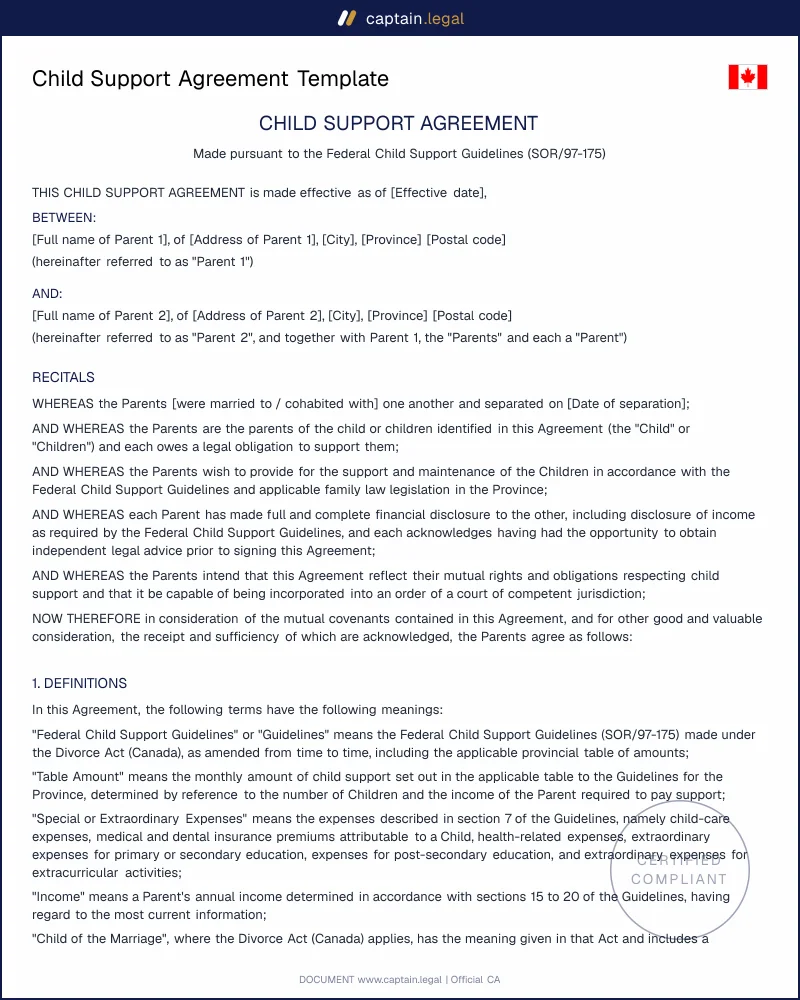
Child support in Canada sits on a foundation that parents cannot contract away. The governing instrument for married and divorcing spouses is the Divorce Act (RSC 1985, c. 3, 2nd Supp.), and the amount itself is set by the Federal Child Support Guidelines (SOR/97-175). The core principle, drawn from section 26.1(2) of the Divorce Act, is that both parents share a joint financial obligation to their children according to their relative ability to pay. This is a right that belongs to the child, not a bargaining chip the parents are free to trade. A court can and routinely does set aside an agreement that pays less than the guideline figure, particularly where financial disclosure was thin or the income gap between the parents was large.
The Guidelines work in two layers. The first is the table amount, a figure that depends on the payor's gross annual income, the province of residence, and the number of children. The second layer is section 7 special or extraordinary expenses, which the parents divide in proportion to their incomes. These cover work-related childcare, the child's portion of medical and dental premiums, health costs exceeding insurance reimbursement by at least $100 a year, post-secondary education, and extraordinary extracurricular activities. The federal tables were refreshed effective 1 October 2025, the first revision since 2017, and the income floor below which no table support is payable rose to $16,000. You can read the operative provision directly in the Department of Justice consolidation of the Federal Child Support Guidelines.
Property and many support questions for unmarried partners fall under provincial law rather than the Divorce Act, so the document you sign must match your actual legal status. A child support agreement signed by common-law partners or married spouses follows the same guideline math for the children, but the surrounding rights differ sharply by province. Enforceability turns on process: honest and complete disclosure, the absence of pressure, and terms that are not unconscionable. Skipping income disclosure is the single fastest way to have your agreement reopened later.