Create my document
Login

Choose country

CanadaCanadaChoose country
Non-Profit

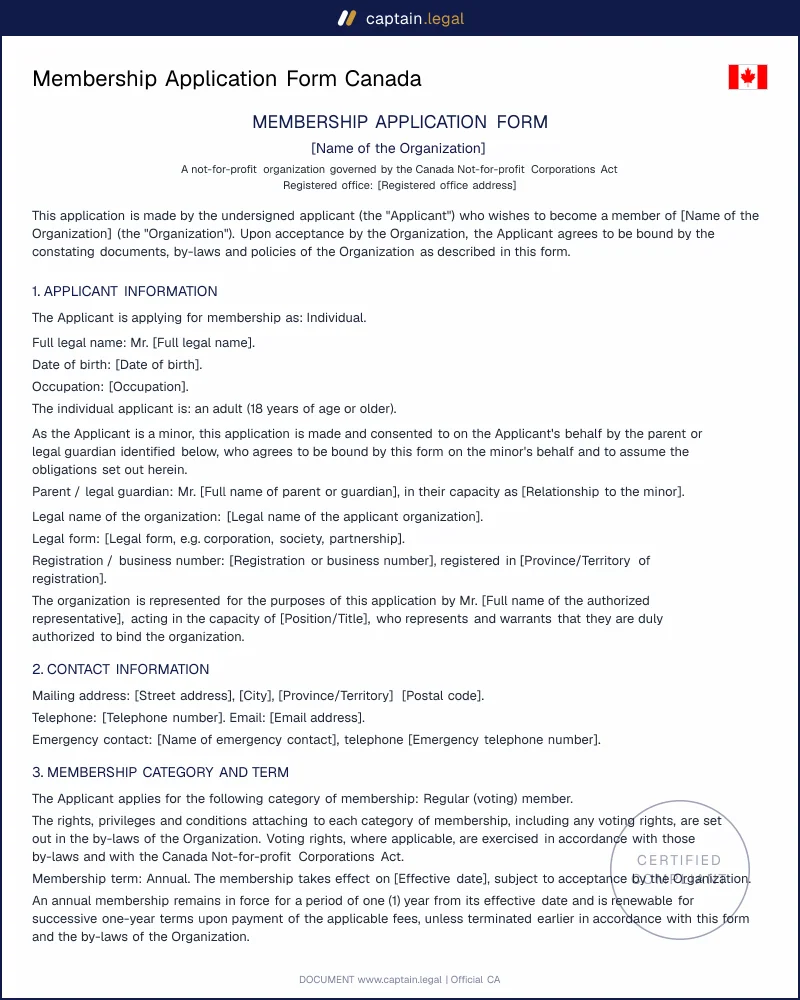
Membership Application Form | NFP Act Compliant Canada

Membership application form built for the Canada Not-for-profit Corporations Act and PIPEDA. Names classes, fees and voting rights. Word and PDF download.
4.9/517 reviews50 000+ downloadsInstant download
Share

A membership application form is the document a Canadian non-profit, society or association uses to record who is asking to join, on what terms, and under which class of membership. It captures the applicant's contact details, the membership category they are applying for, any fees or dues payable, and the applicant's written agreement to be bound by the organization's by-laws and policies. Whether you run a federally incorporated not-for-profit under the Canada Not-for-profit Corporations Act, a provincial society, or an unincorporated club, a clean application form is the first link in your governance chain. It is also where membership rights begin: under most Canadian non-profit statutes a person becomes a member only when they meet the conditions set out in the by-laws, and this form is how you prove they did.

Compliant

2026 Legislation

50,000+ clients

trust us

Affordable

From $4.90 / doc

Secure payment

Instant download

Membership Application Form | NFP Act Compliant Canada

Secure payment · No subscription

Fill in the template

What is a membership application form?

A membership application form is a written request to be admitted as a member of a non-profit organization, signed by the applicant and accepted by the board, a committee or the existing membership. It is not the same thing as a membership card or a receipt. The card confirms an existing relationship; the application form creates it, by tying the applicant to a specific class of membership and to the obligations attached to that class. Under the Canada Not-for-profit Corporations Act (the NFP Act), a corporation must have at least one class of members, and the by-laws set the conditions a person has to satisfy to belong to each class. The application form is the practical instrument that records satisfaction of those conditions.

Canadian organizations should keep the form distinct from a donation or volunteer agreement. A donor gives money without acquiring voting rights; a member is admitted into the governance structure and may be entitled to vote, attend the annual meeting and receive financial statements. Treating a donation as a membership, or vice versa, is one of the most common drafting errors we see, because it confuses who is actually entitled to vote at a members' meeting. A well-drafted form names the class, states whether that class carries a vote, and confirms the applicant has read the non-profit by-laws and governance documents for Canada before signing.

2

When do you need this document?

The clearest trigger is a brand-new non-profit signing up its founding cohort. Once the articles and by-laws are filed, the organization needs a consistent way to admit every applicant on the same terms, and the form becomes the record that each founding member met the by-law conditions. Established organizations reach for it during an annual renewal cycle, when lapsed members reapply and the board wants a fresh signature confirming agreement to by-laws that may have changed since last year. A second common scenario is the introduction of multiple membership classes, say voting members, associate members and honorary members, where each class carries different fees and rights and a single tailored form keeps applicants from drifting into the wrong category.

Clubs and associations that have chosen not to incorporate still need the document, arguably more than anyone. Without a separate legal entity, an unincorporated association governs itself almost entirely through its constitution and the contractual relationship created by each member's application, so the form does heavy lifting it would never have to do inside a corporation. Two edge cases deserve a flag. First, organizations admitting members under the age of majority should build in a parent or guardian signature, since a minor's capacity to bind themselves to fees and by-laws is limited and PIPEDA guidance treats consent for children with particular care. Second, when membership is open to corporations or other entities rather than individuals, which the NFP Act expressly permits, the form must capture the entity's legal name and an authorized signatory, not a personal name. A board considering its broader governance suite often pairs the application with the director and officer resolution templates for Canadian non-profits.

3

Key clauses included in our template

  • The applicant identification section captures full legal name, mailing address, email and telephone, and for organizational members the entity's legal name and the name of its authorized representative. This is the data PIPEDA governs, so the field set is kept to what the organization actually needs to administer the membership rather than everything it might one day want.
  • The membership category selection lets the applicant choose the class they are applying for, with a short statement of the rights and obligations of each, including whether the class carries a vote. This is the clause that ties the form to your articles under the NFP Act, and getting it precise is what separates a lawyer-grade form from a generic sign-up sheet.
  • The fees and dues clause records the amount payable, the period it covers, and when payment is due, without locking in a figure that will date the form. It also states the consequence of non-payment, which under many by-laws causes a membership to lapse automatically.
  • The agreement to the by-laws and policies is the operative promise: the applicant confirms they have read and will abide by the constitution, by-laws and any code of conduct or conflict-of-interest policy. This consent is what makes the by-laws enforceable against the member, particularly in an unincorporated association where the relationship is purely contractual.
  • The privacy consent clause sets out the purposes for which personal information is collected and obtains the applicant's meaningful consent, satisfying the PIPEDA identifying-purposes and consent principles.
  • The declaration and signature block confirms the truth of the information given, records the date, and leaves space for board acceptance, because a membership is not complete until the application is approved in the manner the by-laws require.
4

Regional considerations

Federal (NFP Act) organizations anchor everything to the articles filed with Corporations Canada. Because the Canada Not-for-profit Corporations Act requires the articles to name every authorized class and the by-laws to state the conditions of each, a federal organization's application form should reference the specific class names exactly as they appear in the articles. Where there are two or more classes, members of each class enjoy statutory protections, including the right to vote separately as a class on certain fundamental changes, so the form should make the chosen class unambiguous.

Ontario (ONCA) adds an extra layer of precision. The Not-for-Profit Corporations Act, 2010 requires the by-laws to set out the conditions of membership for each class and, crucially, to detail how members join, transfer or withdraw when there is more than one class. An Ontario form that simply offers a checkbox without referencing those by-law mechanics leaves a gap a disgruntled member can exploit. Ontario organizations transitioning legacy letters patent should confirm their by-laws were brought into ONCA compliance before relying on an older form.

British Columbia and Alberta societies operate under their provincial Societies Acts, which similarly delegate membership conditions to the by-laws but use the vocabulary of "societies" and "members in good standing." A form drafted for these provinces should use that terminology and reflect any by-law rule on when a member ceases to be in good standing, typically for non-payment of dues. Quebec organizations incorporated under provincial law follow a civil-law framework with its own terminology, so a society operating there should have its form reviewed against the applicable Quebec statute rather than assuming a common-law form transfers cleanly. Organizations active in more than one province, especially federal corporations registered extra-provincially, should confirm their Canadian business and corporate document templates align with each jurisdiction where they operate.

5

How to fill out this membership application form

You begin by selecting the type of organization the form is for, because a federal NFP Act corporation, a provincial society and an unincorporated association each pull in slightly different by-law references and terminology. From there the form asks for the organization's legal name and the membership classes it offers, so the applicant sees only the categories that actually exist in your articles or constitution. The applicant then enters their contact details, chooses a class, and reviews the rights and fees attached to that class before going further. The privacy notice appears at the point of collection, which is where PIPEDA expects consent to be sought, and the applicant confirms it. Finally the form generates the declaration and signature block, with an acceptance line reserved for the board or membership committee, and produces a clean copy in Word and PDF. You can adjust the field set, add or remove a membership class, and tailor the by-law references to match your own governing documents before you download. Organizations building a full governance kit often complete the application alongside Canadian privacy and personal document templates.

6

Common mistakes to avoid

The most frequent error is offering membership classes on the form that do not match the classes named in the articles or constitution. Under the NFP Act the application has to map onto the corporate structure, and a form that invents a "junior" or "premium" class the articles never authorized creates members whose status is open to challenge. A close second is silence on voting rights. When the form fails to say whether the chosen class carries a vote, the organization invites disputes at the annual meeting about who is entitled to be there, a problem that compounds when fundamental changes need a class-by-class vote. A third recurring mistake is collecting more personal information than the organization needs, then failing to state why, which runs against PIPEDA's limiting-collection and identifying-purposes principles.

Two further pitfalls show up in practice. Organizations often forget that admission is a two-step process: the applicant signs, but the membership is not complete until the board or members accept it in the manner the by-laws require, so a form with no acceptance line leaves the relationship legally ambiguous. And many groups treat a one-time donation as if it conferred membership, blurring the line between a donation and sponsorship agreement for Canada and genuine membership, which later muddies the voting register. Naming the class, stating the vote, and reserving an acceptance line solve most of these at once.

Key takeaways

Membership status

A member exists only when admitted

A membership application is not a card or a receipt. It is the signed request that, once accepted by the board, a committee, or the members (as your by-laws require), creates the membership relationship. Under the Canada Not-for-profit Corporations Act, membership turns on meeting the by-law conditions for a class. The form is your proof those conditions were satisfied.

Governance fit

Match the form to articles and by-laws

Your form has to line up with your governing documents. For federal NFP Act corporations, the articles authorize the classes (and any voting rights) and the by-laws set the conditions to belong to each class. Provincial regimes follow the same structure with variations (for example, ONCA and provincial Societies Acts). A generic template can accidentally contradict your articles or by-laws.

Voting rights

Do not confuse donors, volunteers, and members

Treating a donation as a membership (or the reverse) is a common error that can derail a members’ meeting. Donors give money without automatically entering governance; members may be entitled to vote, attend the annual meeting, and receive financial statements. A good application form names the membership class, states whether it carries a vote, and confirms the applicant agrees to be bound by the by-laws and policies.

Frequently Asked Questions

Yes, once it is signed by the applicant and accepted by the organization in the way its by-laws require. The form's binding force comes from two sources: the applicant's written agreement to be bound by the by-laws, which creates a contractual relationship, and the corporate statute that recognizes the resulting membership. Under the Canada Not-for-profit Corporations Act a person becomes a member when they satisfy the by-law conditions, and a completed application is the evidence of that. For an unincorporated association the form matters even more, because the membership relationship rests almost entirely on the contract the application creates rather than on any incorporating statute.

At a minimum it should capture the applicant's full legal name, current contact details, the membership class applied for, the fees payable, and the applicant's signed agreement to the by-laws. For organizational members it also needs the entity's legal name and an authorized signatory. Beyond that, the guiding principle under PIPEDA is restraint: collect only what the organization needs to administer the membership and clearly state the purpose at the point of collection. Asking for sensitive details that serve no governance purpose creates a compliance risk without any administrative benefit, so a tighter field set is usually the better choice.

You can download the completed form in both Microsoft Word and PDF. The Word version is editable, which matters because you will want to align the membership-class names and by-law references with your own articles and constitution before circulating it. The PDF is the clean, signature-ready copy you can email to applicants or print for in-person sign-up. Many organizations keep the Word file as their internal master and distribute the PDF, updating the master whenever the by-laws change so that every new applicant agrees to the current version.

Only if your articles or constitution authorize more than one class. The Canada Not-for-profit Corporations Act requires every authorized class to be named in the articles, with its conditions set out in the by-laws, so your form should offer exactly those classes and no others. If your organization has a single class of members, the form is simpler and just confirms admission to that class. If you offer voting and non-voting categories, the form must state which class the applicant is joining and whether it carries a vote, because that determines who may participate at the annual members' meeting.

Submission alone does not create membership. The application is an offer that the organization accepts in the manner its by-laws specify, usually by a board resolution, a committee decision or a vote of the existing members. The relevant by-law sets the timing, and some organizations approve applications on a rolling basis while others batch them for the next board meeting. Until acceptance, the applicant has no membership rights, including no right to vote. A well-drafted form reflects this by leaving an acceptance line for the board, so the record shows both the applicant's signature and the date the organization admitted them.

It can. Non-profit status does not automatically exempt an organization from PIPEDA; what matters is whether it engages in commercial activity, which the Act defines to include selling, bartering or leasing a membership or donor list. Many small associations that simply administer their own members fall outside that trigger, but the moment an organization monetizes its lists or runs paid commercial offerings, the Act is likely to apply. The prudent approach is to build PIPEDA-grade consent into the form regardless, stating the purposes of collection and obtaining the applicant's agreement, because good privacy practice protects the organization whether or not the Act strictly applies.

Yes, with adjustments. The NFP Act expressly allows membership to be open to corporations and other entities, not just individuals, so the form can capture an entity's legal name and authorized representative in place of a personal name. For applicants under the age of majority, the form should include a parent or guardian signature, since a minor's capacity to commit to fees and by-laws is limited, and privacy guidance treats consent involving children with extra care. In both cases the underlying class still has to exist in your articles or constitution, so confirm the category is authorized before admitting a non-individual or a minor member.

A donation agreement records a gift of money or property and does not, on its own, make the donor a member or give them any vote. A membership application brings the applicant into the governance structure, with the rights and obligations that attach to their class. The distinction matters at every annual meeting, because only members vote. Conflating the two is a common error that leaves an organization unsure who sits on its voting register. If you need both relationships documented, keep them in separate instruments and let the application form deal exclusively with admission to membership and agreement to the by-laws.

4.9/5

17 verified reviews · 50 000+ downloads

Membership Application Form | NFP Act Compliant Canada
  • Immediate access to the document
  • PDF + Word download
  • Compliant with 2026 legislation
  • Reviewed by lawyers
Fill in the template
Secure payment · No subscription
Updated on June 18, 2026

You might also like

Conflict of Interest Policy Canada
Donation Agreement Template