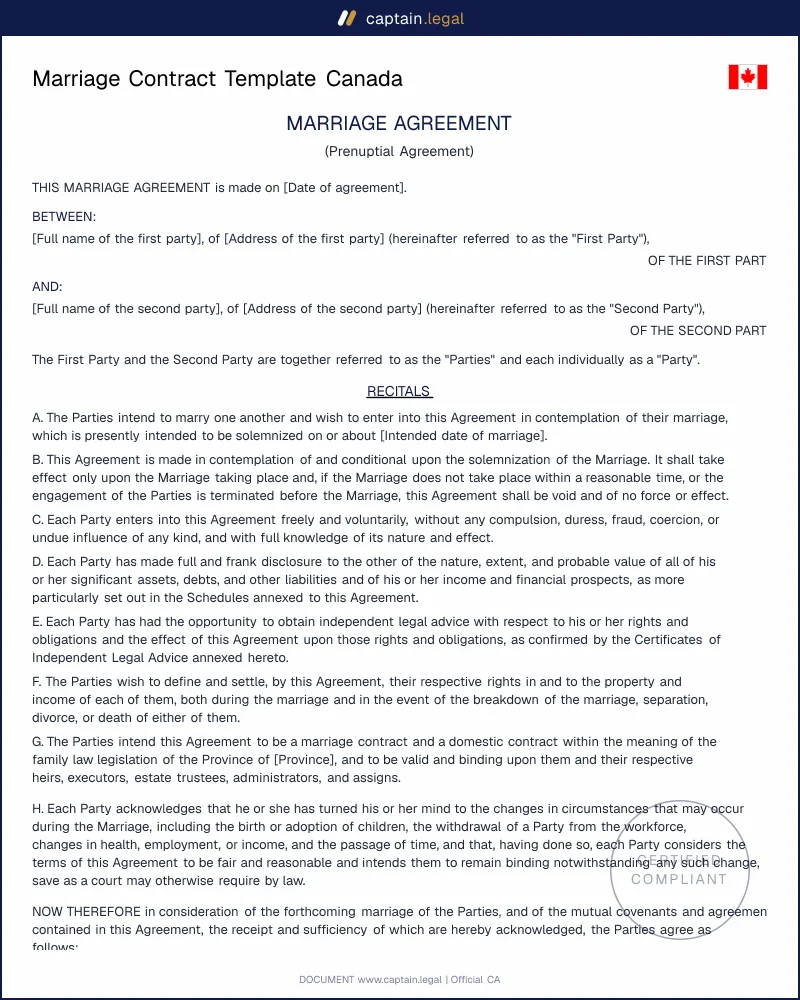
Ontario treats the marriage contract as a domestic contract under section 51 of the Family Law Act, enforceable once it is written, signed, and witnessed under section 55. The province's distinguishing feature is the equalization of net family property: absent a contract, the spouse with the larger increase in net worth during the marriage pays half the difference. A marriage contract's whole purpose is often to opt out of that calculation. Remember that no Ontario contract can limit possession of the matrimonial home under section 52(2), and that section 56(4) makes independent legal advice close to essential for any clause touching family property.
British Columbia governs agreements under the Family Law Act, S.B.C. 2011, c. 25, where section 92 lets spouses divide, include, exclude, or value property differently than the default. The catch sits in section 93: a court can set the agreement aside for a procedural flaw such as failure to disclose, and even a procedurally clean agreement can fall under section 93(5) if it has become significantly unfair with the passage of time. BC's set-and-forget problem is real, so the template builds in review triggers.
Alberta applies the Family Property Act to married spouses and many adult interdependent partners. Its formalities are the strictest in the country: section 38 requires the agreement to be in writing, each party to acknowledge its nature and effect separately, and each party to receive genuinely independent legal advice before signing. An Alberta agreement signed without separate counsel is highly vulnerable.
Quebec stands apart entirely. A contrat de mariage must be executed by notarial act under the Civil Code of Québec, not merely witnessed, and it primarily fixes the matrimonial regime. Critically, article 391 and the family patrimony rules at articles 414 to 426 mean spouses cannot waive their rights in the family patrimony, the family residence, household furnishings, family vehicles, and pensions accumulated during the marriage are divided equally no matter what the contract says. A Quebec couple should consult a notary; this template is built for the common law provinces.