Create my document
Login

Choose country

CanadaCanadaChoose country
Employment

Employee Offer Letter Canada | Employment Standards Act

Employee offer letter built for provincial Employment Standards and the Canada Labour Code, with enforceable termination clauses. Download Word and PDF.
4.6/519 reviews50 000+ downloadsInstant download
Share

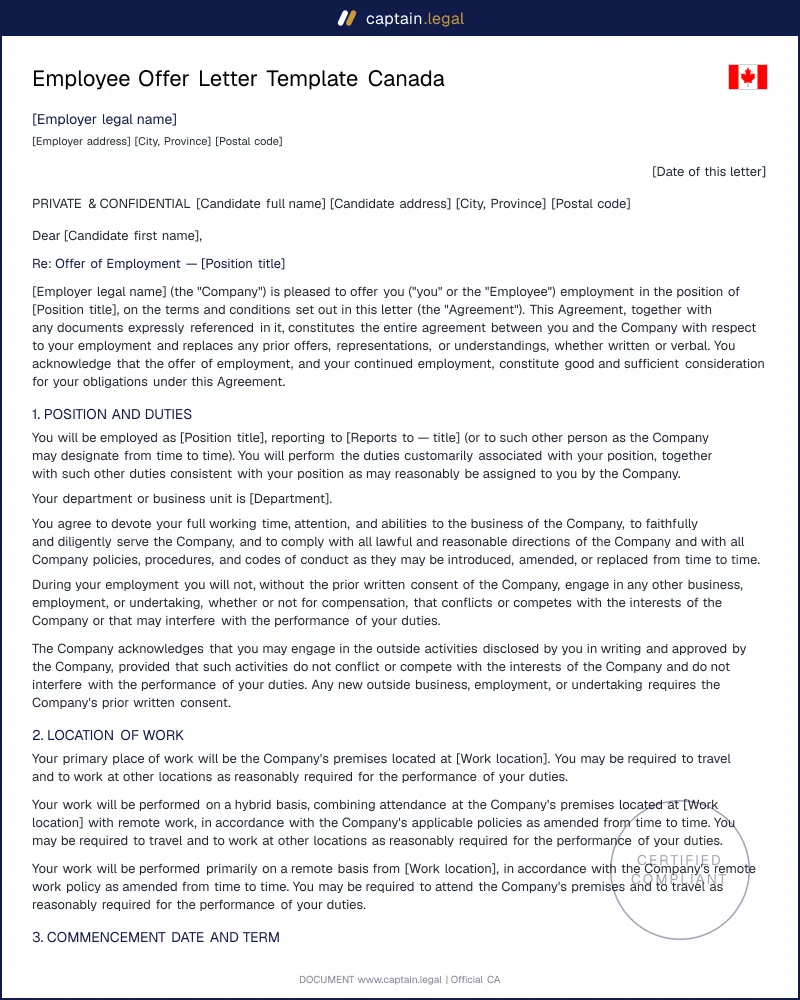
A Canadian employee offer letter is the document an employer sends to set out the terms of a job before the candidate starts: position, start date, compensation, benefits and the conditions attached to the offer. It is the first written record of the deal, and in Canadian law it carries far more weight than most employers assume. Once a candidate signs and accepts, an offer letter can form a binding employment contract even before the first day of work. This template gives you a clean, defensible job offer letter built for provincial Employment Standards legislation and the realities of common-law reasonable notice.

Most hiring managers treat the offer letter as a formality that the "real" contract will replace later. That assumption is where the trouble starts. A poorly worded offer can lock you into terms you never meant to grant, or expose you to a damages claim if you withdraw it after acceptance.

Compliant

2026 Legislation

50,000+ clients

trust us

Affordable

From $4.90 / doc

Secure payment

Instant download

Employee Offer Letter Canada | Employment Standards Act

Secure payment · No subscription

Fill in the template

What is an employee offer letter?

An employee offer letter is a written proposal of employment that names the position, the salary or wage, the start date, the reporting structure, the benefits and any conditions the candidate must satisfy before the role becomes firm. In Canadian practice it sits between the verbal "we'd like to hire you" and the longer employment agreement, and it is frequently the document a candidate relies on when handing in their resignation elsewhere.

The distinction that trips people up is the one between an offer letter and a full employment contract. They are not always different things. A signed offer letter that contains the essential terms, the parties, the role, the pay and a start date, is a contract in its own right. Courts have repeatedly held that a valid employment contract creates the relationship even before any work begins, and that an employee is entitled to reasonable notice for breach of that contract, and may sue for damages if appropriate notice is not given. So the offer letter is not a placeholder. It is the foundation, and whatever you put in it can govern the entire engagement if a later agreement fails for lack of fresh consideration. That single point shapes every drafting decision below, and it is why a careful offer letter belongs alongside a properly drafted employment contract for Canadian hiring rather than being treated as throwaway paperwork.

2

When do you need this document?

The obvious moment is a straightforward hire, where you want the candidate to have the position, pay and start date in writing before they commit. Most employers send the offer letter the moment a verbal "yes" is given, partly as a courtesy and partly because a candidate cannot reasonably resign from their current job on a handshake. A second, more delicate scenario is the conditional offer, used when the role depends on reference checks, a criminal record check, professional licensing, or immigration clearance. Here the letter has to spell out each condition precisely, because an undefined or vague condition will not save you. Business reasons such as budget changes, restructuring or economic conditions are not conditions that let an employer avoid liability where an accepted offer already constitutes a binding contract.

A third use is the competing-offer situation, where you need to move fast to secure a candidate other firms are courting and a clean, complete letter signals seriousness. Offer letters also matter when you are formalizing an internal promotion or a change of terms, since a material change in role or pay should be papered properly to avoid a constructive-dismissal argument. The edge case worth flagging is the executive or inducement hire. When you actively recruit someone away from secure employment, courts inflate the reasonable notice period for the inducement, which means a rescinded or short-notice exit becomes far more expensive than the salary alone would suggest. Pair the offer with a properly scoped confidentiality and non-solicitation arrangement wherever the hire will touch sensitive client relationships.

3

Key clauses included in our template

  • The identification of the parties and position names the legal employer entity and the exact job title, reporting line and work location. Sloppiness here, for instance naming a trade name rather than the incorporated employer, creates ambiguity about who is actually bound, which matters enormously if the relationship is later disputed.
  • The compensation and benefits clause sets out the base salary or wage, the pay frequency, any bonus or commission structure, vacation entitlement and the benefits the employee will receive. Each figure is stated clearly because a number left out of the letter is filled in by Employment Standards legislation by default, often in the employee's favour.
  • The start date and conditions of employment clause fixes the commencement date and lists every condition the offer depends on, such as satisfactory references, background checks or proof of eligibility to work. Each condition must be specific and genuine, because a court will read a broad "subject to business needs" reservation as an attempt to dodge liability rather than a real condition.
  • The termination clause is the single most important provision in the document. It is drafted to expressly limit entitlement to the statutory minimum where you want to displace common-law notice, using language that can never fall below the Employment Standards floor in any scenario, since a clause that could theoretically breach the minimum is struck down entirely.
  • The confidentiality and non-solicitation clause protects trade secrets and client relationships through restraints the courts will actually enforce, scoped to a legitimate business interest. The template deliberately omits a non-compete, which in Ontario is void for most employees and elsewhere is presumptively unenforceable.
  • The acceptance and signature block records the candidate's signed acceptance and the date, creating the clear evidentiary trail you need to show that a binding agreement existed on agreed terms.
4

Regional considerations

Ontario is the strictest province on restrictive covenants. The Working for Workers Act, 2021 added Part XV.1 to the Employment Standards Act, 2000, and section 67.2 prohibits non-compete clauses for most employees, sparing only narrowly defined "chief" executives and sale-of-business sellers. An offer letter that still carries a non-compete for an ordinary hire is not merely unenforceable, it signals legal carelessness. Ontario is also phasing in pay-transparency rules for advertised postings, so salary ranges in offers should align with what was advertised.

British Columbia has no non-compete ban, but its courts apply the common-law reasonableness test rigorously, and a non-compete will almost always lose to a properly drafted non-solicitation clause. BC's Employment Standards Act governs the minimums, and offer letters should reflect its specific notice and vacation provisions rather than borrowing Ontario language wholesale.

Alberta allows restrictive covenants where reasonable and enforces them through the Employment Standards Code, but the same caution applies: a tightly scoped non-solicit beats a broad non-compete every time. Alberta employers should confirm their offer letter's overtime and holiday-pay references track the provincial code.

Quebec stands apart, operating under the Civil Code of Québec and the Act respecting labour standards rather than common-law principles, and it recognizes non-compete clauses subject to strict limits on duration, territory and activity under article 2089. Offer letters for Quebec roles should be reviewed against the Civil Code and ideally issued in French to satisfy the province's language requirements.

Federally regulated employers in banking, telecom and transport must draft to the Canada Labour Code, whose notice and severance scheme differs from the provincial regimes and whose unjust-dismissal provisions give non-managerial employees added protection after twelve months of service.

5

How to fill out this offer letter

You start by choosing the province or selecting the federal regime, because that single choice drives the statutory references, the notice language and which restrictive covenants are even available to you. From there the template asks for the legal name of the employer entity and the candidate, then the position title, reporting line and work location. You enter the compensation details next, base pay, pay frequency, bonus or commission terms, vacation and the benefits package, and the form keeps these aligned with the minimums for the jurisdiction you picked. You then set the start date and add any conditions the offer depends on, with prompts to phrase each one specifically rather than leaving a vague catch-all. The termination section guides you toward language that limits entitlement to the statutory floor without ever dipping below it. Finally you generate the document, review it against your internal approvals, and issue it for signature. If the hire also needs broader business paperwork, you can pull related agreements from the full catalogue of Canadian legal templates in the same session.

6

Common mistakes to avoid

The most expensive error is treating the offer letter as a draft that the "real" contract will fix later. If you issue a generous offer and then hand over a restrictive employment agreement after the candidate has started, the later agreement often fails for lack of fresh consideration, and the original offer letter governs the whole relationship. The cure is to attach the full terms to the offer itself, or to provide genuine new consideration when the formal contract is signed. A second frequent mistake is leaving conditions undefined. "Subject to satisfactory checks" without saying which checks, by when and judged how invites a court to treat the offer as unconditional and binding on acceptance.

Employers also stumble by copying a non-compete into every offer out of habit. In Ontario that clause is void for most employees, and across Canada it is presumptively unenforceable, so it adds risk without protection while a non-solicitation clause would have done the job. Another error is rescinding an accepted offer for an indefinite role on the assumption that no work has started so nothing is owed; an accepted offer is a contract, and withdrawing it triggers reasonable-notice damages unless a real condition went unmet or the candidate misrepresented something. Finally, watch for termination clauses that could theoretically pay less than the Employment Standards minimum in some scenario, because a single such flaw voids the entire clause and reopens the door to common-law notice.

Key takeaways

Contract effect

A signed offer letter can bind you

In Canada, a signed offer letter with the essentials (parties, role, pay, start date) can be a binding employment contract before the first shift. If the candidate accepts and later paperwork never gets signed, the offer letter may still govern because a later agreement can fail for lack of fresh consideration. Draft it as if it will be the only contract.

Minimum standards

Pick the right law and meet it

Employment rules run on two tracks: most employees fall under a provincial Employment Standards Act (for example Ontario or British Columbia), while federally regulated sectors follow the Canada Labour Code. Your offer terms cannot undercut statutory minimums for items like vacation, overtime, public holidays, and termination notice. Any clause that dips below the legal floor is void.

Termination risk

Without a valid clause, notice can balloon

If your offer letter does not include an enforceable termination clause that lawfully limits entitlements to the statutory minimums, common-law reasonable notice may apply. Courts assess notice using the Bardal factors (age, length of service, role, job market), and awards can run to many months. Rescinding an accepted offer can also trigger breach-of-contract damages measured by that notice period.

Frequently Asked Questions

Yes, once a candidate accepts it. A signed offer letter that contains the essential terms, the parties, the position, the compensation and a start date, forms a binding employment contract even before the first day of work. Canadian courts have confirmed that a valid employment contract creates the relationship before any work begins, and that breaching it entitles the employee to reasonable notice or damages. This is why an offer letter should be drafted with the same care as a full contract. Treating it as a casual formality is the single most common and costly mistake employers make, because whatever terms appear in the letter can end up governing the entire engagement.

Usually only at a real cost. Once an offer for an indefinite role is accepted, a binding contract exists, and rescinding it is a breach that exposes you to damages measured against the common-law reasonable notice the employee would have received. The narrow exceptions are where a genuine, clearly stated condition was not met, where the candidate misrepresented a material fact, or where you would have had just cause. Vague "business needs" language will not protect you. If the offer was properly conditional and the condition failed, you can withdraw without paying, which is exactly why every condition in the letter must be specific and verifiable.

Less than most people think. An employment contract is a complete agreement covering all terms of the relationship, while an offer letter is the initial written proposal of the core terms. The catch is that a signed offer letter containing the essential terms is itself a contract in Canadian law. If you intend a longer agreement to govern, you must either incorporate its full terms into the offer or provide fresh consideration when the employee signs the later document. Otherwise the offer letter can prevail, and any protective clause you saved for the "real" contract, such as a limiting termination provision, may never take effect.

A verbal offer can be legally binding, but relying on one is unwise. Without a written record you have no clear proof of the agreed salary, start date, conditions or termination terms, and gaps are filled by Employment Standards legislation by default, frequently in the employee's favour. A written offer letter fixes the terms, documents the conditions, and gives you the evidentiary trail you need if the relationship is later disputed. It also protects the candidate, who often relies on the written offer to resign from their current job. For any meaningful hire, put the offer in writing.

In most cases you should not. In Ontario, the Employment Standards Act, 2000 bans non-compete clauses for the great majority of employees, sparing only true C-suite executives and sale-of-business sellers. Elsewhere in Canada a non-compete is presumed void and enforceable only where genuinely reasonable in time, scope and geography, which is a high bar most clauses fail to clear. The practical answer is to protect your business with a well-drafted confidentiality and non-solicitation clause instead. Those restraints are enforceable when reasonable and target the real risk, departing employees taking clients or trade secrets, without the legal fragility of a non-compete.

You can download the completed offer letter in both Word and PDF. The Word version lets you make final adjustments, add your letterhead or tailor a clause to an unusual hire before sending. The PDF version is the clean, fixed format you issue for signature and keep on file. Most employers send the PDF for the candidate to sign and retain the Word copy for their records. Both versions reflect the province or federal regime you selected during drafting, so the statutory references and notice language stay correct for the jurisdiction the role sits in.

That is your call to set, and the letter should state it expressly. A defined acceptance window, commonly anywhere from a few days to two weeks, gives the candidate time to consider while letting you move on if they decline. Stating a deadline also clarifies when the offer lapses, which matters because an open-ended offer can linger and create uncertainty about whether a contract has formed. If the candidate accepts within the window, a binding agreement exists on the stated terms. If the deadline passes without acceptance, the offer simply expires and you are free to extend it elsewhere.

Only if you want a probationary period, and then it must be stated clearly. Probation is not automatic in Canada, so if the letter is silent, the employee is treated as a regular hire from day one with full entitlements. A properly drafted probation clause lets you assess fit during an early window, but even during probation you generally owe at least the Employment Standards minimum notice once the statutory waiting period passes. The clause should specify the length and what standard the employee must meet, because a vague probation term offers little real protection and can be read against the employer who drafted it.

4.6/5

19 verified reviews · 50 000+ downloads

Employee Offer Letter Canada | Employment Standards Act
  • Immediate access to the document
  • PDF + Word download
  • Compliant with 2026 legislation
  • Reviewed by lawyers
Fill in the template
Secure payment · No subscription
Updated on June 19, 2026

You might also like

Performance Improvement Plan Template
Employment Agreement Template Canada