Create my document
Login

Choose country

CanadaCanadaChoose country
Employment

Termination Letter Canada | ESA and Labour Code Rules

Termination letter drafted to provincial Employment Standards Acts and the Canada Labour Code, covering notice, pay in lieu and severance. Word and PDF.
4.8/517 reviews50 000+ downloadsInstant download
Share

A termination letter is the document that formally ends an employment relationship in Canada, recording the effective date, the reason where one is required, the notice or pay in lieu of notice, and the final entitlements owed to the departing employee. Employers use it to close out an engagement cleanly and create a written record that holds up if the parting is later contested. The stakes are higher than most people expect, because in Canada the way a dismissal is documented and timed often decides whether an employer pays the statutory minimum or a far larger common-law amount. A well-drafted termination letter protects both sides: it gives the employee certainty about what they are receiving, and it shields the employer from claims that notice was inadequate or that the separation was handled in bad faith.

This guide explains what the letter does, the legislation behind it, when you need one, and the clauses that make it enforceable across Canada's common-law provinces.

Compliant

2026 Legislation

50,000+ clients

trust us

Affordable

From $4.90 / doc

Secure payment

Instant download

Termination Letter Canada | ESA and Labour Code Rules

Secure payment · No subscription

Fill in the template

What is a termination letter in Canada?

A termination letter is a written notice from an employer to an employee confirming that the employment contract is ending, on what date, and on what financial terms. In Canadian practice it is the instrument that records the employer's compliance with both the contract and the applicable employment standards statute. It is distinct from a resignation letter, which flows from the employee, and from a release, which is a separate agreement where the employee waives future claims in exchange for an enhanced package. The termination letter itself is the trigger document; the release is what an employer asks the employee to sign afterward, usually in return for severance above the legal floor.

There are two broad categories the letter must distinguish between. A without cause termination ends the relationship for ordinary business reasons such as restructuring, redundancy or poor fit, and it carries an obligation to provide notice or pay in lieu. A with cause termination alleges serious misconduct and claims that nothing is owed, but it is the exception rather than the rule and courts set a high bar for it. Labelling a dismissal "for cause" without genuine, well-documented misconduct is one of the most expensive mistakes an employer can make, because a failed cause argument usually converts into a full wrongful-dismissal liability. The letter must therefore be drafted to the reality of the situation, not to the outcome the employer wishes were true.

2

When do you need this document?

The most common trigger is a without cause dismissal driven by business reasons. A company restructuring a department, eliminating a redundant role, or parting with an employee who is simply not the right fit needs a letter that states the effective date and sets out the notice or pay in lieu being provided. The second frequent scenario is the end of a fixed-term contract, where a poorly drafted early-termination provision can leave the employer liable for the entire balance of the term, a result that catches many small businesses off guard. A third situation is the with cause dismissal, reserved for genuine serious misconduct, where the letter must record the specific grounds with enough precision to survive scrutiny if the employee challenges it.

Two edge cases deserve attention because they generate disproportionate litigation. The first is constructive dismissal, where an employer unilaterally changes a fundamental term such as pay, role or location; the employee may treat that change as a termination and claim notice even though no letter was ever issued. Documenting any agreed change in writing is the practical defence here, and a clean employment contract that sets the terms from the start is the best prevention. The second is the mass termination, where 50 or more employees are let go from one establishment within a four-week window, triggering extended group-notice obligations and mandatory ministry filings. Mass-termination notice rules override the individual figures and a single sequencing error can restart the entire statutory notice clock.

3

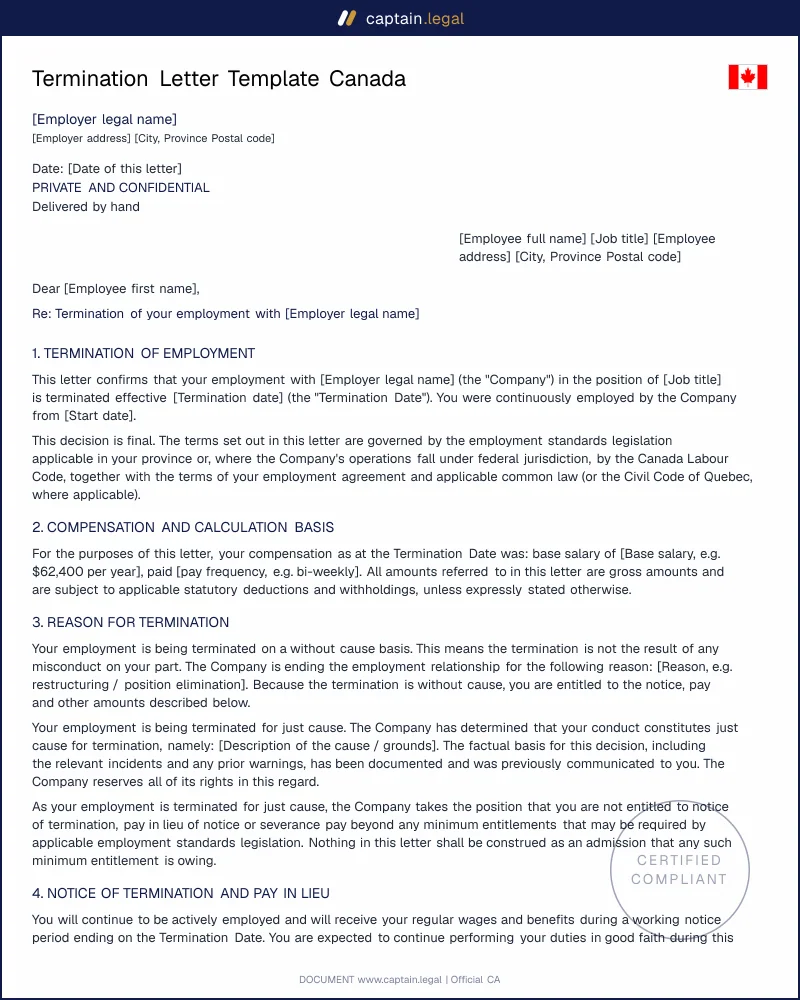
Key clauses included in our template

  • The effective date of termination is stated precisely, because every downstream entitlement is calculated from it. The letter distinguishes the last day worked from the date employment legally ends, which matters when an employee is given working notice rather than pay in lieu.
  • The ground for termination is drafted to match the legal basis. A without cause letter avoids assigning blame and simply confirms a business decision, while a with cause letter sets out the specific misconduct relied on, because vague language like "performance issues" rarely holds up.
  • The notice or pay in lieu provision records exactly what is being offered and how it satisfies the applicable Employment Standards minimum, which under Ontario's ESA is roughly one week per completed year up to eight weeks, or the equivalent under the Canada Labour Code.
  • The statutory severance section addresses the separate entitlement that arises, in Ontario, when an employee has five or more years of service and the employer's payroll reaches the prescribed threshold, calculated at one week per year up to a maximum of 26 weeks.
  • The final pay and accrued entitlements clause captures outstanding wages, vacation pay and any other amounts owed at separation, all of which must be paid out within the statutory deadline.
  • The administrative confirmations cover the issuance of the Record of Employment, the continuation or cessation of benefits, and the return of company property, closing the loop on the practical side of the exit. Employers building a full HR file often pair this with a non-disclosure agreement to protect confidential information after departure.
4

Regional considerations

Ontario. The Employment Standards Act, 2000 sets termination pay at one week per completed year of service up to a maximum of eight weeks, with severance pay treated as a wholly separate entitlement. Statutory severance applies only where the employee has at least five years of service and the employer's Ontario payroll is $2.5 million or more, or where 50 or more employees are severed within six months due to a permanent closure, calculated at one week per year up to 26 weeks. Mass-termination notice runs to eight weeks for 50 to 199 employees, twelve weeks for 200 to 499, and sixteen weeks for 500 or more. Ontario also prohibits most non-compete clauses under the Working for Workers Act, so any restrictive covenant carried into a termination letter must be checked against that ban.

British Columbia. The Employment Standards Act requires written notice or compensation for length of service after three consecutive months of employment, rising on a graduated scale to a maximum of eight weeks after eight years. British Columbia has no separate statutory severance regime layered on top of notice, which makes its statutory exposure simpler than Ontario's, though common-law reasonable notice still applies with full force where there is no enforceable termination clause. Employers managing property or operations in the province often coordinate the exit with a property management agreement that reflects BC compliance when the role touched real estate functions.

Alberta. Termination notice under Alberta's Employment Standards Code ranges from one week after three months of service up to eight weeks after ten or more years. Alberta has no statutory severance entitlement separate from notice, so the letter focuses on the graduated notice scale and the final-pay deadline, which in Alberta is ten consecutive days after the end of the pay period in which termination occurred.

Federally regulated employers. Workplaces under the Canada Labour Code face a distinct structure: individual notice, plus statutory severance of either two days' wages per year of service or five days' wages, whichever is greater, after twelve consecutive months. Group terminations of 50 or more at a single industrial establishment trigger a sixteen-week notice obligation and a mandatory joint planning process. A federally regulated letter must be drafted to the Code, never to a provincial statute.

5

How to fill out this termination letter

You start by selecting the province where the employee works, or the federal option if the workplace is regulated under the Canada Labour Code, because that single choice drives the notice periods and statutory references the document applies. From there you indicate whether the termination is with cause or without cause, and the template adjusts its language so that a without-cause letter stays neutral while a with-cause version prompts you to set out the specific grounds. You then enter the employee's start date, position and the effective date of termination, which the form uses to frame the entitlements. Next you record the notice or pay in lieu being offered and confirm any statutory severance that applies given length of service and payroll size. The final fields capture outstanding wages, accrued vacation, benefits continuation and the Record of Employment commitment. The completed letter downloads in Word and PDF so you can issue it on company letterhead, and you can revisit the guided fields if circumstances change before the separation date.

6

Common mistakes to avoid

The most damaging error is offering less than the statutory minimum, often because the employer counts only termination pay and forgets that long-service employees may also be owed separate severance. A letter that conflates the two, or that pays eight weeks where eight weeks of notice plus twenty-six weeks of severance are due, is non-compliant and invites a claim. Closely related is the assumption that the Employment Standards minimum is the ceiling rather than the floor: where the contract has no enforceable termination clause, common-law reasonable notice applies on top, and the gap between the statutory figure and the Bardal amount can be enormous for an older, long-tenured employee.

Employers also stumble on the with cause label, alleging cause for conduct that does not meet the high legal threshold and then losing both the cause argument and the litigation. Another frequent failure is treating a fundamental change to pay or role as something short of dismissal, which exposes the employer to a constructive-dismissal claim. Finally, do not let the final pay, the Record of Employment or the benefits continuation slide past the statutory deadlines, because procedural defaults carry their own penalties even when the dismissal itself was lawful. When restructuring a whole team, pair the letters with a clear board or director resolution authorizing the decision so the governance record is complete.

Key takeaways

Purpose

A termination letter is the official record

A termination letter formally ends employment and captures the effective date, any reason that must be stated, the notice period or pay in lieu, and final entitlements owed. It is the paper trail that often determines what gets paid later if the dismissal is challenged. Done well, it gives the employee clear numbers and dates, and helps the employer show the separation was handled fairly and consistently.

Regime

Write to the right statute

The letter has to match the legal regime that applies to the job. Most employees fall under a provincial Employment Standards Act (for example, Ontario or British Columbia), while federally regulated workplaces (such as banks and interprovincial transport) fall under the Canada Labour Code. Statutory minimum notice or termination pay cannot be waived, so a letter offering less than the minimum is non-compliant even if the employment contract says otherwise.

Risk

Mislabelled cause can explode liability

A termination letter must distinguish between without-cause and with-cause dismissal and reflect the facts, not a preferred outcome. “For cause” is a high bar in Canadian courts and needs genuine, well-documented misconduct. If an employer alleges cause and fails, the dispute can shift into wrongful dismissal exposure, including common-law reasonable notice unless a valid termination clause limits entitlements to the statutory floor.

Frequently Asked Questions

Yes. A termination letter is legally effective once it is delivered to the employee and accurately reflects the employment contract and the applicable statute. Its enforceability depends on the substance: the notice or pay in lieu offered must meet or exceed the Employment Standards minimum for your province, or the Canada Labour Code floor for federally regulated workplaces. The template is drafted to those minimums and prompts you to confirm the figures, but it does not override any greater common-law entitlement that may apply where the employment contract lacks an enforceable termination clause. For genuinely high-value or contested separations, having the package reviewed before issuance remains prudent.

Yes. Every termination letter you create is available immediately in both Microsoft Word and PDF. The Word file lets you adapt wording, insert your company letterhead and tailor clauses to the specific employee, while the PDF gives you a clean, fixed version ready to print, sign and serve. Most employers keep the signed PDF in the personnel file as the formal record and retain the Word version in case the terms need adjusting before the effective date. Both formats carry the same compliant structure, so you can move between them without losing any of the statutory language built into the document.

It depends on the governing statute and the employee's length of service. Under Ontario's Employment Standards Act, 2000, statutory notice is roughly one week per completed year up to eight weeks, and a separate severance entitlement of up to 26 weeks can apply for employees with five or more years of service where the payroll threshold is met. Federally regulated employees fall under the Canada Labour Code, which has its own notice and severance formula. These are minimums only: where the contract has no enforceable termination clause, common-law reasonable notice under the Bardal factors applies and can be substantially higher.

For a without cause termination you are generally not required to state a detailed reason; confirming that the decision is a business one and providing the correct notice or pay in lieu is enough, and many employers deliberately keep the letter neutral to avoid creating arguments. For a with cause termination the letter must set out the specific grounds, because you are asserting that nothing is owed and you will need to justify that position if the employee challenges it. Given how high the legal bar for cause is in Canada, the reason recorded must be precise, documented and serious.

The deadline is set by the applicable statute and varies by province. In Ontario, outstanding wages, vacation pay and termination pay are generally due within seven days of termination or on the employee's next regular pay date, whichever is later. Alberta requires final pay within ten consecutive days after the end of the relevant pay period. Federally regulated employers have their own timing rules under the Canada Labour Code. Missing these deadlines triggers penalties independent of whether the dismissal was otherwise lawful, so the practical advice is to have the final payment and the Record of Employment ready to issue on or before the effective date.

They are two separate entitlements that are frequently confused. Termination pay, or pay in lieu of notice, compensates the employee for the advance notice they did not receive and is owed on most without-cause dismissals after the qualifying service period. Severance pay, in provinces such as Ontario that have it, is an additional amount that compensates long-service employees for lost seniority, and it applies only where stricter conditions are met, such as five or more years of service combined with a payroll threshold. An eligible employee can be owed both, so a compliant letter accounts for each separately rather than rolling them into one figure.

Yes, provided you select the federal option. Federally regulated workplaces such as banks, airlines, telecommunications carriers and interprovincial transport are governed by the Canada Labour Code rather than any provincial Employment Standards statute, and the notice, severance and group-termination thresholds differ accordingly. The template adapts its statutory references and entitlement language when you indicate a federal workplace. If you are unsure which regime applies, the determining factor is the nature of the business, not where the employee happens to live, and getting that classification right at the outset is essential to issuing a compliant letter.

4.8/5

17 verified reviews · 50 000+ downloads

Termination Letter Canada | ESA and Labour Code Rules
  • Immediate access to the document
  • PDF + Word download
  • Compliant with 2026 legislation
  • Reviewed by lawyers
Fill in the template
Secure payment · No subscription
Updated on June 19, 2026

You might also like

Non-Disclosure Agreement Canada
Independent Contractor Agreement Template